
Postline vs Hootsuite A Marketer's Guide to Choosing the Right Tool
Explore our detailed Postline vs Hootsuite comparison to see which social media tool best fits your needs. We cover features, pricing, and real-world use cases.
Choosing between Postline and Hootsuite really boils down to what you’re trying to achieve. Are you looking to master LinkedIn with laser-focused content, or do you need a command centre for managing a bunch of different social media accounts? Think of it as focus versus scale.
This isn’t just another feature list. I want to give you a proper, nuanced look at both so you can pick the tool that actually fits your goals.
Postline vs Hootsuite: A High-Level Overview
To get this right, you first have to understand the core idea behind each platform. One is a precision instrument made for a very specific job, while the other is more like a Swiss Army knife, built to handle a bit of everything. That difference is key to figuring out which one will actually help you, not just add another subscription to your credit card bill.
Postline was built from the ground up with one thing in mind: helping individuals create authentic, high-impact content specifically for LinkedIn. It’s packed with AI-driven writing assistance, voice learning, and real-time research features designed for solopreneurs, consultants, and sales pros who want to build a serious personal brand. The entire experience is streamlined for speed and efficiency on that one, crucial network. You can get a better feel for its specialised approach by visiting the Postline.ai website.
Then you have Hootsuite, an industry veteran built for complexity and scale. It’s the go-to for social media marketing teams, digital agencies, and big companies juggling a whole portfolio of social accounts. Its real power lies in its beefy scheduling options, deep team collaboration tools, and detailed analytics that pull data from multiple platforms.
The classic Hootsuite dashboard says it all. It’s designed to be an all-in-one hub where you can see all your different social streams, analytics, and content plans in one place. It screams multi-channel strategy.
To make the core differences crystal clear, here’s a quick snapshot.
Postline vs Hootsuite At a Glance
This table cuts right to the chase, giving you an immediate sense of where each tool shines. It’s the quickest way to see if you’re leaning in the right direction.
| Comparison Point | Postline | Hootsuite |
|---|---|---|
| Primary Focus | AI-driven LinkedIn content creation for individuals | Multi-platform social media management for teams |
| Ideal User | Solopreneurs, consultants, thought leaders | Marketing teams, agencies, large businesses |
| Key Strength | Personalised, AI-generated content and ideation | Centralised scheduling, analytics, and collaboration |
| Platform Scope | LinkedIn only | All major social networks (Instagram, Facebook, X, etc.) |
As you can see, the choice isn’t about which one is “better” overall, but which one is better for you. It depends entirely on whether your world revolves around LinkedIn or spans the entire social media universe.
Comparing Core Features for Social Media Management

When you put Postline vs Hootsuite side-by-side, you’re not just looking at different feature lists; you’re seeing two completely different ways of thinking about social media. Postline is your specialised tool for creating killer LinkedIn content. Hootsuite, on the other hand, is the sprawling command centre for managing everything, everywhere.
Getting to grips with these practical differences is the only way to figure out which one actually fits into your daily workflow. Postline is built to do one thing exceptionally well: help you craft high-impact, authentic LinkedIn content as efficiently as possible. Think of it less as a management tool and more as your dedicated content partner.
Hootsuite’s game is breadth. It gives you a massive suite of tools designed to manage an army of social media profiles at scale. Its power comes from its ability to cover scheduling, monitoring, and analytics across a huge number of networks.
Content Creation: Postline’s AI vs. Hootsuite’s Versatility
The biggest gap between these two platforms is how they handle content creation. Postline is all about a deep, AI-assisted writing process, while Hootsuite is built for versatile, multi-platform content management.
Postline’s AI Post Generator is the heart of the platform. It doesn’t just spit out generic captions; it’s a tool for brainstorming and writing entire thought leadership articles. It’s an interactive process where you provide the prompts, and it generates polished drafts that you can then shape and refine.
The real magic here is the Voice Learning feature. The AI actually studies your past LinkedIn posts to pick up on your unique writing style, tone, and vocabulary. This is what helps you sidestep that robotic, “AI-written” feel that plagues so many other tools. The goal is to make the content sound like it genuinely came from you.
Postline is all about depth, not breadth. Its AI doesn’t just write for you; it acts as a strategic partner that gets your voice and your audience. This makes it a perfect fit for consultants, executives, and anyone serious about building a personal brand on LinkedIn.
Hootsuite takes a wider view. Its OwlyAI assistant is designed to help you quickly generate captions and content ideas for a mix of platforms like Instagram, Facebook, and X (formerly Twitter). It’s built for speed and adaptability, helping you create everything from short, punchy updates to image-heavy posts.
What it lacks, though, is the deep personalisation and long-form content muscle that Postline offers. It’s a handy assistant for a busy social media manager juggling multiple accounts, not a specialised ghostwriter for a thought leader.
Research and Ideation: A Tale of Two Approaches
We all know the struggle of coming up with fresh content ideas. Postline and Hootsuite tackle this challenge from completely different angles.
Postline bakes real-time online research right into its workflow. As you generate a post, its AI can pull in current data, statistics, and articles from across the web to add weight and relevance to your writing. For creating timely, authoritative posts that grab attention, this is a massive advantage.
On top of that, its Audience Explorer helps you pinpoint trending topics and questions that are top-of-mind for your followers. This gives you a steady stream of inspiration that’s already tailored to what your network actually wants to read.
Hootsuite’s strength is in social listening. It’s brilliant for monitoring keywords, brand mentions, and industry chatter across tons of platforms. While powerful for brand management and spotting broad trends, it’s a separate activity from content creation. You find the trend in one corner of the dashboard and then have to move to another to build the content.
Scheduling and Publishing: The Specialist vs. The Generalist
Both tools let you schedule posts, but their capabilities really highlight their core philosophies. Postline gives you a clean, simple scheduler built just for LinkedIn. You can map out a full week of high-quality posts in minutes, with an interface that’s perfectly streamlined for a single-platform workflow. If you’re curious about other options, our guide on the best social media scheduling tools offers a wider look.
Hootsuite, true to form, offers one of the most powerful scheduling systems you can find.
- Multi-Platform Calendar: You get a single calendar view to manage your entire content schedule across every connected network.
- Bulk Composer: This is a lifesaver for agencies. You can upload and schedule hundreds of posts at once, which is essential for large campaigns.
- Optimal Send Times: Hootsuite looks at your audience activity and suggests the best times to post for maximum engagement.
This multi-channel power is where Hootsuite really pulls away from the pack. If you’re a digital agency managing ten different brands across four platforms each, its centralised scheduling is a non-negotiable. But for a solo entrepreneur focusing entirely on LinkedIn, it can feel like bringing a cannon to a knife fight.
The value of these features can also shift depending on where you are. In Germany, for instance, user engagement data shows a clear preference for interactive tools. X (Twitter) posts saw a 107% year-over-year increase in replies in 2024, a trend Hootsuite’s real-time analytics can easily track and act on. With Germany’s internet penetration at 93%, marketers there are increasingly using sophisticated AI to manage complex campaigns, which lines up perfectly with Hootsuite’s advanced toolset.
Evaluating User Experience and Workflow Efficiency

The flashiest features don’t mean a thing if a platform is a clunky, confusing mess. How a tool feels to use day-in and day-out—its user experience (UX)—is what really determines how productive you can be. And when it comes to the Postline vs Hootsuite matchup, their entire philosophies on workflow couldn’t be more different.
Postline is all about minimalism and focus. The interface was clearly designed with a single, laser-focused goal: help you create top-tier LinkedIn content as quickly and painlessly as possible. The whole process, from brainstorming with the AI to hitting “schedule,” is a straight line. No detours, no distractions.
Hootsuite, on the other hand, is built like a mission control centre. Its signature is the comprehensive, multi-column dashboard where you can keep an eye on everything at once—multiple social feeds, analytics, team tasks, you name it. It’s incredibly powerful, but that power comes at the cost of a much steeper learning curve.
The Learning Curve for New Users
Getting up and running with Postline is refreshingly simple. Most new users figure out the core workflow—generate a post, tweak it, and schedule it—in under an hour. The platform practically holds your hand through the process, which is perfect for solo operators or busy founders who don’t have time to burn on training.
Hootsuite is a different story. The initial setup is much more involved. You have to connect all your social accounts, figure out how to customise the streams to show what you need, and get your head around the ocean of analytics options. It can feel pretty overwhelming at first. Hootsuite has tons of tutorials to help, but be prepared to set aside a few solid hours before you feel truly comfortable.
User Insight: “Postline feels like a focused writing app, not a complex management tool. I was creating content within minutes. With Hootsuite, I spent the first day just learning where everything was.”
This difference really shines a light on who each tool is for. A solopreneur needs to hit the ground running. A social media manager on a bigger team is expected to master a more complex system for that extra layer of control.
Daily Workflow and Time to Value
So, how do the two stack up in the daily grind? This is where those core design philosophies make a real impact on your efficiency.
Postline’s Daily Workflow:
- Speed and Focus: The whole setup is engineered for creative flow. Thanks to the integrated AI writer and the real-time research feature, you can go from a half-baked idea to a polished, scheduled post in just 10-15 minutes.
- Reduced Context Switching: Everything you need is right there in one clean space—idea generation, writing, research, and scheduling. You’re not bouncing between a dozen different tabs or modules.
Hootsuite’s Daily Workflow:
- Comprehensive Management: A typical session might look like this: check mentions across five networks, schedule 20 posts using the bulk composer, and then pull a performance report. It’s a powerhouse for managing social media at scale.
- Potential for Distraction: That multi-stream view, while great for monitoring, can be the enemy of deep work. It’s all too easy to get sucked into replying to comments when you’d blocked out time to write new content.
At the end of the day, Postline is optimised for creative efficiency, helping you publish high-impact content faster. Hootsuite is optimised for managerial efficiency, giving you the tools to command a wide-ranging social media operation. To get a better handle on how these distinct workflows fit into a bigger picture, it’s worth digging into the principles of content workflow management. The right choice for you boils down to a simple question: is your primary job creation or coordination?
Analysing Pricing Models and Real-World Value
Deciding between Postline vs Hootsuite often boils down to your budget, but the price tag is only half the story. The real question is about value—what do you actually get for your money, and does it line up with what you’re trying to achieve? Postline and Hootsuite come at this from completely different worlds, and it shows in their pricing.
Postline keeps its pricing simple and clear, built for individuals. Its plans are designed around the needs of a single user—a consultant, founder, or creator whose main goal is to create high-quality LinkedIn content without breaking the bank. You won’t find confusing add-ons or complex enterprise tiers here.
On the other hand, Hootsuite’s pricing is complex and layered, made to scale with growing teams and organisations. The plans are structured around the number of users, social accounts, and access to advanced features like deep analytics and ad spend management. This model is perfect for agencies and corporate marketing departments but can feel like overkill for an individual.
Postline: The Value of Simplicity
Postline’s pricing is refreshingly straightforward. It usually offers a single premium tier that unlocks all its powerful AI features. This approach gets rid of decision fatigue and guarantees every user gets the full experience.
The core value here is efficiency and specialisation. You’re paying for a dedicated AI partner that helps you brainstorm, write, and schedule top-tier LinkedIn content in a fraction of the time it would take on your own.
- For the Solopreneur: The cost is easily justified by the time you get back. If Postline saves you five hours a month on creating content, it has already paid for itself many times over in billable hours or business development.
- For the Consultant: The investment is directly tied to building your personal brand. Better content means more visibility, more inbound leads, and a stronger professional reputation.
Postline’s pricing model is a direct reflection of its product philosophy: focus on delivering maximum impact for a specific task. You’re not paying for features you’ll never use; you’re investing in a tool that excels at its one job.
This streamlined model also means there are very few hidden costs. What you see is what you get, which is a welcome change in the SaaS world.
Hootsuite: The Cost of Being Comprehensive
Hootsuite’s pricing strategy is all about scalability, starting with a professional plan and going all the way up to enterprise-level solutions. Each tier unlocks more users, more social profiles, and more powerful features.
The value here is centralisation and control. You are paying for a single dashboard to manage a wide-ranging social media presence. For a marketing team, this consolidation is a lifesaver, preventing chaotic workflows and keeping the brand consistent across every platform. But this all-in-one approach comes at a price.
Costs can climb quickly as you add team members or need more advanced analytics. Features that are standard in many other tools, like robust reporting, are often locked away in higher-priced plans. This makes it critical to look at not just what you need now, but where you’ll be in a year. You have to know exactly what each plan includes to avoid hitting a wall. A key part of this is understanding how to measure content performance, as the tools for this are often gated behind more expensive tiers in platforms like Hootsuite.
Pricing Plan Breakdown for Different User Needs
To make sense of it all, let’s break down where each platform’s pricing makes the most sense for different types of users. This isn’t about the exact pounds and pence, but about the philosophy behind the plans and who they’re really for.
| Platform | Ideal Entry-Level User | Ideal Business-Tier User | Primary Value Proposition |
|---|---|---|---|
| Postline | Solopreneurs, consultants, and founders focused exclusively on LinkedIn personal branding. | The same individual user, but now fully committed to maximising their LinkedIn efficiency. | Specialised AI for high-quality LinkedIn content. |
| Hootsuite | A small business owner or marketer managing 3-5 social profiles across different platforms. | A marketing team or agency needing collaboration, advanced analytics, and multi-platform control. | Centralised management for a broad social media strategy. |
As you can see, the choice isn’t just about features; it’s about your entire operational model. Are you a one-person show aiming for LinkedIn dominance, or a team juggling multiple channels?
Ultimately, the better value depends entirely on your situation. Postline offers immense value for individuals laser-focused on LinkedIn excellence, while Hootsuite provides indispensable value for teams managing multi-channel complexity.
Who Is Each Tool Actually Built For?
Forget features and workflows for a second. The real decider in the Postline vs Hootsuite matchup is people. A tool is only as good as its fit for the person using it—their role, their goals, and their day-to-day grind. Once you get a clear picture of who these platforms were designed for, the right choice becomes obvious.
Postline is a precision instrument, built for the individual. Think solopreneurs, consultants, coaches, and sales leaders. These are people who know their personal brand on LinkedIn isn’t just a nice-to-have; it’s their single most valuable business asset. The entire platform is designed to solve the solo creator’s biggest headaches: finding time, staying consistent, and coming up with fresh ideas.
This person doesn’t need to juggle a dozen social profiles; they need to dominate one. They aren’t managing a team because they are the team. Postline’s AI writing and idea-generation features are there to amplify their own expertise, turning stray thoughts into authoritative content without eating up their whole day.
The whole idea behind Postline is to be a force multiplier for an individual’s expertise. It’s for the person whose business depends on their ability to build authority and trust on LinkedIn, one great post at a time.
This sharp focus on the solo professional means every feature is streamlined for personal productivity. It deliberately strips away the complexity you find in larger, team-focused platforms.
The Team-Centric World of Hootsuite
Hootsuite, on the other hand, is built from the ground up for collaboration and scale. Its natural habitat is within social media marketing teams, digital agencies, and large corporate communications departments. These folks aren’t just creating content; they’re managing entire brands across a sprawling, often complex, portfolio of social media accounts.
For this crowd, creating an individual post is just one small piece of a much bigger puzzle. Their world revolves around governance, managing workflows, and proving performance. Hootsuite’s heavy-duty collaboration tools, deep analytics, and enterprise-level security aren’t just extras; they’re mission-critical for keeping the brand’s voice consistent and justifying their budget. If you’re an agency looking at your options, it’s worth seeing how these platforms compare with the best social media management tools for agencies.
You can see this team-first approach everywhere in its design. Features like approval queues, team assignments, and shared content libraries are essential for coordinating work between multiple people. Hootsuite acts as a central command centre, making sure everyone is on the same page and the brand sounds like itself, no matter who hits “publish.”
Understanding the Regional Context in Germany
The target user for each tool is also shaped by local digital habits. In Germany, for instance, Hootsuite has a solid foothold with marketers who need centralised control and detailed analytics. With around 78.9 million internet users but a social media adoption rate of just 51%, German marketers need precise tools to connect with a more discerning audience. Hootsuite’s long-standing integrations with platforms like X (Twitter) and Facebook—which commands over 62% of the German social media market—make it a dependable choice for multi-platform strategies in a strict, GDPR-aware environment. The platform’s maturity and extensive feature set appeal to German businesses that tend to prefer proven, scalable solutions.
Personas: A Practical Comparison
To make the difference crystal clear, let’s look at two real-world scenarios that show who each tool is really for.
Persona 1: The Business Consultant (Ideal Postline User)
- Goal: To become a recognised thought leader in his industry and attract high-value clients.
- Challenge: He’s an expert in his field but just can’t find the time to consistently write insightful LinkedIn posts.
- Why Postline Fits: Postline’s AI becomes his personal writing assistant. It helps him brainstorm topics his audience actually cares about, drafts posts in his voice, and gets them scheduled. He can maintain a powerful presence on LinkedIn in just a couple of hours a week.
Persona 2: The Agency Social Media Manager (Ideal Hootsuite User)
- Goal: Manage social media for five different clients, each on four platforms, while delivering detailed performance reports.
- Challenge: She needs to juggle content calendars, get approvals from clients, and track campaign results without losing her mind.
- Why Hootsuite Fits: Hootsuite’s dashboard is her command centre, letting her see all client accounts at once. She uses the bulk scheduler to be efficient, the collaboration tools to get client feedback, and the analytics suite to build out those crucial monthly reports.
These two examples cut right to the core of it: Postline gives the individual expert superpowers, while Hootsuite equips the professional team for battle.
How to Make Your Final Decision
Choosing between Postline and Hootsuite isn’t about picking the “best” tool. It’s about picking the right one for the job at hand. The decision really boils down to a simple question of focus versus scale.
Are you an individual trying to build an authoritative voice on one specific, high-value platform? Or are you part of a team coordinating a brand’s presence across the entire social media map? Your answer to that question points you directly to the right tool.
Postline is the specialist, purpose-built for mastering LinkedIn. Think of it as a precision instrument. Hootsuite, on the other hand, is the generalist—a comprehensive command centre designed for managing multiple channels and complex team workflows.
This decision tree helps visualise the core choice, simplifying things.
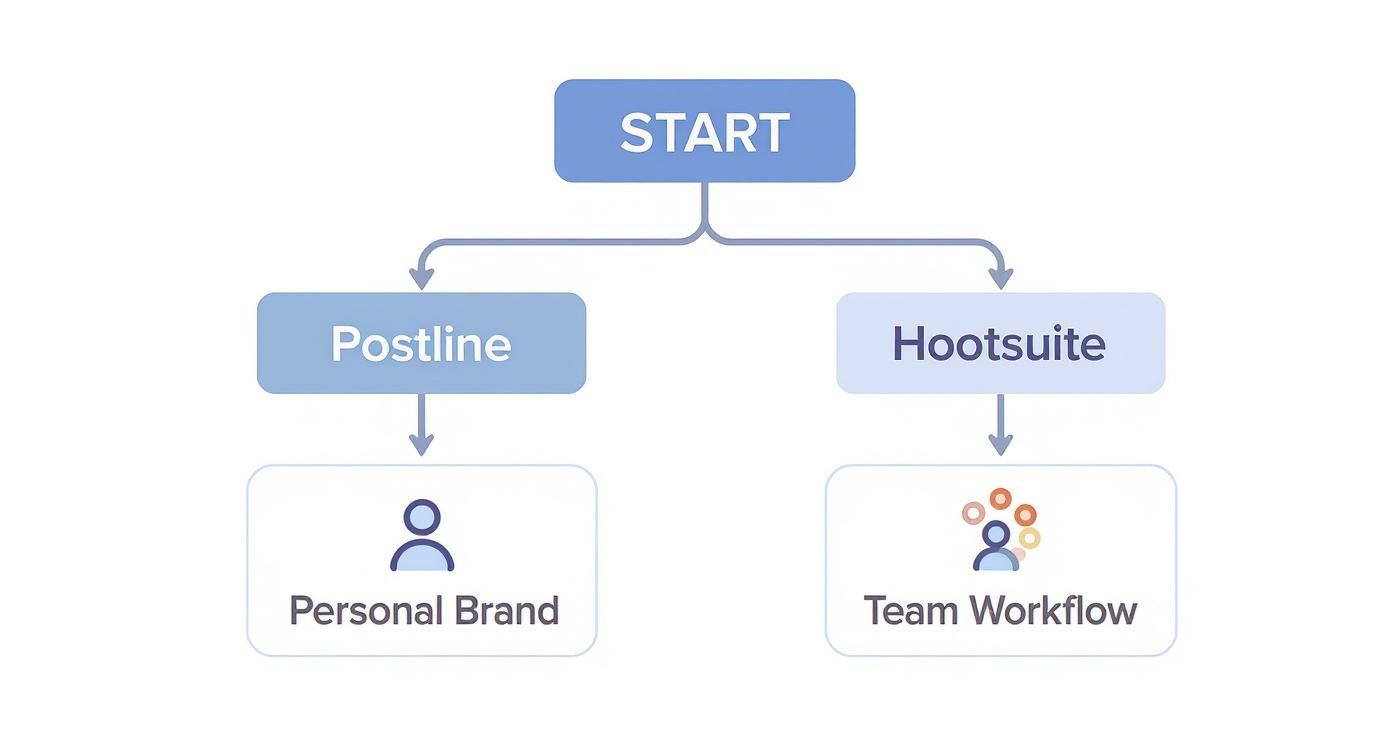
As you can see, if your primary goal is personal brand growth, Postline is the straight path. For complex team workflows, all signs point to Hootsuite.
Choose Postline If…
You should go with Postline if your professional world lives and breathes on LinkedIn. This tool is for you if your main goal is to establish yourself as a thought leader, generate high-quality leads, or build a powerful personal brand that opens up business opportunities.
Postline is the ideal choice when:
- LinkedIn is your primary channel. You don’t need to juggle five other platforms; you need to dominate one.
- You prioritise content quality over quantity. Your aim is to publish insightful, authoritative posts, not just tick boxes on a content calendar.
- Time is your most valuable asset. You’re a solopreneur, consultant, or busy executive who needs to create high-impact content without a dedicated team.
- Authenticity is a must. You need AI that learns your unique voice, ensuring every post sounds like it came directly from you.
In short, Postline is for the creator, the expert, and the individual professional. It’s a force multiplier for your expertise, turning what you know into compelling content that builds real influence on LinkedIn.
Choose Hootsuite If…
On the flip side, Hootsuite is the clear winner if your job involves managing a broad, complex social media strategy. It’s built for marketing teams, digital agencies, and large organisations that need robust tools for coordination, governance, and multi-platform analytics.
Hootsuite is your go-to when:
- You manage multiple social media accounts. Your duties span Instagram, Facebook, X (formerly Twitter), LinkedIn, and more.
- Team collaboration is critical. You need features like approval workflows, team assignments, and shared content libraries to keep everyone on the same page.
- You require deep, cross-platform analytics. A big part of your job is reporting on performance, tracking brand mentions, and proving ROI across all channels.
- Scheduling at scale is a priority. You need to manage a high volume of content for different clients or brands, making tools like the bulk composer essential.
Ultimately, Hootsuite is for the manager, the agency, and the corporate team. It provides the structure, control, and oversight needed to execute a wide-ranging social media strategy effectively. Your final choice should directly reflect whether your role is about focused creation or broad coordination.
Got Questions? We’ve Got Answers
Choosing between a laser-focused tool and an all-in-one suite always brings up a few questions. Let’s tackle some of the most common ones that come up when comparing Postline and Hootsuite to help you make the right call.
Can I use Postline for anything other than LinkedIn?
Nope. Postline is built from the ground up for one thing and one thing only: mastering LinkedIn. Every feature, from its advanced AI to the voice learning and real-time research, is dialled in to conquer the unique world of professional networking on that single platform.
If you need to manage Facebook, Instagram, X (formerly Twitter), or any other network, a multi-platform tool like Hootsuite is definitely the way to go.
The core difference is specialisation versus scale. Postline gives you incredible depth on one critical network. Hootsuite delivers breadth across many. Your choice should mirror your strategic focus.
How does Hootsuite’s AI really stack up against Postline’s?
Hootsuite’s OwlyAI is best thought of as a generalist assistant. It’s great for broader tasks like churning out captions that work across several platforms or finding decent posting times for general engagement. It gets the job done for a wide audience.
Postline’s AI, on the other hand, is a dedicated LinkedIn content strategist. It’s built to do the heavy lifting—drafting long-form thought leadership articles, actually learning your personal writing style with its Voice Learning feature, and pulling in timely research to make your posts hit hard with a professional crowd. Think of it as a creative partner for LinkedIn, not just a simple caption writer.
Does Postline even have scheduling features?
It does. While Postline’s real power is its AI content creation, it includes a clean, native scheduling tool made specifically for LinkedIn. You can create your content and get it queued up without leaving the platform.
But let’s be clear: Hootsuite is the heavyweight champion of scheduling. It offers a much more powerful, multi-network system. You get advanced tools like a bulk composer for massive campaigns, a unified content calendar for all your channels, and send-time suggestions based on a mountain of audience data. If your scheduling needs are complex and span more than just LinkedIn, Hootsuite is the stronger choice here.
Ready to transform your LinkedIn presence with AI that actually understands your voice? Postline.ai helps you craft high-impact content in minutes, not hours. Start creating with Postline.ai today!

Run every client pipeline in one place
Give each LinkedIn profile its own voice, calendar, approval flow, and analytics. Start in minutes.
Start free trial