A Guide to Marketing in LinkedIn for German Businesses
Unlock growth with our guide to marketing in LinkedIn. Learn proven strategies to generate leads and build your brand in the German B2B market.
Before you even think about posting on LinkedIn, we need to talk about your digital storefront. Your personal profile and your company page are the absolute bedrock of any successful marketing effort on the platform. Get these right, and potential clients will trust you, connect with you, and listen to what you have to say. Get them wrong, and they’ll just scroll right past.
Think of them as your primary landing pages on the world’s biggest professional network.
Build Your Foundation for LinkedIn Success
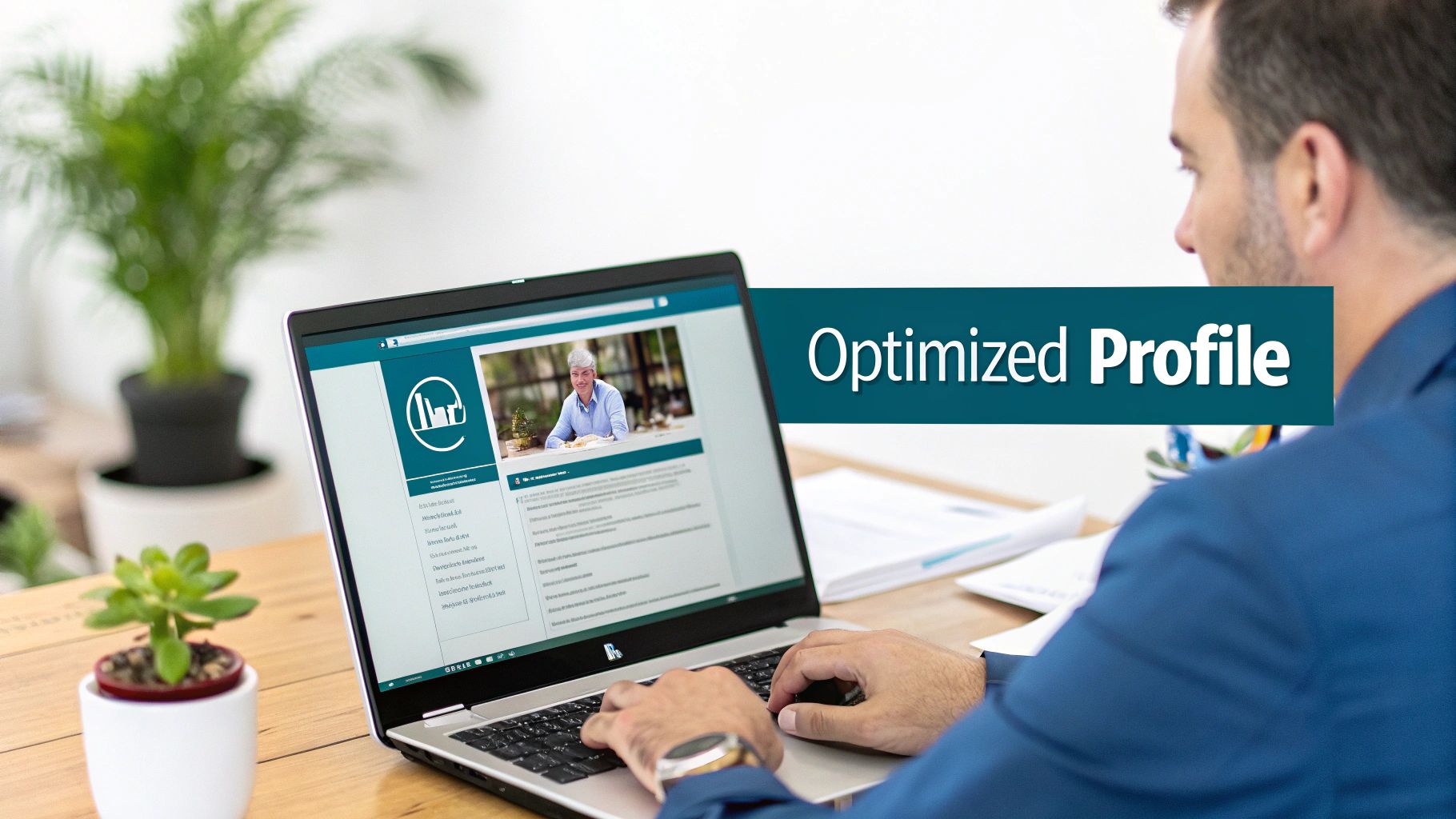
You can’t effectively market anything with a half-baked, unprofessional presence. It just screams a lack of attention to detail. In the German B2B world, where credibility and professionalism are everything, that first impression is make-or-break.
Let’s walk through how to turn your profiles from simple online CVs into powerful client-attraction tools.
Optimise Your Personal Profile for Discovery
This is your personal brand HQ. It’s where you’ll build those crucial one-on-one relationships and cement yourself as an expert. Too many people treat their profile like a static document, but it’s a dynamic marketing tool that should be working for you 24/7.
First things first: your visual identity. A clear, professional headshot where you look friendly and approachable is non-negotiable. Pair this with a custom background banner that isn’t the default blue gradient. Seriously, that banner is free advertising real estate—use it to show off your company tagline, a core value proposition, or even contact info.
Next, nail your headline. Ditch the boring job title like “Marketing Manager.” Instead, craft a statement that screams value. For a German SaaS marketer, that could be something like: “Helping Mittelstand companies drive growth with data-driven marketing | B2B SaaS | Demand Generation.” This instantly tells visitors who you help and how you do it, all while packing in valuable keywords.
Your LinkedIn profile should pass the five-second test: can a visitor understand what you do, who you help, and why they should connect with you in five seconds or less? If not, it’s time to simplify and clarify your message.
The “About” section is where you bring it all together. Tell a story. Don’t just list your skills; explain how you actually use them to solve problems for your clients. Weave in your keywords naturally, keeping the tone conversational and genuine.
Establish Credibility with a Polished Company Page
While your personal profile builds relationships, your Company Page builds brand credibility. It’s the central hub for your business, and an active, complete page is a massive signal of trust for potential clients. It shows you’re a legitimate, professional operation.
If you’re starting from scratch, our guide on https://postline.ai/de/blog/2/how-to-create-a-business-profile-on-linkedin walks you through the entire setup process.
Make sure every single section is filled out properly. This means:
- A compelling “About Us” summary: Be crystal clear about your mission, what you offer, and who you serve. Use language that will resonate specifically with the German market.
- A high-resolution logo and cover image: Keep your branding consistent with your website and other marketing materials.
- Accurate company details: Fill in your website, industry, company size, and location. This is crucial for helping LinkedIn categorise your page and surface it in relevant searches.
A simple but powerful move is to get all your employees to connect their personal profiles to the company page. This instantly expands your page’s reach and adds a huge layer of authenticity.
As you build out your LinkedIn presence, it helps to understand the bigger picture. Broader strategies on how to promote a site from zero to launch can offer some great insights into gaining overall visibility. After all, your Company Page is just one piece of a much larger digital puzzle. By optimising both your personal and company profiles, you create a powerful, cohesive foundation for all your marketing in linkedin efforts.
Develop a Content Strategy That Resonates

Alright, your profile and company page are polished and ready to go. You’ve built the launchpad. Now it’s time to add the fuel: content that actually connects with a discerning German professional audience.
Posting randomly about your services just won’t cut it. You need a plan. This isn’t about shouting what you want to say; it’s about listening and delivering what your ideal clients need to hear. A solid content strategy solves problems, shares real insights, and consistently proves you’re the expert in your field. Think of it as creating a magnetic pull rather than a hard push.
Choosing the Right Content Formats
Not all content is created equal on LinkedIn, and different formats achieve different goals. The trick is to create a content mix that keeps your feed interesting and appeals to how different people like to consume information. Remember, the German professional landscape generally values substance over flash, so clarity and genuine value are paramount.
Let’s look at what’s been working for us and our clients:
- Insightful Text Posts: This is your bread and butter. Use these to share a strong opinion, a lesson learned from a recent project, or a quick, valuable tip. Keep your paragraphs short and snappy (1-2 sentences is perfect) and use simple formatting like bullet points to make them easy to scan.
- Data-Rich Carousels (PDFs): Carousels are brilliant for breaking down complex ideas into easy-to-digest slides. We use them for sharing industry data, step-by-step guides, or key takeaways from a report. They get great engagement because they naturally encourage people to swipe through to the end.
- Formal Video Presentations: Short, well-produced videos can really establish your authority. Think less about casual vlogging and more about concise expert interviews, product demos, or a quick summary of a whitepaper. Always include captions – most people on LinkedIn watch videos with the sound off.
Knowing who you’re talking to is everything. In Germany, LinkedIn has 22 million users, and the biggest group is professionals aged 25 to 34. This is a tech-savvy audience that appreciates well-researched, cleanly designed content that gets straight to the point. For a deeper dive into the numbers, check out the latest LinkedIn user stats for Germany on NapoleonCat.
To help you decide what to use and when, here’s a quick breakdown of how different content formats perform for a German professional audience.
LinkedIn Content Format Effectiveness
| Content Format | Best For | Key Tip for German Audience |
|---|---|---|
| Text-Only Posts | Sharing quick insights, personal stories, or posing questions to spark discussion. | Keep it structured and scannable. German professionals appreciate clarity and well-reasoned arguments, even in short form. |
| Image Posts | Showcasing team culture, event highlights, or visual data (infographics). | Use high-quality, authentic photos over generic stock images. Behind-the-scenes content often performs very well. |
| Carousels (PDFs) | Breaking down complex processes, tutorials, or repurposing reports and guides. | Focus on clean design and data-driven content. A step-by-step guide to solving a specific business problem is golden. |
| Video | Demonstrating products, sharing expert interviews, or summarising key findings. | Professional production quality matters. Keep it concise and add German subtitles as standard practice. |
| Polls | Gauging audience opinion, collecting quick market feedback, or starting conversations. | Frame questions around relevant industry trends or challenges. Avoid overly simplistic or salesy polls. |
Ultimately, the best approach is to experiment with a mix of these formats. See what resonates with your specific audience and double down on what works.
Brainstorming Topics with Content Pillars
We’ve all been there: staring at a blank screen, wondering what on earth to post. The fix for this is building your strategy around content pillars. These are three to five core themes your brand will own and talk about consistently. Your pillars must align directly with your expertise and the problems your audience is trying to solve.
For instance, a German B2B software company targeting the Mittelstand might use these pillars:
- Digital Transformation for Mittelstand: Practical advice for small and medium-sized enterprises.
- Process Automation & Efficiency: Tips, tricks, and case studies on streamlining workflows.
- Data Security & Compliance (DSGVO/GDPR): Addressing critical local regulations to build trust.
By defining your content pillars, you create a framework that makes content creation faster and more consistent. Every post you create should fit neatly into one of these pillars, reinforcing your core message and expertise.
This way, you’re not just posting for the sake of it. You’re strategically building a library of resources that cements your reputation as the go-to expert in your niche. We cover this topic in much more detail in our complete guide to building a powerful LinkedIn content strategy.
Finding Your Authentic Voice with AI Assistance
Authenticity is the currency of trust on LinkedIn. Your audience wants to connect with real people, not a corporate robot. This is where many businesses get nervous about using AI, afraid their content will sound generic.
The key is to use these tools as a partner, not a replacement. Instead of asking an AI tool to “write a post about marketing,” give it your specific context, personal stories, and unique point of view. Use it as a brainstorming partner to sharpen your ideas, check for clarity, or suggest different angles you hadn’t considered.
Beyond just strategy, it’s vital to learn how to create engaging content that connects on a human level. The best AI-assisted content always starts with a human insight and uses technology to amplify it. This balance helps you maintain quality and post consistently without losing the personal touch that builds real relationships.
Master Authentic Audience Engagement
Let’s be honest, just tossing content onto LinkedIn and hoping for the best is a strategy for failure. The real magic happens when you start building a community. You need to shift your mindset from giving a speech to starting a conversation. This is how you turn those passive scrollers into active followers, and eventually, into clients.
When you genuinely interact with people, you’re not just building relationships. You’re also sending strong signals to the LinkedIn algorithm that your content is valuable, which helps more people see it. Every thoughtful comment you write and every reply you post is a small action that strengthens your network and cements your authority.
Beyond the Like Button: How to Interact Meaningfully
A “like” is the lowest form of engagement. It’s nice, but it doesn’t build a connection or show off your expertise. The real action is in the comments section—both on your posts and on others’.
Forget generic comments like “Great post!” or “Thanks for sharing.” They’re empty calories. Instead, add some real value. Ask a sharp question, share a quick personal story that relates to the topic, or offer a different point of view. This simple shift positions you as a thoughtful expert who’s actually part of the conversation, not just shouting from the sidelines.
Here’s a simple way to structure a comment that gets noticed:
- Acknowledge their point: Show you actually read the post. “I agree with your take on X…”
- Add your two cents: Share a brief personal story, a relevant stat, or a follow-up thought. “…in fact, I saw a similar trend with a client last month where…”
- Ask a question: Keep the ball rolling with an open-ended question. “…how do you see this playing out in the next quarter?”
This little framework turns a fleeting comment into a genuine networking opportunity. It’s a small investment of time that pays off big in visibility and relationship-building.
Your goal with engagement isn’t just to be seen; it’s to be remembered. One insightful comment on a popular post can often do more for your visibility than creating a mediocre post of your own.
Fuelling the Fire on Your Own Posts
When people take the time to comment on your content, that’s a golden opportunity. Your first rule should be to respond to every single comment. It makes the person feel heard and seen, which encourages others to jump in.
And please, try to respond with more than just a “Thank you.” Ask a follow-up question to dig deeper into what they said. This simple tactic can easily double the number of comments on your post, signalling to the algorithm that you’ve created a hub for active discussion. For more advanced tactics on this, check out our guide on how to increase LinkedIn engagement.
Using Hashtags and Groups the Smart Way
Hashtags aren’t just for decoration; they’re discovery tools. But you have to be strategic. Don’t just stuff your post with a dozen random tags. A better approach is to pick three to five highly relevant hashtags.
A solid mix usually looks like this:
- 1-2 broad industry tags (e.g., #B2BMarketing, #SaaS)
- 1-2 niche tags specific to your post’s topic (e.g., #LeadGenerationStrategy)
- 1 branded tag for your own content series (e.g., #MarketingMondayTips)
Beyond hashtags, LinkedIn Groups can be a goldmine for focused networking. Yes, many groups are just noisy spam-fests, but if you find a few high-quality, well-moderated ones, they’re invaluable. The key is not to just drop links and run. Answer questions, share your expertise, and actually participate in discussions to build real rapport.
Don’t just take my word for it. The data shows how powerful this is, especially for B2B businesses in Germany. The broader EMEA region, which includes Germany, saw a 4.05% conversion rate for sponsored updates. And get this: employee advocacy is a massive driver of engagement. Posts shared by employees can generate engagement rates up to 8 times higher than what the corporate page gets. You can dig into more of these numbers on LinkedIn engagement by region on Contentin.io. It all points to the same conclusion: real human interaction is the cornerstone of great LinkedIn marketing.
Create a System for Lead Generation
Your content and engagement lay the groundwork, building your authority and pulling in an audience. But the real goal is to turn that visibility into actual business opportunities. This is where a proactive approach comes in – you can’t just wait for messages to land in your inbox. You need a repeatable system to find, connect with, and nurture your ideal clients.
Successful marketing in linkedin isn’t about collecting connections; it’s about starting genuine conversations. That means building a thoughtful, non-spammy workflow that fits the platform’s professional vibe.
Identifying Your Ideal Clients on LinkedIn
Before you can reach out, you have to know exactly who you’re looking for. LinkedIn’s search function is an incredibly potent tool for this, especially when targeting the German market. The trick is to go beyond simple job titles.
Get granular with your search by combining filters:
- Industry: Choose specific sectors like “Automotive,” “Maschinenbau” (Mechanical Engineering), or “Informationstechnologie und Services.”
- Location: Zero in on regions or major cities in Germany, such as Bavaria, North Rhine-Westphalia, or Berlin.
- Company Size: You can focus on the Mittelstand (11-200 employees) or larger enterprises, depending on who you serve.
- Keywords: Use the main search bar for specific responsibilities or buzzwords, like “supply chain management,” “DSGVO,” or “digital transformation.”
Let’s say you’re a software provider trying to reach logistics managers in Hamburg. A simple search for “Logistics Manager” combined with the location “Hamburg Area, Germany” and industry “Logistics and Supply Chain” instantly gives you a highly relevant prospect list. This precision is what makes your outreach effective from the get-go.
Once your business starts to scale and this becomes a core sales activity, it’s time to look at LinkedIn Sales Navigator. Its advanced filters, lead-saving features, and InMail credits are a game-changer for any serious B2B sales team.
The simple engagement workflow below shows how commenting and responding can naturally open the door to networking.
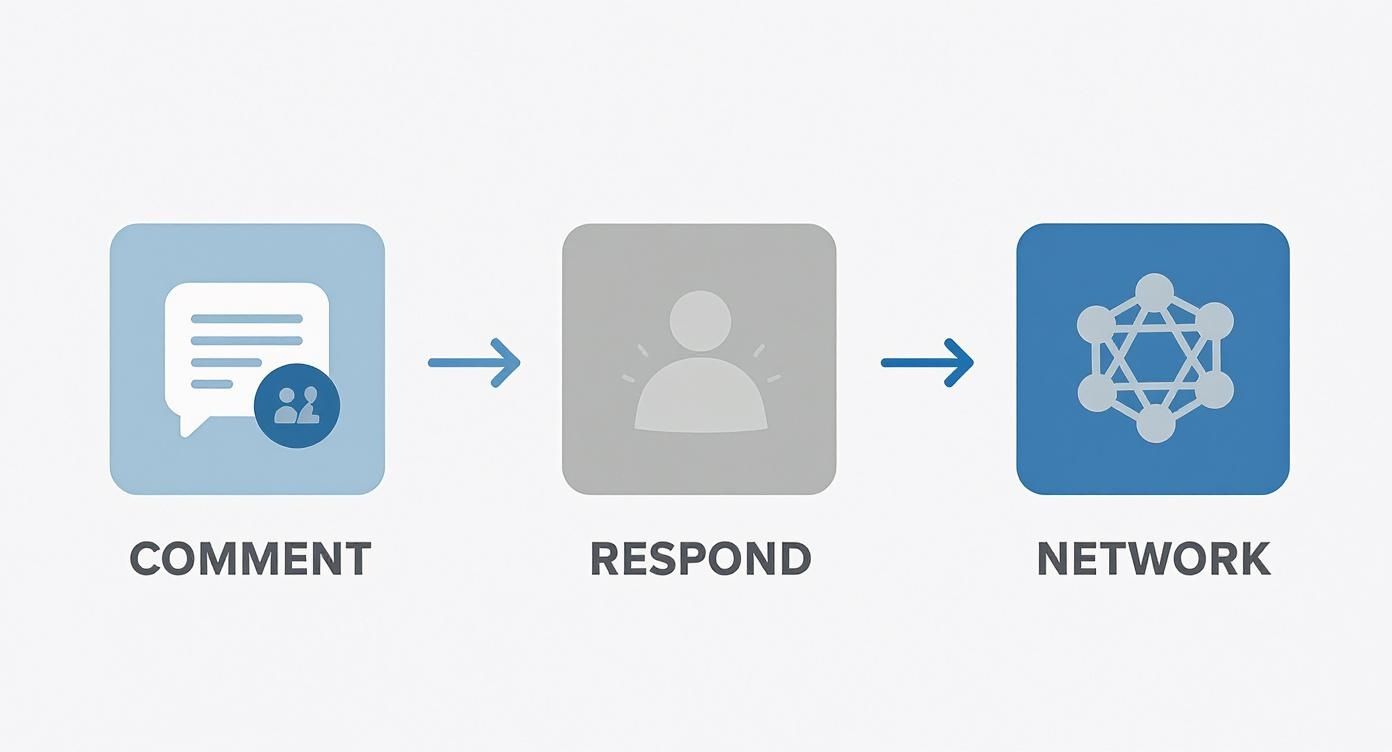
This really brings home the point that great lead generation starts with real interaction, which creates a natural opening for a connection request.
Crafting Connection Requests That Get Accepted
That default “I’d like to connect with you on LinkedIn” message? It’s a one-way ticket to being ignored. Personalisation isn’t just a nice-to-have; it’s everything. You have to give people a clear, compelling reason to click “Accept.”
Always, always add a short, custom note. Here are a few angles that I’ve seen work time and time again:
- The Mutual Interest Angle: “Hello [Name], I saw your recent comment on [Influencer’s Name]’s post about [Topic] and completely agree with your perspective. I’m also focused on this area and would like to connect.”
- The Shared Group Angle: “Hi [Name], I noticed we’re both members of the [LinkedIn Group Name]. I found your question about [Topic] very insightful and would be glad to connect with other experts in our field.”
- The Content Appreciation Angle: “Hi [Name], I really enjoyed the article you shared yesterday about [Article Topic]. The point about [Specific Detail] was particularly sharp. I’d like to follow your work more closely.”
The secret is to make it about them, not you. Show you’ve done thirty seconds of homework. This tiny bit of effort makes a massive difference in your acceptance rate.
Nurturing New Connections into Conversations
Getting the connection is just the start. Now, the goal is to build some rapport and gently steer the relationship toward a business conversation—but only when the time is right. Hitting them with a sales pitch right away is the fastest way to burn that bridge.
Try this simple follow-up sequence to warm up the connection:
- The “Thank You” Message (Day 1): Send a quick note thanking them for connecting and briefly reiterate why you reached out. Something like: “Thanks for connecting, [Name]. Looking forward to seeing more of your insights on [Topic].” Crucially, do not pitch here.
- The Value-Add (Day 3-5): Share something genuinely useful—an article, a case study, or a helpful tool—that’s directly relevant to their job or industry. Frame it as a resource, not a sales brochure. For example: “Hi [Name], I remembered our connection and thought you might find this report on [Relevant Trend] interesting. Hope it’s useful.”
- The Gentle Probe (Day 7-10): Now that you’ve offered value, you’ve earned the right to ask a low-pressure, open-ended question. This helps you gauge their interest and uncover potential needs. Try: “Hi [Name], I’m curious, how is your team currently handling the challenges around [Pain Point]? It’s a major topic of discussion with others in your industry.”
This methodical approach respects your prospect’s time and builds trust by proving your expertise first. By following a clear process, you turn your LinkedIn activity into a predictable engine for generating high-quality leads. For a deeper dive, check out our guide that explains in more detail how to generate leads on LinkedIn.
Amplify Your Reach with LinkedIn Ads
While consistent, high-quality organic content is your foundation on LinkedIn, there comes a point when you need to really step on the accelerator. That’s where paid campaigns come in. They let you cut straight through the noise and put your message directly in front of the exact decision-makers you want to reach.
LinkedIn Ads offers a powerful, if sometimes complex, set of tools that are pretty much essential for B2B marketers, especially when targeting the specific professional landscape in Germany.
Think of it this way: organic content is like having a great conversation in a crowded room, hoping the right people overhear. Ads are like scheduling a private, one-on-one meeting with them. You get to define precisely who sees your content, whether it’s the CEO of a particular Mittelstand company or a group of software developers in Bavaria. This level of precision makes sure your budget isn’t wasted and drives genuinely qualified traffic and leads.
Understanding Key LinkedIn Ad Formats
LinkedIn has a whole menu of ad formats, each built for a different goal. Don’t feel like you have to try them all at once. The smart move is to match the format to what you’re actually trying to achieve. Are you looking to give a high-performing post a second life, generate leads on the spot, or get sign-ups for your next webinar?
Here are the main players you need to know:
- Sponsored Content: These are the ads you see most often, popping up right in the LinkedIn feed just like a regular post. They’re perfect for boosting your best organic content, sharing insightful articles, or showing off video case studies to a much wider, targeted audience.
- Message Ads: You might know these by their old name, Sponsored InMail. These ads land directly in your target’s LinkedIn inbox. They have a much more personal feel and work brilliantly for inviting prospects to exclusive events, webinars, or offering something high-value, like a custom industry report.
- Lead Gen Forms: This isn’t strictly an ad format on its own, but it’s an incredibly powerful feature you can attach to your other ads. When a user clicks, the form pre-fills with their LinkedIn profile data. This slashes the friction of signing up, making it ridiculously easy for prospects to convert without ever leaving the platform.
Picking the right format is your first big decision. A German SaaS company looking to book demos, for example, might run a Message Ad campaign that clicks through to a Lead Gen Form offering a free consultation. On the other hand, a consulting firm aiming to build brand authority could use Sponsored Content to boost a major thought leadership article.
The best ad campaigns are the ones that don’t feel like ads at all. They feel like genuinely helpful content. Your ad shouldn’t be shouting “Buy now!”; it should offer a solution, an insight, or an opportunity that feels truly valuable to the person seeing it.
Defining Your Audience with Precision
The real magic of LinkedIn Ads is in the targeting. I can’t stress this enough: getting this right is the difference between a wildly successful campaign and just burning through your budget. You can build audiences based on an incredible range of professional details.
The potential here is huge, especially in a specific market like Germany. As of early 2025, LinkedIn’s ad platform could reach about 21.0 million members in Germany—a number that shot up by 16.7% in just one year. It’s a growing and active user base, with a noticeable skew toward male professionals (61.7%), offering a rich pool for B2B marketers. You can dig deeper into these trends in the digital landscape in Germany report on DataReportal.
To build a super-relevant audience, you can layer filters like:
- Company Attributes: Target by industry (e.g., “Maschinenbau”), specific company sizes, or even a list of company names.
- Job Experience: Zero in on specific job titles (e.g., “Geschäftsführer”), seniority levels (VP, Director, etc.), and even years of experience.
- Education & Skills: You can filter by fields of study, degrees, or specific skills people have listed on their profiles.
For instance, a cybersecurity firm might build a perfectly defined audience targeting IT Directors and CISOs at German financial services companies with 200-1000 employees. That level of focus means your message only ever lands in front of people who have both the authority and the need for what you’re selling.
Budgeting and Measuring Your Performance
Finally, you have to manage your spending and see what’s actually working. The LinkedIn Campaign Manager gives you all the data you need to figure that out. My advice? Start with a modest daily or total budget to test the waters with your first campaigns. Don’t go all-in until you know what resonates.
As your ads are running, keep a close eye on these core metrics:
- Click-Through Rate (CTR): What percentage of people who see your ad actually click on it? A low CTR is often a sign that your creative or headline just isn’t grabbing attention.
- Cost Per Click (CPC): Simple enough—how much are you paying for every single click? This tells you how efficient your ad spend is.
- Conversion Rate: Of the people who clicked, what percentage actually did the thing you wanted them to do (like filling out that form)? This is the real measure of your campaign’s success.
- Cost Per Lead (CPL): Your total ad spend divided by the number of leads you got. This is the bottom-line metric that connects your campaign directly to tangible business results.
By tracking these numbers, you can make smart, data-driven decisions to improve your ads over time. You can tweak your audience, rewrite your copy, or A/B test new images to constantly get a better return on your investment.
Your LinkedIn Marketing Questions Answered
When you’re trying to get a handle on a new platform, it’s easy to get bogged down in the details, especially when you’re short on time. I’ve seen many German businesses wrestle with the same strategic questions when they first dive into marketing on LinkedIn. Let’s cut through the noise and get straight to some practical answers.
These aren’t just textbook theories. They’re takeaways from years of seeing what actually moves the needle in a professional setting. Nail these fundamentals, and you’ll see a real difference in your results.
How Often Should You Post on LinkedIn?
Forget the magic number—consistency is what truly matters. For most businesses, aiming for three to five high-quality posts per week is a great, sustainable target. It’s frequent enough to stay on your network’s radar without flooding their feeds or leading to burnout on your end.
Always remember: one thoughtful post that kicks off a real conversation is worth more than five rushed ones that get ignored. If you’re just starting out, try two posts a week. You can always build from there once you get into a good rhythm.
The real aim isn’t just to fill a content calendar; it’s to stay top-of-mind. The LinkedIn algorithm tends to reward consistent activity, so a predictable schedule helps you build momentum and ensures your content keeps getting in front of the right people.
Is LinkedIn Premium Necessary for Marketing?
Honestly, no. It’s not essential, particularly when you’re just getting your bearings. You can get fantastic results with a free account by focusing on what really counts: creating genuinely good content, engaging with people authentically, and being strategic about who you connect with. All the core tools for that are free.
Where LinkedIn Premium (specifically Sales Navigator) starts to make a lot of sense is when you’re ready to get serious about proactive lead generation. Its advanced search filters, the ability to create and save lead lists, and the extra InMail credits make targeted outreach far more efficient.
Think of it as a way to scale up what’s already working:
- Start with the free version: Get the hang of creating great content and building relationships first.
- Upgrade when you’re ready: Once you have a proven outreach process and just need to do more of it, that’s the time to invest.
How Do You Measure Your Marketing ROI?
Figuring out your return on investment (ROI) on LinkedIn means looking at both your time and your money. With organic marketing, the “return” often comes in the form of leads, increased brand awareness, and valuable networking opportunities. These can be tricky to put a number on, but they’re incredibly valuable.
For paid ads, it’s a bit more straightforward. Inside your Campaign Manager, you’ll want to keep a close eye on a few key metrics:
- Cost Per Lead (CPL): This is the big one. How much are you paying for every person who fills out your form?
- Conversion Rate: What percentage of people who clicked your ad actually took the next step?
- Click-Through Rate (CTR): This tells you if your ad creative and copy are grabbing enough attention to make people click.
For your organic efforts, track things like profile views, connection requests from your ideal clients, and how many of those DMs turn into actual sales calls. By combining this mix of hard numbers and qualitative data, you’ll get a much clearer picture of what your efforts are truly delivering.
Ready to create standout content without the hassle? Postline.ai combines powerful AI with your unique voice to help you write, schedule, and publish engaging LinkedIn posts in minutes. Stop staring at a blank screen and start building your brand. Discover how Postline.ai can transform your LinkedIn strategy today.

Run every client pipeline in one place
Give each LinkedIn profile its own voice, calendar, approval flow, and analytics. Start in minutes.
Start free trial