
Postline vs Sprout Social Which Is Right for You
Deciding between Postline vs Sprout Social? This guide breaks down features, pricing, and ideal use cases to help you choose the best platform for your needs.
The real difference between Postline and Sprout Social boils down to one thing: specialisation versus scale. Postline is an AI-powered specialist, built from the ground up for individuals and small teams who want to create high-impact LinkedIn content without the fuss. On the other hand, Sprout Social is a comprehensive, all-in-one social media management suite designed for larger teams and agencies juggling multiple platforms, complex campaigns, and deep data analysis.
Postline vs Sprout Social: a Quick Comparison
Choosing the right social media tool is all about knowing your main goal. Are you a solo professional focused on building authority on one specific, high-value platform? Or are you part of a larger team managing a brand’s voice across the entire social media landscape?
How you answer that question will point you directly to either Postline or Sprout Social. They’re built for fundamentally different jobs.

Postline is laser-focused on solving the unique headaches of creating great content for LinkedIn. Its entire toolkit—from ideation and AI-assisted writing to scheduling—is purpose-built for that network. This makes it the perfect partner for consultants, founders, and sales pros whose primary goal is personal branding and lead generation on LinkedIn.
Sprout Social operates on a much bigger playing field. It offers powerful tools for scheduling, monitoring, analytics, and customer support across platforms like Instagram, Facebook, X (formerly Twitter), and many more. It’s the command centre for a multi-channel strategy.
At-a-Glance Comparison: Postline vs Sprout Social
To make the core differences crystal clear, I’ve put together a quick breakdown of how each platform handles the key parts of social media management. Think of it as the specialist creator tool versus the enterprise-level command centre.
For context on where these tools fit in the wider market, you might want to check out a broader look at social media scheduling tools as well.
| Criterion | Postline | Sprout Social |
|---|---|---|
| Primary Function | AI-powered LinkedIn content creation and scheduling | Comprehensive multi-channel social media management |
| Ideal User | Individuals, solopreneurs, and small teams | Medium-to-large businesses, agencies, and enterprise teams |
| Core Strength | Deep LinkedIn focus, AI writing, and content ideation | Cross-platform management, advanced analytics, and team collaboration |
| Pricing Model | Simple, affordable subscription tiers for individuals | Tiered, per-user pricing designed for scaling teams |
Ultimately, the right choice really hangs on your strategy. If LinkedIn is the main engine driving your growth, Postline gives you a streamlined, powerful solution built for that specific job. But if your strategy involves a full team managing a brand’s voice across many different channels, Sprout Social provides the heavy-duty infrastructure you’ll need.
Understanding Their Core Design Philosophies
To really get the difference between Postline and Sprout Social, you have to look past the feature lists and dig into why they were built in the first place. These two platforms weren’t made to solve the same problem. They were engineered for fundamentally different people with completely different goals. Nailing this distinction is the key to picking the right tool.
Postline was created from a simple idea: for a certain type of professional, specialisation beats a one-size-fits-all approach. Its entire DNA is coded for one main mission: helping individuals and small teams win on LinkedIn. It’s built on the belief that becoming an authority on this network demands a very specific way of creating content—one that mixes the speed of AI with a deep, personal touch.
Postline: A Purpose-Built Specialist
The workflow inside Postline is a direct result of this specialist mindset. This isn’t a control panel for juggling ten different social media accounts. Think of it more as a focused creator’s studio, built to take you from a rough idea to a polished, high-impact LinkedIn post as smoothly as possible.
This design is all about depth, not breadth. The platform is built for consultants, founders, or sales pros who know that quality and consistency on LinkedIn are what really move the needle. Every feature, from the AI that learns to write in your voice to the built-in online research tools, serves that one single purpose.
Postline is like a master craftsman’s workshop. It doesn’t have every tool under the sun, but it has the perfect, specialised instruments you need to excel at one specific craft: creating killer LinkedIn content.
This focused approach keeps the user experience clean and simple, without the clutter of managing multi-channel campaigns. To see how this philosophy creates a powerful yet easy-to-use tool, you can check out the AI-powered assistant for LinkedIn at Postline.ai. The whole point is to remove friction and just let the LinkedIn-first professional create.
Sprout Social: An Enterprise Command Centre
Sprout Social is the complete opposite. It was engineered from the ground up to be an enterprise-grade command centre. Its design philosophy is all about centralisation and scale. It tackles the massive challenges large companies and agencies face when trying to manage a single brand voice across a dozen different social media channels.
This platform is built for teams, not just individuals. Its whole structure is designed to handle complex workflows, multi-step approval processes, and large-scale collaboration. If Postline is a workshop, Sprout Social is mission control, giving you a bird’s-eye view of all social media operations from one dashboard.
Its features are intentionally broad and all interconnected.
- Campaign Orchestration: The tools are made for planning, launching, and measuring big, integrated campaigns that run at the same time on platforms like Instagram, Facebook, X, and LinkedIn.
- Customer Service Integration: It comes with things like a smart inbox to handle all the customer questions and support tickets that flood in from different social channels.
- Comprehensive Analytics: The reporting is built to give you cross-channel insights, see what your competitors are doing, and track team performance—exactly what a marketing department needs.
Sprout Social’s philosophy is about giving big teams control, visibility, and governance over a complicated social media ecosystem. It’s designed for situations where social media is a team sport involving marketing, sales, and customer support. This makes it a must-have for corporations protecting their brand reputation, but it’s often way too much horsepower for an individual creator just trying to build their personal brand on LinkedIn.
Comparing the Core Feature Toolkits
Once you get past the big-picture philosophies, the real differences between Postline and Sprout Social show up in their toolkits. Each platform is built to do specific jobs well, and figuring out which one fits your workflow comes down to understanding these core features. It’s not just about a checklist of what they have, but how those tools are meant to be used every day.
When you’re looking at these tools, it helps to keep the end goal in mind. For a lot of us, that means effective social media for lead generation, and the right set of features can make or break your results.
This side-by-side look breaks down the practical strengths of each platform across four key areas. It’ll give you a much clearer picture of what each one is really for.
AI Content Generation
The biggest difference in the Postline vs. Sprout Social matchup is how they handle AI. Postline’s AI is a specialist writer; Sprout Social’s is more of a generalist assistant.
Postline’s LinkedIn-Focused Writer Postline’s AI does one thing, and it does it exceptionally well: writing high-quality LinkedIn content that sounds human. It actually learns your unique writing style by studying your past posts, making sure everything it creates matches your personal brand voice. The AI also pulls in real-time online research to back up your points with fresh insights, turning it into a powerful partner for building thought leadership.
The real game-changer for Postline is its Ghostwriter Mode. It actively interviews you about your expertise, asks about your experiences, and then turns those conversations into polished, ready-to-go posts. It perfectly closes the gap between your raw ideas and compelling content.
Sprout Social’s Broader AI Assist Sprout Social’s AI Assist, on the other hand, is built for breadth. It’s a versatile tool meant to help teams manage content across a bunch of different platforms. Its main jobs are rewriting text for different channels, brainstorming content ideas, and suggesting the best times to post. It’s designed for efficiency at scale, helping a social media manager quickly adapt one campaign message for Facebook, X, and LinkedIn without having to start over each time.
Content Ideation and Research
Coming up with relevant topics is a never-ending battle. Both platforms have tools to solve this, but they come at it from completely different angles. Postline is all about proactive content discovery, while Sprout is a master of reactive market listening.
Postline’s Integrated LinkedIn Research Postline’s tools are designed to help you figure out what your specific LinkedIn audience is buzzing about. Its Audience Explorer feature lets you uncover trending topics and conversations in your niche right inside the platform. This means you can jump on timely ideas and position yourself as an informed voice in your industry. The whole process is built to take you from research to writing in just a few minutes.
Sprout Social’s Advanced Social Listening Sprout Social offers a much more powerful and comprehensive social listening engine. It lets teams monitor brand mentions, keep an eye on competitors, and analyse industry-wide conversations across the entire web—not just one platform. You can set up complex searches to track sentiment, spot emerging trends, and manage your brand’s reputation. This is an enterprise-level tool for market research, not just for finding your next post idea.
For example, a big company might use Sprout’s listening tools to see what customers are saying about a new product launch across all social channels. A consultant, however, would use Postline to find a trending topic for their next LinkedIn article.

The data Sprout Social collects highlights how much consumers want brands to be responsive and engaging, which really underlines the need for sophisticated listening tools if you’re managing a multi-channel strategy.
Publishing and Scheduling
How you plan and publish your content says a lot about what you need operationally. Postline gives you a simple, effective scheduler perfect for individuals. Sprout Social provides a heavy-duty, collaborative calendar built for teams. If you want a wider look at the landscape, check out our guide on the best social media scheduling tools.
Postline’s Simple LinkedIn Scheduler Postline’s scheduler is clean, direct, and built for maintaining consistency on LinkedIn. You can map out a full week of content in minutes, attach media, and see your upcoming posts in a simple calendar view. Its simplicity is its strength—it cuts out all the noise and focuses purely on getting high-quality LinkedIn posts out at the right time.
Sprout Social’s Multi-Channel Calendar Sprout’s calendar is the command centre for team-based social media. It supports tons of social networks and is packed with features that are essential for bigger organisations, like:
- Approval Workflows: Drafts can be routed to managers or legal teams for a sign-off before they go live.
- Campaign Tagging: You can tag posts as part of larger marketing campaigns to track performance better.
- Team Collaboration: Multiple people can add to the calendar, leave comments, and manage their assigned tasks.
This is made for a world where social media is a coordinated team effort that needs tight control and oversight. This advanced setup has made it a go-to choice in demanding markets. In Germany, for example, Sprout Social is popular with larger companies because of its multi-channel muscle and features that handle regional networks and data privacy rules. European firms using Sprout have even reported that customer response times have improved by up to 30%, showing just how efficient it can be in complex situations.
Analytics and Reporting
Finally, when it comes to measuring performance, the two platforms couldn’t be more different. Postline measures individual impact, while Sprout measures organisational and competitive performance.
Postline’s Individual Performance Insights Postline gives you the core metrics a LinkedIn creator needs: engagement rates, views, likes, and comments for every post. The analytics are clear and focused, designed to help you see what’s resonating with your audience so you can tweak your strategy. It answers one simple question for the individual user: “Is my content working?”
Sprout’s Comprehensive Reporting Suite Sprout Social’s reporting is in a different league entirely. It has dozens of customisable report templates that track performance across all your connected profiles. You can run detailed competitive analysis reports, measure your team’s productivity, and calculate the ROI of your paid social campaigns. It’s built to give marketing leaders the hard data they need to make strategic business decisions and report back to the higher-ups.
Analysing the Pricing and Value Proposition
When you’re weighing up Postline vs. Sprout Social, the price is really only one part of the equation. What truly matters is the value you get for your money. These two platforms have completely different pricing philosophies, built for entirely different users. One is all about specialisation, the other is built for scale.

Postline keeps its pricing simple and accessible. It offers a few straightforward, affordable tiers that put its powerful AI writing and LinkedIn tools within reach of individuals, consultants, and smaller businesses. The value is crystal clear: you get a highly specialised toolkit to dominate LinkedIn without shelling out for enterprise features you’ll likely never touch.
Sprout Social, on the other hand, uses a tiered, per-user pricing model. This is pretty standard for enterprise software and is designed to grow with large teams. While the starting cost is much steeper, it makes sense for big organisations and agencies needing extensive collaboration tools, multi-channel management, and deep analytics.
A Look at Different Cost Scenarios
To put this into perspective, let’s break down how these pricing models work for different team sizes. It’s a simple way to see how the cost aligns with the intended user and where your own needs might fit.
| Team Size | Estimated Monthly Cost (Postline) | Estimated Monthly Cost (Sprout Social) |
|---|---|---|
| Solopreneur | Low, predictable monthly fee | High, per-user cost makes it prohibitive |
| Small Team (3 Users) | Affordable, scales gently with team features | Significantly higher, as cost triples per user |
| Large Team (10+ Users) | Remains cost-effective for larger groups | Enterprise-level investment, often requires custom quoting |
As you can see, for a solo creator or a small team laser-focused on LinkedIn, Postline offers incredible value. It delivers exactly the tools needed at a fraction of the cost. The ROI here comes from better content and more consistency on the one platform that matters most to them.
For larger teams, the high cost of Sprout Social is offset by its role as a central command centre. The value is in operational efficiency, risk management through approval workflows, and deep, cross-channel business intelligence that can steer major marketing decisions.
Connecting Price to Performance
Ultimately, the right tool depends on what “performance” means to you. If you’re using Postline, you’re likely measuring success by your personal brand’s growth and lead generation on LinkedIn. For Sprout Social customers, success is tied to brand-wide metrics, team productivity, and competitive positioning across the entire social media landscape. For more on this, check out our guide on how to measure content performance effectively.
Both tools offer a strong value proposition, but only when they’re in the right hands. A solopreneur paying for Sprout Social is buying a Swiss Army knife when they only need a screwdriver. Likewise, a big corporation trying to manage multiple brands with Postline would quickly find themselves missing the oversight and collaborative features they need. Your budget should always follow your strategy, not the other way around.
Identifying the Ideal User for Each Platform
Choosing between Postline and Sprout Social gets a lot clearer once you stop looking at feature lists and start thinking about who you are and what you actually do every day. The best tool for you depends entirely on your situation. One is a sharp, focused blade for an individual; the other is a full-blown mission control for a large team.
Getting this right is critical. Your daily workflow, your end goals, and your team’s size will point you directly to the right choice. Let’s walk through two very different professional profiles to see who really comes out on top in the Postline vs Sprout Social showdown.
The LinkedIn-First Solopreneur Consultant
Let’s talk about Alex. Alex is a business consultant who just launched their own practice. Their entire business model depends on building a powerful personal brand on LinkedIn to attract high-value clients. For them, LinkedIn isn’t just a social network; it’s their primary lead generation engine.
But Alex has a few problems:
- No Time: Between client work, invoicing, and running the business, there’s barely any time left to think about content, let alone create it.
- The Consistency Treadmill: Alex knows they need to post insightful content on LinkedIn every single day to stay on their prospects’ radar, but the pressure is immense.
- Blank Page Syndrome: The daily struggle of staring at a blinking cursor, trying to come up with a brilliant idea, is completely draining.
For someone like Alex, Postline is a game-changer. It’s built to solve these exact frustrations. The AI Ghostwriter Mode can take a quick conversation about a recent client win and spin it into several polished, ready-to-go posts. That one feature alone solves the time crunch and consistency issues.
On top of that, the Audience Explorer tool helps Alex tap into trending topics that their ideal clients are actually talking about, taking the guesswork out of ideation. With Postline’s tight, focused workflow, Alex can brainstorm, write, and schedule a full week of high-impact LinkedIn content in less than an hour.
For the solo professional whose business lives or dies by their authority on LinkedIn, Postline isn’t just a tool—it’s a strategic partner. It takes the hardest parts of content creation off their plate so they can focus on what they do best: being an expert.
The Corporate Communications Team
Now, meet Sarah. She manages a corporate communications team of five at a growing tech company. Her team’s job is to manage the company’s voice across LinkedIn, X (formerly Twitter), Facebook, and Instagram. Her goals are much broader and way more complex.
Sarah’s team faces a completely different set of challenges:
- Multi-Channel Chaos: They have to keep the brand’s voice consistent everywhere while tweaking the message for each platform’s specific audience.
- Approval Bottlenecks: Every single post has to run a gauntlet of approvals—from legal to marketing heads—before it sees the light of day.
- Reporting to the Top: Sarah needs to deliver detailed monthly reports to the leadership team, proving ROI, tracking competitors, and measuring audience sentiment across every channel.
In this world, Sprout Social is the undisputed champion. The platform is engineered to handle these kinds of operational headaches. Its unified Smart Inbox lets her team manage every comment and message from one central spot, so no customer question ever gets lost in the shuffle.
The shared content calendar with built-in approval workflows is absolutely essential for managing brand risk and keeping everyone on the same page. Sarah can assign tasks, leave feedback on drafts, and see the whole multi-channel strategy at a glance. Most importantly, Sprout Social’s heavy-duty analytics suite lets her build the kind of deep, cross-channel reports that executives demand. Trying to manage this level of complexity with a tool built for one person would be pure chaos. Seeing how different social media automation tools are designed really highlights why enterprise suites like Sprout exist.
These two stories lay it all out. Your choice in the Postline vs Sprout Social debate isn’t about which tool is “better”—it’s about your context. Are you a single expert building a personal brand on LinkedIn, or are you a team managing a company’s entire social media universe?
Making the Final Call for Your Business
Alright, we’ve pulled apart Postline.ai and Sprout Social, and now it’s time to decide. The final choice isn’t about which tool is flat-out better, but which one is built for your world—your specific goals, team size, and where you’re focusing your energy.
Forget just comparing feature lists. This is about matching the core philosophy of each platform to your real-world needs. Getting this right means picking a partner that genuinely makes your social media efforts easier and more effective.
The flowchart below gives you a quick visual path to follow based on whether you’re a one-person show or part of a bigger team.
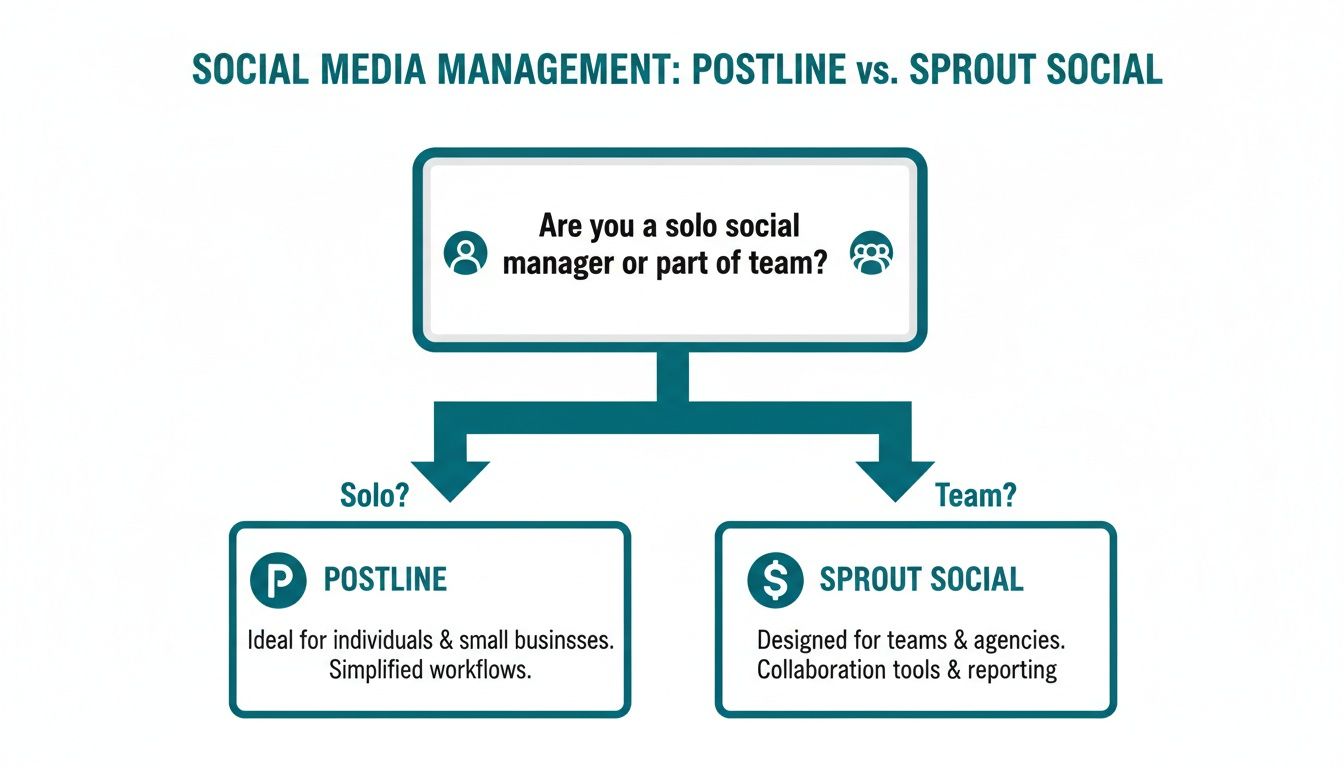
This decision tree cuts through the noise. It points individuals toward a specialist tool and teams toward an all-in-one suite, simplifying the choice based on who the platform was really designed for.
Choose Postline If…
Postline is your go-to if your game is all about building individual authority and creating killer content for a specific audience. It’s designed for depth on one platform, not breadth across many.
You should go with Postline if:
- Personal branding is your main objective. You’re a consultant, founder, or sales pro who needs to be seen as a thought leader on LinkedIn.
- You’re a solopreneur or a small, lean team. Your workflow needs to be fast and simple, without getting bogged down by complex collaboration tools or endless approval chains.
- Your world revolves around LinkedIn. You need a powerful, AI-driven assistant that’s laser-focused on creating top-notch content for this network alone.
- You’re watching the budget. You need a high-impact, specialised tool that doesn’t come with the enterprise-level price tag of a massive multi-channel suite.
Choose Sprout Social If…
Sprout Social is the right move when you’re dealing with scale, control, and managing a brand’s presence across multiple channels. It’s built from the ground up for the complexities of corporate communications and busy agency workflows.
You should pick Sprout Social if:
- Corporate brand management is your top priority. Your job is to maintain a consistent brand voice and presence across several different social media platforms.
- You’re working in a medium-to-large team. You need serious collaboration features like approval workflows, task assignments, and a shared calendar to keep everyone on the same page.
- You’re executing a multi-channel strategy. You need to manage, monitor, and analyse what’s happening on Instagram, Facebook, X, and LinkedIn all from one place.
- Deep analytics and reporting are non-negotiable. You need to deliver detailed performance reports, run competitive analysis, and prove the ROI of your social media efforts to leadership.
Frequently Asked Questions
When you’re weighing up a specialist tool against an all-in-one suite, a few key questions always pop up. Let’s get straight to the point and clear up some of the common queries that come up when comparing Postline and Sprout Social.
Can I Use Postline for Platforms Other Than LinkedIn?
Nope. Postline.ai is laser-focused on LinkedIn. It’s built from the ground up for one job: helping you create brilliant content for that specific platform.
Every feature, from the AI Ghostwriter Mode to the Audience Explorer, is tuned for the LinkedIn ecosystem. It won’t schedule posts for Instagram, Facebook, or X (formerly Twitter) because its entire purpose is to master the one network where professional branding really counts.
Is Sprout Social Overkill for a Solopreneur?
Honestly, for most solopreneurs, it absolutely is. The real magic of Sprout Social comes alive in a team setting. Think complex approval workflows, multi-channel campaign management, and in-depth team analytics.
If you’re a single operator focused on building your personal brand on LinkedIn, you’d be paying for a massive toolkit you’ll likely never touch. It’s like buying a commercial kitchen when all you need is a really good chef’s knife—powerful, but unnecessarily complex and expensive for the job at hand.
For a solopreneur, the game is all about efficiency and making a real impact on their main platform. Sprout Social is built for managing an organisation; Postline is built for amplifying an individual’s influence.
How Do the AI Content Features Really Differ?
This is where the difference in philosophy really shows. Think of it this way: Postline’s AI is your creative partner. It’s designed to learn your unique writing style, interview you to pull out authentic stories, and do real-time research to help you build genuine thought leadership from scratch.
On the other hand, Sprout Social’s AI is an efficiency assistant. Its main job is to help teams work faster—repurposing content for different platforms, rewriting posts, and optimising existing ideas. It’s a workflow accelerator for a team, not the core engine for creating original, personalised content in the way Postline’s AI is.
Ready to master LinkedIn with an AI partner that truly gets your voice? Postline.ai helps you turn your expertise into compelling content in minutes, not hours. Start creating standout LinkedIn posts today at Postline.ai.

Run every client pipeline in one place
Give each LinkedIn profile its own voice, calendar, approval flow, and analytics. Start in minutes.
Start free trial