
Postline vs Kleo An In-Depth AI Content Tool Comparison
Choosing between Postline vs Kleo? This guide analyzes their AI capabilities, data integration, workflow automation, and pricing to help you decide.
Picking the right AI content platform is a big deal; it directly affects how efficiently you can work and grow. When you put Postline vs Kleo side by side, the main difference becomes pretty obvious. Postline is built for structured, SEO-driven content creation, which makes it a fantastic fit for marketing teams that live and breathe search rankings and organised workflows. Kleo, on the other hand, is all about its real-time data integration, making it the go-to for anyone needing to create content based on what's happening right now.
A High-Level Comparison of Postline and Kleo
To really get a feel for Postline and Kleo, you have to look past their headline features. One is geared towards building a solid foundation of SEO content, while the other is designed for creating dynamic, data-rich articles on the fly. Their entire philosophies are built for different business needs. Figuring out which one aligns with your strategy is the first step to choosing a tool that doesn't just automate tasks but actually helps you hit your goals.
Postline has been engineered from the ground up for teams who need a repeatable, organised content machine. The entire feature set is designed around creating evergreen, long-form content that will climb the search rankings and stay there. This is perfect for businesses that are playing the long game with organic growth, building out a library of authoritative content over time.
Kleo is built for speed and relevance. Its secret sauce is the ability to tap into live data sources, which is a massive advantage for newsrooms, financial analysts, or marketing teams running reactive campaigns. If your strategy hinges on commenting on breaking news or creating content around fluctuating market data, Kleo gives you a serious edge. It’s a powerful way to grab your audience's attention in industries that move at a breakneck pace.
Postline vs Kleo at a Glance
To cut to the chase, this quick table sums up their core differences. It's a simple way to see where each platform puts its energy, helping you spot which one is a better match for your immediate needs.
Core Function | Postline | Kleo |
|---|---|---|
Primary Strength | Structured SEO Content & Workflow | Real-Time Data & Trend Analysis |
Ideal User | Marketing teams, SEO specialists, agencies | Journalists, financial analysts, content creators |
Content Focus | Evergreen blog posts, articles, guides | News-driven articles, market reports, timely analysis |
Data Integration | SEO data, competitor analysis, internal knowledge | Live news feeds, market data, current statistics |
Workflow Design | Project management, calendars, review cycles | Rapid iteration, real-time co-editing, quick publishing |
This table shows it's not just about a list of features. It’s about understanding their DNA.
The choice isn't just about features; it's about matching a platform's core philosophy to your content strategy. Postline builds foundational assets, while Kleo capitalises on momentary opportunities.
So, it really boils down to whether your content strategy is proactive or reactive. Postline gives you the tools for a deliberate, long-term SEO plan, making sure every piece of content is built to rank. Kleo, however, lets you react to the world in real-time, turning current events into sharp, data-backed stories. The next few sections will dig deeper into what each one can do to make this distinction even clearer.
Comparing AI Models and Content Generation Quality

The heart of the Postline vs Kleo debate really comes down to how each platform’s AI thinks. How does it take your idea and turn it into a finished piece? Their core models are built on completely different philosophies, and that means you get very different results depending on your goal.
One tool is all about building structured, SEO-driven content that lasts. The other is a master of creating dynamic, data-fuelled articles that are relevant right now.
Postline's AI was clearly built by people who live and breathe content frameworks and search engine optimisation. It’s less of a blank-canvas writer and more like a strategic partner, guiding you through a structured process to create long-form content that’s engineered to rank. This approach builds consistency and quality right from the start.
Kleo, on the other hand, is built for speed and relevance. Its big trick is its ability to tap into live data. This allows it to generate articles that are not just well-written, but also factually current and aware of the world around them. It's a seriously powerful tool for jumping on breaking news or reacting to market trends as they happen.
The Postline Approach: Structured Creativity
Postline’s content creation process is steeped in proven SEO methodologies. When you give it a prompt, the AI doesn’t just start writing. It breaks down your request through the lens of search intent, keyword strategy, and structural best practices. The result is content that’s consistently well-organised and aligned with what search engines want to see.
For instance, if you ask Postline for a blog post on "effective remote team management," you'll get a draft with a clear H1, logical subheadings (H2s and H3s), and content that naturally weaves in related keywords. It's brilliant at creating that foundational, cornerstone content that becomes a long-term asset. This methodical process is perfect for marketing teams focused on building out a solid content library.
Postline's AI is more like a co-strategist. It bakes SEO principles directly into the content’s DNA, focusing on creating durable assets, not just disposable articles.
This structured approach also makes it much easier to maintain a consistent brand voice. The AI works within predefined frameworks you can align with your company's style guide, helping you build authority through well-researched, methodically built articles.
The Kleo Method: Dynamic and Data-Driven Output
Kleo goes down a different road entirely, focusing on content that reflects the world in real time. Its AI is designed to pull information from various live sources—think news APIs or financial data feeds—and spin it into a cohesive story. This is its standout feature in the Postline vs Kleo matchup.
Imagine you need an article analysing a sudden dip in the stock market. Kleo can pull the latest numbers, find expert commentary from recent news reports, and generate an analysis in minutes. The quality here is measured by its timeliness, accuracy, and how well it can present complex data in a way people can actually understand. While this offers incredible flexibility, it can mean you need a bit more editorial oversight to get the brand voice just right.
For a wider look at what different AI models can do, checking out the 12 best AI copywriting software picks offers some great insights into their unique strengths.
Content Quality and Factual Accuracy
When you look at the final piece of content, both tools produce high-quality text, but their strengths are geared for different jobs. Postline’s content usually feels more polished from an SEO and structural perspective, right from the first draft. Because it relies on established knowledge and SEO frameworks, you get highly reliable, evergreen content.
Kleo’s accuracy, however, is directly linked to the reliability of its data sources. It's an incredibly powerful feature for timely content, but it does mean you need a quick verification step to ensure the data is interpreted correctly and the sources are solid. For teams in fast-paced industries, this is just a normal part of the workflow.
If you're looking for more general creative sparks, exploring different social media content creation tools can open up other avenues. Ultimately, the choice comes down to what your content strategy values more: foundational stability or immediate relevance.
Evaluating Data Integration and Real-Time Capabilities

The core difference between Postline and Kleo often comes down to a single question: how do you want to use data? One tool uses data to build a solid, long-term content strategy. The other plugs live data right into your content, making it relevant this very second.
This isn't just a minor feature difference; it completely shapes what you can create and how you work day-to-day.
Kleo's entire game is its real-time data connectivity. It's built to grab current statistics, breaking news, and market trends straight from the web and feed them into its content engine. For teams that need to react to world events on a dime, this is a massive advantage.
Postline, on the other hand, treats data more strategically. It's focused on digging into SEO insights, competitor content, and your own internal knowledge. It's less about reporting what happened five minutes ago and more about creating authoritative, evergreen content that climbs the search rankings over time.
Kleo's Live Data Advantage
Kleo isn’t just about writing content; it’s about creating content that’s plugged into the present moment. Its ability to tap into live news APIs, financial market feeds, and other dynamic data sources is its biggest selling point. This opens up a reactive content strategy that's almost impossible to pull off manually at any real scale.
Think about a financial analyst. They could use Kleo to pump out a daily market summary just minutes after the closing bell. The AI could pull the final numbers, flag the biggest movers, and even weave in quotes from recent financial news to create a full report. Speed and up-to-the-minute accuracy are everything here.
Or imagine a marketing team in a fast-moving industry like tech. A new product just dropped. Kleo could instantly gather key specs, initial reviews, and social media buzz to create a timely, well-rounded article while the news is still hot.
Kleo’s real strength is turning raw, real-time information into a coherent story. It closes the gap between an event happening and a brand being able to comment on it intelligently.
Postline's Strategic Data Integration
Postline’s approach to data is much more deliberate. It uses data not for immediate reporting, but to build a stronger foundation for every piece of content. Its integrations focus on sources that fuel a winning SEO strategy, like analysing top-ranking articles to spot content gaps or pulling keyword data to optimise every post.
Where Postline really shines is connecting to your company's own internal knowledge base—what some call a "brand brain." This lets the AI learn from your existing documents, case studies, and internal research. The result? Content that is factually accurate according to your business and perfectly aligned with your brand voice.
Let's say an e-commerce business is writing about market trends in Germany. You could use a tool like Kleo to pull live stats for a data-rich piece. For instance, in Germany’s competitive 2025 online market, Amazon.de holds a massive 63% share, with its marketplace sellers driving 46% of that volume. This kind of real-time data highlights how marketplaces now dominate, accounting for 57% of all online sales, putting huge pressure on domestic retailers. You can find more on these market dynamics on Marketplace Universe.
This distinction defines the entire user experience. A Postline workflow is proactive; it's all about planning and building content assets for the long haul. A Kleo workflow is reactive, designed to jump on opportunities as they pop up. Your choice really depends on whether your strategy values foundational authority or in-the-moment relevance.
Workflow Automation and Team Collaboration Features

Creating content at scale isn't a solo mission. It needs organised workflows and a team that moves in sync. The Postline vs Kleo debate gets really interesting when you look at how each platform handles the daily grind of a modern content team. Their approaches couldn't be more different: one is built for structured project management, the other for fast-paced, real-time co-creation.
Postline is clearly designed with the methodical work of marketing agencies and in-house teams in mind. It treats every piece of content like a project that can be managed, tracked, and delivered on time. This structure is its biggest strength for any team that puts consistency and quality control first.
Kleo, on the other hand, builds its collaboration tools for speed and flexibility. It feels like a perfect fit for a newsroom or a trend-chasing content team where quick turnarounds are more valuable than rigid, multi-stage approval chains. This makes it a serious contender for teams that need to move fast.
Postline’s Structured Project Management
Postline acts as a central command centre for planning, creating, and reviewing content. Its workflow is built on clarity and accountability, making sure everyone knows their part and when it's due. This is a game-changer for larger teams or agencies juggling dozens of client projects at once.
Its key features are all about bringing order to the chaos:
Shared Content Calendars: Lets you see the entire content pipeline at a glance, from first draft to publication. This helps managers assign work and spot bottlenecks before they become a problem.
Task Assignments and Status Labels: You can assign tasks like writing, editing, or design to specific team members and track where everything stands with labels like "Draft," "In Review," or "Scheduled."
Defined Review Cycles: Create a clear path for feedback and sign-offs. This guarantees every piece of content is on-brand and polished before it goes out the door.
This organised approach smooths out the friction that so often grinds content production to a halt. Forget chasing updates in Slack or email threads; everything is tracked right inside the platform. If you want to dive deeper into optimising your team's process, our guide on building a successful content creation workflow has some practical tips that really click with Postline’s features.
Postline excels by turning content creation into a predictable, repeatable system. It’s built for managers who need to oversee a process, not just a folder full of documents.
This system is a massive plus for SEO-focused teams. The structured workflow ensures every step in the optimisation process—from keyword research to on-page checks—is done consistently, which is what drives better results over time.
Kleo’s Real-Time Co-Creation
Kleo’s collaborative space feels more like a shared digital whiteboard designed for immediate action. Its real power is in making rapid co-editing and brainstorming feel effortless, which is vital when your content is tied to breaking news or viral trends.
Where Kleo really shines is its fluid, less rigid approach. A journalist and an editor could, for example, jump into the same document to work on a developing story, pulling in live data and shaping the narrative together in real time. It cuts out the delays you get with formal hand-offs.
But this flexibility can be a double-edged sword. Without the strict guardrails of a tool like Postline, keeping a consistent brand voice and sticking to a formal review process becomes much harder. It really puts the pressure on your team to stay disciplined and self-organised.
Comparing Permission Levels and Integrations
Both platforms get that modern teams run on a web of connected tools, but they focus on different things. Postline tends to prioritise integrations with project management software and digital asset management systems, cementing its role as the central hub for content operations.
Kleo leans more towards integrations with communication platforms like Slack or Microsoft Teams. This makes sense for its real-time, reactive nature, allowing for instant notifications and discussions around live content.
Here’s how their permission structures stack up in practice:
Feature Area | Postline | Kleo |
|---|---|---|
User Roles | Granular roles (Admin, Editor, Writer, Viewer) to control who can do what. | Simpler roles (e.g., Editor, Contributor) focused on content creation access. |
Approval Flow | Multi-step, customisable approval workflows are built right in. | Less formal, relying on real-time comments and direct team communication. |
Version Control | Solid version history to track all changes and easily roll back to previous drafts. | Basic version tracking, designed more for quick edits than for formal audits. |
In the end, the right choice comes down to your team’s culture. If your team works best with structure, clear processes, and well-defined roles, Postline provides the framework you need to scale efficiently. If your team values speed, agility, and the ability to collaborate on the fly to react to the market, Kleo’s more open and fluid environment will be the better fit.
Analysing Pricing Models and Return on Investment
Cost isn’t just a number on a price tag; it’s about the value you get back. When you put Postline vs Kleo side-by-side, you can see their pricing structures are built around completely different philosophies. One is designed for scalable team workflows, while the other offers flexible access to its unique real-time data features.
Postline’s pricing is built to support growing content teams. Its tiers scale logically based on the number of user seats, how much content you’re generating, and access to more advanced collaboration tools. This model is perfect for businesses that can forecast their content output and need a clear, predictable cost as their team expands.
Kleo, on the other hand, often ties its pricing to data access and real-time generation. This means your costs might be linked to the number of data queries you run or the complexity of the content being created. This approach works well for users who get their value from timely, data-rich content, even if they have a small team.
A Breakdown of Pricing Tiers and Features
You’ve got to understand what you’re getting at each level. A cheap entry-level plan might look tempting, but it could be missing the one feature that actually saves your team serious time and money. It’s vital to look at the total cost of ownership, not just the monthly fee.
Here’s a look at how the plans generally stack up, showing you where your investment goes with each platform.
Pricing Tier and Feature Comparison
This table breaks down the typical pricing structures for both Postline and Kleo, helping you see where each platform places its value and which tier aligns with different user needs.
Pricing Tier | Postline Cost & Key Features | Kleo Cost & Key Features | Ideal User |
|---|---|---|---|
Entry-Level | Lower cost, focused on individual creators. Includes core AI writer, limited post generations, and a single-user seat. | Flexible entry point, may offer limited real-time data access or a set number of data-driven articles per month. | Solo entrepreneurs, freelancers, or small businesses just starting with AI content creation. |
Mid-Tier/Pro | Best value for growing teams. Adds more user seats, higher content limits, and essential collaboration features like review workflows. | Unlocks more advanced data sources and higher generation limits. May include API access for custom integrations. | Marketing teams, small agencies, and businesses ready to scale their content strategy. |
Enterprise | Custom pricing. Offers unlimited generation, advanced security, dedicated support, and full team management features. | Custom plans focused on high-volume data needs, dedicated data pipelines, and enterprise-grade support. | Large organisations, newsrooms, and agencies with extensive content and data requirements. |
As you can see, Postline’s value scales with your team’s size and operational efficiency. Kleo’s value, in contrast, scales with the intensity of your data usage and your need for unique insights.
Return on investment isn't just about saving money on writing. It’s about how the tool amplifies your strategy. Postline offers ROI through workflow efficiency, while Kleo delivers it through unique, time-sensitive content opportunities.
Calculating Your True Return on Investment
To really figure out the ROI, you need to look past the subscription cost and measure the impact on your business goals. For Postline, this could mean tracking the reduction in time spent drafting, editing, and managing content. If a €150/month plan saves your team 20 hours of work, the return is obvious and immediate.
For Kleo, the ROI calculation is different. It’s about the value of being the first to market with a data-backed insight or a breaking analysis. A single piece of content could land a major client or cement your brand as an industry leader, making the investment more than worth it. To do this properly, you first need a solid grasp of how to measure content performance effectively.
Ultimately, both platforms can deliver a strong return, but only if their pricing model clicks with your main business objective. Postline is a smarter investment for teams looking to streamline and scale a predictable content engine. Kleo is the clear winner for those whose success hinges on creating unique, data-driven content that competitors simply can’t match.
Making the Right Choice for Your Content Strategy
The final decision in the Postline vs Kleo showdown isn't about which tool is objectively "better." It's about which one clicks with your core content strategy. Your choice really boils down to one question: are you building structured, long-term assets or creating agile, in-the-moment content? One platform is an architect for your content foundation; the other is a journalist reporting on today's events.
This decision tree gives you a quick visual guide based on what you're trying to achieve.
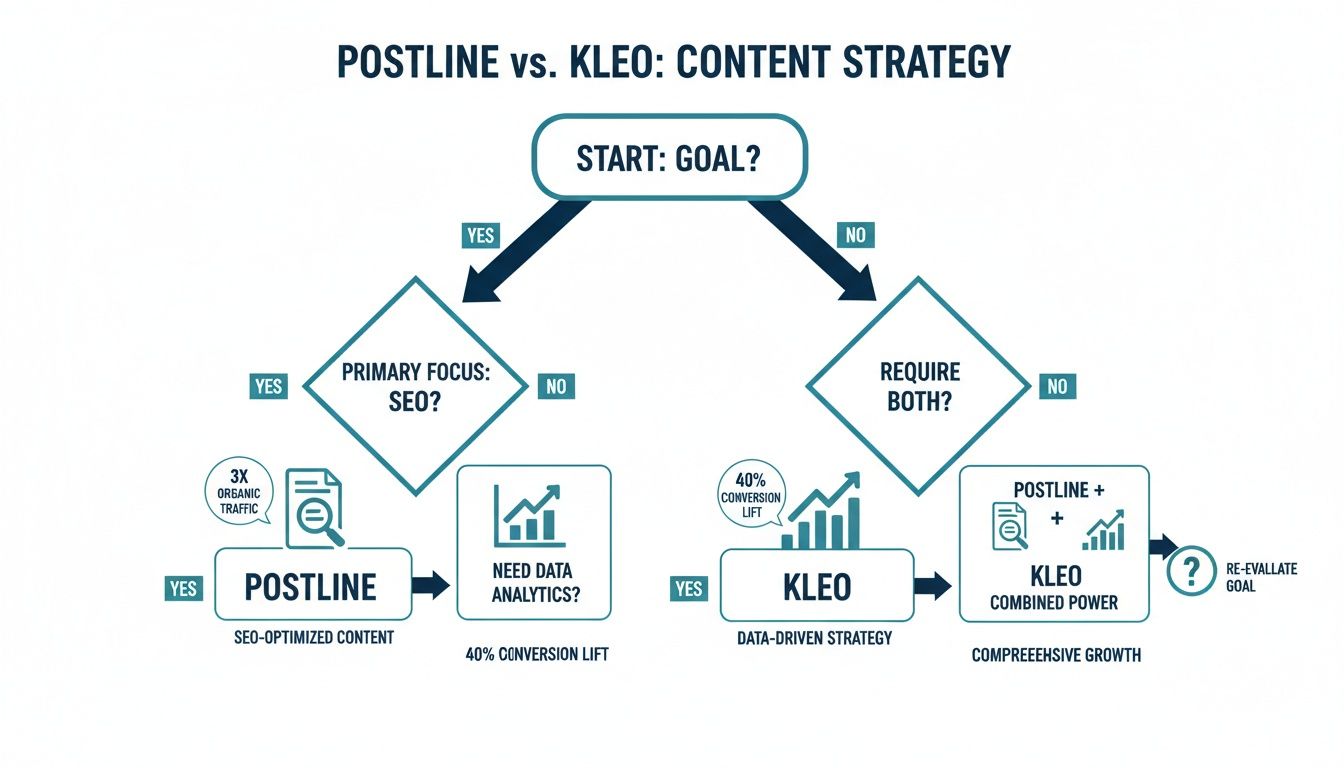
As you can see, the path splits depending on whether you're chasing SEO-driven growth or data-driven insights. Answering that single question makes it pretty clear which platform's philosophy is the right fit for you.
When to Choose Postline
Postline is the clear winner for teams that live and breathe search engine optimisation. Its entire workflow is built from the ground up to produce consistent, high-ranking, long-form content. If your KPIs are all about organic traffic, keyword rankings, and building a library of authoritative articles, Postline gives you the structure you need.
Think about these specific situations where Postline just makes sense:
Marketing Agencies juggling multiple clients who need a repeatable, scalable process for creating optimised blog posts and guides.
In-house SEO Teams laser-focused on building cornerstone content and establishing topical authority in a crowded niche.
Content Managers who need solid project management tools to oversee a structured content calendar, from ideation right through to publication.
Postline is an investment in process and predictability. It turns the art of SEO content creation into a scalable science, ensuring every article is built on a foundation of proven optimisation principles.
If your main goal is to build a content engine that predictably drives organic growth for months and years to come, Postline's feature set is designed for you. It takes the guesswork out of the equation and enforces best practices, making it the strategic pick for long-term content marketing.
When to Choose Kleo
On the flip side, Kleo has a massive advantage for teams whose content strategy hinges on speed and real-time data. If being the first to publish an analysis or commentary gives you a competitive edge, Kleo is the tool for the job. Its ability to pull in live data makes it indispensable for any time-sensitive industry.
Kleo is the go-to option in these scenarios:
News Organisations and Journalists who need to produce articles on breaking events and current statistics in an instant.
Financial Analysts and Market Researchers creating reports and commentary based on constantly fluctuating market data.
Trend-Focused Marketing Teams running reactive campaigns that need to jump on viral topics or sudden industry shifts.
The platform is built for agility. It empowers creators to turn raw, current information into compelling stories in minutes, not days. For any organisation where timeliness is the most important measure of content value, Kleo provides the tools you need to win.
Frequently Asked Questions
When you're weighing up two powerful tools like Postline and Kleo, a few specific questions always pop up. Let's get straight to the answers to help you lock in the right decision for your team.
Which Platform Has a Steeper Learning Curve?
The learning curve for each platform really comes down to what it was built for. Postline is generally quicker to pick up, especially if you're already comfortable with standard content marketing or project management software. Its workflow is logical—plan, write, schedule—so it feels familiar right out of the box for most marketing teams.
Kleo, on the other hand, can take a bit longer to fully get your head around, particularly its advanced real-time data features. You'll need to spend some time setting up data feeds, making sure the sources are solid, and learning how to actually use the AI insights. The basic writing part is simple enough, but unlocking Kleo's real power requires a bit more upfront effort.
How Do They Handle Data Privacy and Security?
Both platforms are serious about security, but they focus on different areas based on the data they handle.
Postline: Its main job is to protect your user-generated content, internal knowledge docs, and team chats. It uses standard encryption and solid access controls to keep your content strategy and company information locked down.
Kleo: Puts a huge emphasis on securing its data integrations. It works hard to ensure any connection to an external data source is secure and compliant, protecting both its own system and the integrity of the information you’re pulling in.
It really boils down to what you need to protect more: your internal content creation process (Postline) or the sensitive external data streams that power your articles (Kleo).
Can I Migrate Existing Content to Either Platform?
Yes, but they approach it from different angles. Postline is built for content migration, especially for teams trying to create a "brand brain." You can import existing articles, documents, and style guides to teach the AI your specific voice and knowledge base. This is a massive part of its appeal.
Kleo is less about importing your entire back catalogue and more about creating fresh, timely content. While you can definitely store and manage articles in the platform, it wasn't designed for a large-scale migration of your whole blog. The Postline vs Kleo comparison makes it clear: if you want to centralise and reuse your existing content library, Postline is the way to go.
Ready to create standout LinkedIn content with an AI that gets your voice and strategy? Postline.ai brings together powerful writing assistance with deep personalisation to help you grow your audience, faster.

Run every client pipeline in one place
Give each LinkedIn profile its own voice, calendar, approval flow, and analytics. Start in minutes.
Start free trial