Build a Powerful Personal Brand on LinkedIn
Learn how to build a powerful personal brand on LinkedIn with proven strategies for your profile, content, and network to unlock career opportunities.
Your personal brand on LinkedIn isn’t just some fluffy marketing term; it’s your digital reputation. In today’s professional world, it has become one of the most powerful assets in your career toolkit.
A strong, deliberately built brand is the difference between you chasing opportunities and the right opportunities finding you. It completely shapes how recruiters, potential clients, and future partners see your value, long before you ever have a conversation. It turns your profile from a static CV into a dynamic platform for real growth.
Why Your LinkedIn Brand Is Your Biggest Career Asset
Let’s be blunt: your LinkedIn profile is your professional storefront, and in a competitive market, a neglected one is a massive missed opportunity. People don’t just glance at your experience anymore. They’re looking for a clear story—who you are, what you stand for, and the unique value you bring to the table.
Think of it this way: a well-tended profile, buzzing with consistent, insightful content, is out there working for you 24/7. It builds trust, establishes you as an authority in your space, and creates a magnetic pull for the right kinds of connections. This isn’t just a nice theory; it’s the new standard for professional visibility.
The Shift from Passive CV to Active Reputation
Not long ago, a CV was just a historical document, a list of things you’d done. Today, your LinkedIn brand is a living, breathing thing that showcases your expertise in real-time. It’s the difference between telling someone you’re an expert and showing them every single day through your content and interactions.
This shift is especially critical in Germany, where personal branding on LinkedIn has become a cornerstone of career advancement. The platform is fuelled by a massive 22 million users—that’s 26.9% of the population. The 25-34 demographic is leading the charge, making up 7.8 million of those users. And here’s the kicker: 82% of European recruiters, including those right here in Germany, now actively prioritise candidates with strong personal brands. You can dig into more of the data on LinkedIn usage in Germany.
A powerful personal brand doesn’t just attract job offers. It builds a network that proactively brings you business leads, speaking gigs, and collaborative projects. It’s all about creating inbound opportunities rather than constantly being in outbound-hustle mode.
Real-World Impact on Your Career
Picture two professionals with identical skills. One has a basic, rarely touched LinkedIn profile. The other actively shares industry insights, jumps into relevant discussions, and showcases their best work in the “Featured” section.
When a recruiter searches for their shared expertise, who makes the more compelling first impression? It’s not even a contest.
The active professional instantly communicates passion, deep knowledge, and a real commitment to their field. This proactive approach delivers tangible results you can actually feel:
- More inbound messages from recruiters and potential clients who feel like they already “know” you through your content.
- Higher-quality connections with industry leaders who are drawn to your demonstrated expertise and clear point of view.
- Serious credibility that makes you a go-to person in your niche, opening doors to media features or conference invitations.
Ultimately, a strong LinkedIn brand is a core part of developing executive presence. It builds that hard-to-define gravitas and influence that sets you apart. Think of it as a long-term investment in your own career resilience and growth.
Transforming Your Profile Into a Powerful First Impression
Your LinkedIn profile is the foundation of your entire personal brand. Think of it as your digital storefront. It’s the first place recruiters, potential clients, and future collaborators will look you up. It needs to do more than just list your job history—it has to tell a compelling story about who you are and the value you bring to the table.
This isn’t about just filling in the blanks. It’s about being strategic, crafting each element to make an immediate, powerful impact.
The whole process starts with a killer profile. From there, you move into creating content that builds your brand, which ultimately leads to real, tangible opportunities.
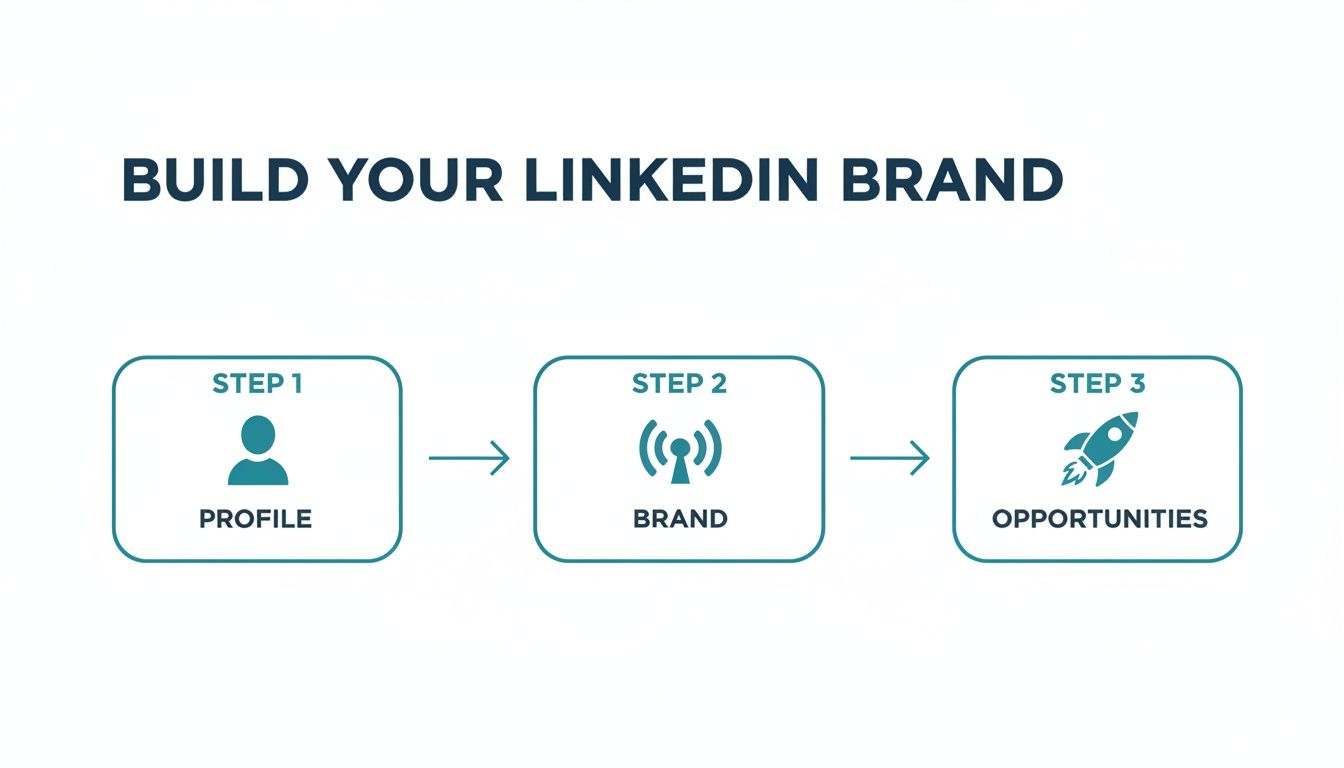
As you can see, a rock-solid profile is the essential first step. Without it, you can’t effectively broadcast your brand or attract the career opportunities you’re after.
Your Profile Picture and Banner
First impressions are almost entirely visual. Your profile picture is your digital handshake, and it has to communicate professionalism and approachability in a single glance. Holiday snaps or poorly cropped group photos are out.
Instead, invest in a high-quality headshot. You should be smiling and looking directly at the camera. A clean, uncluttered background is always the best choice. This simple detail builds instant trust and makes you seem far more engaging.
Your banner image is the next most important visual. Please don’t leave it as the default blue graphic. Use this space to visually reinforce your brand. It could be:
- A shot of you speaking at an event.
- A custom graphic with a tagline that sums up your value proposition.
- An image that represents your industry or the results you deliver.
Crafting a Headline That Communicates Value
Your headline is prime real estate. It shows up right next to your name in search results, connection requests, and every time you comment. A common mistake is simply listing a job title, like “Marketing Manager at ABC Company.” This tells people what you are, but not what you do for them.
A powerful headline focuses on the value you offer and the problems you solve, while also being packed with relevant keywords. It should be a concise summary of your professional identity. For instance, instead of a generic title, try something much more descriptive.
Headline Example Transformation:
- Before: “Software Engineer”
- After: “Senior Software Engineer | Building Scalable FinTech Solutions for Growing Start-ups | Java & Python”
See the difference? The revised headline is loaded with keywords (“Software Engineer,” “FinTech,” “Java”) and clearly communicates expertise and a target audience. It immediately answers the silent question in every reader’s mind: “What can this person do for me?” For a deeper dive, check out these expert LinkedIn headline tips to make yours truly stand out.
Writing a Compelling About Section
Think of your “About” section as your professional story. This is your chance to go beyond the bullet points of a CV and connect with the reader on a human level. Always write it in the first person—it feels more authentic and direct.
Start with a powerful opening that hooks the reader and summarises your core mission or expertise. From there, you can elaborate on your background, your unique approach, and the specific results you’ve achieved for clients or employers.
Remember to structure this section for scannability. Use short paragraphs and maybe some bullet points to highlight key skills or accomplishments. Always end with a clear call to action, like inviting people to connect, visit your website, or send you a message about a potential collaboration.
Showcasing Your Best Work
The “Featured” section is one of the most underutilised—and powerful—parts of a LinkedIn profile. It lets you pin your best content, projects, or external links right at the top. This is your personal portfolio, front and centre.
Use it to showcase things that prove your expertise:
- A link to an article you wrote that positions you as a thought leader.
- A case study or project that highlights a significant achievement.
- A video of a presentation or webinar you delivered.
- Your company website or a specific landing page you’re proud of.
By curating this section, you provide immediate, tangible proof of your skills and value. It reinforces the story you’re telling throughout the rest of your profile and is one of the fastest ways to build credibility and make your personal brand unforgettable.
Finding Your Voice and Content Niche
Okay, so you’ve got a killer profile. Now for the real work. Moving from a passive LinkedIn scroller to an active voice on the platform is the single biggest leap you’ll make in building your personal brand. This is where you stop just having a profile and start becoming a recognised authority.
A solid content strategy isn’t about just shouting into the void every day. It’s about consistently adding real value in a specific area where you can actually make a difference. It all starts with defining what you want to be known for, because without a clear niche and a distinct voice, your posts are just noise.
Defining Your Expertise and Niche
Trust me, everyone is an expert at something. The trick is finding that sweet spot where what you know, what you love talking about, and what your audience genuinely needs all overlap. Forget trying to be a generalist who covers every corner of your industry. You want to become the go-to person for one specific thing.
Think about the unique angle you bring to the table. Are you a project manager who’s figured out the secret to keeping hybrid teams from falling apart? Or a software developer who can explain complex code in a way that even the marketing team gets it? That’s your goldmine.
To drill down, ask yourself a few honest questions:
- What do my colleagues always bug me for help with? This is a massive clue about where people already see your expertise.
- What industry problem do I have a strong, maybe even controversial, opinion on? A unique point of view is what makes people stop scrolling.
- If I could only talk about three work topics for the next year, what would they be? This forces you to pick subjects you’re genuinely passionate about and won’t get sick of.
Your niche isn’t your job title. It’s the specific problem you solve or the unique insight you offer. The tighter your niche, the faster you’ll attract the right kind of followers.
Finding Your Authentic Voice
Once you know what to talk about, you need to figure out how you’re going to talk about it. This is your “voice”—the personality that shines through your posts. Are you the analytical type who backs everything up with data? The storyteller who weaves in personal anecdotes? Or the straight-talker who cuts through all the corporate fluff?
There is no “right” voice for LinkedIn. The only thing that works long-term is authenticity. Trying to mimic another creator you admire will feel fake and you’ll burn out fast. Your content needs to sound like you. If you need some help with this, it’s worth reading up on how to find your writing voice and make it your own.
Choosing the Right Content Formats
The package your message comes in can be just as important as the message itself. Different formats do different jobs and click with different people. In the German market, people value clarity and substance, so pick formats that deliver information without the waffle.
Deciding what format to use for your next post can feel overwhelming. Each one has its own strengths and is suited for different goals. This table should help you figure out which format to pick based on what you’re trying to achieve.
LinkedIn Content Format Comparison
| Content Format | Best For | DE Engagement Level | Pro Tip |
|---|---|---|---|
| Text-Only Posts | Sharing quick insights, telling stories, and asking engaging questions. | High | Start with a killer hook. The first two lines are everything. |
| Image Posts | Stopping the scroll with a strong visual, adding a personal touch. | Medium-High | Use high-quality, simple graphics. Avoid clutter. A photo of you often performs surprisingly well. |
| Carousels (PDFs) | Breaking down complex topics into digestible, step-by-step guides. | Very High | These are amazing for positioning you as an expert. Aim for 5-10 slides with one key idea per slide. |
| Video | Sharing quick tips, offering behind-the-scenes content, or short tutorials. | High | Keep it short (under 90 seconds), add captions, and have a clear call-to-action at the end. |
| Polls | Driving quick engagement and gathering direct audience feedback. | Medium | Use polls to start a conversation, not just to collect data. Follow up with a post about the results. |
Ultimately, the best approach is to experiment. Mix it up and pay close attention to what your audience responds to. Don’t be afraid to try something new, but double down on what works.
Building a Sustainable Content Calendar
Consistency is king on LinkedIn. Posting in random bursts won’t build any real momentum. You need a rhythm you can stick to without turning it into a chore. For most people, posting 2-4 times per week is the sweet spot—it’s effective and totally manageable.
Start by brainstorming a few core content “pillars” related to your niche. For a marketing expert, these might be “SEO Strategy,” “Content Repurposing,” and “Team Leadership.”
From there, map it out in a simple content calendar. Honestly, a basic spreadsheet is all you need. Plan your posts a week or two ahead. This takes the pressure off dreaming up something brilliant on the spot every single day. This organised approach is the secret to staying on-message and delivering value time and time again.
Building Your Network Through Authentic Engagement
Publishing great content is a massive step, but it’s only half the story when it comes to building a powerful personal brand on LinkedIn. At its core, the platform is built for conversation, and the algorithm absolutely loves to see genuine interaction.
Simply posting and then logging off is like shouting into an empty room. The real growth, the kind that leads to opportunities, happens when you start actively engaging with others. It’s about moving from just consuming content to becoming an active voice in your industry’s conversations. This is hands-down the fastest way to get more eyes on your profile, build real relationships, and show LinkedIn you’re a valuable member of the community.
The Power of Insightful Comments
Let’s be honest: the generic “great post!” or “thanks for sharing” comments are completely useless. They add zero value, do nothing for your brand, and everyone just scrolls right past them. The real goal of commenting is to spark a conversation and showcase your expertise, even when it’s on someone else’s post.
Treat every comment you write like a mini-post. It’s a golden opportunity to make a strong impression. A truly insightful comment should:
- Add to the conversation. Offer a fresh perspective, ask a thoughtful follow-up question, or share a quick personal story related to the topic.
- Showcase your expertise without coming off as arrogant. You could reference a relevant statistic you know or briefly mention a strategy that worked for you.
- Tag the original poster or other people in the comments to keep the dialogue flowing and pull them into the discussion.
Here’s what that looks like in the real world: Imagine an industry leader posts about the challenges of managing a remote team.
- Weak Comment: “Totally agree, great insights.”
- Strong Comment: “@[Poster’s Name], fantastic points on asynchronous communication. We found implementing a ‘daily check-in’ document reduced unnecessary meetings by 30%. Has anyone else tried a similar non-meeting approach?”
See the difference? The second comment immediately positions you as a thoughtful problem-solver, not just a passive follower.
Strategic Connection Requests
Once you’ve started popping up in people’s notifications with valuable comments, you can start expanding your network more directly. But sending a connection request with no personal message has a terrible success rate, especially when you’re reaching out to influential people. Your request needs context.
A personalised note is your chance to explain why you want to connect. It proves you’ve done your homework and aren’t just trying to rack up numbers. Keep your message short, but make it count. For a deep dive, check out these killer tactics on how to get more LinkedIn connections and make every request matter.
A solid connection request usually includes these three things:
- A specific reference to something you have in common or admire about their work.
- A brief mention of who you are or what you do.
- A clear reason for wanting to connect.
For example: “Hi [Name], I really enjoyed your recent post on sustainable supply chains. As a logistics specialist focused on green initiatives, I’d love to follow your work more closely and connect with you here.”
Leveraging LinkedIn Groups Effectively
LinkedIn Groups can be a goldmine for your personal brand—if you use them correctly. Let’s face it, many of them have become spam-filled wastelands. The key is to find and get active in well-moderated groups that are buzzing with conversations in your niche.
Forget just dropping links to your own content. That’s a fast track to getting ignored. Instead, focus on being genuinely helpful. Jump into discussions, answer people’s questions, and share insights without expecting anything back. This is how you build a reputation as the go-to expert within a highly targeted community.
Responding to Your Own Community
Finally, engagement isn’t a one-way street. When people take the time to comment on your posts, responding is non-negotiable.
Acknowledging every comment helps build a real community around your content and encourages those people to engage again next time. The LinkedIn algorithm sees this, too. Posts with a lot of back-and-forth conversation in the comments often get a boost in the feed. Your replies don’t need to be essays, but they should be genuine. Ask follow-up questions to dig a little deeper into what a commenter is saying—this is how you turn a simple post into a thriving discussion.
Leveraging the Berlin LinkedIn Ecosystem
Sure, the principles for building a personal brand on LinkedIn are pretty much universal. But if you’re based in Germany’s capital, you have a massive advantage: you can tap into the incredibly dynamic Berlin LinkedIn scene. This isn’t just another city; it’s a super-concentrated hub of innovation, opportunity, and professionals who are actually paying attention.

The city just operates on a different frequency. You’ve got this unique mix of scrappy start-up culture, huge established corporations, and a massive international talent pool all mashed together. The result is a network that’s both dense and exceptionally interactive, making it a prime location for anyone serious about building their professional brand.
Why Berlin Is a LinkedIn Goldmine
The data tells a pretty compelling story. Berlin isn’t just Germany’s epicentre for LinkedIn activity by chance. The city is home to over 2.1 million users, but the real magic is in the details.
Berlin hosts a staggering 380,000 B2B decision-makers, which is 22% more per capita than the German average. And these people are active. The posting rate here is 47%—a full 38% higher than the national figure. To top it off, engagement is 52% higher than anywhere else in the country. This means Berlin-based professionals aren’t just scrolling; they’re actively participating. If you want to dive deeper, you can explore more data on the Berlin LinkedIn market to really see the potential.
This high concentration of engaged decision-makers means your content has a much greater chance of landing in front of the right people—founders, investors, and hiring managers who can actually change your career trajectory.
This unique ecosystem demands a tailored strategy. Generic, one-size-fits-all content will just get lost in the noise. But posts that speak directly to the challenges and opportunities buzzing within the Berlin market? That’s how you get noticed.
Strategies for the Berlin Market
To really make an impact, your approach has to reflect the city’s character. Berlin’s professional culture values authenticity, directness, and ideas that push boundaries. It’s not about corporate fluff; it’s about what’s next.
Here’s how to tune your strategy into the local vibe:
- Talk Tech and Innovation: Berlin is a start-up powerhouse. This is the place to share your perspectives on emerging tech, sustainable business, or the future of work. It immediately positions you as someone who’s thinking ahead.
- Embrace the International Angle: The city is a true melting pot of global talent. Always post in English to reach the widest audience and don’t be shy about highlighting your international experience. It’s a massive plus here.
- Network with Intention: Randomly firing off connection requests is a waste of time. Instead, identify leaders in Berlin’s key industries like FinTech, SaaS, or creative tech. Engage with their posts thoughtfully before you connect, and then send a request that mentions a shared interest or a local event.
- Showcase Local Wins: Have a story or a case study involving a Berlin-based company or project? Share it. This instantly shows you’re connected to the local business landscape and understand what makes it tick.
By tailoring your content and engagement to this specific, high-energy environment, you stop just having a profile and start building a real reputation. It’s a strategic move that can open doors in one of Europe’s most important professional networks far quicker than any broad, unfocused approach ever could.
Measuring What Matters for Real Growth
Churning out content is one thing, but knowing if it’s actually landing is the real game-changer. If you want to build a personal brand on LinkedIn that genuinely works for you, you have to look past the shiny objects like likes and follower counts. Those are just vanity metrics.
Real growth isn’t about going viral once; it’s about consistently attracting the right people to your profile. The only way to do that is to get comfortable with your LinkedIn analytics. A quick check-in tells you what’s hitting the mark, so you can double down on what works and ditch what doesn’t.
The Metrics That Actually Move the Needle
It’s easy to get fixated on the like count for a single post, but that’s a rookie mistake. To get a true picture of your brand’s health and visibility, make a habit of tracking these three core metrics instead:
- Profile Views: This one’s simple but powerful. Are people curious enough about your post or comment to click through to your profile? An upward trend here is a massive green flag.
- Search Appearances: This metric tells you how often you’re showing up in LinkedIn searches and, crucially, which keywords people are using to find profiles like yours. It’s direct feedback on whether your profile optimisation is working.
- Post Engagement Rate: Forget raw likes. Dig deeper into the comments and shares—that’s where the real connection happens. A simple way to calculate this is to divide your total engagements by your follower count. This gives you a much clearer sense of your post’s true impact.
By looking at these numbers week-over-week, you stop guessing and start making strategic, data-backed decisions. You’ll begin to spot the patterns—the topics and post formats that your audience really cares about. That’s the secret to sustainable, long-term growth. You can find more details in our guide on how to measure content performance.
From Digital Signals to Real-World ROI
Let’s be honest, the end goal here isn’t just to have a nice-looking LinkedIn profile. It’s about generating tangible opportunities for your career or business. The great news is that consistent digital effort translates into real-world results, and you can see it happen within a surprisingly clear timeframe.
Typically, you can expect to see an initial bump in profile views and engagement within the first 3-4 months of putting in the work consistently. But the real payoff—like a steady stream of inbound messages from recruiters or potential clients—often starts to materialise after about 6-12 months.
For those who decide to invest in professional services, which can range anywhere from €500-€3,000 monthly, the returns can be even more significant. Some case studies show a staggering 150% increase in client growth, making a solid business case for the investment. You can discover more insights about the costs and ROI of personal branding.
A Few Common Questions I Hear About Building a LinkedIn Brand
When you’re starting to build your personal brand on LinkedIn, a few questions always seem to pop up. Let’s run through the most common ones I get asked, so you can push forward with a clear plan.
How Often Should I Actually Be Posting?
This is the big one. While you might see gurus posting multiple times a day, for most of us, a solid rhythm is 2-4 times per week. That’s the sweet spot. It’s enough to stay on your network’s radar and build real momentum without completely burning yourself out.
Forget frequency for a second and think about consistency. That’s what really matters. A few thoughtful posts every week, week after week, will do far more for your authority than a chaotic burst of activity followed by radio silence. Find a schedule you can realistically keep, and stick to it.
Seriously, What if I Have Nothing to Post About?
I hear you. This is probably the single biggest fear that holds people back, but it’s almost always a mental block, not a reality. You don’t need to be a revolutionary thinker with a groundbreaking take every single day. Your value is in your unique experience.
Think about it this way. You can always:
- Document what you’re doing: Did you learn a tough lesson on a project this week? Did you figure out a clever solution to a common problem? Share it.
- Share a strong opinion: What’s a piece of “common wisdom” in your industry that you think is completely wrong? Explain your reasoning.
- Add your commentary: Find an interesting article or study, share it, and add a couple of sentences explaining why it’s important and what your take is on it.
Look, the goal isn’t to be the loudest person in the room. It’s to be the clearest. Sharing what you already know from your day-to-day work is more than enough to provide immense value.
How Long Does This Actually Take to See Results?
Building a brand is a long game, not an overnight success story. It’s a marathon, not a sprint. You’ll start to see the early signs of life—more profile views, a steady increase in connection requests, more comments—within the first 3-4 months of consistent posting.
But the real magic? The inbound messages from recruiters, the “Hey, I saw your post and…” DMs from potential clients, the speaking invitations. That stuff usually starts kicking in around the 6-12 month mark. It requires patience and a commitment to the process, but trust me, the opportunities will come.
Ready to build your brand without the burnout? Postline.ai uses AI to help you write, schedule, and publish standout LinkedIn content that sounds just like you, in a fraction of the time. Transform your ideas into engaging posts at https://postline.ai.

Run every client pipeline in one place
Give each LinkedIn profile its own voice, calendar, approval flow, and analytics. Start in minutes.
Start free trial