Personal Brand LinkedIn: Build Your personal brand linkedin That Gets Noticed
Master how to grow your personal brand linkedin with proven strategies: optimize your profile, create engaging content, and network authentically.

Building a powerful personal brand on LinkedIn is all about being intentional. It means strategically showing off what you know and what makes you unique to pull in the right career opportunities. It’s a shift from having a static online CV to creating a living, breathing presence through a killer profile, genuinely valuable content, and real conversations. Get this right, and your professional identity becomes a magnet for clients, collaborators, and employers.
Crafting Your Authentic Personal Brand Foundation

Before you touch a single part of your profile or even think about your first post, you need to lay the groundwork. It’s so tempting to skip this part and jump straight into the doing, but that’s a huge mistake. Without a clear purpose, you end up with mixed messages and a brand that feels generic.
A strong foundation makes sure every move you make is deliberate and pushes you toward your long-term goals.
Think of it like building a house. You wouldn’t just start throwing up walls without a solid blueprint, right? Your personal brand strategy is that blueprint. It’s where you get honest about what you stand for, who you’re trying to help, and the unique way you solve their problems.
Pinpoint Your Core Expertise and Passion
First things first, you need to get specific. Moving from a broad job title to a sharp area of mastery is key. “Marketing Manager” is a role; “B2B SaaS marketing manager who specialises in product-led growth for early-stage start-ups” is an expertise. That level of detail is what makes you stick in people’s minds.
To figure this out, ask yourself a few simple questions:
- What topics am I happily reading about on a Saturday morning?
- What problems do colleagues or clients always seem to ask for my help with?
- If I had to lead a workshop tomorrow on one professional subject, what would it be?
Your sweet spot, your personal brand’s core, is right at the intersection of what you’re great at, what you actually enjoy, and what the market is willing to pay for. Don’t be scared to niche down. Honestly, it’s so much better to be a big fish in a small pond than to be totally invisible in the ocean.
“Don’t try to build a ‘brand.’ Start by telling the truth about what you know and how you learned it. Make it useful. Make it human. People connect with people, not profiles. And that’s where the real opportunities come from.”
This is the heart of an authentic personal brand on LinkedIn. It takes the pressure off trying to be some all-knowing guru. Instead, you’re just a relatable expert sharing what you’ve learned along the way.
Define Your Target Audience
You can’t be everything to everyone. It just doesn’t work. A powerful brand speaks directly to a very specific group of people. When you try to appeal to everybody, your message gets so watered down that it becomes irrelevant to anyone. Get laser-focused on who you want to reach.
Is your audience made up of:
- Founders of tech start-ups desperate for marketing advice?
- HR managers on the hunt for recruitment insights?
- Junior professionals in your field who are looking for a mentor?
Once you know exactly who you’re talking to, you can shape all your content to hit their specific pain points, challenges, and goals. For instance, a post about “5 Ways to Improve Team Morale” is fine. But “5 Ways for Remote Engineering Managers to Prevent Burnout” is infinitely more powerful because it speaks directly to a defined audience’s real, urgent problem.
Articulate Your Unique Value Proposition
Okay, you’ve got your expertise and your audience sorted. The last piece of the puzzle is figuring out what makes you different. What unique perspective, experience, or method do you bring to the table? This becomes your brand’s voice and signature angle. To really sharpen this, it can be helpful to look at some established brand voice guidelines and see how top-tier brands build a consistent, recognisable tone.
Maybe your unique value comes from your unconventional career path. Or perhaps it’s your data-driven approach in what’s usually a creative field, or your knack for making ridiculously complex topics easy to understand. This distinct angle is what will guide every single piece of content you create, making sure your personal brand isn’t just seen, but remembered.
Transforming Your Profile Into a Powerful First Impression

Think of your LinkedIn profile as your professional storefront. It’s the first place a potential client, recruiter, or partner will go to figure out who you are and what you’re all about. If you’re still treating it like a dusty online CV, you’re leaving a massive opportunity on the table.
Your profile needs to tell a compelling story, one that instantly establishes your credibility. When someone lands on your page, they should immediately get it—what you specialise in, the problems you solve, and what makes you the right person for the job. This is the bedrock of a strong personal brand on LinkedIn.
Optimise Your Visuals for Instant Credibility
Before anyone reads a single word, they see your picture and banner. These visuals set the entire tone. An incomplete profile or a blurry photo can make people question how serious you are. Let’s get that sorted.
Your headshot needs to be a high-quality photo where you look professional but also approachable. Think well-lit, clear, and focused on your face. No holiday snaps, I beg you.
And that banner image? That’s prime real estate. Don’t waste it with the default blue background. A custom banner shows you’ve put in the effort.
It could feature:
- A snappy tagline that captures what you do.
- Your key services or areas of expertise.
- Contact info or a link to your personal website.
Putting these two elements together creates a polished look that screams “I pay attention to the details.”
Craft a Headline and Summary That Captivate
Your headline is probably the single most important bit of text on your profile. It follows you everywhere on LinkedIn—into comments, connection requests, and search results. It has to do more than just list your job title.
A killer headline is a short, sharp, keyword-rich statement of your value.
So, instead of “Marketing Manager at Company X,” try something like: “B2B SaaS Marketing Leader | Driving Product-Led Growth | Ex-HubSpot.” This one immediately tells me your expertise, industry, and even throws in some social proof. If you’re stuck, digging into different LinkedIn headline tips can give you some great frameworks to work with.
Next up, your “About” section is where you flesh out that story. Don’t just list skills; tell me your why. What challenges get you out of bed in the morning? What results do you deliver for people? Write it in the first person. It feels more direct and builds an instant connection.
Your LinkedIn profile is your personal landing page. It should be optimised not just for keywords, but for human connection. The goal is to make someone feel like they know and trust you before you’ve even had a conversation.
This is where you inject your personality. Share a short story or a core belief that drives your work. And always, always end with a clear call to action. Tell people what to do next—connect with you, visit your website, or drop you a message.
Showcase Accomplishments, Not Just Duties
When you get to your work experience, shift your thinking. Stop listing duties and start highlighting what you actually accomplished. Nobody cares about a bulleted list of your daily tasks. They want to see the impact you made. This is a crucial part of optimizing your LinkedIn profile for tangible results.
Use a simple formula: Problem → Action → Result.
- Weak: “Responsible for managing social media accounts.”
- Strong: “Grew organic social media engagement by 300% in one year by developing and executing a content strategy focused on user-generated stories and video tutorials.”
See the difference? The second version uses real numbers to prove your value. It turns your experience section from a boring record into a portfolio of your wins. Use bullet points to make these achievements scannable.
Below is a quick checklist to help you move your profile from basic to a top-tier “All-Star” status, which LinkedIn itself says makes you significantly more likely to be discovered.
Your Profile Optimization Checklist From Basic to All-Star
This table breaks down the essential elements and shows you exactly what to do to get your profile noticed by the right people. Each step builds on the last, turning a simple profile into a powerful branding tool.
| Profile Element | Optimization Action | Impact on Visibility & Branding |
|---|---|---|
| Profile Photo | Add a professional, high-resolution headshot. | Increases profile views by up to 21x. Builds immediate trust and recognition. |
| Headline | Go beyond your job title. Use keywords for your industry and value proposition. | Your most visible text. Crucial for search results and grabbing attention. |
| Industry & Location | Fill these in accurately. | Helps you appear in targeted searches by recruiters and potential clients. |
| “About” Summary | Write a compelling, first-person narrative about your “why” and your impact. | Your chance to connect on a personal level and articulate your unique value. |
| Experience Section | Detail at least two past positions, focusing on achievements with metrics. | Provides concrete proof of your skills and accomplishments. |
| Skills | Add at least 5 relevant skills. | Profiles with 5+ skills get up to 17x more views. Enables endorsements. |
| Connections | Build your network to 50+ connections. | Reaching this milestone unlocks key network visibility features. |
Following this checklist is a surefire way to boost your profile’s effectiveness.
Finally, don’t forget to add relevant skills and ask colleagues or clients for endorsements. A high number of endorsements for a specific skill is powerful social proof. It backs up everything else you’ve claimed on your profile. When all these pieces work together, you create a first impression that doesn’t just get noticed—it gets results.
Developing a Content Strategy That Builds Authority
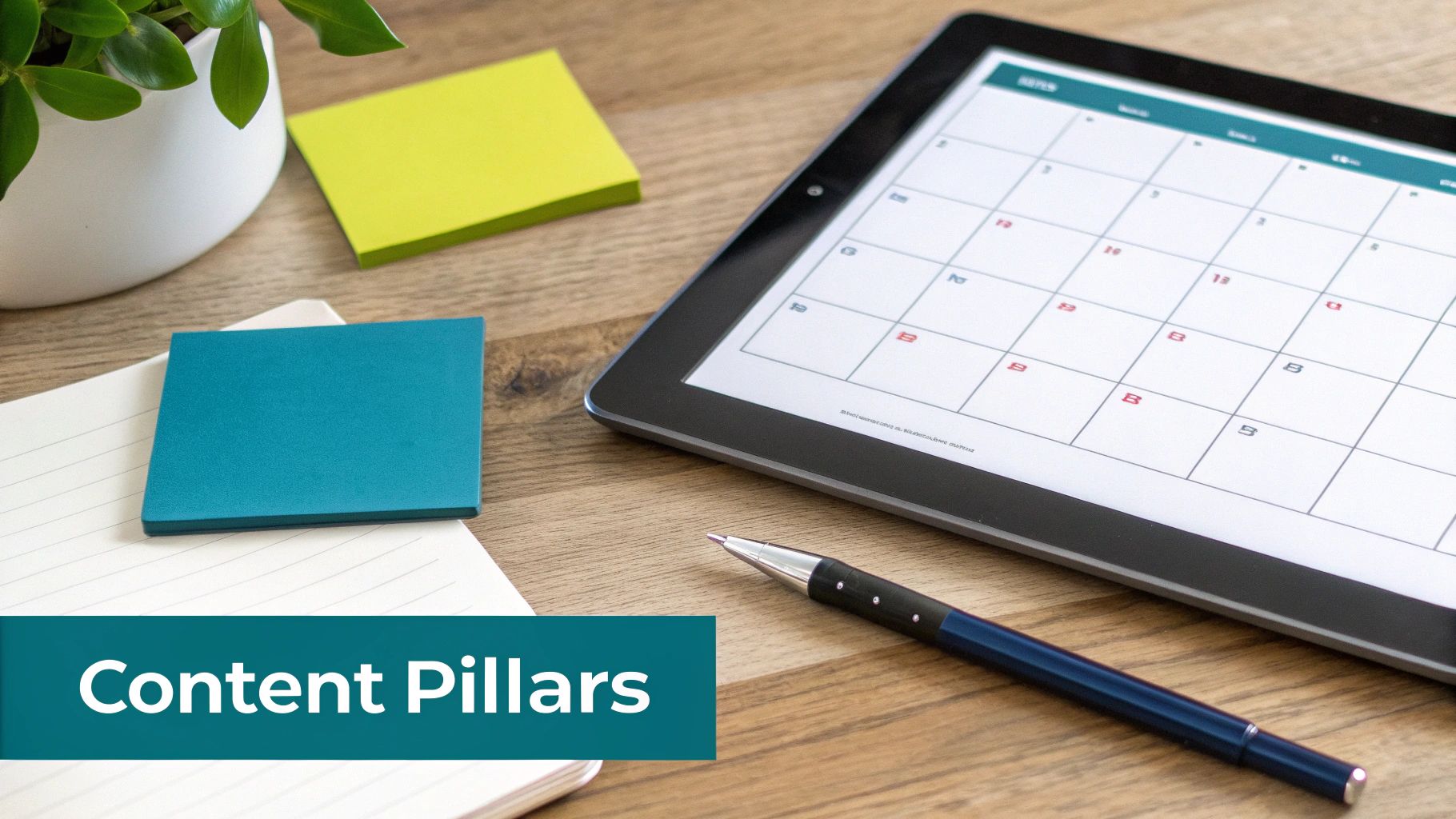 A perfectly polished profile is a great start, but it’s only half the battle. If you aren’t creating content, you’re essentially invisible. Content is what transforms your static profile into a dynamic, living presence. It’s how you prove your expertise in real-time and build the crucial “know, like, and trust” factor that underpins any strong personal brand on LinkedIn.
This isn’t about posting just for the sake of it. A winning strategy is built on purpose, consistency, and genuine value. The aim is to become the go-to person in your niche—the one people think of first when they have a problem you can solve.
Identify Your Core Content Pillars
Before you even think about writing a post, you need to define your territory. What are the 3-5 core topics you want to be known for? These are your content pillars, the foundational subjects that all your content will tie back to. They should live at the intersection of what you know, what your audience needs, and where you want to go professionally.
Let’s say you’re a project manager who specialises in agile methods for software teams. Your pillars might look something like this:
- Agile Frameworks: Breaking down complex concepts like Scrum and Kanban in a simple way.
- Team Leadership & Motivation: Sharing real-world tips for keeping remote teams fired up and engaged.
- Productivity Tools & Tech: Reviewing and comparing the project management software you actually use.
- Career Journey & Lessons: Telling personal stories about project challenges you’ve overcome.
Having these pillars acts as a simple but powerful filter. Before you post, just ask yourself: “Does this fit within one of my pillars?” This check keeps your message focused and consistent, making it crystal clear to your audience what you’re all about.
Choosing the Right Content Formats
LinkedIn gives you a whole toolbox of formats to play with. The most effective personal brands mix things up to keep their feed fresh and interesting. Each format has its own strengths, and knowing when to use which one is key to a solid content plan.
- Text-Only Posts: Fantastic for telling stories, sharing a strong opinion, or just starting a conversation. They’re quick to create and super easy for people to read on the go.
- Image Posts: A powerful image or a sharp infographic can literally stop the scroll. Use them to show data, share a memorable quote, or give a behind-the-scenes peek at your work.
- Carousels (PDFs): These are absolute gold for educational content. You can walk people through a step-by-step process or share a list of tips in a clean, swipeable format that keeps them glued to your post for longer.
- Short-Form Video: Perfect for sharing a quick tip, a personal story, or answering a common question. Video builds a much stronger connection because your audience can see and hear the real you.
A classic mistake is getting stuck on one format. The people who really crush it on LinkedIn vary their content. This approach doesn’t just stop your audience from getting bored; it also means you’ll connect with people who prefer different ways of learning and consuming information.
From Ideas to High-Performing Posts
The difference between a post that sinks without a trace and one that sparks a real discussion often comes down to its structure. It’s not just what you say, but how you say it. To really build authority, you have to get into the mindset of thought leadership marketing, which is all about positioning yourself as a true expert.
Start by framing every piece of content around a problem your audience has. What are they always asking? What roadblocks do they constantly hit? Your post should offer a solution, a fresh perspective, or a useful insight.
A simple framework for a post that gets noticed looks like this:
- A Compelling Hook: The first line or two is everything. Ask a provocative question, state a controversial opinion, or lead with a relatable struggle.
- The Valuable Middle: This is the meat of your post. Share your insights or story using short paragraphs and bullet points to keep it scannable.
- A Clear Call to Action (CTA): Don’t just end it. Tell people what to do next. Ask them to share their own experiences, pose a question, or tag someone who needs to see it.
This structure turns a simple thought into a conversation starter. You can get more great ideas for crafting posts that connect by exploring a complete thought leadership strategy. The goal is to create content that doesn’t just inform but also invites people in, building a community around what you know. When you consistently deliver value, your personal brand on LinkedIn will grow from a simple profile into a recognised voice in your industry.
Growing Your Influence Through Authentic Engagement
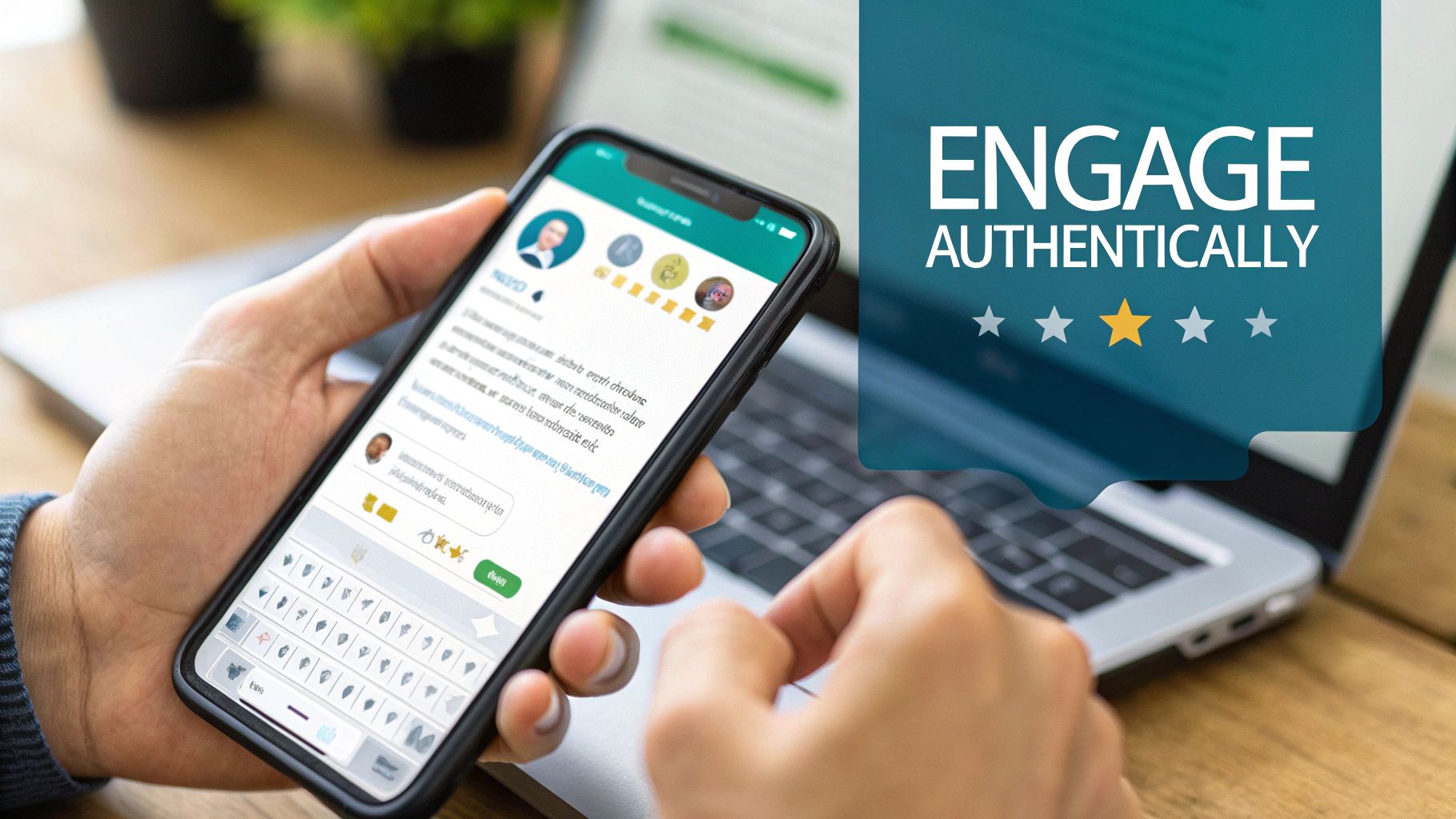
Pushing out great content is a solid start, but it’s only half the story. LinkedIn is a social network first and foremost, and its algorithm absolutely rewards people who participate. If you just broadcast your ideas without ever interacting, you’re essentially shouting into an empty room. You won’t build the real connections that give your personal brand on LinkedIn any momentum.
Think of authentic engagement as your secret weapon. It’s how you turn passive followers into a real community, get noticed by leaders in your field, and prove you’re an expert who listens just as much as you talk. This isn’t about spamming every post you see; it’s about strategically adding value where it counts.
The goal is to be a visible, thoughtful presence in the right conversations. When you do that consistently, you start building relationships and reinforcing your expertise long before anyone even clicks on your profile.
The Art of the Value-Adding Comment
Let’s be honest, a generic “Great post!” or “Thanks for sharing!” is a completely wasted opportunity. It adds zero value and does nothing to make you memorable. The comments that actually get you noticed are the ones that either continue or elevate the original conversation.
Treat your comments like a mini-post. A genuinely insightful comment showcases your expertise and perspective without trying to steal the author’s thunder. It’s surprisingly easy to stand out if you follow a simple framework.
Here’s how to craft a comment that actually works:
- Acknowledge a Specific Point: Start by referencing something specific from the post. It proves you’ve actually read it.
- Add Your Unique Insight: Follow up with a personal experience, a related statistic, or a different angle that builds on their point.
- Ask a Thoughtful Question: Wrap up by posing a question to the author or the wider audience. This invites a reply and keeps the ball rolling.
For instance, on a post about leadership challenges, ditch the “Good advice.” Instead, try something like this: “I really agree with your point about transparent communication. I once led a team through a difficult merger, and holding weekly ‘ask me anything’ sessions was a game-changer for morale. Have you found certain communication channels work better than others in high-stress situations?”
Your voice is your advantage. In a sea of AI-generated and formulaic content, sounding like a real human with strong opinions helps you stand out. This applies just as much to your comments as it does to your posts.
A Simple 15-Minute Daily Engagement Routine
Consistency beats intensity every single time. You don’t need to spend hours scrolling every day to make an impact. A focused, 15-minute routine can deliver huge results over time, keeping you visible and building connections without burning you out.
Here’s a dead-simple routine you can start tomorrow:
- (5 minutes) The Feed Scroll: Spend the first five minutes on your main feed. React to interesting posts and drop one or two value-adding comments on content from people you already follow.
- (5 minutes) Key Influencers: Go directly to the profiles of 3-5 key leaders or ideal clients in your industry. See what they’ve posted recently and engage thoughtfully. This puts you directly on their radar.
- (5 minutes) Meaningful Connections: Send out 1-2 personalised connection requests. Then, spend the rest of the time replying to messages or comments on your own posts from the previous day.
This structured approach makes sure your engagement is strategic, not just a time sink.
Sending Connection Requests That Actually Work
The default “I’d like to connect with you on LinkedIn” is the digital version of a limp handshake. It’s lazy and instantly forgettable. A personalised connection request is your chance to make a genuine first impression and start a real relationship, not just inflate your network count.
Your request should always answer the other person’s silent question: “Why should I connect with you?”
Keep your note short, specific, and focused on them. Mention a piece of their content you enjoyed, a mutual connection, or a common interest you spotted on their profile.
For example: “Hi [Name], I saw your recent post on sustainable supply chains and found your perspective on last-mile delivery fascinating. I’m also working in this space and would love to follow your insights.”
This small effort shows you’ve done your homework and are seeking a meaningful connection, not just another number. It dramatically increases your acceptance rate and lays the groundwork for a real professional relationship—which is the entire point of building a powerful personal brand on LinkedIn.
Measuring What Matters and Refining Your Approach
Just creating content and engaging with people isn’t enough. If you’re not looking at what’s actually working, you’re just guessing. You can’t improve what you don’t measure, right? A successful personal brand on LinkedIn is built on a data-driven mindset—you have to track your progress, listen to what the numbers are telling you about your audience, and then make smart adjustments.
This isn’t about chasing vanity metrics like your follower count. It’s about focusing on the analytics that genuinely show your brand is healthy and moving you closer to your professional goals. When you pay attention to the right numbers, your LinkedIn activity transforms from random shots in the dark into a sharp, effective strategy.
Identifying the Analytics That Truly Matter
LinkedIn gives you a whole dashboard of analytics, and it can feel a bit much at first. The trick is to zero in on the data points that give you actionable insights into how your content and audience are doing. These are the metrics that tell you a story about what’s hitting the mark and what’s falling flat.
Here are the core numbers I always keep an eye on:
- Post Impressions: This is simply how many times your content has been seen. If a post suddenly spikes, you might have hit on a trending topic. If your numbers are consistently low, your opening hook probably isn’t grabbing enough attention.
- Engagement Rate: This is gold. It’s the percentage of people who saw your post and actually did something—reacted, commented, or shared it. It’s a direct signal of how compelling your content is and whether it’s starting a real conversation.
- Profile Views: Who’s checking you out? An uptick in views, especially from people in your target industry or at companies you admire, is a clear sign your content is drawing the right kind of attention.
- Search Appearances: This shows you how many times you popped up in search results last week. It’s a direct measure of how well your profile is optimised with the right keywords for your niche.
Keeping a close watch on these figures gives you a clear picture of your brand’s visibility and impact. If you want to go deeper, our guide on how to measure content performance breaks it all down.
Turning Insights Into Actionable Adjustments
Data is only useful if you do something with it. Once you start tracking your analytics, you can begin tweaking and refining your approach. Look for patterns. What do your best-performing posts have in common?
Maybe you’ll find that your audience loves your personal stories but tunes out when you get too technical. Or maybe your carousel posts consistently blow your text-only updates out of the water. These insights are your audience telling you exactly what they want more of.
Don’t be afraid to experiment and even have a few duds. A post with low engagement isn’t a failure; it’s a data point. It teaches you what your audience doesn’t connect with, which is just as valuable as knowing what they do.
Use this feedback to double down on what works. If videos get you more comments, start making more videos. If asking a question at the end of your posts gets the conversation going, make it a regular feature. This constant loop of measuring, learning, and refining is what separates a brand that grows from one that just sits there.
Setting Realistic Timelines for Growth
Building a personal brand doesn’t happen overnight. It’s a marathon, not a sprint, and you need to set realistic expectations to stay motivated. The first few months are all about laying the groundwork and finding a consistent rhythm.
From what I’ve seen, most professionals start seeing real progress within a predictable timeframe. For instance, with a strategic approach, you’ll likely see an increase in profile views after 3-4 months of consistent effort. By the 6-12 month mark, you’ll be seeing more significant gains. It’s not uncommon for people to get more conference invites and business opportunities after six months, with long-term players achieving a reach they never thought possible. You can find more insights on branding ROI timelines in Europe if you’re curious.
This data-first mindset ensures your hard work is always moving you forward, turning your personal brand on LinkedIn into a powerful asset for your career.
Got Questions About LinkedIn Branding? Let’s Clear a Few Things Up.
Building a powerful personal brand on LinkedIn always brings up a few questions. It’s totally normal to wonder about the nitty-gritty details of posting, whether you need to shell out for paid tools, or what common traps to sidestep.
Here are some straight, no-nonsense answers to the questions I hear most often. Getting these fundamentals right means you can stop guessing and start focusing your energy on what actually works: consistency and real connection.
How Often Should I Be Posting on LinkedIn?
Look, it’s all about consistency, not just blasting your network with content. A great place to start is aiming for 2-3 high-quality posts a week. That’s a rhythm that keeps you visible without leading straight to creative burnout.
Always remember this: one thoughtful, genuinely helpful post is worth a dozen generic updates that just get scrolled past. Once you get into a groove and see what your audience actually responds to, you can think about posting more. But never, ever sacrifice quality just to hit a number.
The real power of a personal brand isn’t just about the size of your audience. It’s about the quality of opportunities that land in your lap because the right people see you consistently solving problems they care about.
Do I Really Need LinkedIn Premium for Personal Branding?
Short answer: no, it’s not essential. You can build an incredibly strong and effective personal brand using only the free features LinkedIn gives you. The things that truly move the needle are your content and your willingness to show up in conversations.
Think of Premium as a potential accelerator, not a ticket to the game. Features like seeing who’s viewed your profile or using advanced search filters are great, but they become much more powerful after you’ve built a solid foundation. Nail the basics first. Then, if your specific goals involve heavy-duty lead generation or recruiting, you can decide if the investment makes sense.
What Are the Biggest Branding Mistakes I Need to Avoid?
I see the same three mistakes trip people up time and time again. If you can steer clear of these, you’ll already be way ahead of the curve.
- Being too salesy. Nobody logs onto LinkedIn to be pitched to. Constantly pushing your services is the fastest way to get ignored. Stick to a 90/10 rule: make 90% of your content about giving value—sharing insights, helping, teaching—and only 10% about anything promotional.
- Vanishing for weeks at a time. Posting like a maniac for one week and then going completely silent for a month will kill your momentum. The LinkedIn algorithm loves consistency, and so will your audience. A steady, predictable presence is key.
- Broadcasting, not conversing. LinkedIn is a two-way street, not your personal megaphone. You’ve got to give engagement to get engagement. That means spending real time leaving thoughtful comments on other people’s posts. It’s how you build relationships and get seen by new audiences.
Ready to create standout LinkedIn content that actually sounds like you, but in a fraction of the time? Postline.ai mixes powerful AI with real-time research and deep personalisation to help you grow your audience and find leads, minus the guesswork. Turn your raw ideas into polished, high-performing posts in minutes. Check out the features at https://postline.ai and start building your brand with confidence.

Run every client pipeline in one place
Give each LinkedIn profile its own voice, calendar, approval flow, and analytics. Start in minutes.
Start free trial