Mastering Your Online Management Reputation a Digital Trust Guide
Build and protect your online management reputation with this definitive guide. Learn proactive strategies, crisis response, and expert tips for digital trust.

Think of your online management reputation as your digital first impression. It’s the story the internet tells about you long before you ever get the chance to introduce yourself. It’s the sum total of everything out there—search results, social media profiles, customer reviews, forum comments, and news articles—that shapes how people see you or your business.
What Is Online Management Reputation and Why It Matters
Let’s be honest, your online reputation isn’t just a collection of links and profiles; it’s a dynamic, living asset that can either open doors for you or slam them shut.
Picture this: a potential employer, a new client, or even a future business partner. What’s the very first thing they do before reaching out? They search for you online. What they find—or what they don’t find—paints a picture in their mind, forming an immediate judgement that’s hard to shake.
This digital footprint is built from three core pillars that work together to tell your story:
- Search Results: The first page of Google is your new business card. Strong, professional results build instant credibility.
- Social Media Presence: Platforms like LinkedIn are your stage to showcase expertise, professional connections, and character.
- Online Reviews: Sites like Google Business Profile and other industry forums offer social proof from the people who matter most—your customers and peers.
Wrangling all of this is what online reputation management is all about. It’s the ongoing process of listening, influencing, and safeguarding how you’re perceived across the entire digital world.
The Real-World Impact of Your Digital Self
It’s tempting to think of your online persona as something separate from “real life,” but its consequences are very real and measurable. A powerful online reputation directly impacts your opportunities and even your bottom line. It’s no secret that trust is the ultimate currency online, and research consistently shows a direct line between positive digital sentiment and revenue growth.
A proactive strategy isn’t just about defence; it’s about offence. It shifts you from frantically cleaning up messes to consistently building a positive image that actively creates new opportunities. You get to control the narrative.
This isn’t just about damage control. It’s about smart, strategic positioning. For a deeper look at the nuts and bolts of building a solid presence, this comprehensive Online Reputation Management Guide is a great resource. The end game is to build a digital presence so strong and positive that it acts as a buffer, making your reputation resilient to the inevitable bumps in the road.
More Than Just PR or Branding
It’s really important to get the distinction between online reputation management and its cousins, public relations (PR) and branding. They’re related, but they play very different roles.
- Branding is you deciding who you are and what you promise.
- Public Relations is you shouting that promise from the rooftops.
- Online Reputation Management is listening to what the world shouts back—and managing that conversation.
Branding and PR are mostly one-way streets where you control the message. Reputation management is a two-way conversation. It deals with the organic, unfiltered, and sometimes messy dialogue happening about you every single day. If you’re not paying attention to that conversation, you’re giving up control over your most valuable asset: your reputation.
Proactive Strategies: Building a Positive Digital Footprint
When it comes to your online reputation, the best defence is a good offence. Instead of just waiting around to put out fires, a proactive approach lets you build a digital presence so strong that it acts as a natural buffer against negativity. It’s all about creating a solid foundation of positive, authoritative content that defines you and your brand on your own terms.
Taking this approach puts you squarely in the driver’s seat. The goal is simple: when someone Googles your name or your company, you want them to find a rich, compelling story that showcases your expertise, your values, and your wins. This doesn’t happen by magic. It’s the result of a deliberate, sustained effort to build a positive digital footprint from the ground up.
Think of it like developing prime real estate. By building up the properties you own (like your website and LinkedIn profile) and contributing valuable content to respected third-party platforms, you construct an identity that is both favourable and resilient.
Creating High-Value Content
The absolute bedrock of any proactive reputation strategy is creating great content, consistently. This is your chance to really show what you know, provide genuine value to your audience, and cement yourself as a credible, go-to voice in your field. This content becomes the very building blocks of your positive digital presence.
The aim isn’t just to share information but to produce assets optimised to show up in search results. That way, when people look for you, your thoughtful, professional work is the first thing they see.
A good content mix often includes:
- Blog Posts and Articles: Whether on your own site or as a guest on industry blogs, in-depth articles are perfect for establishing thought leadership.
- Case Studies and Success Stories: Nothing speaks louder than results. Concrete examples of your work are incredibly powerful social proof.
- Professional Social Media Updates: Regular, insightful posts on platforms like LinkedIn reinforce your expertise day in and day out. You can dive deeper into this in our guide on how to build a personal brand on LinkedIn.
This map illustrates how the different pieces—search results, social media, and online reviews—all come together to form the public’s perception of you online.
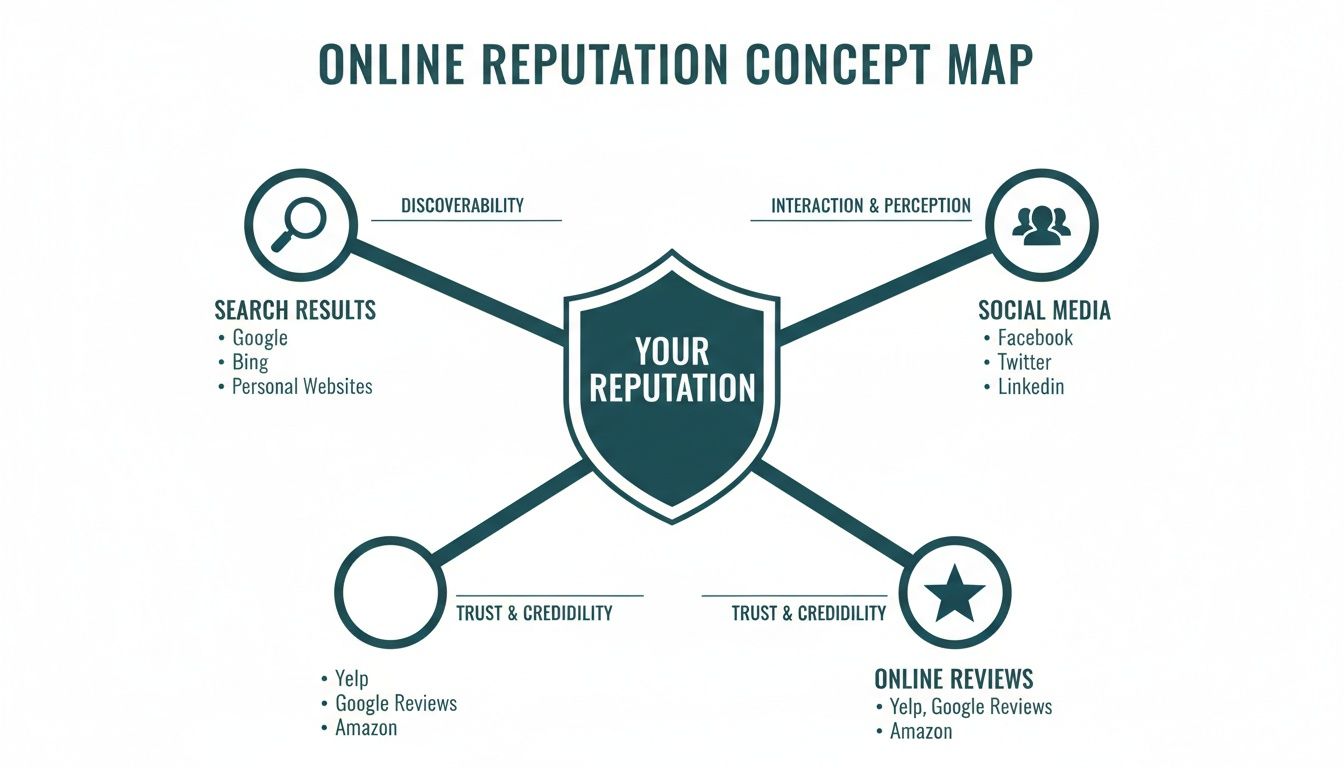
It’s a great reminder that your reputation isn’t just one thing; it’s a mosaic of different digital touchpoints, and each one needs attention to create a cohesive and positive picture.
Securing Your Digital Real Estate
Here’s a non-negotiable first step: claim your name on every relevant digital platform. Your name is your brand’s online trademark. If you don’t grab it, someone else could, leading to massive confusion or, even worse, real damage to your brand.
This is more than just quickly signing up for a couple of social media accounts. It’s about systematically claiming your digital identity everywhere your audience might be looking for you.
Proactively securing your brand name across key platforms is like trademarking your identity in the digital world. It prevents confusion, blocks impostors, and ensures you control the primary hubs for your online presence.
Start by locking down your profiles on the platforms that matter most in your industry. At a bare minimum, this list must include:
- Your Personal or Business Website: This is the most crucial digital asset you can own. It gives you 100% control over your message.
- LinkedIn: The undisputed centre of the universe for professional identity and networking.
- Google Business Profile: Absolutely critical for local businesses and for managing how you appear in Google search and Maps.
- Industry-Specific Review Sites: Find the platforms that matter in your field, like G2 for software or TripAdvisor for hospitality.
Cultivating Positive Reviews
Let’s be honest, positive reviews are one of the most powerful forms of social proof out there. A steady stream of authentic, glowing feedback is a direct signal of trust and quality. But just sitting back and hoping for reviews to trickle in is a huge missed opportunity.
A smart reputation strategy includes a simple system for encouraging happy clients to share their positive experiences. This isn’t about being pushy or buying fake reviews; it’s about making it incredibly easy for satisfied people to voice their support. For instance, sending a polite, automated email a few days after a successful project with a direct link to a review site can work wonders.
By actively working on these three pillars—creating valuable content, securing your digital assets, and encouraging positive reviews—you build a strong, resilient online reputation that doesn’t just shield you from negativity but actively helps you find new opportunities.
Optimising Your LinkedIn Profile for Professional Credibility
Think of your LinkedIn profile as less of a static online CV and more like the central hub for your entire professional reputation. It’s often the very first place colleagues, recruiters, and potential clients will look you up, forming an instant digital impression. The goal is to transform your profile from a passive career history into a dynamic engine that actively builds your credibility and controls your professional story.
Every single part of your profile, from your headline right down to your activity feed, adds a brushstroke to this picture. A neglected profile can hint at a lack of attention to detail, whereas a polished, active presence signals expertise and professionalism. It’s all about strategically showing people who you are, what you do, and the genuine value you bring to the table.

Crafting a Compelling First Impression
The first things anyone sees are your profile picture, banner, and headline. These three elements have just a few seconds to set the right tone, so they need to work together to create a professional yet approachable image.
- Professional Headshot: Nothing builds trust faster than a clear, high-quality photo where you’re looking directly at the camera. Steer clear of casual selfies or cluttered backgrounds.
- Custom Banner: This space is a fantastic opportunity to visually communicate your brand. It could feature your company logo, a professional tagline, or an image that represents your field.
- Keyword-Rich Headline: Your headline is prime real estate. Don’t just list your job title. Weave in keywords that describe your expertise and the value you deliver. For a deeper dive, check out our guide on writing powerful LinkedIn headlines.
When done right, this trio should immediately answer a visitor’s two key questions: “Who is this person?” and “What do they do?”
Building Authority with Your About Section and Experience
Your “About” section is essentially your professional elevator pitch. This is your chance to tell your story in your own voice. Instead of just a dry list of skills, use this space to talk about your mission, your core strengths, and what you’re truly passionate about.
From there, your “Experience” section should be more than a simple list of past duties. For each role, make sure you focus on quantifiable achievements:
- Start with a strong action verb to kick things off.
- Detail the specific project or task you handled.
- Finish with the measurable result you delivered (e.g., “Grew organic lead generation by 15% in six months”).
This simple formula turns your experience from a list of tasks into a portfolio of proven accomplishments, giving people concrete proof of what you can do.
Leveraging Social Proof and Skills
Recommendations and skill endorsements are the digital world’s version of a word-of-mouth referral. They provide third-party validation that’s far more convincing than anything you can say about yourself.
Social proof, in the form of recommendations from respected colleagues and clients, is one of the most powerful credibility signals on your profile. It’s objective evidence of your expertise and collaborative spirit.
Don’t just wait for this proof to appear. Be proactive. Ask former managers, clients, or colleagues you’ve had great working relationships with for a recommendation. When you endorse others, do it thoughtfully for people whose work you genuinely respect—this often encourages them to return the favour.
The platform’s role as the go-to digital infrastructure for professional identity is only growing. In Germany, for instance, LinkedIn has become the dominant professional network, on track to hit 22 million users by early 2025. This surge shows just how vital a strong profile has become for career growth and business development, making proactive reputation management on the platform non-negotiable. Of course, a great LinkedIn presence is most powerful when paired with smart job-seeking strategies, and you can learn more about how to apply for jobs and get hired faster.
Establishing Thought Leadership Through Content
Finally, the most powerful way to build your reputation over time is by consistently sharing valuable content. This doesn’t have to be complicated. It can be anything from original articles you publish on LinkedIn, to insightful posts, or even just thoughtful comments on other people’s content.
Sharing your expertise shows that you’re engaged, knowledgeable, and passionate about your field. It transforms your profile from a historical record into a living, breathing document that showcases your current thinking and solidifies your status as an authority in your industry.
Your Crisis Playbook for Handling Negative Content
It’s going to happen sooner or later. A negative review pops up, a critical comment lands on your social media, or an unflattering article gets published. When it does, panic is not a strategy. What really defines your professional reputation isn’t just the good stuff you put out there, but how you handle the inevitable negative feedback.
This is where a clear, level-headed crisis management playbook becomes indispensable for effective online reputation management. A calm, structured response can turn down the heat on a bad situation and sometimes even convert a critic into an advocate. On the flip side, rushing in with an emotional or defensive reply almost always makes things worse.
I like to break the process down into a simple, three-step workflow: Assess, Respond, and Fortify. Stick to this framework, and you’ll be able to navigate a reputation crisis with confidence and control.
Assess the Situation Calmly
Before you type a single word, just stop. Take a breath and evaluate what’s actually happening. The gut reaction is to fire back immediately, but a strategic assessment is far more powerful. You have to understand the potential damage before you can figure out the right way to fix it.
Start by asking yourself a few key questions to get a real sense of the severity:
- Who is the author? Is this an anonymous troll, a disgruntled former employee, or a genuinely unhappy client? The source says a lot about the credibility and potential reach of the comment.
- What is the platform? A one-star review on a major industry site packs a much bigger punch than an angry comment on a small, obscure forum.
- Is the criticism valid? Be brutally honest with yourself. Is there a kernel of truth in the complaint? Acknowledging a legitimate mistake is often the fastest way to resolution.
This quick assessment stops you from overreacting to minor blips and helps you dedicate the right amount of energy to genuine threats. Not every piece of negative feedback is a five-alarm fire.
Craft a Professional Response
Okay, you’ve assessed the situation. Now it’s time to craft your response. Your goal here is twofold: you need to address the individual’s concern while also showing the public audience (and they are watching) that you’re a professional.
A solid response nearly always includes these elements:
- Acknowledge and Empathise: Kick things off by thanking them for the feedback and showing you hear their frustration. A simple, “I’m sorry to hear your experience didn’t meet your expectations,” works wonders.
- State Your Commitment: Briefly mention your commitment to quality or client satisfaction without sounding defensive. This just reinforces that you have high standards.
- Take it Offline: This is the most critical part. Give them a direct line to continue the conversation in private. Something like, “We want to make this right. Please contact me directly at [email] or [phone number] so we can resolve this for you.”
This approach de-escalates public conflict and shows onlookers you are proactive and responsible. It resolves the specific issue privately while publicly demonstrating excellent customer care.
Whatever you do, don’t get dragged into a long, drawn-out argument online. The public forum is for showing you’re willing to solve the problem, not for winning a debate. And speaking of maintaining a clean digital presence, it’s also smart to understand why you should never buy LinkedIn followers if you’re serious about authentic growth.
Fortify and Suppress with Positive Content
After you’ve handled the immediate fire, the final step is to shore up your reputation for the long haul. This is where you switch from playing defence to going on the offence. The single most effective way to make a negative search result disappear is to bury it.
How? By creating and promoting a wave of high-quality, positive content that eventually outranks the negative piece. This “suppression” strategy is all about building valuable assets, such as:
- In-depth blog posts on your own website.
- Guest articles on respected industry publications.
- Positive press releases or company news.
- Fully optimised social media profiles and a steady stream of good content.
By consistently building this positive digital footprint, you create a “wall” of good content that pushes negative items further down in search rankings. Eventually, they become effectively invisible to the vast majority of people, ensuring one bad review doesn’t define your entire online reputation.
The Right Tools for the Job: Managing Your Reputation Efficiently
Trying to manage your online reputation without the right tools is like trying to weed a massive garden with your bare hands. You might make some progress, but it’s slow, exhausting work, and you’re guaranteed to miss things. To get real traction, you need a smart toolkit that automates the listening and simplifies the content creation.
This isn’t about adding more work to your plate; it’s about working smarter. A few key tools can help you catch brand mentions the moment they happen and consistently publish high-quality content that reinforces who you are. The aim is to build a simple, efficient workflow that protects your brand without eating up all your time.
Setting Up Your Listening Posts
You can’t manage what you don’t measure. The very first step is setting up a system to listen in on conversations about you and your brand across the web. Think of it as your digital early-warning system.
A fantastic, no-cost starting point is Google Alerts. You can set it to email you whenever your name, your company’s name, or other key phrases pop up in new web pages, news articles, or blogs. It’s simple, but effective.
While Google Alerts is a solid foundation, a truly comprehensive setup should also include:
- Social Listening Tools: Platforms like Brandwatch or Mention dig much deeper, tracking conversations on social media where things move at lightning speed.
- Review Site Monitoring: If you’re a business, keeping a vigilant eye on your Google Business Profile, Yelp, or industry-specific review sites is absolutely essential for gauging customer sentiment.
An automated monitoring system ensures you’re one of the first to know what’s being said. This gives you the chance to address negative feedback before it snowballs and amplify positive mentions for maximum impact.
Using AI to Supercharge Your Content
Monitoring tells you where you stand, but creating content is how you shape the narrative. Consistently publishing genuinely valuable content, especially on a professional hub like LinkedIn, is the single best way to control your story. The only problem? It takes a lot of time.
This is where AI-powered writing assistants completely change the game. Tools built specifically for professional content can slash your writing time while actually improving the quality of your output. They help you turn a fleeting thought into a polished, articulate post.
The Postline.ai dashboard, for example, acts as a central command for drafting, refining, and scheduling all the content that builds your reputation.
This kind of setup lets you manage the entire journey of a piece of content—from the initial spark of an idea to its publication—all from one place.
The Power of an Integrated Workflow
Real efficiency kicks in when your tools talk to each other. Imagine your social listening tool flags a trending topic in your industry. In a matter of minutes, you can use an AI assistant like Postline.ai to draft an insightful LinkedIn post that joins the conversation.
Here’s how a workflow like this transforms your process:
- Sparking Ideas: The AI can help you brainstorm relevant topics based on your expertise and what your audience is already talking about.
- Drafting with Finesse: It can take a simple prompt and turn it into a well-structured, engaging post with a compelling hook and a clear call-to-action.
- Keeping it Authentic: The best tools can learn your unique voice and writing style, ensuring the content always sounds like you, not a machine.
- Scheduling for Consistency: Finally, you can schedule an entire week or month of high-quality posts in one session, guaranteeing you maintain a consistent, professional presence. To dive deeper, check out our guide to the best social media scheduling tools.
By pairing real-time monitoring with AI-assisted content creation, you build a powerful engine for your online management reputation. This system doesn’t just save you countless hours; it ensures your digital footprint is strong, positive, and always growing.
Your Online Reputation Questions, Answered
Let’s be honest, the world of online reputation management can feel a bit murky. To clear things up, I’ve put together answers to some of the most common questions that pop up when professionals and businesses start thinking seriously about their digital footprint.
How Long Does It Really Take to Fix a Damaged Online Reputation?
This is the million-dollar question, and the honest answer is: it’s a marathon, not a sprint. The timeline depends entirely on how bad the damage is and where the negative content is living. There’s no magic “delete” button for the internet, so fixing things comes down to patience and a consistent, deliberate effort.
Think of it this way: a single negative review on a small-time blog might be pushed down in search results within 3 to 6 months of you actively creating positive content. This means consistently publishing high-quality articles, social media posts, and other assets that Google starts to see as more relevant. On the other hand, a damaging article from a major news outlet or a nasty forum thread that has been around for ages? That could easily take a year or more of hard work to suppress.
The real game in reputation repair isn’t about removal—it’s about suppression. The goal is to build such a strong portfolio of positive, SEO-optimised content that it simply outranks and buries the bad stuff. Your best weapons here are consistency and patience.
Can I Just Get Negative Content Wiped from the Internet?
Getting something removed completely is incredibly rare. It’s usually only possible if the content breaks a platform’s rules or a specific law—think clear-cut cases of defamation, copyright theft, or doxxing.
For almost everyone else, the strategy isn’t removal. It’s suppression, which is a far more realistic and effective game to play.
- The Goal: Churn out a steady stream of high-quality, positive content about you or your brand that search engines love.
- The Outcome: The negative links get shoved down to the second, third, or fourth page of Google. Since research shows that less than 1% of people ever click past the first page of search results, that content becomes effectively invisible.
You’re not erasing the negative post; you’re building a wall of positive, relevant, and authoritative content in front of it. To the average person searching for you, it might as well not exist.
What’s the Single Most Important Platform for My Professional Reputation?
For almost any professional, entrepreneur, or executive, the answer is unequivocally LinkedIn. It has become your de facto professional ID card online, and it’s almost always the first thing people see when they search your name. It’s the absolute cornerstone of a professional digital presence.
Unlike the wild west of other social platforms, LinkedIn gives you total control over your narrative. You can meticulously showcase your expertise, list your achievements, collect powerful social proof through recommendations, and publish articles to cement yourself as a thought leader.
Given its dominance in the professional sphere—especially in key European markets like Germany where it’s the undisputed leader—a polished, active LinkedIn profile is non-negotiable. It’s the one piece of digital real estate you truly own and can shape to present the very best version of your professional self.
How Often Should I Be Checking on My Online Reputation?
You can’t just set it and forget it. A single negative comment can snowball if you’re not paying attention. The best approach for most people is a tiered monitoring system.
Here’s a practical schedule that works for most professionals and small businesses:
- Daily Automated Scan: Use free tools like Google Alerts to get instant notifications for your name, your company’s name, and key team members. This is your basic early-warning system.
- Weekly Manual Check: Once a week, open an incognito browser window and manually search for your name on Google, key social media sites, and important industry review platforms. This often catches things the automated tools miss.
- Monthly Deep Dive: At the end of each month, take a more comprehensive look. This helps you track your progress and spot any slow-burning trends in public sentiment before they become a problem.
Of course, if you’re a public figure, in a high-stakes industry, or in the middle of a crisis, you’ll want to ramp that up to daily, in-depth monitoring with specialised tools. The goal is always the same: catch the spark before it becomes a wildfire.
Ready to take full control of your LinkedIn presence and build a powerful professional reputation? Postline.ai is your AI-powered assistant for crafting standout content faster and better than ever. Stop spending hours staring at a blank page and start publishing posts that build authority and open doors. Explore how Postline.ai can transform your LinkedIn strategy today!

Run every client pipeline in one place
Give each LinkedIn profile its own voice, calendar, approval flow, and analytics. Start in minutes.
Start free trial