A Modern Playbook for LinkedIn Lead Generation
Tired of spammy tactics? Learn a modern approach to LinkedIn lead generation that builds real connections and drives consistent B2B growth.
Generating leads on LinkedIn isn’t just about sending connection requests. It’s a methodical process of finding, engaging, and ultimately converting potential clients using the world’s largest professional network. Think of it as building a predictable pipeline of high-quality B2B leads through a smart mix of profile optimisation, valuable content, and personalised outreach.
Why LinkedIn Is Your B2B Growth Engine
Forget what you think you know. LinkedIn is far more than a digital CV or a place to catch up with old workmates. It’s the undisputed heavyweight champion for B2B growth, and for one simple reason: it’s a professional ecosystem, not just another social media site.
While other platforms are built around entertainment, LinkedIn is designed purely for business. This creates a unique environment where decision-makers are actively searching for solutions, valuable insights, and new partnerships.
This professional focus is where the real opportunity lies. The platform isn’t a static directory; it’s a dynamic space where your ideal clients gather to discuss their biggest industry challenges and, crucially, signal their intent to buy. This is the heart of modern social selling, a powerful approach that turns conversations into conversions.
The Data Doesn’t Lie
The numbers paint a very clear picture of LinkedIn’s dominance. Recent data shows the platform is responsible for an incredible 62% of all social media-driven leads for B2B companies.
It’s not even a close race. LinkedIn outperforms platforms like Facebook and X by a staggering 277% when it comes to lead generation effectiveness. That makes it an absolutely essential channel for any serious B2B marketing strategy.
What makes it so effective? It’s the sheer concentration of influential professionals. Your target audience isn’t just on LinkedIn; they are there with a business hat on, actively looking for content that helps them solve problems and hit their targets.
This flow chart breaks down how to turn that potential into a repeatable system.
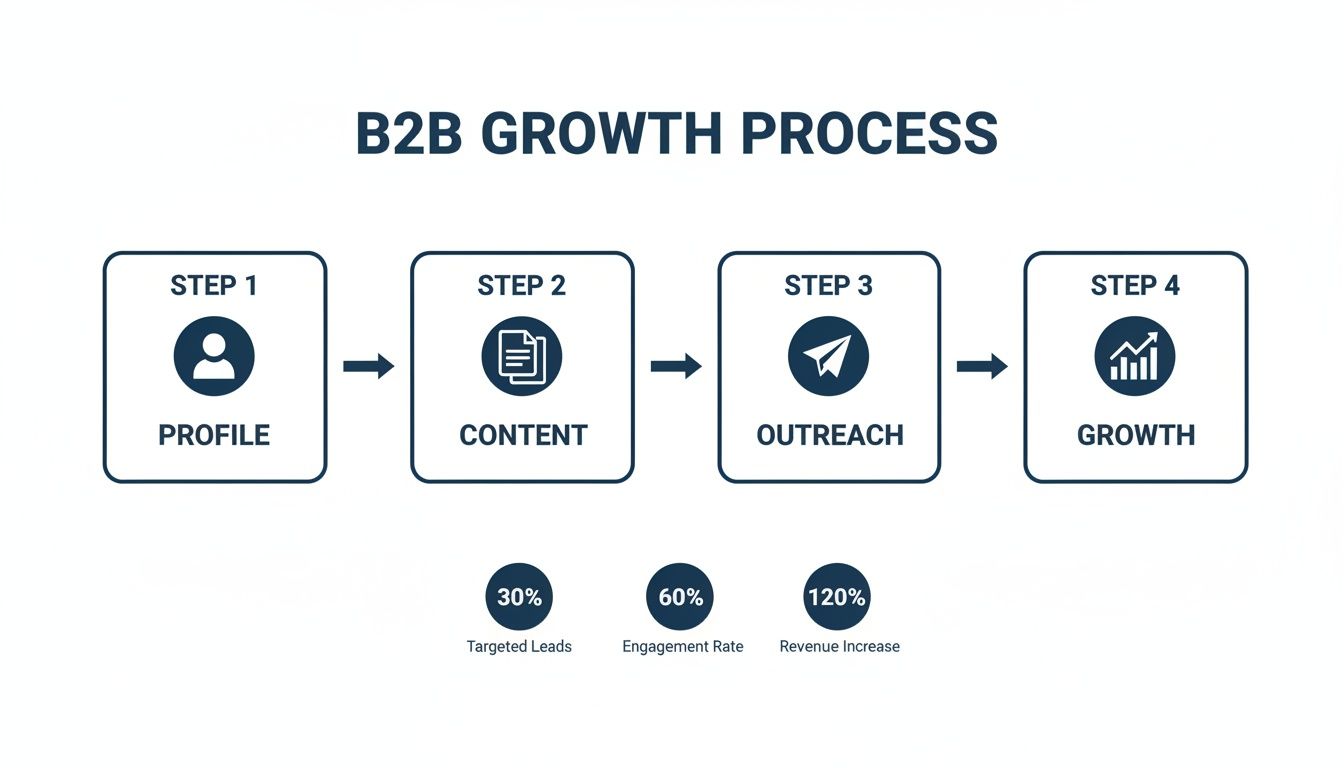
As you can see, it all starts with a solid foundation (your profile), moves into consistent value (content), and is amplified by proactive engagement (outreach), all of which drive measurable growth.
Building a Predictable System
Winning on LinkedIn isn’t about luck or random posts. It’s about building a repeatable system that delivers predictable results, month after month.
Each piece of the puzzle—your profile, your content, your outreach—works in concert to create a powerful lead generation machine. This is where tools like Postline.ai become so valuable, helping you create content that resonates and maintain the consistency needed to stay top-of-mind. To get the most out of LinkedIn as your B2B growth engine, see how B2B Lead Generation AI Content Optimization can amplify your efforts.
Turn Your Profile Into a Lead Magnet
Let’s get one thing straight: your LinkedIn profile is not a digital CV. For anyone serious about B2B sales, it’s your number one landing page. Its sole purpose is to attract, educate, and convert your ideal clients.
Sure, we all know that profiles with a professional photo get 14 times more views, but that’s just table stakes. We need to go deeper.
The real shift happens when you stop thinking about your profile as a record of your past and start treating it as a preview of your client’s future. It has to answer one fundamental question for every single person who lands on it: “What’s in it for me?” Get this right, and your profile starts working for you 24/7, warming up prospects and starting conversations before you’ve even typed a single message. This isn’t just a nice-to-have; it’s the foundation of everything that follows.
Your Headline is Your Billboard
Your headline is the most valuable piece of real estate on your entire LinkedIn profile. It follows you everywhere—into the comments section, onto every connection request, and in every search result. A bland job title like “Sales Manager at Company X” is a massive wasted opportunity.
Instead, you need a headline that speaks directly to the results you create for your target market. It’s your elevator pitch, packed with the exact keywords your ideal clients are typing into the search bar.
A truly effective headline does three things well:
- It names your target audience (e.g., SaaS founders, e-commerce brands).
- It calls out the specific problem you solve (e.g., inconsistent lead flow, low AOV).
- It hints at a quantifiable result (e.g., “double your MQLs,” “cut acquisition costs by 30%”).
Suddenly, a boring job title becomes a compelling value proposition that grabs the right people’s attention. If you’re looking for more ideas, check out our guide on crafting powerful LinkedIn headline tips for more formulas and real-world examples.
The About and Featured Sections: Where You Build Trust
If the headline is the hook, the “About” section is where you reel them in. This is your chance to expand on the promise you made and build some genuine trust. Please, stop writing about yourself in the third person or stuffing it with corporate jargon.
Write to your ideal client, not at them. Start by describing their world—their challenges, their frustrations, the things that keep them up at night. Show them you get it. Once you’ve established that empathy, you can introduce your solution as the bridge from their current problems to their desired outcomes.
Pro Tip: A great “About” section isn’t a list of your skills. It’s a story where your client is the hero, and you are their expert guide. Always wrap it up with a clear and simple call-to-action, like an invitation to connect or book a quick, no-pressure discovery call.
The Featured section is where you back it all up with proof. This is your highlight reel, providing tangible evidence that you can deliver on your promises. Don’t just drop a link to your company’s homepage. That’s a dead end.
Instead, feature assets that do the selling for you:
- Case studies that break down a client’s problem, your process, and the measurable results.
- Short video testimonials from happy clients. Nothing builds trust faster than hearing it from someone else.
- Links to webinars or articles you’ve published that showcase your expertise.
- A direct link to your calendar, making it frictionless for a warm lead to book a meeting.
Profile Optimization Checklist Before and After
To really see the difference, here’s a quick comparison showing the shift from a passive, CV-style profile to an active lead magnet.
| Profile Element | Generic Approach (Before) | Lead-Focused Approach (After) |
|---|---|---|
| Headline | Sales Director at Tech Solutions Inc. | Helping B2B SaaS Companies Scale ARR with Strategic Outbound Systems |
| About Section Start | “An accomplished sales director with 15+ years of experience in…” | “Are you struggling to build a predictable sales pipeline? Many SaaS founders…” |
| Featured Item | Link to the company’s main website. | A detailed PDF case study titled “How We Grew Client X’s MQLs by 200% in Q3”. |
Making these adjustments transforms your profile from a static document into a dynamic, automated asset. It becomes the engine of your entire LinkedIn lead generation strategy.
Crafting Content That Starts Conversations
An optimised profile gets prospects to your door, but it’s your content that invites them in for a chat. I’ve seen too many people get stuck on the vague advice to just “post valuable content.” That’s not a strategy. What you really need is a solid framework for creating posts that consistently attract and engage the right people.
Think of your content as the engine of your inbound strategy. It’s what shifts your role from salesperson to trusted authority in your field. And the data backs this up—a massive 96% of B2B marketers use LinkedIn for their organic content. The space is crowded, but the secret isn’t just to post more often. It’s about being smarter with what you post.
The goal is to stop broadcasting your services and start solving real problems. Share a unique perspective, ask a thought-provoking question, and spark a real dialogue. When you get this right, you build an audience that doesn’t just scroll past your content but actively looks for you when they need help.
Uncovering What Your Audience Craves
The single biggest mistake you can make is guessing what your audience wants to see. When you assume, you create content that nobody cares about, and all your effort goes down the drain. The first step, always, is to listen to the conversations already happening in your niche.
This is where a tool like Postline.ai’s ‘Audience Explorer’ is a game-changer. Instead of mindlessly scrolling for hours, you can quickly pinpoint the hot topics, burning questions, and specific frustrations your target clients are talking about right now. This data-driven approach takes all the guesswork out of the equation.
When you understand the exact language and challenges of your audience, your content feels like you’re reading their minds. That kind of relevance is what stops the scroll and earns you their attention.
Let’s say you’re a financial consultant for tech startups. ‘Audience Explorer’ might show you that founders are constantly asking about managing their burn rate or how to prepare for a Series A funding round. That insight is pure gold. It tells you exactly what topics will grab their interest and prove you know your stuff.
The Anatomy of a High-Performing Post
Every great LinkedIn post you see follows a similar structure, one that’s designed to hook people in and get them talking. If you can master this simple anatomy, your content will start working much harder for you.
A powerful post really just has three parts:
- The Hook: Those first one or two lines are everything. Your job is to spark curiosity, challenge a common belief, or make a bold claim that forces someone to stop and click “…see more.”
- The Body: This is where you deliver the goods. Keep it scannable with short paragraphs, bullet points, and the odd emoji. Tell a story, give a few actionable tips, or break down a complex idea into simple terms.
- The Call-to-Action (CTA): Every post needs a purpose. You have to tell people what to do next. Ask a question to get comments flowing, invite them to share their own experience, or point them towards a helpful resource.
This structure is a repeatable formula for creating great content. To see how to build a full schedule around these posts, you can check out our complete guide to building a powerful LinkedIn content strategy.
Building Your Core Content Pillars
Consistency is key, but posting the same old thing every day is a surefire way to bore your audience. The best strategies are built on a few “content pillars”—these are the core themes you cycle through to keep your feed fresh and valuable.
Here are a few pillars I always recommend building your calendar around:
- Educational Content: Break down a complex industry topic, share a practical “how-to” guide, or explain a new trend. This positions you as the go-to expert.
- Problem-Solving Content: Take a common pain point your ideal client has and tackle it head-on. Frame the problem, explain why it’s so tough, and give them one solid piece of advice they can use today.
- Behind-the-Scenes Insights: People connect with people. Share a story about a business challenge you overcame, a lesson you learned the hard way, or a peek into your company culture. This builds trust like nothing else.
- Provocative Viewpoints: Don’t be afraid to share a counter-intuitive opinion or question a well-known “best practice.” These posts spark debate and drive a ton of engagement.
By planning your content around pillars like these, you create a diverse feed that speaks to different needs and keeps people coming back for more. It shows you’ve got real depth to your knowledge.
From Idea to Polished Post with AI
Knowing what to write is half the battle. Actually writing it is the other half, and it’s where most people get stuck. You have the ideas, but turning them into well-structured, punchy posts takes time you might not have.
This is exactly what Postline.ai’s ‘AI Post Generator’ was made for. You can take a raw idea you found during your research—like “tips for managing startup burn rate”—and instantly get a polished draft. The AI handles the hook, the formatting, and the CTA, freeing you up to focus on what matters: adding your personal insights and unique voice.
For example, you could feed it a prompt like: “Write a LinkedIn post on three common mistakes startups make when managing burn rate.” In seconds, you’ll get a draft with a strong hook and a clear structure. Your job is to then jump in, tweak it, and add a specific client story or a personal anecdote to make it truly yours. This blend of AI efficiency and human expertise is how you scale high-quality content without sounding like a robot.
Mastering Outreach That People Actually Reply To
Sure, great content will pull leads in your direction, but smart, personalised outreach is how you turn high-value prospects into actual business. This isn’t about blasting a generic template to hundreds of people. Effective LinkedIn lead generation today is a thoughtful process of building relationships, not burning bridges with spammy sales pitches.
The real key is a mental shift from “selling” to “helping.” Your first message should always be centred on providing value first. You need to show you’ve done your homework and genuinely believe you can solve a problem for them. This requires a much more surgical approach, starting with a hyper-targeted list of ideal prospects.
Building Your A-List with Precision
The quality of your outreach is directly tied to the quality of your prospect list. End of story. Tools like LinkedIn Sales Navigator are indispensable here, letting you filter way beyond basic job titles to find prospects based on buying signals, company growth, and recent activity.
Instead of just searching for “Marketing Directors,” you can get incredibly specific. Imagine building a list of “Marketing Directors at UK-based SaaS companies with 50-200 employees who have posted about ‘demand generation’ in the last 30 days.” See the difference? That level of detail ensures your message will actually be relevant from the moment it lands in their inbox.
This targeted approach is vital in high-performing markets. For instance, the EMEA region achieves a remarkable 4.05% conversion rate for sponsored updates on LinkedIn, which shows just how receptive professionals are to well-aimed communication. Germany, as Europe’s largest economy, is a particularly strategic market where this kind of precision is rewarded. You can learn more about the strong LinkedIn engagement rates in the EMEA region.
Crafting a Connection Request That Stands Out
Your connection request is your first impression. That default “I’d like to connect with you on LinkedIn” message? It’s a massive missed opportunity. Your goal is to give them a compelling reason to accept, and that reason should never be “so I can sell you something.”
A great connection request is short, personal, and focused entirely on them.
- Find shared ground: Mention a mutual connection, a group you’re both in, or a piece of content they recently shared or commented on.
- Show you’ve done your homework: Compliment a recent company win, a project they launched, or an insightful post they wrote.
- Keep it simple: Nobody wants to read an essay. A single, thoughtful sentence is almost always more effective.
Here’s a weak request: “Hi Alex, I see we both work in the marketing industry. Let’s connect.”
And a strong one: “Hi Alex, I really enjoyed your recent post on the challenges of product marketing. Your point about user feedback loops was spot on. Would love to connect.”
The Multi-Touchpoint Follow-Up Sequence
Getting the connection is just the starting line. The real, meaningful conversations almost always happen in the follow-ups. A patient, value-driven sequence is how you build trust and stay top-of-mind without being that annoying person who just won’t go away.
Key Insight: The purpose of your first few messages is not to book a meeting. It’s to start a genuine conversation by offering value with no strings attached. The sales conversation comes later, once you’ve earned their trust.
Here’s a simple, adaptable sequence that works time and time again:
- The “Thank You & Value” Message (Day 1): As soon as they accept, send a quick thank you. Immediately offer something valuable—not your sales brochure, but a helpful third-party article, an industry report, or a tool you think they’d find useful based on their profile.
- The Engagement Follow-Up (Day 4): Go find a recent post of theirs and leave a thoughtful comment. This shows you’re actually paying attention to what they care about and keeps you on their radar in a very non-intrusive way.
- The “Problem & Soft Ask” Message (Day 7): Now you can gently pivot. Reference a common challenge that your product solves and is relevant to their role. End with a low-friction question like, “Is this something your team is focusing on at the moment?”
- The “Break-Up” Message (Day 14): If you’ve heard nothing but crickets, it’s time for a polite closing message. Let them know you won’t follow up again but you’re around if they need anything. It’s professional and, surprisingly often, it gets a response.
Understanding Cultural Nuances in Outreach
Great communication is never one-size-fits-all, especially when you’re targeting international markets. An approach that works wonders in North America might come across as too direct or overly informal in regions like DACH (Germany, Austria, Switzerland).
In these markets, for example, professional communication tends to be more formal and direct. Small talk is less of a priority, and people often appreciate you getting straight to the point with a clear, logical value proposition. Acknowledging these cultural nuances shows respect and can significantly improve your response rates, making your global LinkedIn lead generation efforts far more successful.
Measuring What Matters to Drive Real Growth
You can’t build a successful LinkedIn lead generation system on guesswork. It’s all too easy to get caught up in vanity metrics like likes and views, but let’s be honest—those numbers don’t pay the bills. Real growth comes from tracking the actions that directly lead to revenue.
To create a predictable flow of leads, you have to shift your focus to data that actually means something. These are the metrics that tell you what’s working, what’s not, and where you need to double down. This isn’t about getting lost in complicated spreadsheets; it’s about gaining clarity with a consistent review.

Key Metrics for LinkedIn Lead Generation
It’s time to cut through the noise and concentrate on the numbers that signal real progress. Your weekly review should centre on a handful of key performance indicators (KPIs) that map the entire journey, from a simple profile view to a qualified lead.
Here are the essentials I always keep an eye on:
- Profile Views from Your Target Audience: Are the right people finding you? A hundred views from students or people in irrelevant industries won’t help you. This metric confirms your profile optimisation and content are hitting the mark with your ideal clients.
- Connection Acceptance Rate: This is your outreach report card. A high acceptance rate, ideally above 30-40%, is a great sign that your targeting is sharp and your personalised connection requests are genuinely resonating.
- Reply Rate to Initial Messages: So you’ve connected. Now what? This number shows how many prospects are actually engaging in a conversation. A low reply rate is often a red flag that your opening message feels too salesy or just isn’t valuable enough.
- Qualified Sales Conversations Started: This is the big one. How many of your chats are turning into actual discovery calls or meetings? This is the metric that ties all your LinkedIn activity directly to your sales pipeline.
When you track these specific numbers, you stop hoping for leads and start systematically creating them.
Establishing a Weekly Review Process
Consistency is your secret weapon here. Carve out just 30 minutes each week—maybe Friday afternoon to wrap up, or first thing Monday to plan—to look at your performance. This simple habit is what separates the people who get results from those who just spin their wheels.
Your weekly check-in doesn’t need to be complicated. A simple dashboard or spreadsheet to log your numbers is all you need to answer a few critical questions.
Your Weekly Review Checklist:
- Review the Numbers: Log the four key metrics listed above. How do they stack up against last week?
- Identify the Winners: What went really well? Maybe a certain type of post drove a ton of profile views, or a new connection request template killed it.
- Analyse the Losses: Where did things dip? If your reply rate dropped, go back and read your sent messages. Were they too generic or pushy?
- Formulate an Action Plan: Based on what you’ve learned, what one or two tweaks will you make this week? You could test a new content pillar or refine your follow-up message.
This cycle of measuring, analysing, and tweaking is the engine of a successful LinkedIn lead generation strategy.
A data-informed approach transforms your LinkedIn efforts from a series of random actions into a predictable system for generating high-quality leads. Each week, you get a little smarter and a little more effective.
This disciplined routine ensures you’re always learning and adapting. If you want to go even deeper, you can explore our detailed guide on how to measure content performance, which offers more frameworks for analysing your impact. Over time, these small weekly adjustments compound, turning your LinkedIn presence into a powerful and reliable source of new business.
Your Top LinkedIn Lead Generation Questions, Answered
Once you start putting a LinkedIn strategy into practice, the real questions begin to pop up. Moving from a plan on paper to daily action is where the rubber meets the road, and the small details can make or break your success. Let’s dig into some of the most common questions I hear from people trying to get their lead generation engine running.
Think of these answers as your starting grid, not a rigid set of rules. The best approach for your business will always come down to your specific industry, who you’re trying to reach, and what you’re hoping to achieve.
How Often Should I Be Posting?
This is easily the most common question, and the answer is refreshingly simple: consistency beats frequency, every time. It’s far more effective to share three high-quality, genuinely helpful posts a week than it is to push out seven half-baked ones just for the sake of it.
The data backs this up—companies that get into a weekly posting rhythm on LinkedIn see double the engagement. The key is finding a pace you can stick with for the long haul without letting the quality slip.
Your goal is to become a familiar, trusted voice in your network’s feed, not just another account adding to the noise. A steady presence is what builds momentum and cements your authority over time.
How Long Until I Actually See Results?
This is a marathon, not a sprint. While you might get some early encouragement—a spike in profile views or a few more connection requests in the first couple of weeks—building a reliable pipeline of leads takes real patience.
Here’s a realistic timeline to set your expectations:
- Months 1-2: This is all about laying the groundwork. You’re dialling in your profile, figuring out your core content themes, and starting to connect with people. At this stage, you’re watching metrics like your connection acceptance rate and initial post engagement.
- Months 3-4: You should start to see the first green shoots. Consistent inbound interest starts to trickle in, and you’ll likely have your first few qualified sales calls that came directly from your LinkedIn efforts. This is a sign your content is hitting the mark.
- Months 5-6 and beyond: By now, you should have a repeatable system. You know which content performs best, your outreach messages are polished, and you’re booking meetings regularly. This is the sweet spot where all your earlier efforts begin to compound into a predictable flow of leads.
What’s a Good Connection Acceptance Rate?
Your connection acceptance rate is a fantastic gut check. It tells you exactly how well your targeting and personalisation are working. While it can definitely fluctuate depending on your industry and the seniority of the people you’re reaching out to, a solid benchmark to aim for is somewhere between 30% and 40%.
If you’re consistently seeing rates below 20%, that’s a red flag. The first thing to do is double-check your targeting in Sales Navigator to make sure you’re fishing in the right pond. But more often than not, the culprit is a generic connection message. It’s time to get back to basics and add a genuine, personal touch.
Is It Okay to Use Automation?
Automation can be your best friend or your worst enemy on LinkedIn. The trick is to use it wisely. My rule of thumb is this: automate the tasks, not the relationships.
Using tools to schedule your content or help you manage prospect lists? That’s just smart. It frees you up to focus on what matters.
What you absolutely want to avoid are tools that blast out automated, impersonal DMs. Not only is LinkedIn’s algorithm smart enough to spot and penalise spammy behaviour, but your prospects can sniff out a robotic message from a mile away. The most powerful strategies blend smart automation for efficiency with authentic, human interaction to build real rapport. That’s the balance that truly drives results.
Ready to create standout content and build your lead pipeline without spending hours on LinkedIn? Postline.ai combines powerful AI writing, real-time research, and smart scheduling to help you turn your ideas into high-performing posts in minutes. Start writing with Postline.ai today.

Run every client pipeline in one place
Give each LinkedIn profile its own voice, calendar, approval flow, and analytics. Start in minutes.
Start free trial