
LinkedIn Hook Generator (Free Tool)
Tired of low engagement? Use our free LinkedIn hook generator to write captivating intros that stop the scroll and grow your professional reach.

Let’s be real for a moment. Nothing stings quite like pouring your heart and mind into a LinkedIn post, only to see it get completely ignored. It’s frustrating, right? The tough truth is, the problem usually isn’t your big idea—it’s the very first line. This is where a sharp LinkedIn hook generator becomes your secret weapon, helping you craft those crucial opening sentences that stop the scroll.
Our free LinkedIn Hook Generator is designed to give you an endless supply of scroll-stopping ideas instantly. Just enter your email below to get access and start creating hooks that capture attention.
Why Your LinkedIn Posts Are Sinking Without a Trace

On a platform as fast-paced as LinkedIn, that first sentence has to do all the heavy lifting. If it doesn’t instantly flag up value, spark a bit of curiosity, or connect on a human level, your audience is already gone. Even the most brilliant insights will gather digital dust if the hook fails to grab them.
The challenge is getting bigger by the day. Just look at Germany, for example. By early 2025, LinkedIn had around 21 million registered members there, which is nearly 30% of the adult population. With the platform adding about 1 million new German users every quarter, the fight for attention is intense. (You can dig into more of this data over at Datareportal).
This is precisely why a dedicated LinkedIn intro generator isn’t just a nice-to-have; it’s a core part of any serious content strategy. It pulls you out of that “staring at a blank cursor” phase and gives you proven, structured formulas to capture attention from the word go.
Common Reasons for Low Engagement
Often, fantastic ideas fall flat because of simple mistakes in the first two lines. I see the same culprits time and time again:
- Burying the Lede: You’ve saved your most compelling point for the middle of the post, but let’s be honest, most people never scroll that far.
- Being Too Vague: Your opener is so generic (“I wanted to share some thoughts on leadership…”) that it gives people zero reason to click “…see more.”
- Lacking a Strong Opinion: Playing it safe is the fastest route to being forgettable. A contrarian take or a bold statement makes people pause and actually think.
A great hook isn’t just an introduction. It’s a promise you make to the reader—a promise of a valuable insight, a compelling story, or a fresh perspective they haven’t heard before.
Really getting to grips with what makes a good LinkedIn post is the foundation. Our free tool is built to help you nail those critical opening lines without the guesswork.
A Quick Guide to Effective Hook Formulas
To get you started right away, it helps to understand the psychology behind the most effective hooks. A solid LinkedIn hook generator will spin up endless variations of these, but knowing the core principles is what gives you the strategic edge.
Here’s a quick-reference guide to the formulas that consistently deliver results.
Top 5 High-Converting LinkedIn Hook Formulas
| Hook Formula Type | Core Principle | Best For |
|---|---|---|
| The Contrarian Take | Challenge a widely held belief or common practice in your industry. | Sparking debate and positioning yourself as a thought leader. |
| The Personal Story | Start with a relatable vulnerability, failure, or personal achievement. | Building authenticity and creating an emotional connection. |
| The Data-Driven Stat | Open with a surprising or impactful statistic that demands attention. | Establishing credibility and providing immediate, concrete value. |
| The “How I…” Formula | Tease a personal story of transformation or success. | Sharing case studies, personal growth, or actionable advice. |
| The Direct Question | Pose a thought-provoking question that your audience wants to answer. | Driving immediate engagement and starting a conversation in the comments. |
Think of these formulas not as rigid rules, but as creative launchpads. The best hooks often blend elements from two or three of these, creating something uniquely compelling and tailored to your specific message.
The Psychology Behind Scroll-Stopping Hooks

Let’s be honest, a great hook is more than just a clever opening line. It’s a direct tap into human psychology. If you want to create posts that consistently stop the scroll, you need to understand why certain phrases grab attention. It all comes down to triggering a specific emotional or cognitive response in those first two seconds.
This is where a good LinkedIn hook generator becomes your creative partner. It doesn’t just spit out words; it gives you entry points into these psychological triggers. It helps you find the right angle to instantly capture attention, grounding your content in the principles of how we process information.
Tapping Into Core Human Drivers
Every truly effective hook appeals to a fundamental human drive. Once you get a handle on these, you can strategically pick the perfect hook for your post’s goal and your audience’s mindset.
Take the German LinkedIn audience, for example. It’s dominated by young, ambitious professionals. The biggest group, aged 25 to 34, makes up about 7.8 million of the platform’s 22 million users. These are career-focused people, so they’re incredibly responsive to hooks that promise a competitive edge or a path to personal growth. You can dive deeper into these demographics over at NapoleonCat.
Here are some of the most powerful psychological triggers you can pull:
- Curiosity: Present a puzzle or tease a story. This creates an information gap our brains feel an urgent need to close.
- Controversy: Go against the grain. A contrarian opinion challenges what people think they know, forcing them to pause and reconsider.
- Relatability: Open up about a personal failure or a common struggle. This builds an immediate bridge of empathy and trust.
- Authority: Start with a powerful statistic or a bold, data-backed claim. It immediately positions you as a credible source.
Think of your hook as an emotional and intellectual contract with your reader. It’s a promise that the next 60 seconds of their time will be rewarded with a valuable story, a useful insight, or a perspective that makes them think.
Choosing Your Hook Category Strategically
Different hooks achieve different things. Your choice shouldn’t be random; it needs to be a deliberate move based on the reaction you want to spark. A LinkedIn intro generator can help you brainstorm, but you need to make the final strategic decision.
Want to spark a debate? A contrarian hook is your best bet.
- Example: “Stop chasing work-life balance. It’s a myth, and here’s why.” This immediately challenges a popular belief, inviting strong opinions and driving comments.
Looking to build your personal brand and trust? A storytelling hook is perfect.
- Example: “I was rejected from my dream job three times. The third rejection taught me the most important lesson of my career.” This creates an instant personal connection and promises a valuable lesson learned the hard way.
Need to establish authority quickly? A data-driven hook gives you instant credibility.
- Example: “Over 70% of sales teams miss their quota for one simple reason.” The specific number grabs attention and promises a clear, actionable solution to a common problem.
When you understand these psychological underpinnings, writing a hook stops being a guessing game. It becomes a strategic exercise in human connection.
How to Write Prompts That Generate Great Hooks
You’ve probably heard the old saying, “garbage in, garbage out.” Well, it’s never been more true than with AI tools.
Any LinkedIn hook generator is a fantastic creative partner, but it can only work with what you give it. If your instructions are vague, you’re going to get back hooks that are bland, generic, and totally forgettable. The real magic happens when you learn to write precise, context-rich prompts that steer the AI exactly where you want it to go.
Think of it this way: you wouldn’t walk up to a copywriter and just say, “write me an intro.” You’d give them the background, tell them who they’re writing for, and explain the vibe you’re going for. Treat your AI the same way. Specificity is your secret weapon.
The Core Ingredients of a Perfect Prompt
To get past the generic fluff, every prompt you write needs a few key elements. Think of these as the essential context that helps the AI generate hooks that aren’t just clever, but are actually aligned with your post’s goal and, most importantly, your personal brand.
Here’s what you need to include:
- The Core Message: What’s the one big idea you’re trying to get across? Nail it down in a single, clear sentence.
- Your Target Audience: Who are you talking to? Get specific. “Early-stage tech founders” is infinitely better than “business people.”
- The Desired Tone: How do you want to come across? Using words like “inspirational,” “contrarian,” “witty,” or “empathetic“ gives the AI crucial direction.
- The Hook Style: Are you looking for a question? A bold statement? A mini-story? Specifying the format you want helps shape the structure from the get-go.
The goal isn’t just to get a hook; it’s to get your hook. A well-crafted prompt ensures the AI’s output is a solid starting point that already sounds like you, saving you a ton of editing time later.
For a deeper dive into the mechanics of content creation, our guide on the best LinkedIn post generator offers more advanced strategies.
From Vague to Valuable: Prompt Examples
Let’s see this in action. The difference between a lazy prompt and a thoughtful one is night and day.
Before (The Vague Prompt): “Write a hook about productivity.”
This is way too broad. You’re practically asking for a cliché like, “Want to be more productive?” It has no personality, no direction, and no soul.
After (The Specific Prompt): “Generate three bold, contrarian hooks for a post aimed at burnt-out marketing managers. The core message is that multitasking is a myth that destroys deep work. The tone should be direct and slightly provocative.”
Now that’s a prompt. It gives the AI everything it needs to succeed. The audience is crystal clear (marketing managers), their pain point is front and centre (burnout), the core idea is sharp (multitasking is a myth), and the tone is perfectly defined (direct, provocative). The hooks you get back will be miles ahead in terms of quality and impact.
This approach lets you guide the AI, turning it from a simple text-spinner into a true strategic partner. If you’re looking to explore more tools that can help with this kind of creative work, you might find some great options in this list of the best AI tools for content creators.
Adding Your Human Touch to AI-Generated Hooks
Think of a LinkedIn hook generator as your creative co-pilot, not the final author. It gives you a fantastic first draft, but the real magic happens when you inject your unique personality and perspective into it. Automation gets you started, but authenticity is what makes people stop scrolling and actually connect with you.
The goal here is to take a solid, AI-generated idea and turn it into something that sounds genuinely like you. This is the step that separates memorable, brand-building content from the sea of generic posts everyone else is publishing. It’s about taking a good foundation and layering on the personal touches that build trust.
Make It Genuinely Yours
The fastest way to make a hook resonate is to tie it directly to your own experiences. An AI can suggest a structure, but it can’t tell your story.
- Weave in a personal anecdote. If the AI suggests, “Failure is the best teacher,” you can immediately make it more compelling: “My first startup failed in six months. Here’s the one lesson that failure taught me that business school never could.” See the difference?
- Adjust the vocabulary. Ditch the generic business jargon and use the words you’d actually use in a real conversation. If you’d say “figure out” instead of “ascertain,” make that change. People can spot inauthentic language from a mile away. For more on this, check out our guide on how to find your writing voice.
Your personal stories, specific examples, and your unique voice are your greatest assets on LinkedIn. An AI can’t replicate them, so don’t be afraid to edit generated hooks aggressively to inject that human element.
Optimise for the Mobile Scroller
LinkedIn has now reached over 1.09 billion users, and a massive 74 percent of all time spent on the platform happens on a mobile device. Think about that. The average user is on the app for about 33 minutes a day, scrolling quickly through their feed. For more stats like this, check out the great insights over at SQ Magazine.
This means your hook has to grab attention instantly on a small screen.
- Check the “See More” Cutoff. Before you post, paste your hook into a LinkedIn draft on your phone. Does the most crucial part of your message show up before the fold? If not, rewrite it. Front-load the value.
- Ensure a Clear Connection. Your hook is a promise. It needs to act as a perfect signpost for what’s coming next. The transition should feel seamless, making the reader feel that clicking “…see more” is the natural next step to get the payoff you teased in those first two lines.
How to Test and Measure What Hooks Work
Getting a great hook from a LinkedIn hook generator is just the start. The real magic happens when you figure out what your audience actually cares about, and that means looking past vanity metrics like likes and impressions. To really sharpen your content game, you need a simple way to test and measure what’s working.
This isn’t about drowning in analytics. It’s about tuning into the right signals. A post can rack up hundreds of likes but lead to zero meaningful conversations or leads. The goal here is to find the hooks that not only stop the scroll but also get people talking in a way that helps you hit your professional goals.
Beyond Likes: The Metrics That Matter
Stop chasing numbers that don’t tell the whole story. The best data reveals how deeply your content connected with your readers. When you’re testing different hooks—say, a storytelling intro versus a data-packed one for the same post—keep an eye on these key performance indicators.
Here’s what you should be tracking in your LinkedIn analytics:
- View-to-Engagement Ratio: This is a critical health check. If a post hits 5,000 views but only gets 20 likes, the hook probably didn’t do its job of turning scrollers into readers. A healthy ratio tells you your opening line was compelling enough to pull people in.
- Quality of Comments: Don’t just count comments; read them. Are people dropping one-word replies like “Great post!”? Or are they sharing their own stories, asking smart questions, and tagging their colleagues? The second kind of comment is gold—it shows your hook ignited a genuine conversation.
- Click-Through Rate (CTR): If you’ve included a link in your post, the CTR is the ultimate test. A great hook builds enough curiosity and trust to make someone click, proving your opener successfully set the stage for the value you were offering.
A data-driven approach transforms content creation from a guessing game into a repeatable system for growth. By testing what works, you ensure every post is smarter than the last.
Setting Up a Simple A/B Test
You don’t need any fancy software to A/B test your hooks. The process is surprisingly straightforward. Just take one core post idea and have your LinkedIn intro generator whip up two different hooks for it—maybe one is a bit provocative, and the other is more personal and story-driven.
Post the first version on a Tuesday morning. Then, schedule the second version two weeks later on a different day, like a Thursday afternoon, to give your audience a bit of a breather. Once each post has been live for at least 48 hours, jump into your analytics and compare those key metrics we talked about.
This simple cycle of creating, testing, and analysing will quickly show you which hook styles your audience vibes with. For a wider view on this, it’s always useful to understand the fundamentals of how to measure social media engagement across the board.
This feedback loop is what separates the pros from the amateurs. If you’re ready to go even deeper, check out our detailed guide on how to measure content performance for some more advanced techniques.
Making It All Stick: Your LinkedIn Content Workflow
Alright, theory is great, but turning these ideas into a repeatable, efficient process is how you really win on LinkedIn. Weaving a LinkedIn hook generator into your routine isn’t just about cranking out posts faster; it’s about building a solid system that removes the guesswork and keeps your content pipeline flowing.
This workflow takes the chaotic art of content creation and turns it into a manageable science. It’s about setting up a structure that lets you brainstorm, draft killer posts, and stick to a schedule without that last-minute “what do I post today?!” panic.
From a Spark of an Idea to a Published Post
The best workflow is one you can actually stick to—simple and sustainable. The aim is to get from a rough concept to a scheduled post in as few steps as possible, letting your tools do the heavy lifting.
Here’s a practical flow you can steal and make your own:
- Brainstorm & Prompt: It all starts with your core message. What’s the one thing you want to say? Feed that idea into a LinkedIn intro generator, adding details about who you’re talking to and the vibe you’re going for. This should give you a handful of solid hook options to play with.
- Draft & Personalise: Pick the hook that grabs you the most and build out the rest of the post from there. This is your moment to inject your own stories, experiences, and unique point of view. It’s what makes the post yours.
- Schedule & Forget: Use a scheduling tool like Postline.ai to map out your content calendar. I’m a huge fan of batching—sitting down and writing several posts in one go. It’s a game-changer for staying consistent without the daily pressure.
The most successful creators on LinkedIn aren’t just winging it. They’ve built a reliable system that lets them show up day in, day out. A smart workflow is the backbone of that entire system.
This simple loop of writing, testing, and analysing is what separates the pros from the amateurs. It’s how you keep getting better.
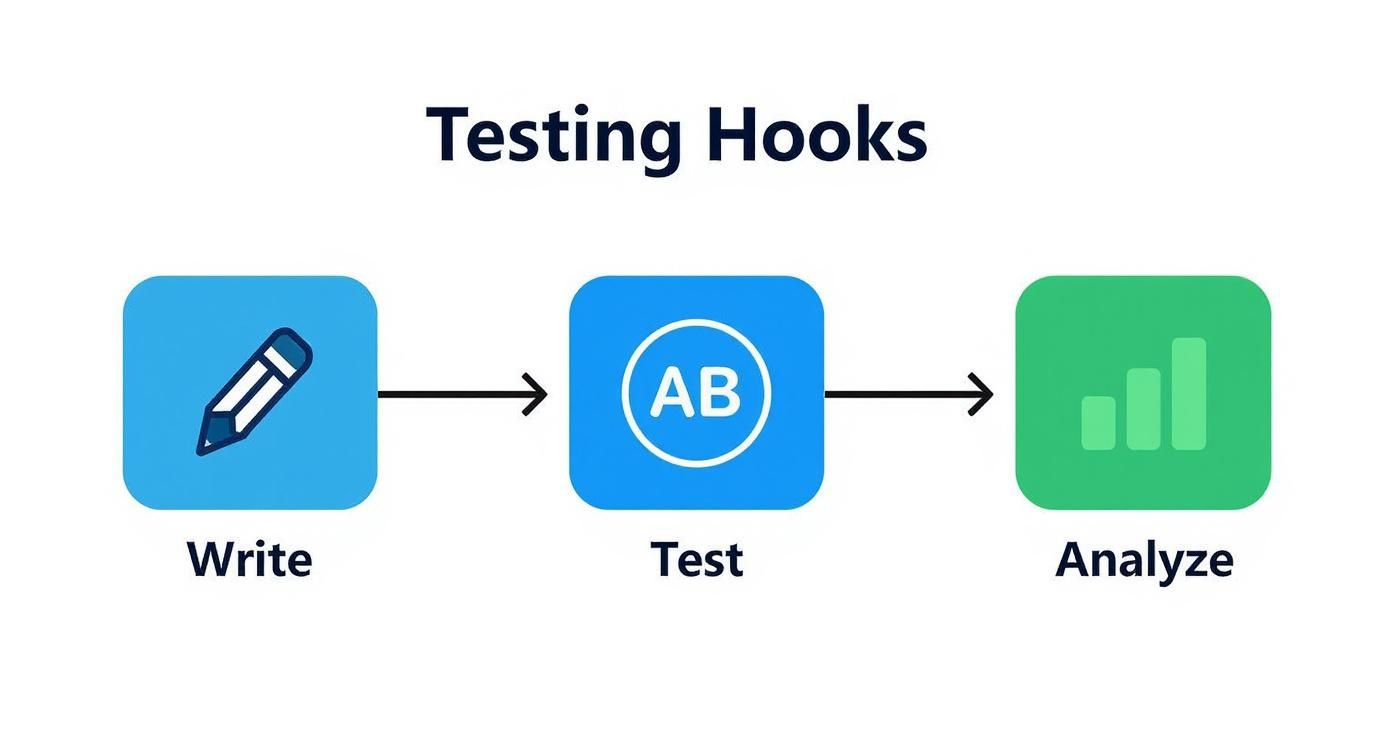
When you get into this rhythm, you create a powerful feedback loop. Every post you publish becomes a little bit smarter than the one before it.
Frequently Asked Questions
You’ve got the basics down, but a few practical questions always pop up when you start getting serious about your LinkedIn content. Let’s tackle some of the most common ones.
How Long Should a LinkedIn Hook Be?
You want to keep it short and punchy. Aim for somewhere between 140 and 200 characters.
The goal is simple: your entire hook needs to be visible on a mobile screen without anyone having to tap the “…see more” link. That’s how you make an impact when someone is scrolling through their feed at lightning speed.
Should I Use the Same Hook Formula Every Time?
It’s easy to fall into a groove once you find a formula that works. But be careful—relying on the same one over and over can make your content feel predictable, and people will start to tune you out.
The key is to mix things up depending on what you want to achieve with the post. Use data-driven hooks when you want to establish authority. Tell a personal story to build your personal brand. Or just ask a direct question to get a conversation going. Variety is what keeps your audience coming back for more.
A LinkedIn hook generator is perfect for breaking out of those creative ruts. It can help you explore different angles you might not have thought of on your own.
Is an AI Hook Generator Better Than Writing My Own?
Think of a LinkedIn hook generator as your creative co-pilot, not a replacement for your own brain and experience. Its real strength is helping you blast through writer’s block and giving you a solid starting point.
The best approach is actually a hybrid one:
- Fire up the generator to brainstorm a handful of different ideas and structures.
- Pick the one that feels right, and then inject your own unique voice, personal stories, and industry insights to make it shine.
- This way, the final hook is not only engaging but also genuinely you.
Ready to finally stop the scroll and start creating LinkedIn content that gets noticed? With Postline.ai, you can turn your rough ideas into polished, engaging posts in a matter of minutes. Our AI-powered assistant helps you write, research, and schedule content that sounds like you, but better.
Try Postline.ai for free and see the difference for yourself.

Run every client pipeline in one place
Give each LinkedIn profile its own voice, calendar, approval flow, and analytics. Start in minutes.
Start free trial