
A Guide to Content Personalization AI in Germany
Discover how content personalization AI is transforming German businesses. Learn the concepts, applications, and strategies to boost your marketing ROI.
Content personalisation AI is simply about using smart technology to give every single user a unique, one-to-one content experience. Instead of blasting everyone with the same generic message, AI analyses user data to serve up the most relevant articles, products, or recommendations on the fly.
The New Standard for Customer Engagement in Germany

Let’s face it: in a sophisticated market like Germany’s, one-size-fits-all content just doesn’t cut it anymore. Today’s customers don’t just want—they expect—brands to get them. Understanding their individual needs has become the baseline for any meaningful digital conversation.
Think about your favourite local shopkeeper, the one who remembers your tastes and suggests things you’ll actually love. Content personalisation AI does exactly that, but on a massive scale for thousands or even millions of customers at once. This is so much more than basic segmentation; it’s about crafting a truly individual journey for every person.
For German businesses, this isn’t just another tech trend. It’s a fundamental shift in how you build and nurture customer relationships. In a crowded marketplace, it’s the secret to creating deep, lasting loyalty.
Why You Can’t Afford to Ignore Personalisation Anymore
The numbers speak for themselves. Getting this right can reduce customer acquisition costs by up to 50% and pump up revenues by 5-15%. German consumers are increasingly drawn to fast, tailored digital experiences. AI makes it possible for websites to dynamically change content and calls-to-action based on what each visitor does.
To see just how big this is, take a look at Statista’s detailed outlook on the AI market in Germany—it’s clear this is where the industry is heading.
Ultimately, this is about securing your competitive edge. And to really knock it out of the park, you’ll want a modern social media engagement strategy that works hand-in-glove with your AI-driven efforts.
If you’re ready to go deeper on the basics, our guide on what content personalization is is the perfect next step. Make no mistake, this technology is now an essential tool for any German business serious about standing out.
How AI Learns to Personalise Your Content
To really get your head around content personalisation AI, think of it like a master chef crafting a unique meal for every single guest. The AI isn’t just taking a wild guess at what people want; it’s following a precise recipe fuelled by data, algorithms, and smart delivery. This whole process turns raw information into a truly bespoke experience.
The entire system is built on a simple, three-part foundation: getting the right ingredients (data), having a skilled chef (the AI model) cook the dish, and finally, serving the perfect meal (personalised content). It’s this structured approach that lets technology mimic—and even outdo—a human expert’s intuition, but on a massive scale.
The Ingredients: Data Collection
First things first, the AI needs ingredients. These ingredients come in the form of data. It gathers countless signals that we all leave behind as we browse, click, and interact online. These signals paint a detailed picture of who a person is and what they’re interested in at that very moment.
Key data signals include:
- Explicit Data: This is the straightforward stuff people tell you directly. Think age, location, job title, or interests they’ve selected in a preference centre.
- Behavioural Data: This is where the magic really happens. It tracks actions like what someone clicks on, how long they stay on a page, past purchases, and items they’ve added to a cart. It’s all about what they do, not just what they say.
- Contextual Data: This covers information about a user’s immediate situation, like the device they’re using (mobile or desktop), the time of day, or their current location.
This data collection is the absolute bedrock of effective personalisation. Without high-quality, relevant data, even the smartest AI is essentially cooking blind. You have to understand your audience’s digital footprint, which is why a proper audience analysis is a crucial first step.
The Chef: AI Algorithms
Once all the ingredients are gathered, the AI chef—the algorithm—gets to work. These algorithms are basically sets of rules and statistical models that crunch the data to predict what a user will find most engaging. They’re the brains of the whole operation.
There are two main “cooking styles,” or models, that these AI chefs use:
- Content-Based Filtering: This approach is built on a simple idea: “If you liked that, you’ll probably like this, too.” The AI looks at the characteristics of things you’ve engaged with before (like the genre of a film or the category of a product) and then suggests similar items.
- Collaborative Filtering: This model is a bit more social. It works on the premise that “people who liked X also liked Y.” It finds other users who have similar tastes to you and then recommends things they loved that you haven’t seen yet. This is how platforms often surprise you with new, unexpected discoveries.
Most modern systems actually use a hybrid model, blending both techniques. This gives you recommendations that feel both familiar and excitingly new, creating a much more balanced and satisfying experience.
And these models are always learning. Every single click and interaction refines the AI’s understanding, making its next recommendations even more spot-on.
Practical Applications of Content Personalisation AI
Okay, the theory is great, but what does AI-powered content personalisation actually look like in the real world? It’s one thing to talk about algorithms and data models; it’s another to see it genuinely connect with people and deliver results.
Across Germany, smart businesses are already shifting from shouting one message to the many, to having quiet, individual conversations with their customers—all at a massive scale.
This is the basic idea in a nutshell: take user data, let the AI work its magic, and deliver a unique experience.
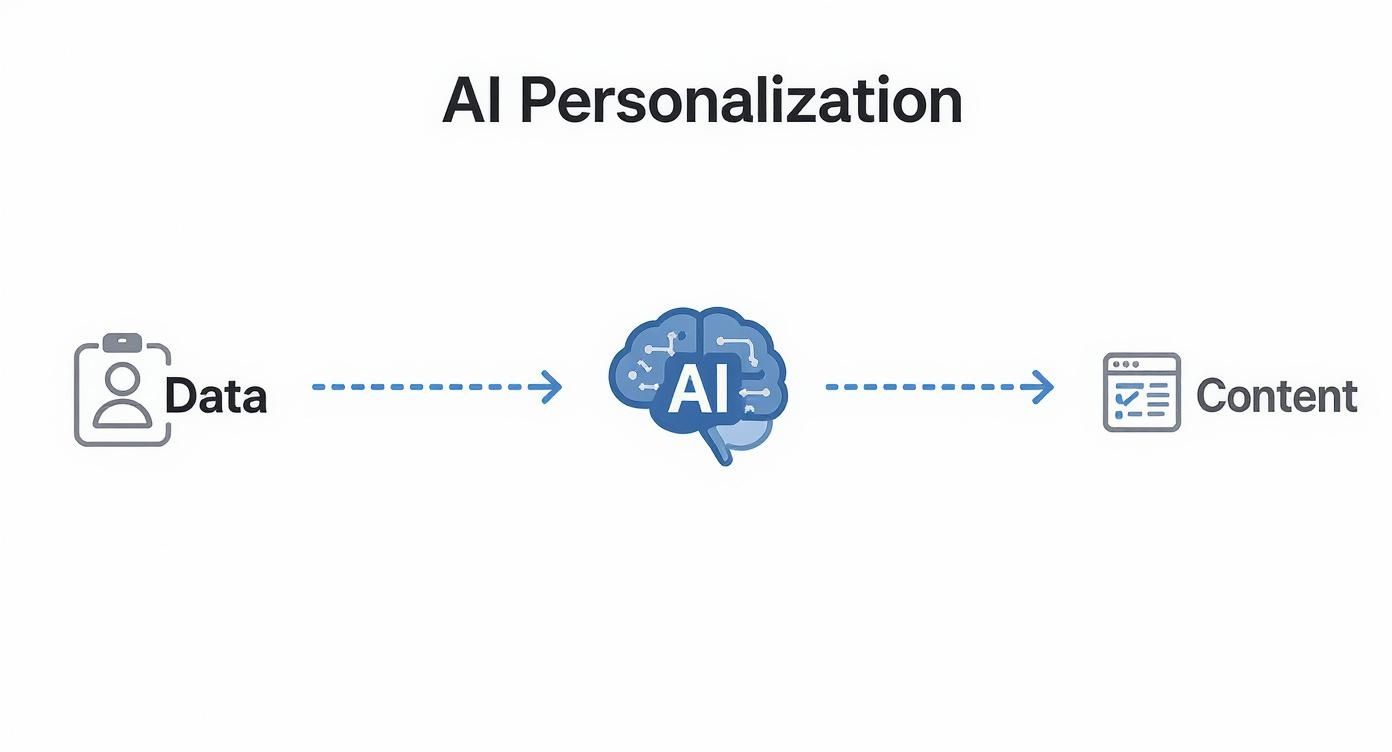
As you can see, individual user data is the fuel. Without it, the AI engine has nothing to process, and you’re left with the same old generic content for everyone.
This isn’t just a tech fad; it’s a direct response to what people actually want. A whopping 60% of Germans are interested in customised products or routines. And when you look at younger audiences, that number jumps to 84% for those aged 16-34. The demand is clearly there.
Dynamic Website Experiences
One of the most immediate ways to see this in action is with dynamic website content.
Imagine a travel website. A visitor from Baden-Württemberg lands on the homepage. Instead of seeing generic deals for Mallorca, the AI instantly shuffles the content to feature Black Forest getaways and weekend trips to Lake Constance. The experience is immediately more relevant, more personal, and far more likely to grab their attention.
This turns a static, one-size-fits-all webpage into a living, breathing platform. The content can shift in real-time based on all sorts of signals:
- Geographic Location: Showing local store details, regional events, or products specific to their area.
- Past Behaviour: Highlighting articles or products similar to what they’ve clicked on before.
- Referral Source: Tweaking the welcome message if they came from a specific social media ad versus an organic search.
Hyper-Personalised Marketing Communications
Beyond the website, content personalisation AI is breathing new life into email and social media. An e-commerce brand can finally move past just dropping a {first_name} tag into a generic email blast. Now, it can send a follow-up email with curated recommendations based on a customer’s last purchase or items they left in their cart. That’s a conversation starter, not just a sales pitch.
The same goes for a B2B company on LinkedIn. Instead of posting content and hoping it hits the mark, an AI can help ensure followers in the automotive sector see case studies on car manufacturing, while connections in finance get articles about fintech. This kind of targeting makes every single post feel more valuable and less like noise.
At its heart, the principle is simple: deliver the right message to the right person at just the right moment. AI is what finally makes this possible at a scale we could only dream of before, turning every touchpoint into a real chance to connect.
Of course, the whole thing falls apart if it feels robotic. To make sure these AI-driven interactions actually work, understanding how to humanize AI content for better engagement is absolutely critical. The goal, after all, is to use technology to build better human connections, not to replace them.
Implementing Your Personalisation Strategy
Jumping into content personalisation AI without a clear plan is like setting off on a road trip with no map. Sure, you’ve got a powerful vehicle, but you’ll probably end up lost. Success with this technology isn’t about flipping a switch; it hinges on a well-thought-out strategy tied directly to your business goals.
First things first: define what you’re trying to achieve. Is it about getting more people to click “buy”? Are you trying to keep visitors engaged on your site for longer? Or maybe you want to stop customers from leaving by serving up more relevant help articles. Whatever it is, get specific.
A successful personalisation strategy isn’t just about the AI; it’s about a clear, measurable goal. Without one, you’re flying blind and won’t be able to prove the return on your investment.
Once you know your destination, it’s time to think about fuel. For any AI system, that fuel is data.
Building a Solid Data Foundation
You simply can’t do personalisation without good data. It’s impossible. The AI needs clean, relevant information to learn from and start making smart predictions about what your users want to see.
This means you need to be deliberate about what you collect. Focus on gathering information that actually helps you reach your goal:
- Behavioural Data: This is gold. We’re talking about page views, click-through rates, purchase history, and items left in a basket. It tells you what people actually do, not just what they say they do.
- Demographic Data: Things like age, location, and job title add crucial context. A user in London will have different needs than one in Sydney.
- Contextual Data: Details like the device being used (mobile vs. desktop), time of day, or how they found you (e.g., from a specific ad) help the AI adapt the experience on the fly.
Getting this data organised is a non-negotiable step. Many companies use a Customer Data Platform (CDP) to pull all this information together from different places—like your website, CRM, and email platform. This creates a single, unified profile for each user, giving the AI the full picture it needs to work its magic.
Choosing Your Tools and Starting Small
With your goals set and your data in order, you can start looking at tools. The market has everything from huge, all-in-one platforms with personalisation baked in, to specialised AI engines that do one thing incredibly well. Your choice will come down to your budget, your team’s technical skills, and how complex your goals are.
Now, here’s a pro tip: don’t try to do everything at once. Instead of a massive, company-wide launch, start with a small, manageable pilot project. This is your test flight.
Maybe you start by personalising the main banner on your homepage for returning visitors. Or you could tailor the product recommendations in your weekly newsletter. A phased approach like this has some huge advantages:
- It proves the concept: A successful pilot gives you hard numbers and a clear ROI, making it much easier to get the green light for a bigger budget.
- It minimises risk: If something goes wrong, you can fix it quickly without it affecting your entire customer base.
- It creates a feedback loop: You’ll learn a ton from the pilot. The data and insights you gather can be used to tweak and improve your AI models before you go big.
Ultimately, getting content personalisation AI right is a methodical journey, not a sprint. Start with clear goals, build a strong data foundation, and test your approach with small projects. That’s the formula for setting yourself up for long-term success.
Choosing Your Content Personalisation AI Tool
Selecting the right AI tool can feel overwhelming, with options ranging from simple plugins to enterprise-level platforms. The key is to match the tool’s capabilities with your specific needs, technical resources, and budget. To help you navigate the landscape, here’s a breakdown of the common tool categories.
| Tool Category | Best For | Example Features | Typical Cost |
|---|---|---|---|
| All-in-One Marketing Platforms | Businesses looking for an integrated solution with CRM, email, and analytics. | Built-in A/B testing, audience segmentation, rule-based personalisation, product recommendations. | $$$ - $$$$ (Often subscription-based, tiered pricing) |
| Specialised Personalisation Engines | Companies with specific, complex goals and the technical team to integrate a dedicated tool. | Advanced machine learning models, predictive analytics, real-time decisioning, API access. | $$$$ - $$$$$ (Custom pricing, often high) |
| E-commerce Platform Plugins | Online retailers on platforms like Shopify or WooCommerce needing quick wins. | “Frequently bought together” widgets, personalised pop-ups, dynamic content blocks. | $ - $$ (Monthly subscription, often based on traffic) |
| Content Management Systems (CMS) | Marketers whose primary focus is personalising website content, like blogs and landing pages. | Visitor segmentation based on behaviour, personalised content components, integration with CDPs. | $$ - $$$ (Often an add-on or higher-tier plan) |
Remember, the “best” tool is the one that fits your strategy. Don’t pay for an enterprise engine if a simple e-commerce plugin will achieve your pilot project’s goals. Start with what you need, prove the value, and then you can scale your toolkit as your personalisation efforts mature.
Measuring Success and Optimising Performance
So, you’ve got a content personalisation AI up and running. That’s a great first step, but the real question is: how do you know if it’s actually working? Just flicking the switch isn’t the finish line. The true value comes from constantly measuring its impact and tweaking its performance based on what the data tells you.
This means you need to look past simple vanity metrics like clicks or page views. To really get a handle on success, you have to focus on Key Performance Indicators (KPIs) that tie directly to business growth and customer happiness. This is where the iterative power of AI really comes into its own; it’s not a ‘set and forget’ tool, but a system that gets smarter with every single interaction you analyse.
Key Metrics for Personalisation ROI
To prove your efforts are paying off, you need to track metrics that show a clear return on investment. These KPIs give you concrete proof of how personalised experiences are changing user behaviour and impacting your bottom line.
Here are the essential numbers to keep an eye on:
- Conversion Rate Uplift: This is the ultimate test. Pit a personalised experience against a generic, one-size-fits-all control version. A clear uplift in conversions is the most direct sign that you’re on the right track.
- Average Order Value (AOV): Smart product recommendations and tailored offers often nudge customers to add a little extra to their carts. If your AOV is climbing, it’s a good sign your AI is successfully up-selling and cross-selling.
- Customer Lifetime Value (CLV): Personalisation isn’t just about one-off wins; it’s about building loyalty. By tracking CLV, you can see if your tailored content is encouraging repeat business and turning casual buyers into long-term fans.
- Reduced Bounce Rates: When content hits the mark right away, people are far less likely to leave. A lower bounce rate on your key landing pages is a strong indicator that your AI is grabbing and holding attention from the get-go.
For a much deeper look into this, check out our guide on how to measure content performance. It lays out a complete framework for tracking the metrics that genuinely matter.
The Optimisation Cycle: A/B Testing and Beyond
Measuring performance is only half the job. You have to use those insights to sharpen your strategy. A content personalisation AI thrives on a constant feedback loop: test, learn, and improve. This is how you make the AI smarter over time.
Personalisation isn’t a destination; it’s a continuous process. Every test you run feeds valuable data back into your AI models, training them to deliver increasingly relevant and effective experiences.
The go-to method for this is A/B testing. You simply test one version (A) against another (B) to see which one performs better. For example, you could test a personalised homepage banner against a generic one. For more complicated scenarios, multivariate testing lets you test several changes at once—like a new headline, image, and call-to-action all in one go. This constant cycle of testing is what sharpens the AI’s predictive power, ensuring your personalisation efforts deliver stronger results, month after month.
Navigating Data Privacy and Ethical Considerations

While content personalization AI gives us an incredible ability to connect with people, it also hands us some serious ethical responsibilities. For businesses in Germany and the EU, getting to grips with the General Data Protection Regulation (GDPR) isn’t just about ticking a legal box—it’s about earning and keeping your audience’s trust.
There’s a very fine line between a helpful, personalised tip and a creepy intrusion. Step over that line, and you’ll see customer loyalty evaporate fast. The trick is to treat user data less like a commodity and more like a loan from your customer—one that demands the utmost care and respect.
Maintaining Trust Through Transparency
The bedrock of doing personalization right is absolute transparency. People have every right to know what data you’re collecting and exactly how you’re using it to shape what they see. This isn’t something to bury in the small print of a document nobody reads.
Instead, you should be crystal clear. That means:
- Clear Consent: Getting a straightforward, unambiguous ‘yes’ before you start collecting any data.
- Easy Access: Giving users a simple way to see, manage, and change their own data and preferences.
- Plain Language: Explaining how you handle data in normal, everyday terms that anyone can get their head around.
This kind of openness builds real confidence. It shows your audience that you’re using AI to make their experience better, not just to mine their data. If you want to see how we put this into practice, you can read our straightforward guidelines in the Postline.ai privacy policy.
Avoiding the Filter Bubble
The other big ethical tightrope to walk is the dreaded “filter bubble.” This is what happens when an AI gets so good at showing people what they already like that it accidentally walls them off from different opinions or new ideas.
The goal of personalisation should be to open doors for users, not build walls around them. An ethical AI strategy must balance relevance with the serendipity of discovering something unexpected.
The generative AI market is on track to hit a staggering $356.10 billion by 2030. On top of that, it’s predicted that by 2027, 80% of all marketing content will be AI-generated. With growth like that, locking in strong ethical principles now isn’t just a good idea—it’s essential.
Common Questions About AI-Powered Personalisation
Whenever a powerful new tool comes along, it’s natural to have questions. Getting a handle on these basics is the best way to move forward and sidestep the usual growing pains. Let’s tackle a few common ones.
How Can a Small Business Start Without a Huge Budget?
Good news: you don’t need to break the bank. Many small businesses get their feet wet by simply using the built-in personalisation features of tools they already pay for. Think about your email marketing service or e-commerce platforms like Shopify. They often include basic product recommendations or simple content targeting right out of the box.
The trick is to start small and aim for a quick win. Focus on a single, high-impact area first. Maybe that’s personalising email subject lines to boost open rates, or tweaking the homepage banner for returning visitors. This lets you prove the return on investment (ROI) before you even think about scaling up to more complex solutions.
What’s the Real Difference Between Personalisation and Segmentation?
This one trips a lot of people up, but the difference is pretty simple. Segmentation is about bucketing your audience into broad categories, like “new customers” or “users from Berlin.” It’s a one-to-many approach. AI-powered personalisation, on the other hand, is about treating every single user as an individual—a genuine one-to-one conversation.
Think of it like this: segmentation is like sending the same generic postcard to everyone in a particular neighbourhood. AI-driven personalisation is like writing a unique, handwritten note to each person on the street, referencing your last conversation with them. One is broad, the other is deeply personal.
What Data Matters Most for Making This Work?
While all data has its place, behavioural data is the undisputed king. This is the goldmine of information that shows what your audience actually does—the pages they browse, how long they stick around, the products they click on, and what they’ve bought before.
This “first-party” data gives the AI the clearest possible signals about what someone wants or needs in that exact moment. It’s what allows the system to move beyond educated guesses and start making truly relevant, timely recommendations that feel genuinely helpful.
Ready to put the power of AI to work on your own LinkedIn content? With Postline.ai, you can turn your ideas into engaging, personalised posts in minutes, helping you connect with your audience on a whole new level. Start creating standout content today at https://postline.ai.

Run every client pipeline in one place
Give each LinkedIn profile its own voice, calendar, approval flow, and analytics. Start in minutes.
Start free trial