
Social selling with linkedin: Master LinkedIn to Accelerate Sales
Discover social selling with linkedin: practical steps to optimize your profile, craft content, and build relationships that close deals.

So, what does social selling on LinkedIn actually mean? It’s the art of using the platform to find the right people, connect with them, share useful ideas, and build genuine relationships. Forget the old-school cold outreach. This is about guiding potential customers through your sales process by being a helpful, trusted resource, not just another salesperson.
Your Blueprint for Social Selling Success on LinkedIn
Let’s get one thing straight: your LinkedIn profile isn’t a dusty CV. It’s your digital storefront, your personal brand headquarters, and a powerful sales tool all rolled into one. A proper social selling strategy isn’t about firing off random posts or sending generic connection requests; it’s a deliberate, structured approach built on four key pillars. Nailing this framework is what shifts your LinkedIn presence from passive to proactive, creating a steady stream of interest from the right people.
Think of it as a flywheel. A compelling profile makes your prospecting more effective. Your content then lands in front of that ideal audience. Finally, your engagement builds the trust and rapport that spark actual sales conversations. It all works together.
This flow is a simple but powerful model for turning connections into customers.
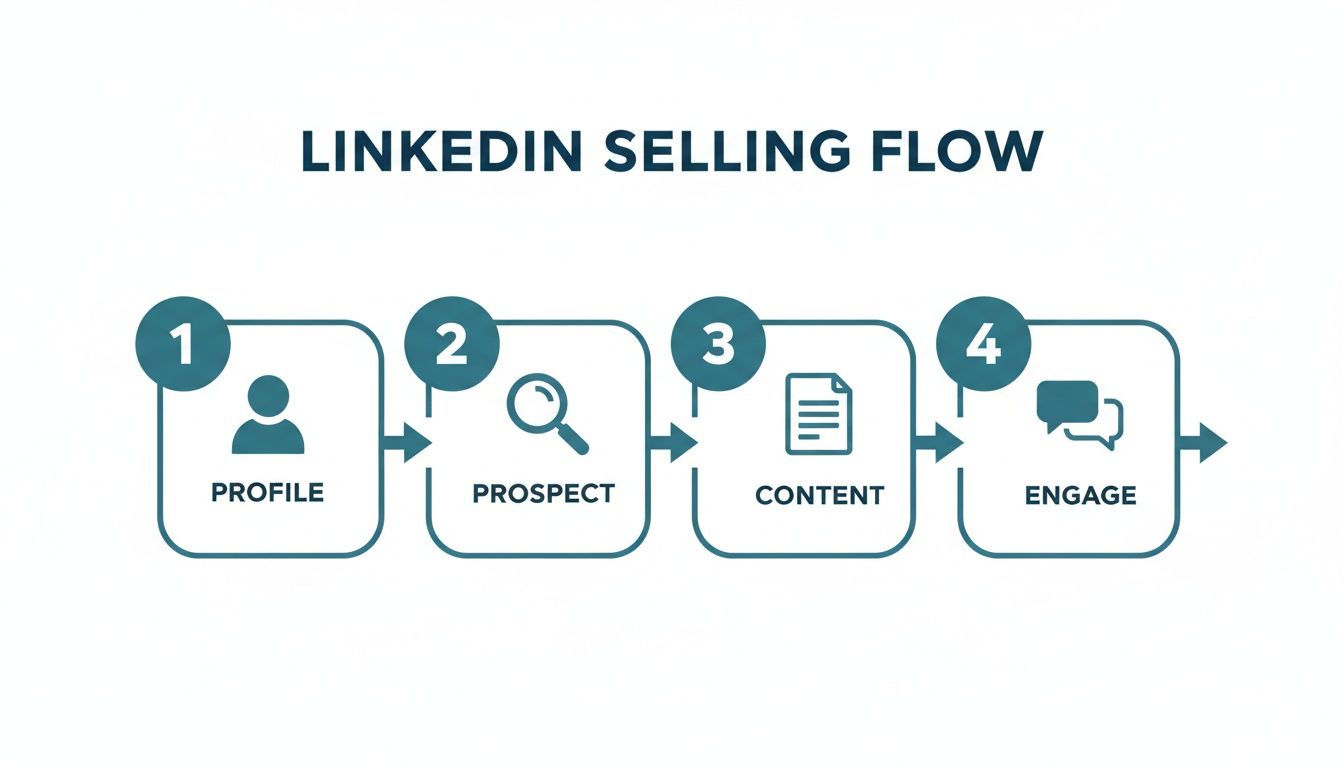
Each stage naturally leads to the next, giving you a repeatable system for growth. We’re going to break down each of these pillars with practical tactics you can start using today. If you want a refresher on the basics first, take a look at our deeper dive into what social selling is.
The Four Pillars of a Winning Strategy
The potential on LinkedIn is massive, and it’s still growing. Take Germany, for instance. As of December 2023, the platform had 17.52 million users there—that’s 21.4% of the entire population. That number jumped by over 1.6 million in just the previous six months alone. This isn’t just a platform; it’s a thriving hub of professionals you can connect with.
To successfully tap into this audience, you need a strategy built on these four foundational pillars. Each component is critical for creating a cohesive and effective social selling system.
Core Pillars of LinkedIn Social Selling
| Pillar | Objective | Key Action |
|---|---|---|
| Buyer-Focused Profile | Establish credibility and attract your ideal client. | Optimise your headline, summary, and experience sections to speak directly to your customer’s pain points. |
| Intelligent Prospecting | Build a high-quality network of potential buyers. | Use Sales Navigator or advanced search filters to find and connect with decision-makers who fit your ICP. |
| Value-Driven Content | Position yourself as a trusted authority. | Consistently share insights, tips, and stories that solve problems for your target audience. |
| Genuine Engagement | Nurture relationships and create sales opportunities. | Leave thoughtful comments on others’ posts and send personalised, relevant messages instead of generic pitches. |
By mastering these four areas, you build a system where every piece reinforces the others. Your profile gives you the credibility to do outreach, your content keeps you top-of-mind, and your engagement is what opens the door to real business.
A great profile builds trust for your outreach. Great content nurtures your network at scale. And genuine engagement turns those connections into conversations that actually lead somewhere.
While we’re focused on LinkedIn here, it’s always smart to keep the bigger picture in mind. You can explore broader marketing and sales insights to see how this fits into your overall strategy. Now, let’s get into the nitty-gritty of putting each pillar into practice.
Turning Your Profile Into a Lead Magnet
Let’s be honest: your LinkedIn profile isn’t just an online CV anymore. It’s your digital shopfront, the absolute cornerstone of any social selling you do. Before you even think about sending a single connection request, your profile needs to scream, “I get you, and I can help.” It should be working for you around the clock, turning curious visitors into genuine prospects.
So many people make the classic mistake of treating their profile like a laundry list of past job duties. A profile that actually generates leads, however, is all about the buyer. It flips the script from “Here’s what I do” to “Here’s what I can do for you.” That subtle shift in focus is everything—it’s what pulls your ideal clients in and makes them see you as an expert right away.
This means every single part of your profile—from that big banner image at the top down to your ‘About’ section—needs to be fine-tuned to reflect your target audience’s problems, their goals, and the language they use. When a potential client lands on your page, they should feel like you’ve been reading their mind.
Crafting a Compelling First Impression
Your headline and banner are the first things anyone sees. Think of them as your most valuable digital real estate. A generic job title like “Account Executive” says nothing and grabs no one’s attention. You need to transform it into a powerful, results-focused statement.
A headline that works follows a pretty simple formula: “I help [Ideal Client Profile] achieve [Specific Outcome] by [Your Solution].”
- Weak Headline: Sales Manager at Tech Corp
- Strong Headline: Helping SaaS Start-ups Reduce Churn by 20% with Data-Driven Onboarding Strategies
See the difference? The second version immediately tells your target audience that they’re in the right place and shows them the real-world value you bring. If you want to dig deeper, we’ve put together a guide on LinkedIn headline tips that can really help you nail this.
Your banner image should back up this message. Ditch the default LinkedIn background. Use that space for a custom image that reinforces your brand, shows off a client testimonial, or even has a clear call to action.
Writing an About Section That Builds Trust
The “About” section is your big chance to tell your story and make a human connection. This is where you go beyond just listing what you do and start building real trust. Don’t just rattle off your skills; weave them into a narrative that shows you’re not only an expert but also that you actually understand their world.
A good way to structure your summary is to guide the reader through a quick journey:
- The Hook: Kick things off with a question or statement that hits on your audience’s biggest headache.
- Empathy & Authority: Show them you understand their struggles because you’ve seen it all before—and you know how to fix it.
- The Proof: Drop in a quick success story or a key result you got for a client.
- The Ask: End with a simple, low-pressure invitation to connect or learn more.
“Your profile isn’t about you. It’s about your customer. Talk about who you help, how you help them, and the results they can expect. Make them the hero of the story, and they’ll see you as the guide they need.”
Remember, people buy from people they know, like, and trust. A thoughtfully written ‘About’ section is one of the quickest ways to start building that trust.
Optimising Every Profile Element
While your headline and summary do the heavy lifting, every piece of your profile adds to the big picture. Don’t get lazy with the details; they all work together to make your personal brand stronger and help you show up in searches.
Here are a few other key areas to dial in:
- Professional Headshot: Get a high-quality photo where you look friendly and professional. A good rule of thumb is to have your face take up about 60% of the image.
- Featured Section: This is your visual portfolio. Pin your best content, a great case study, or links to valuable resources here. Show, don’t just tell.
- Experience Section: Instead of just listing responsibilities, rewrite these as accomplishments. Use bullet points and add numbers wherever you can (e.g., “Grew inbound leads by 45% in just six months”).
- Recommendations: Social proof is incredibly persuasive. Don’t be shy about asking happy clients for a recommendation that highlights the specific results you helped them get.
By carefully optimising each of these elements, you’ll transform your profile from a static page into a dynamic lead magnet that powers your entire social selling with LinkedIn strategy.
Creating Content That Starts Conversations
If your optimised profile is the storefront, your content is the friendly welcome that invites people inside. Content is what truly powers your social selling with LinkedIn. It’s how you show what you know, build real trust, and get ideal clients coming to you. Forget just posting for the sake of it; you need a smart plan that cements you as the go-to expert.
Good content isn’t about going viral. It’s about sparking conversations. Think of every post as a magnet for your perfect customer—it should speak directly to their problems, share a genuinely helpful idea, or tell a story that makes them nod in agreement. When you consistently deliver that kind of value, you’re the first person they think of when it’s time to buy.

The idea is to shift from being seen as just another salesperson to becoming a trusted advisor, one insightful post at a time. This groundwork makes your future outreach feel less like a cold interruption and more like a natural next step in a conversation you’ve already started.
The Core Content Pillars for Sales Professionals
To keep things consistent without burning out, it helps to focus your ideas around a few core ‘pillars’. These are the themes you’ll return to again and again, making sure you always have something valuable to say.
- Industry Insights and Trends: What’s really happening in your market? Share your take on it. Talk about the new challenges your clients are up against or the opportunities just over the horizon. This shows you’ve got your finger on the pulse.
- Problem-Solving and How-To Advice: Offer up practical, bite-sized tips that help your audience solve a real problem. This is a brilliant way to demonstrate your expertise and build immediate goodwill.
- Client Success Stories and Case Studies: Nothing builds trust like proof. Share stories (with their permission, of course) about how you helped a client get a specific, tangible result. Frame it as a simple story: here was the problem, this is what we did, and here was the fantastic outcome. Even small tweaks can make a huge difference; for example, you can learn how one professional managed to boost LinkedIn engagement with a simple content change.
- Behind-the-Scenes and Personal Stories: People do business with people, not logos. Sharing a lesson learned from a mistake, a tough challenge you overcame, or even a personal win makes you relatable and humanises your brand.
Cycling through these pillars keeps your feed from getting stale and gives your audience multiple ways to connect with you.
Finding Your Authentic Voice
In a sea of sameness, your unique voice is what makes you stand out. It’s that mix of your personality, your experience, and how you see the world. Trying to sound like some other guru is a fast track to creating bland, forgettable content.
So, how do you find it? Just think about how you talk. Are you analytical and love data? Do you have a dry sense of humour? Are you a natural storyteller? Lean into that. Authenticity connects on a much deeper level than a perfectly polished but soulless tone.
Your content should sound like you on your best day. Don’t try to be a “thought leader.” Just be yourself and share what you know. The right people will listen.
This is critical when you start using AI tools. They are incredible for getting ideas flowing and saving time, but the final post has to sound like you. Always take a minute to edit the output, adding your own anecdotes, opinions, and little turns of phrase. To get a better handle on this, check out our guide on how to write engaging LinkedIn posts that truly capture your style.
Streamlining Content Creation With Postline.ai
Let’s be honest, the biggest hurdle with content is just keeping it going. This is where a tool like Postline.ai becomes a lifesaver for any busy sales professional. It’s not about replacing you; it’s about amplifying your expertise and giving you back a massive chunk of your week.
Postline.ai is built to help you go from a blank screen to a finished, scheduled post in just a few minutes, making it much easier to maintain a strong, consistent presence on LinkedIn.
How Postline.ai Speeds Up Your Workflow
- AI Post Generator: Stuck for an idea? Pop in a simple thought or topic, and the generator will spit out several different post drafts to get you started. It’s a fantastic way to break through writer’s block.
- Online Research: Want to back up your point with a killer statistic? The research feature can pull in recent data, articles, or reports from credible sources. This adds a layer of authority to your content instantly.
- Audience Explorer: Not sure what your network actually wants to hear about? This feature lets you see what topics are trending and what questions people are asking, so your content always hits the mark.
Using a tool like Postline.ai lets you batch your work. You can sit down and plan out an entire week’s worth of high-quality content in one go, turning a daily chore into a strategic task you knock out quickly.
To see just how much of a difference this makes, look at the comparison below. It breaks down the time it takes to create a week’s worth of content the old way versus with a little AI help.
Content Creation Workflow with Postline.ai vs Manual Method
| Task | Manual Method (Estimated Time) | Using Postline.ai (Estimated Time) | Key Benefit |
|---|---|---|---|
| Brainstorming Ideas (1 week) | 60-90 minutes | 15 minutes | Overcome writer’s block with AI-generated suggestions |
| Researching & Fact-Checking | 45-60 minutes | 10 minutes | Instantly add credible data with the Online Research feature |
| Drafting 3-4 Posts | 90-120 minutes | 20-30 minutes | Turn simple ideas into polished drafts in seconds |
| Editing & Formatting | 30 minutes | 10 minutes | Automatic formatting for hooks, CTAs, and hashtags |
| Scheduling | 15 minutes | 5 minutes | Plan your entire week’s content in one platform |
| Total Time | ~4-5 hours | ~1 - 1.5 hours | Save over 70% of your time while increasing content quality |
The numbers speak for themselves. You’re not just saving time; you’re freeing up hours that can be spent on what really matters: building relationships and closing deals.
Mastering Outreach That People Actually Reply To
So, your profile is looking sharp and your content is starting to get noticed. You’ve built a solid foundation and started conversations out in the open on the LinkedIn feed. Now it’s time for the real work: taking those conversations into the DMs, where relationships are built and deals begin to take shape. This is the absolute core of social selling with LinkedIn—turning those passive views into active conversations.
Let’s be clear: this isn’t about blasting out generic, automated messages that everyone hates and ignores. Forget that old playbook. Effective outreach is a craft, and it’s built on three things: relevance, personalisation, and genuine value. It’s about showing you’ve actually done your homework and have a thoughtful reason for landing in their inbox.

The goal isn’t to pitch right away. Far from it. The goal is to earn the right to even have a business conversation by being a human first. When you get this right, your message feels less like a cold interruption and more like a welcome, relevant tap on the shoulder.
The Anatomy of a Connection Request That Gets Accepted
Think of your connection request as your first handshake. You’ve only got 300 characters for that personalised note, so every single one has to pull its weight. Sending a generic, empty request is just lazy, and frankly, it doesn’t work. A little bit of personalisation, on the other hand, can make a huge difference in your acceptance rate.
A winning request really only needs three ingredients:
- Context: Why them? Mentioning a mutual connection, a great piece of content they shared, or a group you’re both in instantly builds common ground.
- Value: What’s in it for them to connect with you? Frame your request around their world, not your sales targets. Maybe you want to follow their insights on a topic or you have a resource that could help with a challenge they’ve mentioned.
- A Low-Pressure Ask: The only goal here is to connect. No sales pitch. No “can I have 15 minutes of your time?” Just connect.
For instance, ditch the bland “I’d like to connect with you,” and try something that shows you’ve been paying attention.
Bad Example: “Hi Alex, I’d like to add you to my professional network on LinkedIn.”
Good Example: “Hi Alex, I saw your recent post on the challenges of scaling marketing teams and really agreed with your point about data silos. I’m always keen to follow experts in the SaaS marketing space. Would be great to connect.”
See the difference? This small effort shows you respect their work and you’re not just another random person trying to boost their connection count. They’re far more likely to click “Accept.” If you want to dive deeper into making these introductions feel less cold, check out our guide on how to reach out to someone with a mutual connection on LinkedIn.
Moving Beyond “Thanks for Connecting”
Once they accept, the clock starts ticking. The “Thanks for connecting!” message is a dead end. It’s polite, sure, but it’s a conversation killer. Any momentum you had just fizzles out. Your first message after they connect needs to be designed to spark an actual, genuine conversation.
Your one and only objective here is to get a reply. And the best way to do that is to ask a relevant, open-ended question that’s easy for them to answer. This question should tie directly back to their role, their company’s goals, or something they’ve recently posted.
Here’s a simple, repeatable framework:
- Acknowledge the connection (but keep it brief).
- Remind them why you connected in the first place.
- Ask a thoughtful, open-ended question.
Let’s put it into practice.
Scenario: You’ve just connected with a Head of Sales at a growing tech company. You saw they recently posted about their team’s hiring plans.
“Hi Sarah, thanks for connecting. I noticed your post about expanding the sales team—congratulations on the growth. I was curious, as you bring on new reps, what’s your biggest focus for their onboarding process to get them ramping up quickly?”
This message works because it’s personal, relevant, and completely non-threatening. It positions you as a curious peer, not a salesperson who is about to launch into a pitch. You’re inviting a conversation about their world, which is always a better approach than talking about yourself.
Proactive Engagement That Builds Rapport
Outreach isn’t just about what happens in the DMs. Some of the most powerful relationship-building happens out in the open, by consistently and thoughtfully engaging with your prospect’s content. Before you even think about sending that first message, you should already be a familiar name in their notifications.
This strategy, sometimes called “comment-led outreach,” warms up the entire interaction. It establishes your credibility before you ever ask for anything.
Here are a few ways to get on their radar proactively:
- Leave thoughtful comments: Don’t just say “Great post!” Add to the conversation. Share a related insight, ask a smart question, or agree with a specific point and explain why it resonated with you.
- Share their content: If a prospect posts an article or resource you genuinely find useful, share it with your own network and be sure to tag them. This signals that you see them as an expert worth listening to.
- Participate in LinkedIn Groups: Find the industry groups where your prospects are active. Answering questions and contributing to discussions there positions you as a helpful, knowledgeable resource.
Don’t forget, the top performers are already doing this. Research shows that 78% of sales reps who use social selling outsell their peers. This kind of proactive engagement is a massive part of what sets them apart.
Measuring What Matters and Scaling Your Efforts
Putting in the hours on LinkedIn is great, but if you’re not measuring your results, you’re just guessing. To get better, you absolutely have to know what’s working and what’s falling flat. This means looking past vanity metrics like likes and focusing on the numbers that actually point to real business outcomes.
Think of it this way: you’re not just firing off posts and messages at random. You’re building a system. A quick weekly check-in on your key performance indicators (KPIs) is the only way to fine-tune that system and make sure your time is leading to qualified conversations and genuine sales opportunities.
Key Performance Indicators for Social Selling
Don’t get lost in a sea of data. A few core metrics are all you need to get a sharp picture of your performance and spot where you can improve. Just set aside a little time each week to see how these numbers are trending.
Here are the essentials I always keep an eye on:
- Social Selling Index (SSI): This is LinkedIn’s own report card for you, scoring you on four key areas. If you can get your score above 70, you know you’re doing things right. I’ve found that a high SSI almost always leads to better engagement and more inbound interest.
- Profile Views: Are more people checking you out week over week? A steady increase is a great sign that your content and comments are hitting the mark and making people curious enough to click on your name.
- Connection Acceptance Rate: This one is huge. If your acceptance rate is dipping below 30-40%, that’s a red flag. It’s telling you that your connection requests aren’t personal enough or aren’t offering a good enough reason for someone to let you into their network. Time to rework that message.
- Reply Rate to DMs: This is the health-check for your outreach. A solid reply rate means your messages feel relevant and human, not like another automated sales pitch destined for the bin.
- Qualified Conversations Started: At the end of the day, this is what it’s all about. How many of your activities are sparking actual business discussions? This is the number that really moves the needle.
The real insight comes when you connect these dots. For instance, if your profile views are soaring but your connection acceptance rate is in the gutter, you know your content is great, but your initial outreach needs a complete overhaul.
Don’t just track activity; track outcomes. A hundred new connections mean nothing if they don’t lead to a single meaningful conversation. The goal isn’t to be busy on LinkedIn; it’s to be effective.
Scaling Your Strategy for Maximum Impact
Once you’ve got a process that works and you’re consistently tracking your results, it’s time to scale up. But scaling doesn’t mean spamming more people. It means getting more efficient and targeted with your time, without losing that crucial personal touch.
This is where the right tools can make all the difference, helping you do more of what works, but in a fraction of the time.
Using Tools to Work Smarter
Scaling effectively really comes down to having the right tech in your corner. Two tools in particular can completely change the game: LinkedIn Sales Navigator for laser-focused prospecting, and a platform like Postline.ai for keeping your content engine running smoothly.
LinkedIn Sales Navigator is non-negotiable for anyone serious about social selling. It takes you way beyond the basic search and lets you:
- Build hyper-specific lead lists based on deep criteria.
- Get alerts for key buying signals, like when a prospect starts a new job.
- Quickly map out and find the key decision-makers in your target accounts.
Postline.ai solves the content problem. Consistently creating high-quality posts is a massive time-sink, especially if you’re trying to manage this for a whole team. With a tool like this, you can:
- Generate fresh post ideas and solid first drafts in minutes using AI.
- Schedule an entire week’s worth of content in one sitting.
- Keep everyone on-brand and consistent if you’re managing a team effort.
When you pair the powerful targeting of Sales Navigator with the content efficiency of Postline.ai, you create a truly scalable workflow. This frees you up to spend your time on the high-value stuff—personalising messages and having real conversations—which is the very heart of successful social selling with LinkedIn.
Frequently Asked Questions About LinkedIn Social Selling
Once you get the hang of social selling, a few practical questions always seem to pop up. You understand the big picture, but what about the nitty-gritty of daily execution? Let’s get into some of the most common hurdles and how to clear them with confidence.
It’s easy to think you need to be glued to LinkedIn to make any real progress, but that’s a quick path to burnout. It’s not about the hours you put in; it’s about what you put into the minutes.
How Much Time Should I Actually Spend on This Every Day?
Honestly, you don’t need to live on LinkedIn to win at social selling. The secret is focused, consistent effort. I always recommend blocking out 20-30 minutes each day for high-impact activities. That’s all it takes to build momentum without sacrificing your core sales responsibilities.
So, what does a productive half-hour on LinkedIn look like? Here’s a simple routine I’ve seen work wonders:
- First 5 Minutes: Clear your notifications. Reply to any comments on your posts and answer messages sitting in your inbox.
- Next 10 Minutes: Go on the offensive (in a good way!). Find posts from 3-5 of your top prospects or key clients and leave a thoughtful, genuine comment.
- Final 10 Minutes: Time for new connections. Identify 2-3 new people who fit your ideal customer profile and send them a personalised connection request.
This little routine ensures you’re nurturing existing relationships, engaging with your target audience, and actively prospecting every single day. It’s manageable, effective, and sustainable.
What Do I Do When a Competitor Tries to Connect?
Getting a connection request from a direct competitor can feel a bit… strange. Do you accept? Ignore it? There’s no single right answer, and it really comes down to your own philosophy.
On one hand, you could ignore or decline the request. This is a totally fair move if you’d rather keep your network and content strategy under wraps. You might be worried they’ll poach your connections or copy your playbook.
My take? I usually accept. Think of it as “keeping your friends close and your competitors closer.” It gives you a front-row seat to their strategy, messaging, and what they’re talking about. It also signals confidence and an abundance mindset—you aren’t scared of a little friendly competition.
At the end of the day, they can see your public posts whether you’re connected or not. Connecting with them is unlikely to cause any real harm, so the decision is purely about your comfort level.
Is It Still Okay to Send Cold Messages on LinkedIn?
Yes, but with a major caveat. The days of blasting out hundreds of identical, spammy sales pitches are long gone (thankfully). While social selling is all about warming up your audience, there’s still room for direct outreach—as long as you do it the right way.
Your outreach needs to be less “cold” and more “cool” or “lukewarm.” This means every single message has to be built on a foundation of relevance and personalisation. You should have a genuinely good reason for reaching out before you even think about hitting “send.”
A message that actually gets a reply usually shows you’ve done your homework. Try referencing things like:
- A recent press release or milestone their company just hit.
- A post or article they shared that you found interesting.
- A mutual connection, group, or experience you share.
The objective here is simply to start a conversation, not to book a demo in the first message. Your initial outreach should feel like the beginning of a dialogue, often ending with a question about their work or perspective. When you lead with genuine curiosity instead of a sales pitch, your “cold” message suddenly feels a whole lot warmer.
Ready to supercharge your content creation and save hours every week? Postline.ai combines powerful AI writing with real-time research to help you create standout LinkedIn posts in minutes. Stop staring at a blank screen and start building your brand. Try Postline.ai today.

Run every client pipeline in one place
Give each LinkedIn profile its own voice, calendar, approval flow, and analytics. Start in minutes.
Start free trial