
Social Selling Index: Boost Your LinkedIn Score with Proven Tactics
Master your social selling index with practical LinkedIn strategies to boost visibility, credibility, and real sales results.
Ever heard of LinkedIn’s Social Selling Index (SSI)? It’s a score LinkedIn gives you, from 0 to 100, that basically grades how well you’re using the platform for sales. Think of it like a credit score, but for your professional reputation online. A higher number signals that you’re building credible relationships and creating real opportunities.
It’s a surprisingly direct link to sales success.
Understanding the Social Selling Index
The Social Selling Index isn’t just a number to brag about; it’s a practical, data-driven guide. It shows you exactly how well you’re doing the key things that actually lead to sales conversations. LinkedIn built the SSI to measure your efforts across four fundamental areas, giving you a clear roadmap to get better.
Essentially, it answers the question, “Am I actually using LinkedIn the right way to connect with people and build trust?”
Your score isn’t static, either. It updates every day based on what you’ve been doing, giving you instant feedback on whether your approach is hitting the mark. For a deeper dive into the core concepts, our guide on what is social selling lays out all the essential background info.
Why Your SSI Score Is Important
In today’s crowded market, a strong SSI score gives you a real edge. It pulls you out of the guesswork and gives you a concrete measure of your ability to build a brand, find the right people, and create genuine relationships.
LinkedIn’s own data makes a pretty compelling case:
- More Opportunities: Sales leaders with high SSI scores generate a whopping 45% more opportunities than those with lower scores.
- Hitting Your Numbers: Top social sellers are 51% more likely to reach their sales quotas.
- Leading the Pack: An incredible 78% of social sellers outsell peers who aren’t using social media in their process.
These numbers show a clear, undeniable link between a high Social Selling Index and real-world business results. It’s not just about being busy on LinkedIn; it’s about being effective.
A high SSI score is a direct reflection of your ability to build a professional brand that resonates with your target audience, find key decision-makers, engage them with valuable insights, and foster genuine trust.
The Four Pillars of the Social Selling Index
Your total score is a mix of four key components, each worth a maximum of 25 points. Getting good at each of these is how you raise your score and, more importantly, your sales game.
To make it easier to see how everything fits together, here’s a quick breakdown of the four pillars.
The Four Pillars of the Social Selling Index at a Glance
| Pillar | What It Measures | Why It’s Important |
|---|---|---|
| Establish your professional brand | How complete and customer-focused your profile is. Think endorsements, rich media, and long-form posts. | A strong brand acts as your digital storefront, attracting prospects and showcasing your expertise before you even say hello. |
| Find the right people | Your skill at using LinkedIn’s search tools to identify and connect with relevant prospects and decision-makers. | Connecting with the wrong people is a waste of time. This pillar ensures you’re building a network that’s actually valuable. |
| Engage with insights | Your ability to share valuable content, interact with others’ posts, and start meaningful conversations. | This is where you move from a passive profile to an active participant, demonstrating your knowledge and staying top-of-mind. |
| Build relationships | How effectively you nurture your connections, turning them into a trusted network of potential clients and partners. | Relationships are the foundation of sales. This pillar tracks your ability to build genuine trust over time. |
Mastering these pillars isn’t just about chasing a high score; it’s about adopting the habits that make modern selling work. Each one contributes to a powerful, cohesive strategy for growing your influence and your pipeline on LinkedIn.
Breaking Down the Four Pillars of Your SSI Score
Think of your Social Selling Index score like a final grade in school. It’s a single number, but it’s made up of your performance across four different subjects. Each one is worth a maximum of 25 points. If you want to boost your overall SSI, you need to get good at all four.
The trick is to see them not as separate chores, but as four interconnected habits. When you weave them together, you become the kind of modern seller who thrives on LinkedIn.
Let’s pull back the curtain on exactly what LinkedIn is measuring and how you can start moving the needle on each pillar.
Pillar 1: Establish Your Professional Brand
This is all about making sure your profile is pulling its weight, even when you’re not online. It’s a measure of how well you’ve built a complete, client-focused presence. We’re not just talking about a list of past jobs; this is about telling a story that clicks with your ideal customer.
A sharp professional brand is your 24/7 sales pitch. It needs to instantly answer a prospect’s two biggest questions: “What do you actually do?” and “How can you help me?”
Here’s what LinkedIn is looking for:
- Profile Completeness: Do you have a professional photo, a headline that grabs attention, and a detailed ‘About’ section?
- Rich Media: Have you spiced up your profile with presentations, case studies, or videos that show off your expertise and results?
- Endorsements and Recommendations: Are other people vouching for your skills? This is crucial social proof.
- Thought Leadership: Are you publishing articles or long-form posts that prove you know your stuff?
Your LinkedIn profile should be less like a CV and more like a landing page for your personal brand. Every single element should be crafted with your target audience in mind, showing them the value you bring to the table.
Pillar 2: Find the Right People
You can have the most polished brand in the world, but if you’re shouting into an empty room, what’s the point? This pillar scores how well you identify and connect with the decision-makers who actually matter. It’s all about quality over quantity.
LinkedIn wants to see that you’re being strategic. A tight-knit network of 1,000 relevant connections is infinitely more valuable than a sprawling list of 10,000 random contacts. This pillar is a direct reflection of your prospecting game.
The algorithm keeps an eye on things like:
- Using Advanced Search: Are you digging into LinkedIn Search or Sales Navigator filters to zero in on the right prospects?
- Connection Acceptance Rate: When you reach out, are people actually accepting your requests? A high acceptance rate tells LinkedIn you’re targeting the right people.
- Viewing Profiles of Decision-Makers: Are you actively researching senior-level contacts at the companies you want to work with?
Essentially, this pillar measures how effectively you’re using LinkedIn’s own tools to build a high-quality network that can actually feed your sales pipeline.
Pillar 3: Engage with Insights
This is where you shift from having a static profile to being an active voice in your industry’s conversation. This pillar is all about how you discover, share, and comment on content to build your authority and stay on people’s radar. You want to be seen as a trusted source of information, not just a salesperson.
Engaging with insights is your chance to showcase your expertise without a hard sell. You’re adding value to your network by sharing relevant news, offering your own take, and sparking real discussions.
Success here comes down to:
- Sharing Relevant Content: Are you posting things your network actually finds valuable? The likes, comments, and shares will tell the story.
- Meaningful Comments: Are you dropping thoughtful comments on other people’s posts that add to the conversation, or just “Great post!”?
- Engagement Metrics: How much engagement are you getting relative to the size of your network?
- Response Rates: When people take the time to comment on your posts, are you replying and keeping the conversation going?
At the end of the day, this pillar shows whether you’re a key part of your professional community’s dialogue.
Pillar 4: Build Relationships
The final pillar is what ties it all together. It measures how well you strengthen your network by nurturing connections and building real trust over time. It’s about taking that initial connection and turning it into a genuine professional relationship.
This part of the social selling index is absolutely critical. In Germany, home to 65.5 million social media users, authentic relationships are the only way to cut through the noise. Global data backs this up: professionals with a high SSI generate 45% more opportunities, and 73% of reps using social selling outperform their peers. This just goes to show the massive potential for German sellers who nail this pillar. You can discover more social selling statistics and see their impact for yourself.
LinkedIn gauges your relationship-building by tracking:
- Connections with Senior Leaders: Are you connecting with the decision-makers and influencers inside your target accounts?
- Nurturing Connections: Do you engage with your network’s milestones, like work anniversaries or promotions?
- Multi-Threaded Connections: Are you building relationships with multiple people at your key accounts to get a stronger foothold?
Solid relationships are the foundation of modern sales. This pillar makes sure you aren’t just collecting contacts, but are actively cultivating a network that leads to real, long-term business.
Actionable Strategies to Boost Each SSI Pillar
Knowing what the four pillars of the Social Selling Index are is one thing, but actually improving them? That’s where the real work begins. Moving from theory to practice means having a solid playbook you can run every single day. So, let’s get practical with some concrete, step-by-step strategies you can use to strengthen each part of your SSI score.
This diagram shows you exactly how each pillar fits into the bigger picture of your overall score.
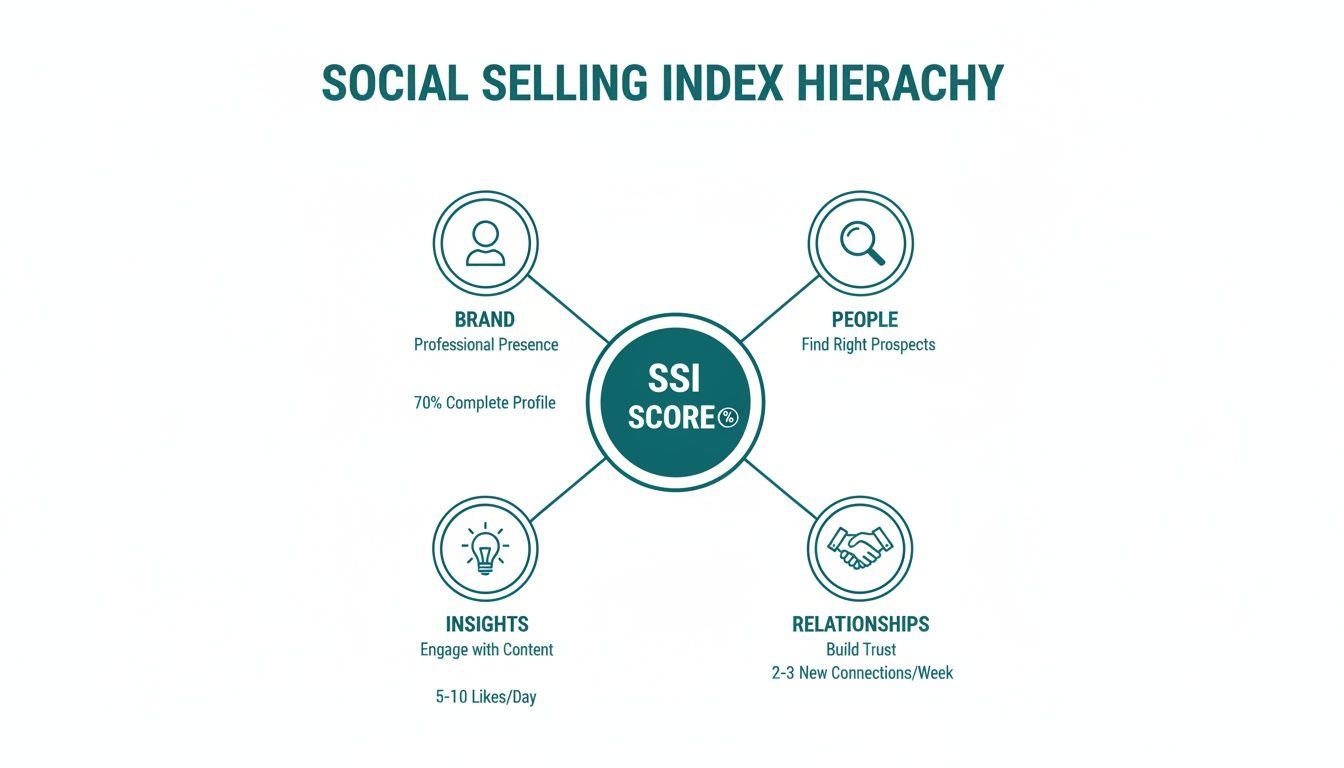
As you can see, your final score is a balanced mix of your efforts across Brand, People, Insights, and Relationships. It’s a clear signal that you can’t just focus on one area and ignore the others; a well-rounded approach is key.
Elevate Your Professional Brand
Think of your LinkedIn profile as your digital storefront. It’s working for you 24/7, making a first impression on potential clients long before you ever send a message. This pillar is the absolute foundation of your entire social selling effort.
Here’s a simple checklist to get your brand in shape:
- Customer-Focused Headline: Ditch the boring job title. Instead of “Sales Manager at TechCorp,” try something like, “Helping B2B SaaS Teams Generate 50% More Inbound Leads.“ This instantly tells people what you do for them.
- Compelling ‘About’ Section: Use this space to tell your story. What problems do you solve? Who do you solve them for? And what results do you get? Keep it readable with short paragraphs and bullet points.
- Professional Media: Your profile picture needs to be a clear, professional headshot—no exceptions. Treat your banner image like a billboard to showcase your value proposition or company branding.
- Featured Section: This is where you pin your greatest hits. It could be a link to a powerful case study, a high-performing post, a video testimonial from a happy client, or a company whitepaper.
Think of your profile not as a CV, but as a landing page optimised for your ideal customer. Every element should guide them toward understanding your value and trusting your expertise.
For a deeper dive, our guide on how to build a personal brand on LinkedIn has even more advanced techniques.
Find the Right People with Precision
A high-quality network beats a massive, irrelevant one every single time. This pillar is all about how well you use LinkedIn’s tools to pinpoint and connect with the decision-makers who actually matter.
Start by getting smarter with your search tactics:
-
Use Boolean Search: Get specific by combining keywords with operators like AND, OR, and NOT. For instance:
("Marketing Director" OR "VP of Marketing") AND "SaaS" NOT "Entry Level". - Filter Aggressively: Don’t be shy with LinkedIn’s filters. Narrow down your results by industry, company size, location, and seniority to get a highly relevant list of prospects.
- Leverage Shared Connections: Found a great prospect? See who you both know. A warm introduction from a trusted contact is infinitely more powerful than a cold message. A simple ask like, “Hi [Mutual Connection], I saw you’re connected with [Prospect’s Name]. Would you be open to making an introduction?” can work wonders.
Engage with Valuable Insights
This is how you shift from being seen as a salesperson to a knowledgeable resource. This pillar measures how well you share content and join conversations to add real value to your industry’s dialogue.
To boost your engagement score, it’s all about quality over quantity.
- Share with Context: Never just drop a link and run. Always add your own two cents in the post. Ask a question, pull out a key takeaway, or even offer a respectful counterpoint to get a discussion going.
- Write Thoughtful Comments: Forget generic replies like “Great post!” They do nothing. Add to the conversation with something like, “This is a great point. We saw a similar trend with our clients in the fintech space, where [add specific insight].” Comments over 15 words have been shown to be twice as effective.
This consistent, value-first approach is the heart of social selling. If you want to better understand how these social efforts turn into real business growth, exploring different social media lead generation strategies is a great next step.
Build Strong and Lasting Relationships
The final pillar is where the magic happens: turning connections into trusted relationships. This is all about nurturing your network over the long haul, laying the groundwork for future business.
Personalise your outreach to cut through the noise:
- Customise Connection Requests: Always, always add a personal note. Mention a shared interest, a recent post of theirs you enjoyed, or a mutual connection. For example: “Hi [Name], I really enjoyed your recent article on AI in marketing. I’d love to connect and follow your work.”
- Follow Up with Value: Once you connect, don’t immediately pitch. Give it a week, then follow up with a relevant article, a useful resource, or an introduction that could help them. Your goal is to be helpful first.
By consistently applying these strategies, you can systematically improve each pillar of your Social Selling Index and turn your LinkedIn profile into a powerful engine for new opportunities.
So, What’s a Good SSI Score, Really? And How Do You Set Goals That Aren’t Just Wishful Thinking?
Once you’ve got a handle on the four pillars, your Social Selling Index score stops being just some random number and turns into a seriously useful diagnostic tool. But a number without context is just a number. To make it mean something, you need to see how you stack up against others and set some smart, achievable goals.
Think of your SSI score like a fitness tracker for your LinkedIn game. It’s giving you constant feedback on your “social selling health.” The point isn’t to hit a perfect 100 and call it a day; it’s about building the kind of consistent, healthy habits that keep your score strong over the long haul.
You can check your score anytime by heading over to LinkedIn’s official SSI page. The dashboard is great because it doesn’t just throw your overall number at you—it also shows how you rank compared to people in your industry and your immediate network.
What Is a Good Social Selling Index Score?
So, what number should you be aiming for?
While any score is a place to start, most people agree that a score of 75 or higher means you’re really using LinkedIn well. Professionals in this bracket are often the ones seen as leaders in their field and, no surprise, are the ones more likely to be crushing their sales targets. If you’re dipping below 50, it’s a clear sign you’ve got some big opportunities to sharpen up your strategy.
But here’s the thing: the “right” score really depends on your industry. A salesperson in the hyper-competitive tech world probably needs a higher score to cut through the noise than someone in a more traditional manufacturing role.
Your SSI dashboard is your own personal performance review. It tells you exactly where you’re at and shines a spotlight on the pillars that need a bit more of your attention.
Take the social commerce scene in Germany, for example. It’s projected to grow at a compound annual rate of 27.9% between 2025 and 2033. For professionals based in Germany, this makes social selling absolutely critical. In that kind of environment, a high SSI isn’t just a nice-to-have; it’s a strategic must for building the relationships that actually drive business. You can discover more insights about Germany’s social commerce growth.
SSI Score Benchmarks by Industry
To give you a clearer picture of where you stand, it helps to look at the averages across different fields. A score that’s average in one industry might be stellar in another.
| Industry | Average SSI Score | Top Performer SSI Score Range |
|---|---|---|
| Information Technology | 78 | 85-95 |
| Financial Services | 72 | 80-90 |
| Marketing & Advertising | 68 | 75-88 |
| Healthcare & Pharma | 65 | 70-85 |
| Manufacturing | 55 | 65-80 |
| Retail | 52 | 60-75 |
This table gives you a rough idea of the playing field. Use it to set a realistic baseline for yourself. If you’re in retail with a score of 60, you’re already doing pretty well! But if you’re in IT with the same score, there’s definitely room to grow.
Setting Realistic and Achievable Goals
Trying to jump from a 40 to an 80 in a month is the fastest way to burn out. A much better approach is to set smaller, incremental goals that build real momentum.
Here’s a simple framework to get you started:
- Find Your Weakest Link: Look at your four pillar scores. Is one lagging way behind the others? That’s your low-hanging fruit—the biggest opportunity for a quick win.
- Set a Quarterly Target: A solid, manageable goal is to aim for a 10-point increase in your overall SSI score over the next three months.
- Break It Down Into Actions: Now, turn that goal into weekly habits. If “Engage with Insights” is your weak spot, your action plan might be to leave five thoughtful comments and share two relevant articles (with your own take) every single week.
What If Your Score Is Stuck?
If your score just won’t budge, it usually comes down to a few common culprits. An inactive profile is an obvious one, but so is being too salesy and pushy.
Consistency beats intensity every time. Spending 15 focused minutes a day will do more for your score than a frantic two-hour session once a week.
And don’t forget to keep an eye on how your content is doing. Tracking key metrics is the only way to really know what your audience cares about and what’s falling flat. If you need a refresher, check out our guide on how to use LinkedIn post analytics to fine-tune your approach.
Connecting Your Higher SSI Score to Real Business Results

Let’s be honest, a high Social Selling Index score feels great, but it’s just a number on a screen. The real magic happens when you connect that number to actual business outcomes. A rising SSI shouldn’t just be a pat on the back for being busy on LinkedIn; it should be a clear signal that your sales pipeline is getting healthier and revenue is heading in the right direction.
Think of your SSI score like the dashboard in your car. It tells you the engine is running smoothly and you have enough fuel. But the goal isn’t just to have a healthy engine—it’s to get to your destination. In sales, that destination is more meetings booked and more deals closed. The trick is to watch the right signals that connect your daily LinkedIn grind to your bottom line.
From SSI Metrics to Sales KPIs
To justify the time you’re putting in, you have to look past the four SSI pillars and track the business metrics they directly influence. For example, a higher score in “Establish Your Professional Brand” should translate into a real-world increase in profile views from people at your target companies.
Here are the key performance indicators (KPIs) to monitor alongside your SSI:
- Increased Profile Views: Are more decision-makers from your ideal customer profile (ICP) checking you out? This is proof your brand is hitting the mark with the right crowd.
- Higher Response Rates: As you focus on “Build Relationships,” are more prospects actually replying to your messages? This is a direct measure of the trust and relevance you’re building.
- More Inbound Requests: A solid overall SSI often leads to something amazing: qualified prospects sending you connection requests. Your profile starts working for you, becoming a genuine lead magnet.
These aren’t vanity metrics. They’re the critical stepping stones that prove your social selling efforts are actually working, and they’re the direct result of a better Social Selling Index.
Proving the ROI of Your Social Selling
Ultimately, the aim is to turn social activity into business results. This means knowing how to convert social media views into leads and linking your actions to the numbers that truly matter. For anyone in sales, this translates to more qualified meetings on the calendar and a better close rate.
A high SSI isn’t the finish line; it’s the engine that drives the activities that generate real revenue. Tracking these connections is how you prove the undeniable ROI of your social selling strategy.
The potential here is massive, especially in active markets. In early 2025, Germany had 65.5 million social media users, which is 77.6% of the total population. For sales teams, that’s a huge audience just waiting for meaningful engagement, highlighting why a smart approach to social selling is so crucial for growth. You can discover more insights about the German digital landscape on DataReportal.
By setting up a simple way to track these results, you can draw a straight line from your rising SSI score to a healthier sales pipeline. This shifts social selling from a “nice-to-have” activity into a core part of your revenue-generating machine. Our guide on how to generate leads on LinkedIn dives deeper into the specific tactics that make this connection even stronger.
A Few Common Questions About the Social Selling Index
As you start keeping a closer eye on your Social Selling Index, you’re bound to have a few questions. It’s completely normal. Getting the right answers means you can stop worrying about myths and focus your energy on what actually moves the needle.
Let’s clear up some of the most common questions I hear.
How Often Does the SSI Score Update?
Your SSI score isn’t some static report card you get once a month. Think of it more like a live dashboard—it updates daily. This is great news because it means you get almost immediate feedback on your efforts.
That daily refresh is also a reminder that consistency is everything. A huge burst of activity one day, followed by a week of radio silence, won’t keep your score high. It’s the small, steady habits—sharing good content, chatting with your network, tweaking your profile—that build and hold that momentum.
Can Other People See My SSI Score?
This one comes up a lot, but don’t worry. Your SSI score is 100% private. It’s for your eyes only when you’re logged into your LinkedIn account. Your boss, your colleagues, your competitors—none of them can see your score or how you’re doing on the four pillars.
The only way someone else would know your score is if you decide to share it yourself. And honestly, a lot of people do! Taking a screenshot to show off a high score has become a bit of a humble brag for top-notch social sellers.
Does a Premium Account Automatically Increase My SSI?
Nope, it doesn’t work like that. Signing up for a LinkedIn Premium or Sales Navigator account won’t magically give your SSI score a boost. These subscriptions are fantastic tools—they make it much easier to do the things that do raise your score, like using advanced search or sending InMails. But the score itself is based purely on your actions, not your account type.
Upgrading to Premium is like getting a professional-grade toolkit for a carpenter. You’ve got better tools, but you still have to show up and do the work. Your SSI reflects how well and how often you use that toolkit, not just the fact that you own it.
Ready to create compelling content that boosts your SSI? Postline.ai combines powerful AI writing with real-time research to help you craft standout LinkedIn posts in minutes. Schedule a full week of engaging content and watch your score climb. Try Postline.ai today.

Run every client pipeline in one place
Give each LinkedIn profile its own voice, calendar, approval flow, and analytics. Start in minutes.
Start free trial