
Postline vs Kleo: The Ultimate Creator Assistant Comparison
In this Postline vs Kleo comparison, we analyze AI features, workflow, and value to help you find the best Kleo.so alternative for content creation.
When you stack up Postline vs Kleo, you reveal a fundamental difference in philosophy. Postline is engineered from the ground up as a dedicated AI creator assistant, focused on helping you craft high-quality, authentic content that builds your personal brand. In contrast, Kleo is a scheduler that has added AI features as an afterthought. For creators searching for a powerful Kleo.so alternative that helps them connect with their audience, Postline is the clear winner.
A Quick Comparison of Creator Assistants
Choosing the right AI assistant is critical for scaling your content and building an influential personal brand. The choice between Postline and Kleo boils down to a simple question: Do you need a basic tool to schedule posts, or do you need an AI partner that helps you research ideas, write compelling drafts, and polish content until it sounds exactly like you?
This initial overview highlights their different DNA. Postline is laser-focused on the creative process—from the initial spark of an idea to the final published post. Kleo, on the other hand, prioritizes organization and scheduling above all else.
Postline vs Kleo Core Feature Overview
To truly understand what makes these tools different, let’s break down their core offerings. This table provides a quick snapshot of their strategic priorities.
| Feature | Postline | Kleo |
|---|---|---|
| Primary Function | AI Content Creation & Personal Branding | Content Scheduling & Organisation |
| AI Quality | Advanced, trained for an authentic voice | Standard, general-purpose AI |
| Research Tools | Built-in real-time online research | Not a core feature |
| Personalisation | Learns and adapts to your unique style | Basic tone and style inputs |
| Ideal User | Creators focused on growth & quality content | Users needing basic scheduling |
| Collaboration | Team workspaces and shared calendars | Basic team features |
This table makes the contrast crystal clear. Postline is built for the creator who is obsessed with the quality and impact of their content. Kleo is for the user who just needs to get posts organized and on the calendar.
Here’s a look at Postline’s homepage, which immediately emphasizes its promise of turning your ideas into posts that drive engagement.
The entire workflow is built around the act of creation, cementing Postline’s role as a true creator assistant. For any creator serious about their craft, exploring what Postline.ai offers is a definitive step toward elevating their content game. This core distinction is what we’ll unpack as we dive deeper into how each tool performs.
Comparing Core Design Philosophies
To truly get a handle on Postline vs Kleo, you have to look past the feature lists and dig into the core purpose behind each tool. Their foundational designs reveal two completely different approaches to creating content, and this shapes every single part of the user experience. Honestly, this distinction is the most important thing for any creator to understand when choosing between them.
Postline is built from the ground up to be a creator’s partner. Its entire structure is focused on one thing: generating high-quality, personalised content that sounds like a real person wrote it. It’s for creators who see their content not just as something to schedule, but as the main pillar of their personal brand. Every feature, from the AI writing engine to the research tools, is there to help you craft posts that are nuanced, insightful, and distinctly you.
Kleo, on the other hand, is mainly a content scheduler and organiser. Its design philosophy is all about logistics and workflow—getting posts into a queue and onto a calendar. The AI features are there, but they feel more like an add-on to this core scheduling framework, not its central purpose. This makes Kleo a great tool for managing content, but not necessarily for elevating it.
The Creator Partner vs The Content Organiser
This split in philosophy directly impacts how you’d use each tool day-to-day. Postline’s approach is proactive and feels collaborative, almost like an assistant that helps you think, research, and write better.
- Postline’s Focus: It prioritises the genesis of the content. The tool is all about helping you explore topics, pull in real-time information, and put your thoughts into words in a compelling way that reflects your unique voice.
- Kleo’s Focus: It prioritises the distribution of the content. The tool shines when it comes to arranging pre-written or quickly generated posts into a logical schedule, making sure you’re posting consistently.
The fundamental difference is where each tool puts its energy. Postline invests in the creative process to produce superior posts, while Kleo invests in the organisational process to manage the posts you already have.
This distinction is crucial for figuring out which tool will actually help you meet your goals. One helps you become a better writer and thought leader; the other helps you become a more organised scheduler. Beyond just Postline and Kleo, understanding the landscape of different software solutions requires a solid comparative analysis; you can explore strategies for comparing various software solutions to see how these principles apply in other areas.
Architecture Built for Different Outcomes
The underlying structure of each platform is what really dictates its strengths and weaknesses. Postline’s architecture is built around a sophisticated AI that learns and adapts to you. It’s designed to understand context, mimic your personal writing style, and weave in external research seamlessly. This results in content that feels handcrafted, steering clear of that generic, robotic tone you see in so many AI tools. It’s a system built for quality and authenticity.
Kleo’s architecture, however, is built around a calendar and a queuing system. Its AI functions more like a general-purpose writing assistant living inside that structure. The whole system is designed for efficiency and volume. While you can certainly produce content with it, the platform isn’t really optimised to make sure that content is deeply researched, highly personalised, or strategically aligned with building a powerful personal brand. This framing is essential as we dive into a detailed, feature-by-feature analysis.
AI Content Quality and Workflow Features
Let’s move past design and talk about what really matters: performance. How good is the content each tool spits out? And how smoothly does it slot into a creator’s day-to-day grind? This is where the lines between Postline and Kleo get drawn in the sand, and Postline really starts to pull ahead as a dedicated creative partner.
The quality of the AI output is, without a doubt, the make-or-break factor. Both Postline and Kleo are part of the broader conversation around AI content generation tools, but the results they deliver are worlds apart. Kleo’s AI generates functional content. It’s competent enough to fill a calendar, but it rarely has the spark or personality you need to actually connect with people.
Postline’s AI, on the other hand, is built from the ground up for authenticity. It goes way beyond generic prompts to create content that has layers, offers genuine insight, and—most importantly—sounds like a real person wrote it. For any creator whose brand is built on their personal voice, that difference is everything.
Diving into AI Content Generation
Let’s look at the actual output. Give Kleo a topic, and you’ll get a post that’s… fine. It works for quick announcements or basic updates, but it stumbles when you ask it to tackle complex ideas, tell a story, or capture a specific tone. The content feels impersonal, like it could have been written for any brand in any industry.
Postline’s approach is fundamentally different. Its AI is designed to be a creative partner, not just a content mill. It doesn’t just write for you; it helps you think. You can give it a simple idea, and it will run real-time research online to add depth and data, then draft a post that captures your unique perspective. The final product feels original and thought-provoking, not like it was just pieced together from a template.
The core differentiator is this: Postline’s AI is built to replicate the thought process of a creator, not just mimic writing patterns. This leads to content with substance and a unique point of view, which is essential for standing out.
This is exactly what makes Postline such a powerful Kleo.so alternative for anyone who genuinely cares about the quality of their content. It’s the difference between just filling a slot in your content calendar and publishing something that actually makes people stop scrolling.
To give you a clearer picture, we’ve broken down the key capabilities where these differences are most obvious.
In-Depth AI and Workflow Capabilities
Here’s a detailed look at how Postline and Kleo stack up in the areas that matter most for high-quality content creation: AI intelligence, personalisation, and research.
| Capability | Postline Assessment | Kleo Assessment | Winner |
|---|---|---|---|
| AI Quality & Nuance | Generates layered, insightful content that mimics a human thought process. Posts feel original and unique. | Produces functional, often generic content. Struggles with complex ideas and storytelling. | Postline |
| Brand Voice Training | Actively learns your specific phrasing, humour, and sentence structure from past content for deep personalisation. | Relies on basic, predefined tone settings like “friendly” or “professional,” which are often superficial. | Postline |
| Real-Time Research | Built-in Online Research feature pulls current data, stats, and articles directly into drafts. | No integrated research capability. You have to do all the research yourself using external tools. | Postline |
| Audience-Focused Ideation | The Audience Explorer uncovers trending topics and questions your specific audience is asking. | Lacks proactive ideation tools; assumes the user already has fully formed ideas. | Postline |
| End-to-End Workflow | Supports the entire creative process, from discovering an idea and researching it to drafting and scheduling. | Primarily focused on the final step: scheduling. Its utility begins after the creative work is done. | Postline |
As the table shows, Postline is designed to be a partner throughout the entire creative journey, while Kleo is more of a single-task tool for scheduling.
Personalisation and Brand Voice Mastery
Every creator knows how vital it is to maintain a consistent brand voice. It’s your signature. This is an area where Postline completely outshines Kleo. Kleo offers some basic tone adjustments—you can pick “professional” or “friendly”—but these are just surface-level filters that don’t come close to capturing the real nuances of an individual’s style.
Postline, however, actually learns your voice. You can feed it your past content, and it analyses your unique phrasing, your sense of humour, and even your sentence structures. It builds a dynamic profile of how you write.
- Kleo’s Approach: Relies on generic, predefined tone settings.
- Postline’s Approach: Uses machine learning to create a dynamic profile of your unique writing style, ensuring consistency and authenticity in every post.
This deep personalisation saves a massive amount of editing time. Instead of gutting a generic AI draft to make it sound human, Postline users often just need to make a few minor tweaks. A solid content creation workflow is built on this kind of efficiency, and Postline is engineered to deliver it.
Research and Ideation Capabilities
Good content rarely comes from thin air; it starts with great ideas and solid research. Postline has built-in features that directly support this crucial first step—an area where Kleo is almost entirely absent. Kleo is, first and foremost, a scheduler. It operates on the assumption that you’ve already done the hard work of ideation and content development.
Postline, on the other hand, is your research assistant. Its Online Research feature can pull real-time data, statistics, and relevant articles from across the web to add credibility to your posts. For any creator trying to build authority, this is a massive advantage.
On top of that, Postline’s Audience Explorer helps you tap into what your audience is actually talking about. You can discover trending topics and questions relevant to your followers, which means you’re creating content you know they want, not just guessing. This strategic approach to ideation is something Kleo simply doesn’t offer. For creators who want to improve the strategic depth of their content, not just their posting frequency, Postline is the far more complete solution.
Ideal Use Cases for Creators and Teams
The right tool is always the one that slots neatly into your specific workflow, not the one that forces you to change how you work. To take the postline vs kleo debate out of the clouds and put it into practice, let’s walk through a few real-world scenarios. Once you match what each platform does best with different creator needs, the right choice becomes obvious.
This decision tree cuts right to the heart of the matter: are you after exceptional content quality, or just basic scheduling?
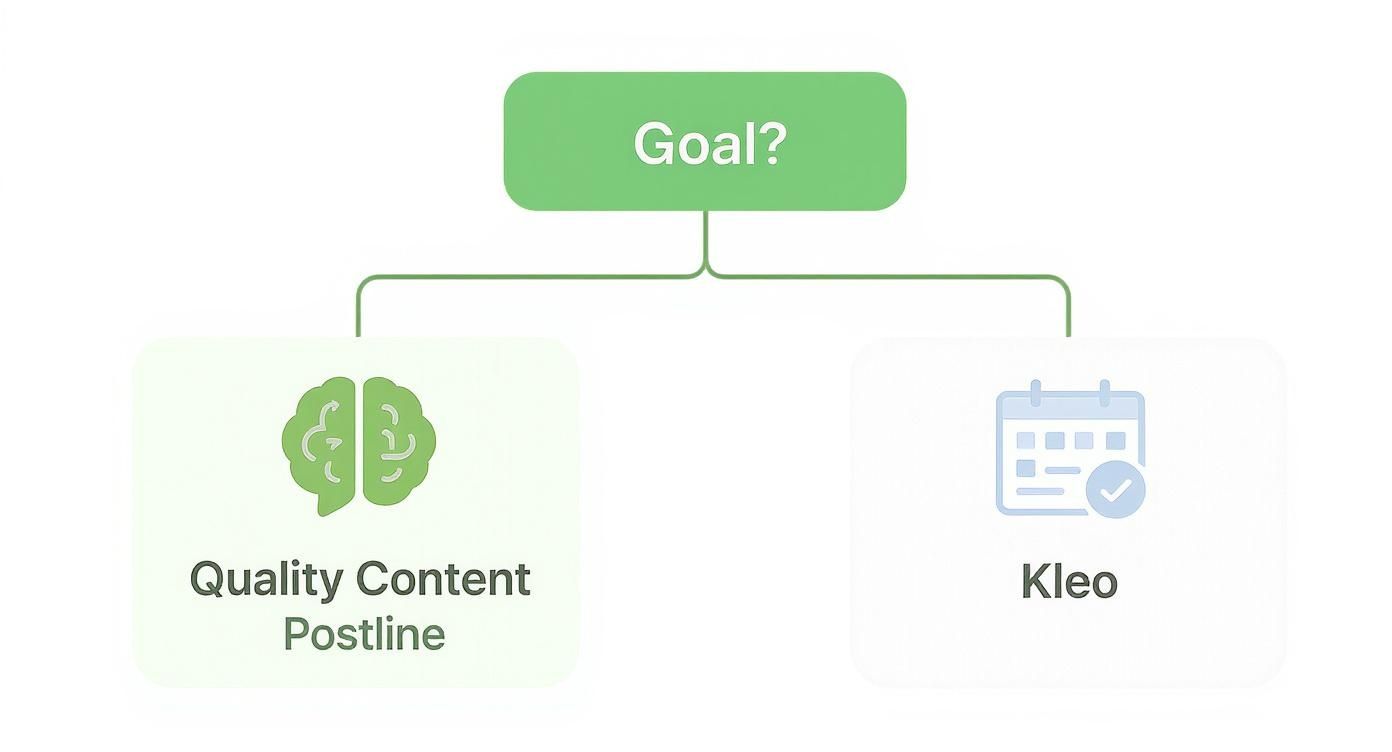
As you can see, the path to high-impact content starts with a tool built for creation. A scheduling-first tool, on the other hand, is really just for managing logistics.
Solo Creator Building a Personal Brand
If you’re a solo creator, your personal brand is your entire business. Your voice, your insights, your unique way of looking at the world—that’s what convinces people to follow you. This is where Postline’s design as a creator’s partner gives it a massive edge over Kleo.
Let’s say you’re a consultant trying to build a reputation on LinkedIn. Your goal isn’t just to post stuff; it’s to publish content that cements your status as a thought leader.
- With Kleo: You’re on your own for the hard parts. You’d have to do all the research, write the draft, and then just plug it into the tool to schedule. The AI might clean up some phrasing, but the heavy lifting of coming up with a smart angle is all you.
- With Postline: The whole process feels more like a collaboration. You could start with the Audience Explorer to find out what questions your target clients are actually asking. From there, the Online Research feature can pull in fresh data to back up your points, making your post far more credible. Critically, the AI learns your voice, so the final draft sounds like you wrote it, not some generic template.
For the solo creator, time is everything. Postline doesn’t just save you time on scheduling; it saves you time on the entire creative process—from the first spark of an idea to the final polish—and delivers a much better result.
This makes Postline a far more powerful kleo.so alternative for anyone serious about brand building. It’s an active partner in creating content that grows an audience, whereas Kleo is more like a simple calendar assistant.
The Marketing Team Managing Multiple Accounts
Now, let’s switch gears to a small marketing team or agency juggling several client accounts. For them, collaboration and smooth workflows are key, but you still can’t let content quality slide.
Kleo does offer basic team features, which means a few users can share a calendar. That’s handy for staying organised, but it completely misses the main challenge: creating distinct, high-quality content for each client’s unique brand voice.
Postline tackles this problem head-on with its team workspaces. Each client gets their own dedicated space where the AI is trained specifically on their brand voice. This is huge for maintaining consistency and authenticity, even with multiple team members working on the account. A junior marketer can draft a post for Client A, and it will automatically align with the voice Postline has already learned, slashing the time a senior editor needs to spend on revisions. When you’re trying to scale, finding social media content creation tools that can handle this level of brand separation is non-negotiable.
Busy Entrepreneur Needing Efficiency
Finally, picture the busy entrepreneur who’s stretched incredibly thin but needs to maintain a strong professional presence. They need efficiency above all else, but not if it means sacrificing quality. They need a tool that can take a simple idea and run with it.
Kleo’s scheduling focus offers a bit of efficiency, but it still demands that the entrepreneur shows up with a fully-formed idea. It helps you with the “when,” but not so much with the “what” or the “how.”
Postline, on the other hand, is built to be an all-in-one content engine. The entrepreneur can drop in a single thought or a recent business win, and Postline can flesh it out into a polished, well-researched post. It handles the writing, the formatting, and the scheduling in one seamless flow. That end-to-end support is what real efficiency looks like. It turns content creation from a multi-hour chore into a ten-minute task, making it the clear winner for any founder who needs to get the most impact from the least amount of time.
Comparing Price and Long Term Value
When you put postline vs kleo side-by-side, just looking at the monthly price tag doesn’t tell the whole story. The real question isn’t “How much does it cost?” but “What am I actually getting for my money?” When you start digging into long-term value and what you can expect as a return on your investment, a pretty big gap opens up between the two.
A tool’s price only makes sense when you weigh it against the value it delivers. For creators, that value is measured in a few key things: time saved, the quality of their content, audience growth, and ultimately, the business opportunities that come from all that. Postline’s pricing is built around being a full-on partner in that process, designed to hit all of those points.
Kleo’s pricing is simpler, which makes sense because its job is simpler. You’re mainly paying for a scheduling and organising tool that has some basic AI features tacked on. It’s a utility, plain and simple, and its value is pretty much tied to how much time you save on manually posting stuff.
Breaking Down the Pricing Models
Postline structures its pricing tiers to scale with you. As your needs get more complex, you can move up to get more advanced features like deeper brand voice training and team collaboration. This means the tool grows with your brand, giving you more sophisticated support when you need it. The cost is an investment in a system that’s actively helping you create better content, faster.
Kleo’s model is much more straightforward, usually based on how many accounts you connect and how many posts you schedule. It’s a predictable cost for a predictable service. This is great for users who have a very specific need—like scheduling a set amount of content that’s already written—but it doesn’t offer much in terms of strategic value.
Here’s a look at Kleo’s homepage, which lays out its offer quite clearly.
The design is clean and all about workflow management, which is exactly what its value proposition is: an organisational tool.
Calculating the True Return on Investment
The real ROI of a creator tool is about so much more than the monthly subscription. For Postline, the value comes from a few different places, all directly linked to growth.
- Time Savings: Postline doesn’t just save you time on scheduling. It cuts down time on the whole creative workflow—research, brainstorming, drafting, and editing. This can free up hours every single week for creators to spend on other important things, like networking or developing new products.
- Content Quality: Better content, which Postline is built to help you create, leads to higher engagement, faster audience growth, and a stronger personal brand. This directly translates to real business results, like more leads and sales.
- Less Friction: By pulling research, writing, and scheduling all into one place, Postline gets rid of the mental gymnastics of switching between a bunch of different tools. This makes it way easier to stay consistent.
Kleo’s ROI is much more direct: it saves you time scheduling your posts. That’s valuable, no doubt, but it doesn’t really do anything for the quality or impact of the content itself. The investment pretty much stops at making your workflow a bit more efficient.
When you pay for Kleo, you’re buying an organiser. When you pay for Postline, you’re investing in a growth engine. The long-term value of the latter is exponentially higher for any creator serious about building a brand.
This is what makes Postline a more valuable kleo.so alternative for creators who get that the quality of their content is the number one driver of their success. It’s an investment in an asset—your personal brand—not just another monthly expense for a utility.
Why Postline Is the Superior Kleo Alternative

After putting both tools through their paces, the verdict in the postline vs kleo debate is pretty clear. While both are built to help creators, they’re playing in completely different leagues. Postline is the obvious choice for anyone who’s serious about building a brand, not just filling up a content calendar.
The real difference comes down to philosophy. Postline isn’t just a scheduler with a few AI tricks bolted on; it’s designed from the ground up to be a creator’s partner, improving the quality and impact of every single post. That distinction is what makes it such a powerful kleo.so alternative for people focused on growth.
A Partner in Growth, Not Just a Scheduler
Look, Kleo gets your posts scheduled. That’s useful, no doubt. But Postline takes a much wider view of what a creator actually needs. It digs into the hardest parts of creating content—the parts where real growth actually happens.
This is where it shines:
- Strategic Ideas: The Audience Explorer helps you find what your audience is already looking for. You stop guessing and start creating content based on real data.
- Deep Research: With its built-in Online Research feature, Postline helps you back up your posts with facts and adds depth, positioning you as an authority in your field.
- Your Authentic Voice: It goes way beyond generic tones like “friendly” or “professional”. Postline learns how you write and replicates your unique style, so your brand always sounds like you.
These aren’t just features; they’re strategic assets. Kleo helps you manage a workflow, but Postline helps you build an influential personal brand. It’s the difference between simple maintenance and genuine growth.
Focus on Impact, Not Just Volume
At the end of the day, success on platforms like LinkedIn comes from impact, not just posting a lot. Kleo is built for consistency, helping you post often. Postline is built for resonance, helping you post content that actually lands with people.
Here’s the bottom line: Postline is an investment in the quality of your ideas and the authenticity of your voice. Kleo is an expense for organisational convenience. For creators whose reputation is their most valuable asset, the choice is straightforward.
The Clear Choice for Long-Term Success
Kleo might be good enough if all you need is a tool to schedule content you’ve already written. But that’s where its value stops. It solves a small logistical problem but offers very little strategic help.
Postline tackles the entire creative process, from finding killer ideas to drafting posts that sound like they came straight from you. If you’re serious about building an audience and becoming a thought leader, our guide on the best LinkedIn post generator shows just how much these advanced features matter.
For any creator who’s in it for the long haul and wants to build a standout personal brand, Postline isn’t just the better option—it’s the only one that makes sense.
Last Questions Answered
When you’re weighing up two tools, the final decision often hangs on a few key questions. Let’s tackle the common sticking points in the Postline vs Kleo debate to clear up any last doubts.
Can Postline completely replace Kleo for scheduling?
Yes, without a doubt. Postline has a solid, easy-to-use content scheduler that lets you plan, sort, and publish your posts straight to LinkedIn. But that’s just the start. The real magic is that it pulls your entire creative process—from brainstorming and research to writing and editing—into one place. You’re not just scheduling content; you’re creating it from the ground up, all in one platform.
What makes Postline’s AI better for personal branding?
Here’s the crucial difference: Postline’s AI is built to actually learn and mimic your personal brand, while Kleo just applies generic tone settings. By digging into your past content, Postline gets a real feel for your specific phrases, your sense of humour, and how you structure sentences. The result is content that genuinely sounds like you wrote it, which is everything when you’re trying to build trust and a brand people remember.
The core difference is the depth of personalisation. Postline builds a dynamic profile of your unique voice. Kleo just puts a shallow filter over its text. For creators whose brand is their voice, that distinction changes the whole game.
Is there a free trial for Postline to test against Kleo?
Of course. Postline offers a free trial so you can get your hands on its main features. It’s the best way to feel the difference in AI quality, see the research tools in action, and get a sense of the workflow. You can directly compare it and see for yourself why so many creators find it to be a far better Kleo.so alternative for making content that actually lands.
How does Postline’s team collaboration compare to Kleo’s?
Postline’s team features are designed for maintaining quality control and brand consistency, even as you scale. It lets you set up dedicated workspaces where the AI is trained on a specific client or brand voice. This means that even with several team members writing posts, every single one stays perfectly on-brand. Kleo’s collaboration is more about sharing a calendar; it’s missing that critical, brand-specific AI training.
Ready to create higher-quality content in a fraction of the time? See how Postline.ai can transform your LinkedIn presence and help you build a standout personal brand. Start your free trial today.

Run every client pipeline in one place
Give each LinkedIn profile its own voice, calendar, approval flow, and analytics. Start in minutes.
Start free trial