
Postline vs Jasper A Definitive Comparison for LinkedIn Creators
Choosing between Postline vs Jasper? This guide analyzes features, output quality, and real-world use cases to help you find the best AI writer for LinkedIn.
The real difference boils down to this: Postline.ai is a specialised tool, built from the ground up for one thing—creating killer LinkedIn content. Jasper, on the other hand, is a general-purpose AI writer, a jack-of-all-trades designed for a huge range of marketing tasks.
Your choice really depends on whether you need a dedicated LinkedIn expert in your corner or a versatile AI assistant that can do a bit of everything.
Postline vs Jasper The Quick Verdict

When you stack Postline against Jasper, the right choice becomes obvious once you know your main goal.
If you’re all in on building a personal brand, drumming up leads, or cementing your status as a thought leader specifically on LinkedIn, Postline is the clear winner. It’s engineered with features that get the little details of the platform just right.
But if you’re a marketing pro or an agency juggling content for blogs, emails, social media, and ads, Jasper’s broader, more flexible toolkit makes more sense. It can definitely write a LinkedIn post, but it just doesn’t have the specialised tools—like real-time research or deep voice learning—that give Postline its edge for anyone serious about LinkedIn.
At-a-Glance Showdown Postline vs Jasper for LinkedIn
To make things even clearer, this table cuts straight to the chase, highlighting the core differences between the two platforms when it comes to creating content for LinkedIn.
| Criterion | Postline | Jasper |
|---|---|---|
| Core Purpose | A dedicated AI assistant for LinkedIn content creation, scheduling, and brand building. | A versatile AI content platform for various marketing needs (blogs, ads, emails, etc.). |
| LinkedIn Specialisation | High. Features are built specifically for LinkedIn, including voice learning, audience research, and native scheduling. | Low. Relies on general templates that can be adapted for LinkedIn but lack platform-specific tools. |
| Ideal User | Founders, sales leaders, consultants, and creators focused on mastering their LinkedIn presence. | Marketing teams, agencies, and general content creators who need a multi-channel AI writer. |
| Key Differentiator | Deeply personalised output through voice learning and real-time data integration for timely, relevant posts. | Broad functionality with over 50 templates, brand voice features, and extensive integration options. |
| Value Proposition | Achieve superior LinkedIn results with less effort through a highly focused, expert tool. | A single AI solution to handle diverse content creation tasks across your entire marketing strategy. |
Think of it this way: Postline is the sharp, specialised knife you use for a precise cut, while Jasper is the multi-tool you keep in your bag for any job that comes up. Both are useful, but you wouldn’t use a multi-tool for surgery.
Comparing the Core Design Philosophies
To really get to the bottom of the “Postline vs Jasper” debate, you have to look past the feature lists. You need to understand the core idea behind each tool. Why was it built? Who was it built for? This is the single most important factor in your decision.
Postline was built from the ground up with one mission: master LinkedIn content. It’s a specialist tool, designed for a very specific environment. All of its development muscle is focused on solving the unique challenges of building a personal brand on that single platform.
Jasper, on the other hand, was created to be a versatile, all-in-one AI writing assistant. Its philosophy is breadth over depth. It’s the jack-of-all-trades for content marketers, giving you a massive toolkit to handle everything from blog posts and ad copy to emails and social media updates across a dozen different channels.
The Specialist Postline Approach
Postline’s specialisation is obvious the moment you start using it. Every feature feels tuned for LinkedIn’s algorithm and what a professional audience expects. It’s built to generate hooks that stop the scroll and even pull in real-time industry news to keep your content fresh. This tight focus means it doesn’t have to be good at everything; it can be great at one thing.
What you get is an experience that feels completely intuitive for anyone serious about LinkedIn. You aren’t trying to bend a generic tool to fit your needs—you’re using a tool that was made exclusively for the job at hand.
The big idea with Postline is that success on LinkedIn isn’t just about good writing. It’s about being timely, authentic, and strategically consistent. A specialist tool is just better equipped to deliver on all three.
Take a look at the Postline dashboard. It’s all about LinkedIn, right from the start.
The interface immediately puts the post generator, scheduler, and content ideas front and centre, all organised within a LinkedIn content calendar. There’s no fluff.
The Generalist Jasper Framework
Jasper’s approach gives you a powerful, central hub for all things content. Its biggest strength is its incredible versatility. A marketing team can use it to draft a long-form article in the morning and then switch gears to create Facebook ad variations in the afternoon, all without leaving the platform.
This “one tool to rule them all” model is perfect if your content strategy is spread thin across multiple fronts. But that same breadth means it lacks the finely-tuned, native features that make a specialist tool so effective for a single platform. When you use Jasper for LinkedIn, you’re essentially using a powerful but generic text editor. You have to rely heavily on your own prompting skills to get a result that feels right for the platform.
If you’re curious about other options, our guide on social media content creation tools offers a wider view.
Ultimately, the choice between Postline and Jasper comes down to this difference in philosophy. Do you need a sharp scalpel designed for the precise surgery of building a brand on LinkedIn? Or do you need a versatile multi-tool that can handle any marketing task you throw at it? Your answer to that question points you directly to the right solution.
A Deep Dive into LinkedIn-Specific Features

When you’re trying to choose between Postline and Jasper, the real difference shows up when you dig into the features built specifically for LinkedIn. A general-purpose AI writer can get you a decent post, sure. But a tool with specialised features can create content that truly connects with the unique professional vibe of LinkedIn. This is where a focused tool really leaves a generalist one behind.
Postline was built from the ground up with a LinkedIn-first approach. Its features aren’t just adapted for the platform; they’re native solutions for the everyday challenges of creating content there. Jasper is a powerhouse, no doubt, but it gives you a broad set of templates that you then have to adapt and tweak for LinkedIn.
Let’s get into how that plays out in the real world.
Personal Voice Learning And Authenticity
One of the biggest struggles with any AI tool is making the output actually sound like you. Authenticity is everything on LinkedIn. If your posts sound like they were written by a robot, people will just scroll right past.
Postline hits this problem head-on with its Personal Voice Learning feature. It scans your past LinkedIn posts to pick up on your specific tone, the words you use, how you structure sentences, and even your emoji habits. What you get is AI-generated content that sounds a lot like your own personal brand, which means way less time spent editing.
Jasper’s “Brand Voice” is similar in concept but works on a much broader level. You can feed it documents, website URLs, and style guides to learn a company’s voice. This is great for keeping things consistent across all your marketing channels, but it’s not as direct for capturing an individual’s unique LinkedIn style. It takes more work to set up and isn’t naturally tuned for the short, conversational posts that do well on the platform.
Key Takeaway: Postline’s voice learning is a precision instrument for individual LinkedIn profiles, learning straight from the source. Jasper’s voice feature is a solid, company-level solution that can be pointed at LinkedIn but needs more deliberate training.
Real-Time Research For Timely Content
Staying relevant is the name of the game for engagement. A post about a trending topic in your industry will almost always do better than a generic one. This is where the Postline vs Jasper comparison shows a real fork in the road.
Postline builds real-time online research right into its workflow. You give it a topic, and it can go out and find current news, stats, or articles, then weave that info into your post—often citing the sources. This lets you jump on market changes quickly and establish yourself as someone who’s in the know.
For example, you could ask Postline to write about “the impact of new AI regulations on small businesses,” and it would pull in recent developments to flesh out the draft.
To get the same result in Jasper, you have to do the legwork yourself. You’d need to do the research, pull out the key points and links, and then feed all that context into a detailed prompt. Jasper can’t independently browse the web for fresh information to create a new piece of content.
Native Scheduling And Workflow Integration
Posting consistently is a huge factor in keeping the LinkedIn algorithm happy. Both tools have an answer for this, but their approaches show their different design philosophies.
Postline has a built-in post scheduler that’s baked right into the content creation process. You can generate a post, format it, and schedule it for a specific time and date without ever leaving the app. This creates a smooth, end-to-end workflow for managing your LinkedIn content. It even has status labels to help you keep your content pipeline organised from draft to published.
Jasper doesn’t have its own social media scheduler. Its entire focus is on generating content. To schedule something you create in Jasper, you have to copy the text and paste it into a separate, third-party tool like Buffer or Hootsuite, or just schedule it directly in LinkedIn. Many teams already use these tools, but it adds an extra step and often another subscription to your workflow. For more ideas on this, check out our guide on how to automate LinkedIn posts.
LinkedIn Feature Performance Matrix
The table below breaks down the practical differences you’ll experience when using each tool for day-to-day LinkedIn tasks. It’s not just about what features exist, but how they actually perform where it matters.
| Feature | Postline | Jasper |
|---|---|---|
| Voice Training | Learns directly from your past LinkedIn activity for a highly personal tone. | Learns from brand documents and URLs for broader, company-level voice consistency. |
| Data Integration | Actively researches real-time news and data to create timely, relevant posts. | Relies on the user to provide all external information and context within the prompt. |
| Scheduling | Includes a native, integrated scheduler for an all-in-one workflow. | Requires a separate, third-party tool to schedule content, adding a step to the process. |
| Formatting | Automatically applies LinkedIn-best-practice formatting, including hooks and CTAs. | Requires specific instructions within the prompt to generate well-formatted posts. |
When you look at it this way, it’s clear that Postline’s features are designed as a complete, interconnected system for winning on LinkedIn. Jasper offers powerful, individual tools that you can aim at LinkedIn. The right choice really comes down to whether you prefer an integrated, specialised solution over a versatile, multi-purpose toolkit.
Evaluating AI Output Quality and Authenticity
At the end of the day, an AI writer is only as good as what it writes. You can have all the features in the world, but if the content comes out sounding robotic, generic, or just not you, the tool has failed. This is where the difference between a specialist and a generalist really comes into sharp focus.
When you put Postline and Jasper head-to-head, it’s about more than just generating text. It’s a test of nuance, tone, and that hard-to-pin-down quality: authenticity. On LinkedIn, personal branding is everything, so sounding like a real human isn’t just a bonus—it’s the entire game. Let’s see how each tool handles this challenge.
The Personal Voice Learning Showdown
The single biggest challenge for any AI writer is capturing a person’s unique voice. It’s your specific way of phrasing things, your go-to vocabulary, even how you use emojis that makes your content feel like it’s actually coming from you. This is where Postline’s focused design gives it a real edge for LinkedIn.
Postline’s Personal Voice Learning is laser-focused. It scans your past LinkedIn posts to learn your style directly from the source. By training on the exact type of content you plan to create, it gets a feel for the subtle patterns that define your online persona. The result? Drafts that need far less editing to sound like you.
Jasper’s “Brand Voice” is certainly powerful, but it’s built for a much broader purpose. You feed it your website copy, marketing materials, and brand style guides. This is brilliant for keeping a company’s voice consistent across different channels. But for an individual’s conversational LinkedIn profile, it’s a bit indirect. You have to do more work prompting it and steering it away from a more formal, corporate tone.
Key Insight: Postline learns your LinkedIn personality by studying your LinkedIn activity. Jasper learns your brand messaging by studying your company documents. For individual thought leaders, Postline’s approach is faster and more direct.
Side-by-Side Post Generation Example
Let’s see how this actually plays out. We’ll give both tools the same simple prompt and look at the raw, unedited output.
Prompt: “Write a LinkedIn post about the importance of deep work for productivity in a world full of distractions.”
Postline’s Output
Hook: In a world of constant notifications, is “deep work” the last real competitive advantage?
Body: It’s easy to confuse being busy with being productive. Answering emails, hopping on calls, and reacting to pings all feel like work, but they often keep us in the shallows.
Real breakthroughs happen when we disconnect and focus intensely on a single, cognitively demanding task. This is the essence of deep work. It’s not about working more hours; it’s about making the hours you work count.
Just 90 minutes of uninterrupted focus can produce more value than a full day of distracted multitasking.
Call to Action: What’s your best strategy for blocking out distractions and getting into a state of deep work? Share your tips below!
Hashtags: #DeepWork #Productivity #Focus #FutureOfWork
Jasper’s Output
Hook: Are you truly being productive or just busy? The concept of “deep work” is critical for professionals today.
Body: In our digitally connected world, distractions are everywhere. Constant notifications and the pressure to multitask can severely hamper our ability to produce high-quality work. This is where the practice of deep work, popularised by Cal Newport, comes in.
Deep work refers to the ability to focus without distraction on a cognitively demanding task. It’s a skill that allows you to quickly master complicated information and produce better results in less time. By setting aside specific blocks of time for focused effort, you can elevate your productivity and output.
Call to Action: How do you incorporate deep work into your routine? Let me know in the comments.
Hashtags: #ProductivityTips #DeepWork #WorkSmarter #ProfessionalDevelopment #Focus
Analysis of the Outputs
Let’s be clear: both outputs are good. You could post either one without much trouble. But the small differences highlight the core philosophies of each tool.
Postline’s version just feels more like a LinkedIn post. It kicks off with a punchy question, drops in a bolded statistic to make you stop scrolling, and keeps the tone conversational. The structure is built for someone scanning on their phone. It’s the kind of subtle polish you’d expect from the best LinkedIn post generator.
Jasper’s output is well-written and smart, but it reads more like a miniature blog article. It correctly attributes the concept to Cal Newport, which shows off its massive knowledge base. However, you’d likely want to tweak it to better match the quick, punchy rhythm of the LinkedIn feed. To get a better handle on the strengths of each tool and to see the bigger picture of how AI is being used for content creation in small and medium businesses, it’s worth digging deeper.
This comparison really shows that while Jasper produces quality text, Postline produces quality LinkedIn content with less fuss.
Comparing Pricing Models and Real-World Value
Money talk is never just about the price tag. It’s about what you get back for what you spend. When you put Postline and Jasper side-by-side on cost, their pricing tells the story of what they are: one is a specialised, all-in-one machine for LinkedIn, the other is a generalist’s toolkit priced for all sorts of marketing tasks.
Postline.ai keeps things simple. It’s a tiered subscription where the main difference is how many posts you can create and schedule each month. Crucially, every plan gets you the full feature set—Personal Voice Learning, real-time research, the scheduler, everything. It’s an all-inclusive deal, so you’re never locked out of the tools you need specifically for LinkedIn.
Jasper is a bit more complicated. Its pricing revolves around word credits, the number of users, and access to premium features like Brand Voice and Campaigns. For a solo creator, the starting price might look similar to Postline’s. But to get the kind of specialisation that actually competes with what Postline offers out of the box—like deep voice learning and team features—you’ll find yourself needing to jump to a pricier plan.
Unpacking the True Cost
Let’s play this out with a real-world example. Imagine you’re a consultant aiming to publish 20 solid, well-researched LinkedIn posts every month.
With Postline, one subscription has you covered from start to finish. You’ve got your idea generation, AI writing tuned to your voice, data-backed insights, and scheduling all under one roof. The cost is fixed and predictable. Simple.
Now, let’s try that with Jasper. You’ll burn through your word credits writing the posts, sure. But then what? You still need to schedule them. That means you’re looking at another subscription for a tool like Buffer or Hootsuite. This “à la carte” method means your total monthly bill is suddenly higher, and your workflow is clunkier, involving a lot of copying and pasting between different tabs.
Key Insight: The real value here isn’t just about the price—it’s about the efficiency. Postline bundles the entire LinkedIn content workflow, saving you money on extra tools and saving you precious time.
This shifts the decision from “which is cheaper?” to “which model actually solves my problem?”. If your professional world revolves around LinkedIn, an integrated system like Postline offers a much better return by cutting out friction and hidden costs. If LinkedIn is just one small part of a bigger content strategy, maybe Jasper’s flexible credits make more sense.
But for most of us trying to build a personal brand on LinkedIn, Postline’s focused, all-in-one value is tough to argue with.
Making the Right Choice for Your LinkedIn Strategy
Choosing between Postline and Jasper isn’t about finding a one-size-fits-all “winner.” It’s about picking the right tool for your specific job. The decision really boils down to your workflow, how much content you’re creating, and most importantly, where your professional energy is best spent.
When you get right down to it, the Postline vs Jasper debate is a classic case of specialisation versus versatility.
Postline is the obvious choice for people and teams who are all-in on LinkedIn. If your main goal is building influence, drumming up leads, and cementing your status as a thought leader on the platform, this is your tool.
If your professional reputation and business pipeline are tied directly to your LinkedIn presence, a specialised tool isn’t a luxury—it’s a strategic advantage. Postline’s focused feature set is built to maximise your impact on this single, crucial platform.
The Ideal Postline User
You’re a perfect match for Postline if you’re a founder, consultant, sales leader, or creator who treats LinkedIn as your primary stage. You need a tool that gets the platform’s unwritten rules, from replicating your authentic voice to creating timely, relevant content.
Your goal is to consistently put out high-quality, personalised posts without it eating up your entire week. Having a scheduler and research function built right in isn’t just nice to have; it’s essential for a streamlined workflow. To really get the most out of it, you should pair the tool with a solid LinkedIn content strategy.
The Ideal Jasper User
On the other hand, Jasper is the better bet for large content agencies, marketing teams, and freelancers juggling a wide variety of client needs across different channels.
If your to-do list involves blog posts, email campaigns, ad copy, and social media updates for five different platforms, Jasper’s broad toolkit offers unbeatable flexibility. Your priority is a single, powerful AI assistant that can handle pretty much any content format you throw at it.
This decision tree can help you visualise which path makes the most sense for you.
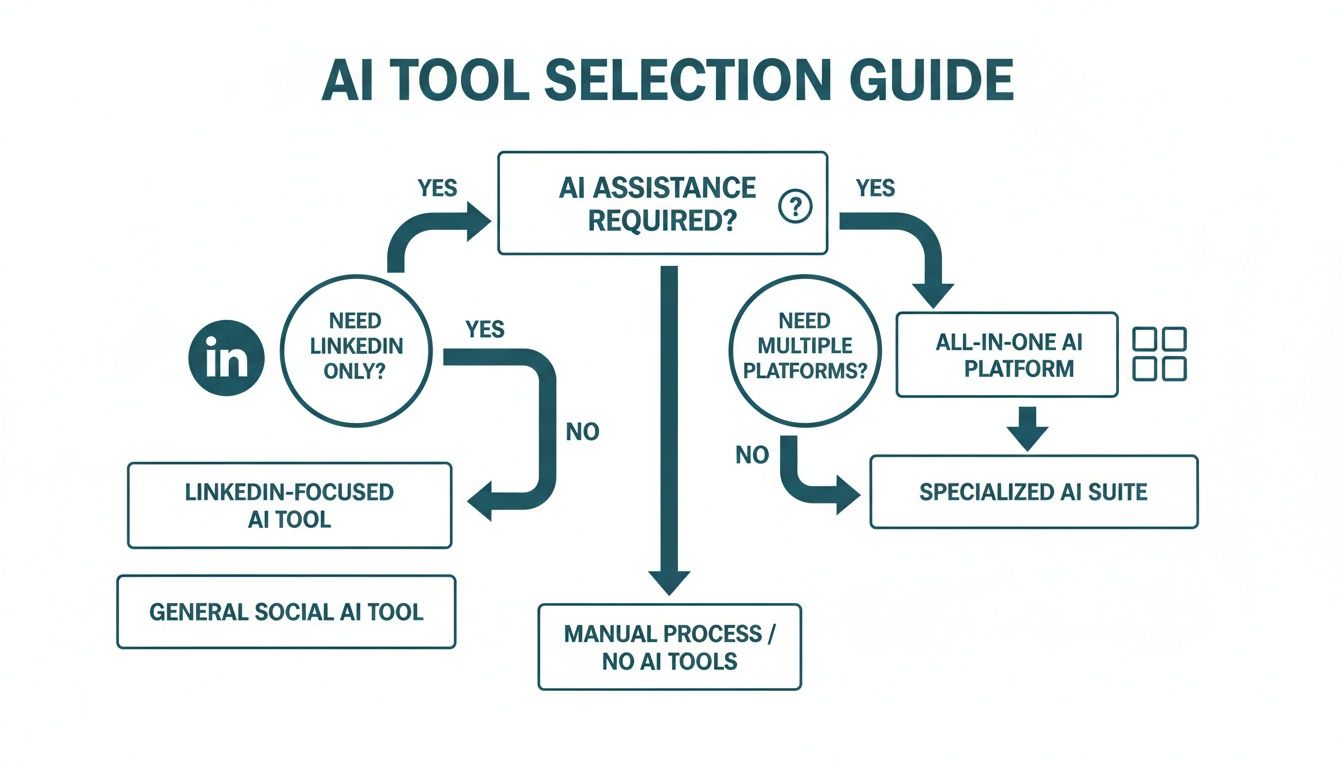
The graphic makes it clear: if your focus is mastering LinkedIn, a dedicated tool is your most direct route to success.
Of course, Postline and Jasper aren’t the only options out there. A freelancer’s tech stack can include a whole host of different AI tools to boost productivity. You can find a comprehensive list of AI tools for freelancers if you want to explore further.
Ultimately, the best advice is to invest in the platform that directly supports your most important business goals.
Your Questions, Answered
Even after a side-by-side look, you might still have a few questions rolling around. Let’s tackle the common ones to help you lock in your decision.
Can I Still Get Good LinkedIn Content Out of Jasper?
Of course. Jasper is a beast of an AI writer, and if you know how to talk to it, you can definitely generate decent LinkedIn posts. Give it the right tone, tell it the format you want, and it can write intelligently on just about anything you throw at it.
But here’s the catch: getting that content to sound genuinely you and fit LinkedIn’s vibe takes more legwork. You’ll be the one doing the real-time research, feeding it specific stylistic cues, and probably spending more time editing to smooth out the corporate-speak. It’s doable, but it’s not specialised.
How Fast Does Postline Actually Learn My Writing Style?
Postline’s Personal Voice Learning gets to work right away. The moment you connect your LinkedIn account, it starts analysing your past posts to build a profile of your tone, vocabulary, and even how you structure your sentences. It’s surprisingly quick.
You’ll see its influence from the very first drafts it spits out. Better yet, it never stops learning. Every time you use Postline and tweak its suggestions, it gets smarter and more dialed-in to your personal brand.
The Bottom Line: Jasper can be told to mimic a voice if you give it enough direction. Postline is built to absorb your voice with almost no effort, getting you to authentic-sounding content much faster.
What’s the Repurposing Workflow Like in Each Tool?
This is a big one, as repurposing content is a massive time-saver. But how each tool handles it is completely different.
Jasper is a repurposing powerhouse. Its strength lies in taking one piece of content and spinning it out for multiple channels. You can drop in a long blog post and ask it to generate:
- A whole series of LinkedIn posts.
- A summary for your email newsletter.
- A handful of tweets and some ad copy.
If you need a central hub for a wide-ranging content strategy, Jasper is incredibly efficient.
Postline, on the other hand, keeps its focus squarely on LinkedIn. You can give it a link to an article or a single idea and ask it to create several different posts from that one prompt. It’s fantastic for building a content series or just exploring different angles on the same topic, all within the LinkedIn ecosystem. It’s not designed to take that content and reformat it for your email list or Twitter feed.
Ready to see what an AI tool built from the ground up for LinkedIn can do for you? Postline.ai has the specialised features you need to create authentic, timely, and engaging content in minutes, not hours. Start your free trial today and feel the difference a specialist makes.

Run every client pipeline in one place
Give each LinkedIn profile its own voice, calendar, approval flow, and analytics. Start in minutes.
Start free trial