
Lead Generation LinkedIn: Mastering lead generation linkedin for a full pipeline
Discover proven tactics for lead generation linkedin: optimize your profile, craft content that converts, and build a predictable sales pipeline.
Your LinkedIn profile is your digital storefront. It’s often the very first impression you make, so before you even think about outreach or content, you need to get this foundation right. This isn’t just about looking professional; it’s about strategically building a presence that makes your ideal clients stop scrolling and take notice.
Building a Profile That Attracts Your Ideal Clients
Think of your LinkedIn profile less like a digital CV and more like a dedicated landing page for your brand. Every single element—from your headline to your summary—needs to work together to answer one critical question for a potential lead: “How can this person solve my problem?” A profile that’s truly optimised for lead generation doesn’t just list your past jobs; it builds instant trust and positions you as the go-to expert in your niche.
Craft a Compelling Value Proposition in Your Headline
Your headline is the most valuable real estate on your entire profile. It follows you everywhere on LinkedIn, showing up next to your name in search results, in the feed when you comment, and in every connection request you send. Don’t waste it with a generic job title like “CEO at Company X.”
Instead, turn it into a powerful, client-facing value proposition. A great headline clearly states who you help and what outcome you deliver.
For instance, a financial consultant could go from “Financial Advisor at ABC Firm” to “I Help Tech Founders Navigate Exit Strategies & Maximise Their Wealth.” See the difference? The second one immediately speaks to a specific audience and their ultimate goal, making it infinitely more effective at grabbing the right person’s attention.
Tell a Story in Your Summary
The “About” section is your chance to expand on the promise you made in your headline. This is where so many people go wrong, writing a dry, third-person biography that reads like an old-school résumé.
Your summary should tell a story that connects directly with your ideal client’s pain points and aspirations. A simple structure works wonders here:
- The Hook: Start with a strong opening that grabs their attention by addressing a key challenge they’re facing right now.
- The Solution: Briefly explain how you solve that specific challenge. What’s your approach?
- The Proof: Back it up. Share a key result, a powerful statistic, or a short client success story to build credibility.
- The Call to Action: Tell them exactly what to do next. Invite them to connect, visit your website, or book a call.
A strong personal brand is the bedrock of effective LinkedIn lead generation. It’s what separates you from the noise and makes prospects want to connect with you before you even send a message.
This whole process—from profile to company page—is about creating a seamless experience for your potential leads.
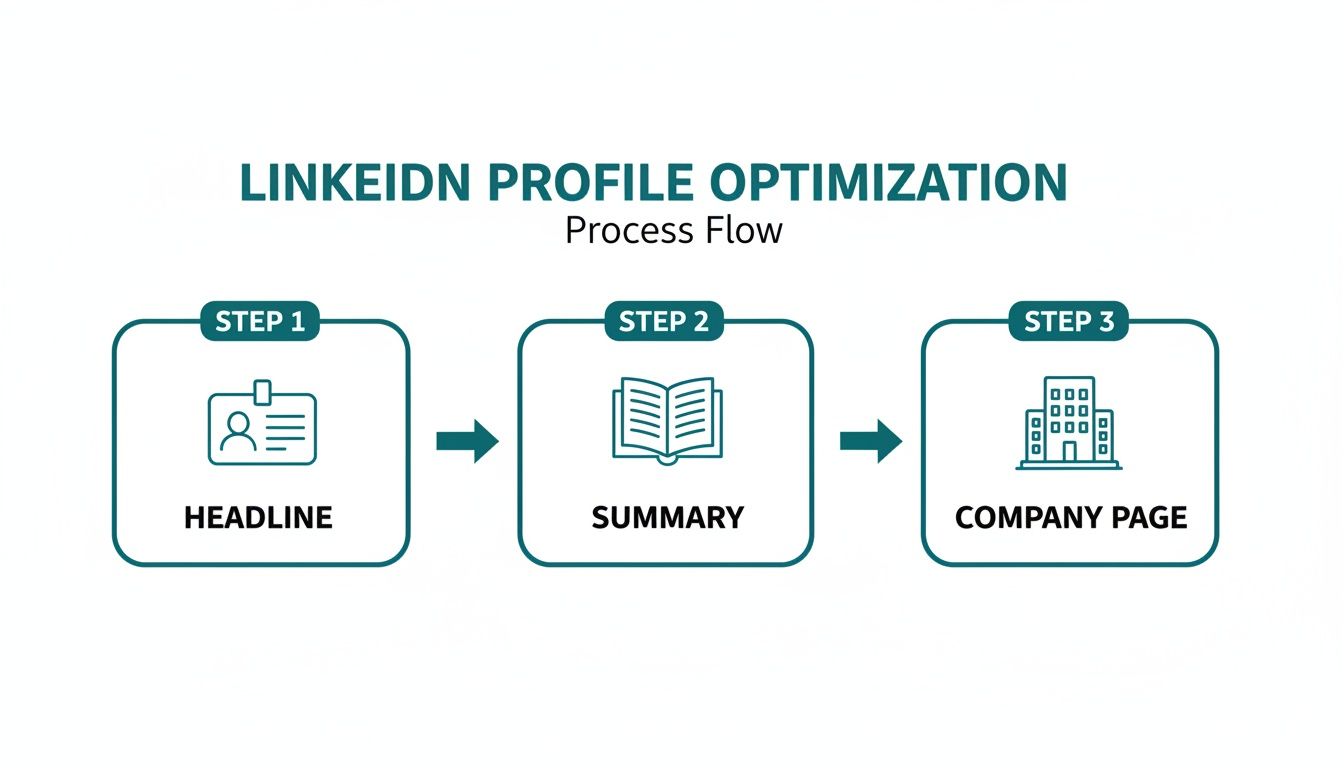
As you can see, a powerful headline is what first grabs their attention. From there, a compelling summary builds trust, and a polished company page provides the social proof they need to take the next step. For a deeper dive, you can learn more about how to build a personal brand on LinkedIn in our detailed guide.
Developing a Content Strategy That Generates Inbound Leads
Think of your optimised profile as a firm digital handshake. That’s a great start, but it’s your content that really gets the conversation going. If you want to generate quality leads on LinkedIn, you can’t just throw posts at the wall and see what sticks. You need a deliberate strategy that turns your feed into a magnet for inbound interest, cementing your authority long before you ever click “connect.”
Your content is the engine of your lead generation machine. A smart strategy ensures every single post has a purpose. It’s all about consistently delivering real value that speaks directly to the pains and ambitions of your ideal client. This is how you shift from being just another face in their feed to a trusted advisor they actively want to hear from.
Building Your Core Content Pillars
Instead of staring at a blank screen wondering what to post today, anchor your strategy around a few core “content pillars.” These are the recurring themes you’ll own—the sweet spot where your expertise overlaps with what your audience desperately needs. This approach keeps you consistent and hammers home what makes you different.
Here are a few powerful pillars you can build on right away:
- Insightful Thought Leadership: Don’t just report on industry news; interpret it. Share your unique take on trends, challenge a popular belief, or make a bold prediction. This positions you as someone shaping the conversation, not just reacting to it.
- Practical Educational Posts: Give away your knowledge. Offer up actionable tips, simple “how-to” frameworks, or checklists that solve a very specific problem for your audience. This stuff is gold because it gives them a quick win and proves your expertise in a tangible way.
- Client Success Stories and Case Studies: Go deeper than a simple quote. Tell the story of a client’s journey. What was the problem they faced? How did you solve it? And most importantly, what were the specific, measurable results? This provides the social proof that people crave.
Remember, with nearly 89% of B2B marketers using LinkedIn for lead generation, you need a deliberate mix of valuable content to cut through the noise. A deep dive into various content creation strategies can give you an edge.
Crafting Posts That Spark Conversations
On LinkedIn, engagement is everything. A ‘like’ is fine, but it’s the comments and shares that truly boost your reach and start real conversations. To get there, every post you write needs two things: a killer hook and a clear call-to-action (CTA).
The hook is your opening line. Its only job is to stop the scroll. It needs to be punchy, relatable, or so intriguing that they can’t help but click “…see more.”
Here’s a real-world hook that works: “I reviewed 50 SaaS landing pages last week. 42 of them made the same critical mistake that costs them leads. Here’s what it is…”
See how that works? It creates immediate curiosity and promises a valuable payoff for reading on. Once you’ve delivered that value, you need to tell people what to do next with a strong CTA. Don’t end on a passive note.
- Instead of this: “Hope you found this helpful.”
- Try this: “What’s the biggest landing page challenge you’re facing? Drop it in the comments.”
That simple tweak turns a broadcast into a dialogue. And that dialogue is the first step toward building a relationship and, ultimately, generating a lead.
Streamlining Your Content Creation with AI
Let’s be realistic—staying consistent with posting is tough when you’re busy. This is where a tool built specifically for LinkedIn can be a game-changer.
A platform like Postline.ai can take you from a rough idea to a polished, scheduled post in a matter of minutes. Its AI writing assistant can generate drafts that are already structured for LinkedIn, complete with strong hooks, relevant hashtags, and effective CTAs.
This isn’t about replacing your voice; it’s about amplifying it. You can generate multiple post variations from a single thought, then pick the one that sounds most like you. You can even train the AI on your past successful posts so it learns your unique style.
This approach easily saves hours every week, freeing you up to focus on what really matters: engaging with the leads your content is bringing in. For a more detailed look at building a comprehensive plan, check out our guide on creating a powerful LinkedIn content strategy.
The whole point is to build a repeatable system. When you combine strategic content pillars, compelling post structures, and smart tools, you create a content machine that consistently attracts, engages, and converts your ideal clients.
Mastering Authentic Outreach and Engagement
A sharp profile and a consistent stream of great content will certainly bring leads to your door. But if you really want to fill your pipeline, you need to be proactive. This is where authentic, one-on-one outreach comes in. I’m not talking about spamming inboxes with generic pitches—this is about starting real conversations that feel human and helpful from the very first message.
At its core, generating leads on LinkedIn is about building relationships, not just racking up connection requests. When you shift your focus from transactions to genuine engagement, you not only get better results but also build a personal brand that people trust, not one they mute.

Pinpointing Your Ideal Prospects
Before you even think about writing a message, you have to know exactly who you’re talking to. LinkedIn’s search filters are your best friend here. Even with a free account, you can get surprisingly specific, filtering by job title, company, industry, and location to build a solid list of potential leads.
But if you’re serious about this, LinkedIn Sales Navigator is a non-negotiable investment. It gives you a whole new level of search power to zero in on prospects with pinpoint accuracy.
- Lead Filters: Search by seniority, how long they’ve been in their role, or even by keywords they’ve used on their profile.
- Account Filters: Find companies based on their annual revenue, headcount growth, or the tech they’re using.
- Saved Searches: Set up alerts, and LinkedIn will literally email you new leads who fit your ideal customer profile.
This kind of detail means you’re building a list of people who are a perfect match for what you offer, not just a loose fit.
The best outreach always starts with impeccable targeting. It’s far better to send ten highly personalised connection requests to the right people than 100 generic ones to the wrong audience. Quality always, always trumps quantity.
Crafting a Multi-Touch Messaging Sequence
Once you’ve got your list, it’s time to start the conversation. The golden rule? Give value before you ask for anything. A cold pitch in a connection request is the fastest way to get ignored or deleted. Instead, think in terms of a multi-touch sequence that builds familiarity and trust over a few days or weeks.
Touch 1: The Connection Request Keep your initial request simple and personal. The only goal here is to get them to click “Accept.” That’s it. Never, ever pitch.
- Bad Example: “Hi Alex, I see you’re a Marketing Director. My company helps with SEO and I’d love to show you a demo.”
- Good Example: “Hi Alex, I saw your recent post on content marketing trends and really enjoyed your take on AI’s role. Would love to connect and follow your insights.”
For a deeper look, our guide on how to reach out to someone with a mutual connection on LinkedIn has more tactics for making that first touch count.
Touch 2: The First Meaningful Interaction After they connect, resist the urge to slide into their DMs with a sales pitch. Wait a few days. Go find one of their posts and leave a thoughtful, insightful comment that actually adds to the conversation—not just a generic “Great post!”
Touch 3: The Soft Pitch A few days after you’ve engaged with them publicly, you can finally send that first direct message. Be sure to reference your previous interaction to warm things up.
- Example: “Hi Alex, hope you’re having a great week. Following up on your post about content marketing—we just published a guide on how teams are using AI to cut down research time. Thought you might find it useful. No strings attached, just thought I’d share.”
This approach immediately positions you as a helpful resource, not just another salesperson. You’re offering value and opening the door for a conversation, which is the whole point of effective lead generation on LinkedIn.
Turning Comments into Conversations
Don’t forget that your own content is a lead generation goldmine. When people take the time to comment on your posts, they’re basically raising their hand and showing interest. These are warm leads waiting for you.
Every thoughtful comment is an invitation to start a private conversation.
- Reply Publicly: First, always respond to their comment right there in the thread. Thank them and add to the discussion.
- Move to DMs: Next, send them a private message. Refer back to their comment and ask an open-ended question to keep the dialogue going.
- Example DM: “Thanks again for your comment on my post about lead nurturing! You mentioned you were struggling with follow-up cadences. What’s been the biggest challenge for you there?”
This simple two-step process is incredibly powerful. You acknowledge them in public, which they appreciate, then seamlessly transition the chat to a one-on-one setting where you can really dig into their challenges and, when the time is right, introduce your solution.
Scaling Your Efforts with Strategic LinkedIn Ads
Organic growth is a fantastic long-term play, but when you need to fill your pipeline now, it’s time to put some budget behind your efforts. Strategic LinkedIn advertising is the accelerator. It lets you get your best content directly in front of your ideal prospects with laser-like precision, turning a modest ad spend into a predictable stream of qualified leads. Think of it as a powerful complement to your organic work, not a replacement.
While your organic posts build trust and authority with your current network, LinkedIn Ads let you jump the queue and target the specific decision-makers you need to reach—even if they’ve never heard of you. This paid-and-organic combination creates a fantastic one-two punch. A prospect might see one of your insightful organic posts, and then later get served a targeted ad for a high-value guide you’re offering. This reinforces your expertise and makes them far more likely to convert.
Choosing the Right Ad Format for Lead Generation
LinkedIn gives you a whole menu of ad formats to choose from. But for B2B lead generation, a couple of them consistently deliver the best results. I always recommend starting here to get the most bang for your buck.
-
Sponsored Content: These are the native ads you see right in your LinkedIn feed, marked with a small “Promoted” label. They blend in seamlessly and are perfect for amplifying your best content—think a killer case study, an insightful article, or a short, engaging video.
-
Lead Gen Forms: This is, hands down, the most powerful tool in the LinkedIn Ads toolbox. Instead of kicking users off to an external landing page, a form pops up right inside LinkedIn, automatically pre-filled with their profile info. It’s a game-changer.
The real magic of Lead Gen Forms lies in their simplicity. You slash the friction by removing extra clicks and manual form-filling. This allows you to capture high-intent leads the very moment they show interest, which can dramatically lower your cost per lead and boost conversions by over 5x compared to a standard landing page.
Now, let’s look at how these formats fit into a broader strategy.
LinkedIn Ad Formats for Lead Generation
Here’s a quick comparison of the most effective ad formats on LinkedIn, what they’re best for, and how to measure their success when your goal is generating leads.
| Ad Format | Best Use Case | Primary KPI |
|---|---|---|
| Sponsored Content | Promoting high-value content (guides, case studies) to build brand awareness and drive traffic. | Click-Through Rate (CTR), Engagement Rate |
| Lead Gen Forms | Capturing lead information directly within LinkedIn for webinars, ebooks, or demo requests. | Cost Per Lead (CPL), Conversion Rate |
| Sponsored Messaging | Sending personalised, direct messages to a highly targeted audience for niche offers. | Open Rate, Response Rate |
| Text Ads | Driving traffic with simple, text-based ads on the side rail for budget-conscious campaigns. | Clicks, Cost Per Click (CPC) |
While Sponsored Content and Lead Gen Forms are your bread and butter, don’t overlook the other formats. Sponsored Messaging can be incredibly effective for high-value, personalised outreach, but it’s crucial to get the targeting and messaging spot on to avoid being intrusive.
Your First Campaign: A Practical Launch Guide
Getting your first LinkedIn Ads campaign up and running doesn’t have to be a headache. If you nail a few core elements, you can start seeing results almost immediately.
Define Your Audience with Precision
This is where LinkedIn truly flexes its muscles. Forget broad demographics and get granular. You can build audiences based on:
- Job Title and Seniority: (e.g., “Marketing Director,” “VP of Sales”)
- Company Industry and Size: (e.g., “Information Technology,” 11-50 employees)
- Member Skills and Interests: (e.g., “SaaS,” “Digital Marketing”)
Aim for an initial audience size between 50,000 and 500,000 people. From my experience, this is the sweet spot. It’s large enough for the algorithm to find the right people and optimise delivery, but specific enough that you’re not wasting your budget on irrelevant clicks.
Set a Realistic Budget and Offer
You don’t need a Fortune 500 budget to get traction. Even a modest daily spend can create a steady flow of leads if you pair it with a genuinely compelling offer. The rookie mistake is going straight for the “Book a Demo” ask.
Instead, lead with value. Offer something they can actually use, like a comprehensive guide, an industry benchmark report, or a free template. This “solution-first” approach builds trust and generates leads who are far more qualified and ready to talk.
A Real-World German Case Study
Let’s look at how this plays out in the real world. An IT consultancy startup in Germany’s Mannheim metropolitan region ran a hyper-local LinkedIn Ads campaign with a daily budget of just €180.
Over four months, they generated 127 leads at an impressive cost per lead of €56.80. Their secret? They targeted professionals only within their specific region and built their ad copy around their “on site” service, a message that hit home with the local market. This focused strategy, which blended paid ads with their existing offline networking, delivered a stunning 340% ROI and played a role in helping them secure a €2.1 million funding round.
You can read more about their successful B2B lead generation strategy in Mannheim. This is a perfect example of how precise targeting can supercharge lead generation on LinkedIn, especially when you fuel your campaigns with AI-optimised content from a tool like Postline.ai that speaks directly to local pain points.
Tracking the Metrics That Actually Matter
Let’s be honest: you can’t improve what you don’t measure. It’s far too easy to get caught up in vanity metrics like follower counts and post likes on LinkedIn. While those numbers might give you a nice little ego boost, they don’t actually pay the bills. The real wins are found in the data that ties your LinkedIn activity directly to your bottom line.
Switching to a data-driven mindset is what separates a stalled strategy from a lead generation machine that you can actually scale. It’s about looking past the surface-level fluff and focusing on the key performance indicators (KPIs) that show real movement through your sales funnel. This lets you see what’s working, double down on it, and ditch the rest.
Core Metrics for Organic Outreach
If you’re putting in the hours on direct outreach, you absolutely need to know if it’s paying off. Keeping tabs on a few simple numbers in a spreadsheet can give you a crystal-clear picture of how healthy your prospecting efforts are.
- Connection Acceptance Rate: This is your first checkpoint. It tells you how well your initial connection requests are landing. A low rate, say below 20-25%, is a red flag that your targeting might be off or your personalised note just isn’t hitting the mark.
- Message Reply Rate: Once someone accepts your request, how many are actually replying to your first message? A healthy reply rate is a great sign that your messaging is relevant and valuable enough to start a genuine conversation.
- Qualified Leads Generated: This is the big one. How many of those conversations are turning into actual, qualified opportunities for your business each week or month? This is the metric that connects your outreach directly to potential revenue.
Key Performance Indicators for Content and Ads
When you shift gears to creating content or running paid campaigns, the metrics change a bit, but the goal is exactly the same: measuring real business impact.
Ultimately, everything boils down to understanding your Cost Per Lead (CPL). Whether you’re spending your time (which is a cost) or actual money on ads, knowing how much it costs to get one qualified lead is your North Star for scaling your LinkedIn strategy.
Here’s what you should be watching like a hawk:
- Lead Gen Form Conversion Rate: For any paid campaign, this is non-negotiable. LinkedIn Lead Gen Forms have an impressive average conversion rate of 13%, which is more than five times the standard for most landing pages. Keeping an eye on this helps you gauge how good your offer and ad creative really are.
- Click-Through Rate (CTR) on CTAs: How many people who see your post or ad are actually clicking your call-to-action link? This is a direct measure of how compelling your copy and offer are.
- Engagement from Target Accounts: Don’t just glance at the overall engagement numbers. Dig deeper. Use tools like Sales Navigator to see if people from your specific target companies are liking, commenting, and sharing. That’s a powerful signal that you’re building influence where it matters most.
Just look at the German market for a real-world example of this potential. With 22 million users, Germany is a massive opportunity for B2B lead generation, particularly among the driven 25-to-34 age group. In a country where 40% of B2B marketers see LinkedIn as their best source for high-quality leads, its power is clear. For any business using a tool like Postline.ai to tap into this audience, tracking these specific metrics is how you turn follower growth into real business.
By consistently keeping an eye on these KPIs, you can fine-tune every part of your lead generation linkedin playbook. You’ll know precisely which outreach messages get replies, what content topics spark conversations, and which ad campaigns give you the best bang for your buck. To get this set up, check out our guide on how to measure content performance and start building a tracking system that works.
Your Top LinkedIn Lead Generation Questions, Answered
When you start digging into lead generation on LinkedIn, a few key questions always pop up. It doesn’t matter if you’re a total beginner or a seasoned pro trying to sharpen your strategy; getting these fundamentals right is what separates a stalled effort from a packed sales pipeline.
Let’s clear up some of the most common hurdles people face on the platform with some straight, practical answers. Think of this as your cheat sheet for building a lead-gen system that actually works.
How Many Connection Requests Should I Send Per Day?
LinkedIn has put a cap on weekly invitations, so the old “spray and pray” method is officially dead. Quality has completely replaced quantity. The sweet spot? Aim for 10-15 highly personalised requests each day. This keeps your account safe and, more importantly, makes people actually want to accept.
A quick, thoughtful note makes all the difference. Mention a post they wrote, a shared connection, or something specific from their profile that caught your eye. It shows you’ve actually looked at their profile and aren’t just another automated bot. Consistency and genuine relevance are the keys to building a network that matters.
What’s the Best Content for Generating Leads?
A varied content strategy is smart, but if leads are your main goal, one type of content is absolute gold: posts that solve a real, specific problem for your ideal customer. This is the fastest way to showcase your expertise and prove your value right out of the gate.
Try creating content like:
- Actionable ‘How-To’ Guides: Walk your audience through a tricky process with simple, clear steps.
- Ready-to-Use Frameworks or Templates: Give them a resource they can download and put to work immediately.
- Powerful Case Studies: Show, don’t just tell. Detail the tangible, measurable results you got for a client who was facing the same challenges as your audience.
The idea is to offer so much value upfront that they can’t help but wonder what else you can do for them. Always finish with a clear call-to-action, like “Drop a comment for the full guide,” to nudge readers into becoming active leads.
Is LinkedIn Sales Navigator Worth the Investment?
If you’re serious about B2B sales on LinkedIn, the answer is a firm yes. The free version of LinkedIn is fine for casual networking, but Sales Navigator is a completely different beast for prospecting. Its advanced search filters are what allow you to zero in on your ideal customer with surgical precision.
You can slice and dice your searches by:
- Company size and industry
- Seniority and exact job title
- Recent job changes or company news
- Keywords they’ve used in their profile
Sales Navigator takes your prospecting from a wild guess to a calculated science. With features like saved searches, custom lead lists, and real-time alerts, it pays for itself quickly, both in the time you save and the sheer quality of the leads you uncover.
How Do I Generate Leads Without Being Pushy?
It all comes down to a “give first” philosophy. Most of your activity on LinkedIn should be about providing value and building real relationships, not just pitching your services. When you operate this way, you build trust and become known as a helpful expert, not just another salesperson.
Focus your energy on sharing useful insights, joining conversations with thoughtful comments on other people’s posts, and offering advice freely without expecting anything in return.
When the time is right to make an offer, it won’t feel like a cold pitch. Instead, it will feel like the next logical step in a conversation you’ve already started. People will want to work with you because they already trust you. That’s the secret to modern, effective lead generation on LinkedIn.
Ready to turn your expertise into LinkedIn posts that actually attract leads? Postline.ai uses smart AI and real-time data to help you create, personalise, and schedule compelling content in minutes. Stop wasting time staring at a blinking cursor and start building a content engine that drives your business forward. Try Postline.ai today.

Run every client pipeline in one place
Give each LinkedIn profile its own voice, calendar, approval flow, and analytics. Start in minutes.
Start free trial