How to format linkedin post for maximum reach
Learn how format linkedin post effectively with hooks, structure, visuals, and hashtags to boost reach and elevate your professional brand.
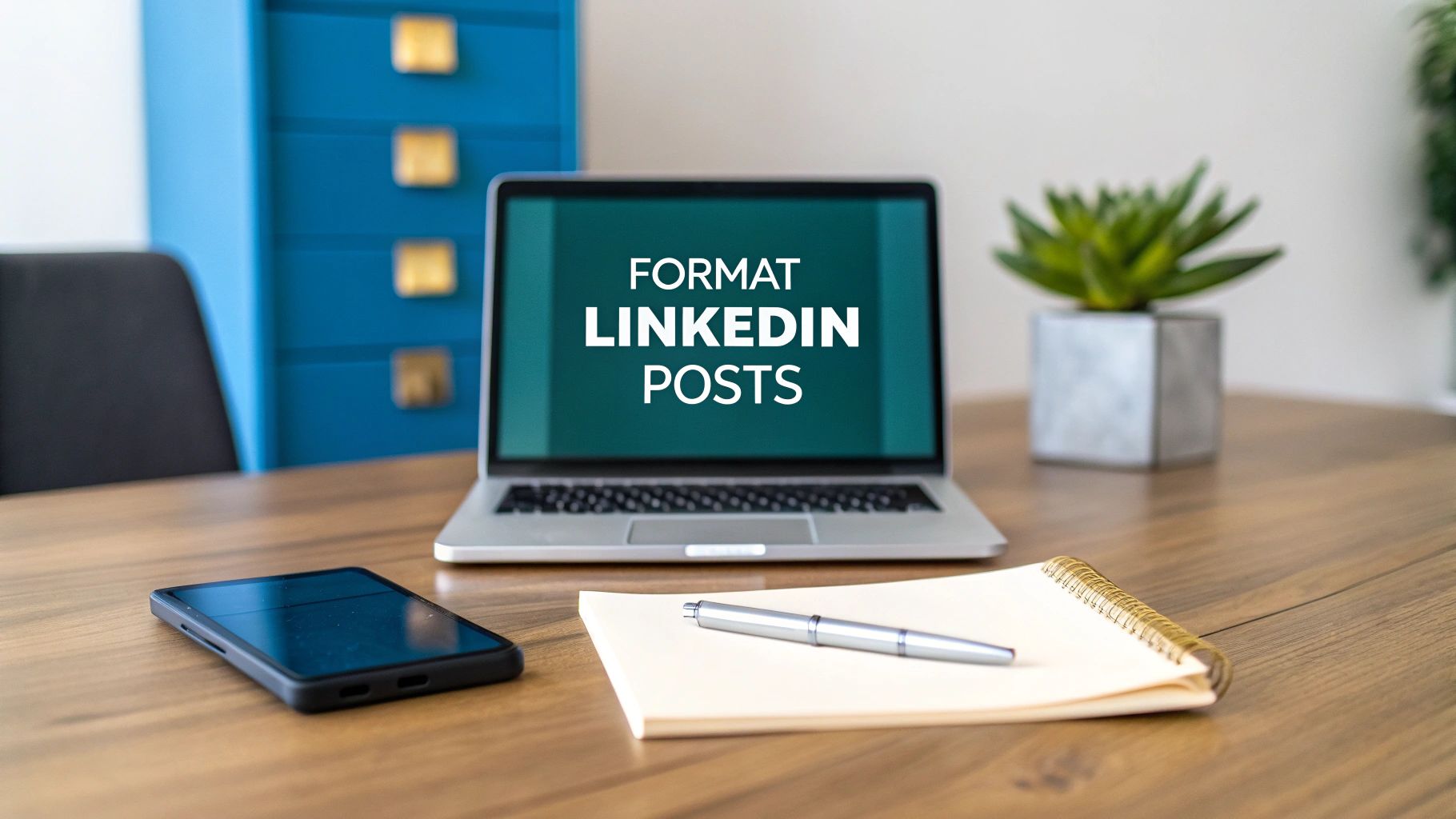
To really nail your LinkedIn post format, you need to think about a few key things: a killer hook, a structure that’s easy on the eyes, smart use of visuals and hashtags, and a clear call-to-action. Getting this right is what turns a simple update into a magnet for engagement, helping you stand out in a seriously crowded feed.
Why Your LinkedIn Post Format Is a Game Changer
Let’s be real. In a professional world drowning in content, just hitting “post” isn’t going to cut it. How you format your post is often what decides whether someone stops to read or just keeps on scrolling.
Think of formatting less as a stylistic choice and more as a strategic weapon. It’s the framework that holds your message up, making it easy to read, engaging, and memorable. A well-structured post naturally guides the reader’s eye, makes your key points pop, and nudges them to interact.
This is especially true in fast-growing professional markets. For example, the LinkedIn user base in Germany shot up to 22 million users by early 2025. That’s a huge slice of the country’s population. With an audience that big and active, you have to master your presentation to grab a sliver of their attention.
From Plain Text to Professional Impact
A thoughtfully formatted post does more than just look pretty; it signals that you’re a professional who respects your audience’s time. By breaking up text, using bullet points, and adding visual anchors like emojis or images, you make your insights so much easier to digest.
Here’s what that structure helps you do:
- Stop the scroll with an opening line they can’t ignore.
- Improve readability by embracing white space and short sentences.
- Highlight key information with a little bolding or a well-placed emoji.
- Drive engagement with a call-to-action that’s impossible to misunderstand.
Here’s a quick-reference guide to keep the essential components of a high-performing LinkedIn post top of mind. These elements are designed to work together for maximum readability and engagement.
Key Elements of a High-Performing LinkedIn Post
| Component | Core Function | Practical Example |
|---|---|---|
| Hook | Grab immediate attention within the first two lines. | “90% of startups fail for the same reason. Here’s what it is:” |
| Body | Provide value with short, scannable paragraphs and bullet points. | Use 1-2 sentence paragraphs. Break up lists with bullet points. |
| Visuals | Increase visibility and break up the text. | A relevant image, a simple chart, or a short video clip. |
| Hashtags | Improve discoverability for your target audience. |
Use 3-5 relevant, niche hashtags like #SaaSMarketing not just #Marketing. |
| CTA | Tell the reader exactly what to do next. | “What’s your take on this? Drop a comment below.” |
Treat this table as your pre-flight checklist before you publish. A solid format ensures your great ideas actually get the attention they deserve.
Ultimately, formatting is just one piece of the puzzle. For a complete game plan, you need a solid LinkedIn content strategy. The principles of great formatting are the foundation, but if you want to dig deeper into the actual substance, check out our detailed guide on what makes a good LinkedIn post.
Crafting Hooks That Actually Stop the Scroll
Let’s be blunt: the first one or two lines of your LinkedIn post are everything. This isn’t just a friendly tip; it’s the digital handshake that decides if someone keeps scrolling or actually pauses to listen to what you have to say. Openers like “I’m excited to announce…” might as well be invisible. They’re wallpaper in a feed that moves at lightning speed.
To really grab someone’s attention, your hook needs to be sharp, specific, and make them instantly curious. You’re not just making a statement; you’re trying to start a conversation.
Provoke Thought with Questions and Bold Statements
Instead of just sharing an update, try reframing it. Turn it into a question that pokes at a common belief in your industry. For instance, a marketing manager could ask, “Is ‘brand awareness’ just a vanity metric we all secretly hate?” This works because it challenges a core concept and immediately pulls people in.
Another killer technique is to lead with a jaw-dropping statistic or a bold, counterintuitive claim. Imagine starting a post with, “90% of our leads last quarter came from a strategy we almost abandoned.“ That line creates an immediate information gap. People will feel an itch to find out what that strategy was, and the only way to scratch it is to read on. This is a non-negotiable part of how you format a LinkedIn post if you want real results.
A strong hook doesn’t just tell people what your post is about; it makes them feel like they need to know what comes next. It’s about creating tension and promising a valuable resolution if they click “…see more.”
The data backs this up. LinkedIn engagement is on the rise globally, with a significant 22 percent increase in interactions per post. This tells us that users are hungry for good content, which makes your hook more critical than ever. You can dig into this trend and what it means for your strategy in this LinkedIn engagement report.
Mastering the art of the hook is foundational stuff. If you’re looking to really nail this and other key elements, our guide on how to write engaging LinkedIn posts offers a much deeper dive into creating content that truly performs.
Structuring Your Post for Readability and Impact
You’ve got their attention with a killer hook. Now what? The body of your post is where you deliver the goods, but a giant wall of text is the fastest way to make someone scroll right past.
Good formatting isn’t just about looking tidy; it’s about making your message easy to scan and absorb.
The most powerful tool in your formatting arsenal? White space. Seriously.
Think of it as breathing room for your ideas. Break up your thoughts into short paragraphs, often just one or two sentences long. This simple change turns a daunting block of text into something inviting and easy to follow.
Sometimes, I’ll even drop a single sentence on its own line just to add a bit of drama or make a key point really land. It works surprisingly well.
Building a Mini-Narrative
Every great post, no matter how short, tells a little story. A simple and incredibly effective way to format a LinkedIn post is to follow a classic narrative arc: Problem, Solution, and Insight. This structure gives your content a natural flow that pulls the reader along.
- The Problem: Start with a pain point your audience knows all too well. For instance, “So many creators I talk to struggle with consistency on LinkedIn. Brainstorming just takes up too much time.”
- Your Solution: Next, share how you tackled it. Be direct and practical. “I started batching my content. I block off one hour every Sunday to plan the entire week’s worth of posts.”
- The Insight: Finish with the key takeaway. What was the real lesson? “It wasn’t just about saving time. The real win was the mental clarity it gave me for the rest of the week.”
This problem-solution-insight framework makes your advice feel earned and relatable. It’s not just theory; it’s a proven result, and that’s how you build trust.
Don’t be afraid to sprinkle in some emojis, either. They add personality and act as visual signposts. A well-placed 💡 or ✅ can break up the text and guide the reader’s eye straight to the important bits.
If you’re looking for more inspiration on how to structure your content, checking out some professionally designed LinkedIn post templates is a great way to see these principles in action.
Using Visuals and Hashtags for Strategic Reach
A killer post can easily get lost in the feed if the text isn’t backed up by smart visuals and the right hashtags. Let’s be honest, your words are only half the story. The other half is making sure your post gets seen by the right people, and that’s where visuals and hashtags come in.
Think of visuals as your co-pilot, reinforcing your message rather than just being window dressing. We all know posts with images get more attention, but it’s the type of visual that really counts. Ditch the generic stock photos. Instead, why not create a simple carousel (just upload a PDF) that breaks down a complex topic into a few easy-to-digest slides? This is a brilliant way to increase dwell time, which is a major signal to the LinkedIn algorithm.
Even a simple, candid photo of your desk or a behind-the-scenes shot can add a human touch that often resonates more than a slick, overly polished graphic. The goal is always to choose a visual that adds genuine value and context.
Mastering Your Hashtag Strategy
Hashtags are basically the GPS for your post, guiding it into the right conversations and feeds. A classic mistake I see all the time is people piling on a dozen generic tags, hoping for the best. This just looks spammy and ends up confusing the algorithm more than it helps. A focused, deliberate approach works much better.
The sweet spot is usually three to five highly relevant hashtags. The real trick is to create a strategic mix:
-
Broad Industry Tag (1-2): Kick things off with a popular, high-volume tag like
#DigitalMarketingor#ProjectManagement. This gives your post a wide initial net to cast. -
Niche Community Tag (2-3): This is where the real engagement happens. Zero in on your ideal audience with more specific tags like
#B2BContentStrategyor#TechSalesTips. These connect you with a smaller but far more interested group of people.
This balanced approach lets you tap into massive conversations while simultaneously reaching the niche communities that are most likely to care about what you have to say. It’s all about precision over sheer volume.
If you want to go deeper on finding the perfect tags for your content, our complete guide on the best hashtags for LinkedIn breaks down even more advanced strategies.
Writing a Call-to-Action That Inspires Action
You’ve just shared an incredible piece of content. Great hook, valuable insights, perfect formatting. But then… nothing. A powerful post without a clear next step is a massive missed opportunity.
Your call-to-action, or CTA, is the bridge between sharing information and actually starting a conversation. It guides your reader on exactly what to do next, turning them from a passive scroller into an active participant.
A lazy “What do you think?” just doesn’t cut it anymore. It often falls flat because it’s too broad. The best CTAs are specific, feel genuine, and encourage a real response.
Crafting a Compelling CTA
A great CTA feels less like a demand and more like an invitation. Your goal is to make it incredibly easy and appealing for someone to chime in.
Here are a few approaches I use all the time:
- Ask a Specific, Open-Ended Question: Instead of a vague “Thoughts?”, try something like, “What’s one surprising lesson you’ve learned about project management this year?” This prompts a story, not just a one-word answer.
- Invite Shared Experiences: Frame your CTA to build community. Phrases like, “Share your experience with…” or “Has anyone else found this to be true?” make people feel included and heard.
- Prompt a Simple Choice: Sometimes, a simple A/B question works wonders. For example, “Are you team ‘plan everything’ or ‘go with the flow’ when it comes to weekly tasks? Let me know below.”
Your CTA isn’t just about juicing the metrics; it’s about signalling that you genuinely want to hear from your audience. A well-crafted question shows you value their perspective, which is the absolute foundation of building a strong professional network.
Finally, let’s clear up the link placement puzzle. The old advice was to hide links in the first comment to avoid hurting your post’s reach. LinkedIn has since confirmed this is a myth.
For the best user experience, place your link directly in the post body where it makes the most sense. Don’t make your audience hunt for it. Make it easy for them to take the next step.
Tailoring Your Format to a German Audience
Adapting your LinkedIn posts for a different country isn’t just about running your text through a translator. It’s about cultural resonance. What lands perfectly in one market can completely miss the mark in another, and this is definitely the case when you’re trying to connect with professionals in Germany.
The German professional world tends to value directness, deep expertise, and real substance. This means your formatting needs to signal clarity and efficiency right from the get-go. Forget the fluffy, vague statements or overly salesy hooks. Instead, your goal should be to structure your posts so they deliver practical value immediately.
Use your formatting to walk the reader through a logical point. You could use bullet points to clearly outline the steps in a process or the key benefits of a particular strategy. This kind of structured, almost analytical approach is often appreciated much more than a purely narrative one.
Understanding the German LinkedIn User
To truly connect, you need a picture of who you’re talking to. In Germany, the largest group on LinkedIn falls between the ages of 25 to 34, accounting for a massive 7.8 million users. Digging a bit deeper, you’ll find the platform’s advertising audience is 61.7 percent male.
These numbers paint a pretty clear picture: a core audience of mid-career professionals who are focused on career progression, real industry insights, and tangible skills. If you want to dive into these patterns yourself, you can explore detailed LinkedIn demographics in Germany.
This data is a strong signal. Your content format should be organised to appeal directly to this ambitious group. Think less about long personal stories and more about case studies, data-backed insights, and expert analysis.
When formatting for a German audience, prioritise clarity over cleverness. A well-organised post that respects the reader’s time and delivers concrete information is far more likely to build trust and generate meaningful engagement.
To make your posts more effective, try making these formatting tweaks:
- Lead with the core message: Get your most important takeaway into the first two lines. Don’t make them wait through a long, winding introduction.
- Use lists for clarity: Break down complex information into digestible points with bulleted or numbered lists. It shows an organised thought process, which is highly valued.
- Incorporate data: Whenever you can, include statistics or figures. Bold them to add credibility and make them pop off the page.
- Keep the tone professional: Emojis aren’t off-limits, but use them sparingly. Stick to professional options (like ✅, 💡, 🚀) to add structure, not to convey casual emotion.
Got Questions About Formatting? You’re Not Alone.
Even the most seasoned LinkedIn pros run into little formatting questions now and then. Getting the details right can feel tricky, but it’s often simpler than you think. Let’s clear up some of the most common head-scratchers so you can post with total confidence.
What’s the Real Sweet Spot for Post Length?
LinkedIn gives you a massive 3,000-character limit, but you almost never need it. Think of it less like a target and more like a safety net.
From what I’ve seen, the posts that really hit home land somewhere between 1,200 and 1,600 characters. That’s about 200 to 250 words. This gives you just enough space to tell a compelling little story, share a key insight, and drop in a call-to-action without making your reader’s eyes glaze over. The goal is to be concise but impactful. Every word should earn its place.
The Great Debate: Link in the Post or in the First Comment?
Ah, the age-old question. For years, the prevailing wisdom was to hide your external links in the first comment to “trick” the algorithm into giving you more reach.
Let’s put this one to bed: LinkedIn has confirmed this isn’t a thing anymore. For the best possible experience for your reader, put the link right in the body of the post where it makes the most sense. The algorithm won’t punish you for it. Making your audience hunt for a link is just adding friction they don’t need.
The “link in comments” trick is a relic of the past. Focus on a smooth user experience by putting links directly where they belong. Don’t make people dig for the good stuff.
A straightforward approach shows you respect your reader’s time. That’s always a good move for engagement.
How Many Hashtags Are Too Many?
When it comes to hashtags on LinkedIn, piling them on does more harm than good. A post loaded with a dozen tags looks spammy and can actually confuse the algorithm about what your content is truly about.
The magic number is 3 to 5 highly relevant hashtags. A balanced mix works best:
-
One or two broad tags to connect with larger industry conversations (like
#Marketingor#Leadership). -
Two or three niche tags to zero in on a more targeted audience that cares about your specific topic (e.g.,
#ContentStrategyor#B2BLeadGen).
This strategy helps the right people find your post without muddying the waters.
Are Emojis Okay for LinkedIn?
Absolutely—when used with a bit of strategy. Emojis have become a standard part of professional communication, and they’re fantastic formatting tools.
They’re perfect for breaking up text, drawing the eye to key points, and injecting a little personality into your professional voice. My advice? Stick to universally understood symbols like ✅, 💡, 🚀, or 👉. Use them to improve readability, not as a replacement for clear, well-written text.
Ready to stop guessing and start creating high-impact LinkedIn content in minutes? Postline.ai combines a powerful AI writer with real-time research and learns your unique voice, helping you craft perfectly formatted posts that sound just like you.

Run every client pipeline in one place
Give each LinkedIn profile its own voice, calendar, approval flow, and analytics. Start in minutes.
Start free trial