
Build an employer brand linkedin that attracts top talent
Discover proven strategies to boost your employer brand linkedin on LinkedIn, featuring real examples and actionable tips to attract top talent.
Before you even think about posting on LinkedIn, you need to answer a fundamental question: What really makes your company a great place to work? Nailing this down is the single most important thing you can do to attract the kind of people you actually want to hire.
Pinpointing Your Authentic Employer Brand
Your employer brand isn’t some slick marketing tagline or a list of trendy office perks. It’s the real, day-to-day experience of your team. The goal here is to unearth that truth and shape it into a narrative that clicks with the right candidates. Forget the bland corporate jargon—this is about finding what makes your workplace genuinely different.
The whole process has to start from the inside out. Seriously, the best stories and the most powerful reasons to join your company are already floating around in team meetings, Slack channels, and casual coffee chats. Your job is to become a good listener and capture them. A big part of this is using smart audience research methods to get a handle on both your current team and the talent you’re hoping to attract.
Start with Your Internal Experts
Who knows your company best? Your current employees. They are living and breathing your culture every single day, and they’ll give you the honest insights you need to build something real. You can start gathering this goldmine of information through some pretty simple channels.
- Try “Stay” Interviews: We all know about exit interviews, but what about asking your top people why they stay? What do they value most about working here? What part of the culture makes them feel energised and committed?
- Run Simple, Anonymous Surveys: Use something like Google Forms to ask pointed questions. Think along the lines of, “Describe our company culture in three words,” or “What was a team moment that made you proud to work here?”
- Check In with New Hires: Chat with folks who’ve been on board for about 3-6 months. Ask what’s surprised them (in a good way) since they started. Does the reality match what they expected during the hiring process?
The most powerful employer brand messages are not invented in a boardroom; they are discovered by listening to the people who build your company every single day. Your team’s stories are your greatest asset.
When you gather this kind of qualitative feedback, you stop making assumptions. You start building your employer brand on LinkedIn on a foundation of genuine experiences. This is the raw material for your Employee Value Proposition (EVP)—the unique promise you make to your team in exchange for their talent and hard work.
This team-first approach makes sure your external messaging is a true reflection of your internal reality, which is crucial for building trust and credibility with potential candidates.

This kind of focus on what your team truly values is more important than ever. Job markets and candidate expectations are shifting all over, including in major European hubs like Germany where purpose-driven work is increasingly a top priority. While it’s tough to nail down precise local statistics, the trend is undeniable. The core principles of authenticity and telling employee-centric stories work everywhere.
And if you’re looking to level up your personal game on the platform, you might find our guide on https://postline.ai/blog/2/how-to-build-a-personal-brand-on-linkedin useful, too.
Developing Your Core Content Pillars
Alright, you’ve nailed down what makes your company special. Now, how do you turn that identity into content that people actually want to see on LinkedIn? If your company page is just a stream of job postings, you’re missing the point. It becomes a static job board, not a living, breathing showcase of your employer brand.
The key is to build your strategy around a few core content pillars. Think of these as three to five central themes that act as the backbone for everything you post. They ensure every single update, video, and story reinforces what makes your company a great place to work. This isn’t about stiff corporate announcements; it’s about telling authentic stories that bring your culture to life.
Moving Beyond the Job Post
Let’s be honest, the best content gives potential candidates a real peek behind the curtain. It answers the questions they’re actually thinking: What’s the team really like? What kind of challenges will I get to tackle? Who are the people I’d be working with every day?
To get you started, here are a few pillar ideas I’ve seen work wonders:
- Our People & Culture: This is all about the human side of your business. Think employee spotlights, celebrating team wins, or sharing stories of personal growth within the company. It’s the heart of your employer brand.
- Innovation & Impact: Here’s where you get to show off the cool stuff your team is building. Give a behind-the-scenes look at a project, host a quick Q&A with a product manager about a new feature, or talk about the real-world impact of your work.
- Career Growth & Learning: This pillar is your proof that you invest in your people. Share stories of internal promotions, highlight unique training opportunities, or feature a conversation between a mentor and mentee. Show, don’t just tell.
- Work-Life & Wellbeing: This is your chance to demonstrate a genuine commitment to a healthy work environment. You could post about flexible work policies, share photos from a team-building trip, or highlight initiatives that support mental health and wellbeing.
I see so many companies make the classic mistake of turning every post into a job pitch. Your real goal is to build an engaged community that follows your brand long before they even consider applying. Job ads should be a small part of your mix, not the whole show.
By establishing strong pillars, you create a content calendar that feels balanced and interesting. For example, you can weave a powerful thought leadership strategy for your leadership team into the “Innovation & Impact” pillar, which adds a ton of credibility and depth.
Structuring Your Content Mix
With your pillars in place, the fun begins—brainstorming the actual post formats. This is how you avoid the trap of just posting text updates day after day. A varied mix of videos, carousels, and stories keeps your feed fresh and engaging.
Here’s a simple framework to show you what I mean. A company using the pillars we just discussed might map out their content strategy something like this:
Sample LinkedIn Employer Brand Content Pillars
This table shows how different post formats can bring each content pillar to life, giving you a blueprint for a varied and engaging content plan.
| Content Pillar | Objective | Example Post Formats |
|---|---|---|
| Our People & Culture | Showcase the team and daily life | - ‘Day in the Life’ video series with different roles<br>- Employee anniversary shout-outs<br>- Team photos from volunteer days |
| Innovation & Impact | Highlight interesting projects | - Short video Q&A with an engineer<br>- Carousel post breaking down a recent success<br>- Article about industry trends from a team lead |
| Career Growth | Demonstrate professional development | - Testimonial from a recently promoted employee<br>- Photos from an internal training session<br>- Story of an employee’s career path at the company |
Using a structured approach like this is what turns your LinkedIn page from a passive recruitment channel into an active hub for compelling brand storytelling. You’re not just filling roles; you’re building long-term affinity and making your company a place where top talent truly wants to be.
Turning Your Team into Brand Ambassadors
Let’s be honest, your most powerful marketing channel isn’t your company’s LinkedIn page—it’s your people. Time and again, research shows that posts from employees get far more engagement than the exact same message coming from a corporate account. Their voices have an authenticity and reach into personal networks that no paid ad campaign can replicate.
But turning your team into genuine brand ambassadors isn’t as simple as asking them to share company news. It’s about building an employee advocacy programme that people actually want to join. The secret is making it easy, valuable, and—this is crucial—completely voluntary.
This entire process starts with the groundwork we’ve already discussed. Your EVP and content pillars are the foundation for what your employees will share.
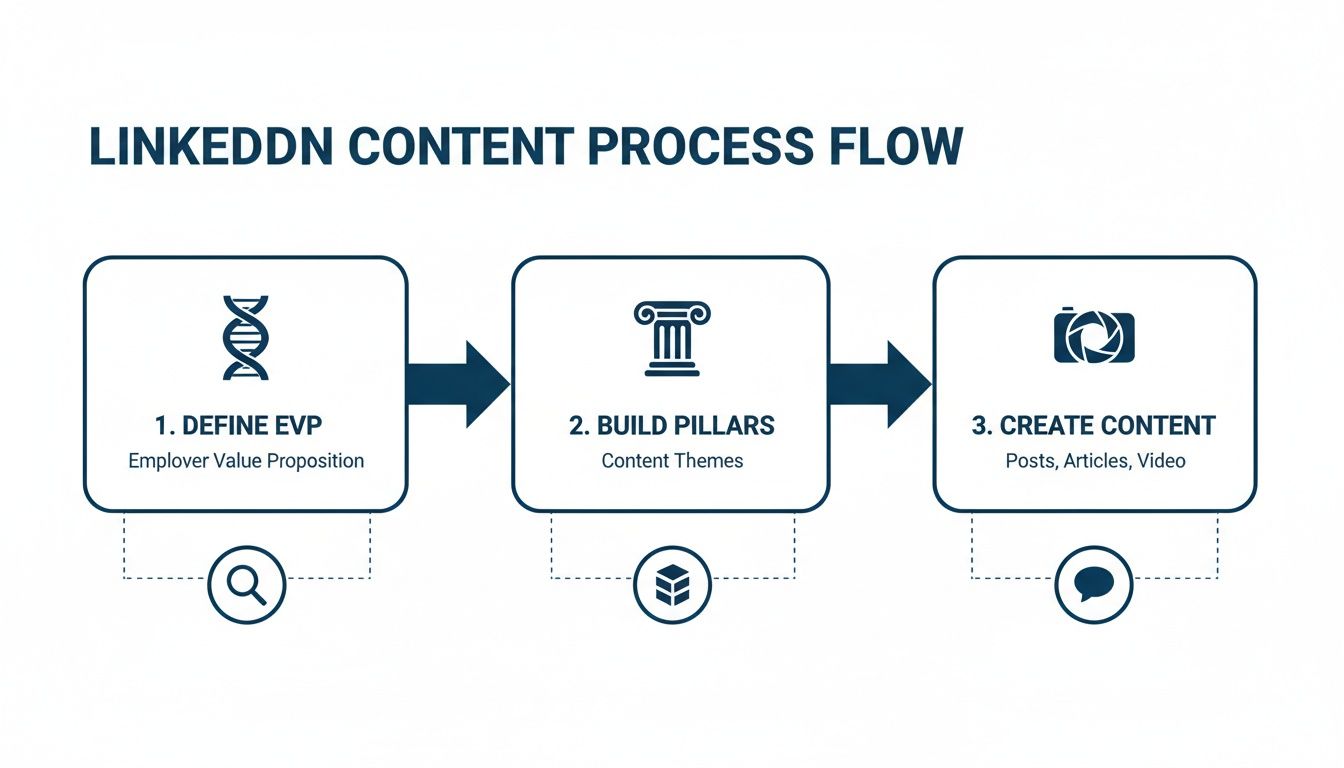
When your team shares content, it’s coming from a place of genuine belief because it’s tied directly to the authentic brand message you’ve all built together.
Making Advocacy Effortless
The single biggest enemy of employee advocacy is friction. If sharing something is a hassle or takes too much time, your team simply won’t do it. Your job is to make amplifying your employer brand ridiculously simple.
Here are a few ways I’ve seen this work brilliantly:
- Build a Content Toolkit: Create a one-stop shop—a shared drive, a dedicated Slack channel, whatever works for you—with pre-approved assets. Think high-quality photos, short video clips, and key messages that align with your content pillars.
- Give Them a Head Start with Copy: Never just drop a link and say, “Please share.” Provide two or three different caption ideas they can copy, paste, and tweak. This small step removes the mental block of staring at a blank text box.
- Insist on Personalisation: Gently remind your team that their personal touch is what makes this whole thing work. Encourage them to add a quick sentence about why a project was meaningful or what a company milestone means to them.
The best advocacy programmes feel less like a corporate chore and more like a shared celebration. When your team is genuinely proud of their work and your culture, they can’t help but become your best storytellers.
How to Keep the Momentum Going
Getting a programme started is one thing; keeping it alive is another challenge entirely. To maintain momentum, you need recognition, feedback, and a clear link back to the company’s identity.
A simple shout-out in a team meeting or a small token of appreciation for active sharers can go a long way. To really reinforce your culture and give advocates something tangible, you could even explore promotional products that actually work as a way to say thank you.
At the end of the day, a successful employee advocacy strategy is built on a foundation of trust. By giving your team the right tools and clear guidelines—without being overly controlling—you unlock their true potential. Their collective voice will extend your brand’s reach far beyond what your company page could ever achieve alone.
Creating a Sustainable Posting Rhythm
Consistency is the secret sauce that separates a powerful employer brand on LinkedIn from one that just gets lost in the noise. If your posts are sporadic and unpredictable, you’ll never build the momentum you need to grab the attention of top-tier talent. The real aim here is to establish a practical, sustainable rhythm that your team can actually stick with without burning out.
This isn’t about just churning out content for the sake of it. It’s about building a reliable presence. A steady cadence trains your audience to look for your content and keeps your company top of mind when they—or someone in their network—start thinking about a new role.
Finding Your Ideal Frequency
Look, there’s no single “magic number” for how often to post. A global corporation will have vastly different resources than a 50-person startup. The key is to forget arbitrary targets and start with what’s genuinely realistic for your team.
A great starting point for most company pages is three to five times per week. That’s frequent enough to stay visible in the feed, but not so much that it completely overwhelms your content creators.
You could map this out against your content pillars, creating a simple structure like this:
- Monday: Kick off the week with something that shows off your company culture—maybe a team win or a group photo.
- Wednesday: Share a genuine insight from your industry or a peek into an innovative project your team is tackling.
- Friday: Wind down the week with a classic employee spotlight or a fun behind-the-scenes look at office life.
This is a long game. It’s far better to post three high-quality, thoughtful updates every single week than to post twice a day for a week and then vanish for a month.
Organise and Execute with a Content Calendar
Once you’ve landed on a frequency that feels right, an editorial calendar will become your best friend. This doesn’t have to be some overly complex software. A simple spreadsheet can do the job, or a dedicated tool like Postline.ai can really help with planning and team collaboration.
Having a visual calendar helps you see your content mix at a glance. You can easily spot if you’re leaning too heavily on one content pillar and neglecting others. For instance, an organised workflow inside a platform gives you that bird’s-eye view.
This kind of organised setup allows you to schedule posts well in advance, making sure your brand stays active and present even when things get hectic. Having a clear plan gets rid of that daily “what on earth should we post today?” panic and frees up your team to focus on what really matters: creating genuinely impactful content. If you need a bit more guidance, our detailed guide on crafting a LinkedIn content calendar is a great place to start.
Think of a content calendar not as a rigid set of rules, but as a strategic framework that actually gives you freedom. When you plan ahead, you create space for those spontaneous, timely posts while ensuring your core brand message always stays consistent and strong.
Measuring What Matters for Your Brand

So, you’ve got a steady stream of content going out. But is it actually doing anything? To prove the value of your employer brand on LinkedIn, you have to look past the easy, surface-level numbers. Likes, comments, and new followers feel good, but they don’t tell the whole story or justify the resources you’re investing.
The real challenge—and where you prove your worth—is tying your LinkedIn activity to actual business outcomes. This isn’t just about reporting numbers; it’s about using data to sharpen your strategy and show leadership that your work is making a real difference to the company’s hiring goals.
Beyond Likes and Follows
Meaningful measurement goes deeper than vanity metrics. It’s about understanding what truly influences your talent pipeline. You need to distinguish between the quick wins of a single campaign and the long-term impact of building a respected brand. A viral post is great, but a strong brand consistently attracts better candidates day in, and day out.
Instead of just chasing impressions, it’s time to dig into the data that matters. LinkedIn’s own analytics are a surprisingly powerful place to start.
Here’s what I recommend focusing on:
- Engagement Rate: Don’t just count likes. Look at the ratio of all engagements (likes, comments, shares, clicks) to your follower count or impressions. A consistently high engagement rate on posts about your company culture is a clear sign your message is hitting home.
- Follower Demographics: Take a hard look at who is following you. Are they in the right industries, with the right job titles, and in the right locations? LinkedIn Analytics gives you a clear view of whether your content is actually reaching your target talent pool.
- Top Performing Posts: Figure out which content pillars and formats are sparking the best conversations. Do behind-the-scenes team videos get more thoughtful comments than a link to an industry report? Use that insight to double down on what truly works.
When you get this right, the payoff is huge. A strong employer brand can reduce your cost-per-hire by up to 50% and lower employee turnover by 28%. These aren’t just social media wins; they’re serious contributions to the bottom line.
Connecting LinkedIn to Business Goals
Ultimately, the true test of your success is how your LinkedIn presence impacts your recruitment funnel. This means stepping outside of LinkedIn’s native analytics and connecting the dots back to your own hiring process.
So, how do you bridge that gap? You have to follow the candidate’s journey from their LinkedIn feed to their application.
- Referral Traffic: Get comfortable with using UTM parameters on every link you share to your careers page. This is non-negotiable. It allows you to open up Google Analytics and see exactly how many people—and more importantly, how many applicants—came directly from your LinkedIn page or your team’s advocacy posts.
- Source of Hire: Make it a standard practice to ask new hires where they first heard about your company. If you start hearing “LinkedIn” more and more, you’ve got concrete evidence that your brand-building is working.
- Quality of Hire: This is the holy grail of measurement. Over time, you need to track whether the candidates you source through LinkedIn are not only good hires but also high performers who stay with the company long-term. This proves you’re not just attracting more candidates, but the right candidates.
By focusing on these deeper metrics, you change the conversation from “How many likes did we get?” to “How did our LinkedIn strategy improve our hiring outcomes?” For a deeper dive, you can learn more about how to measure content performance in our detailed guide. This data-driven approach is what elevates employer branding from a “nice-to-have” marketing task into a critical business function.
Got Questions About Your LinkedIn Employer Brand?
Even with the best strategy in hand, a few questions always pop up when you start building your employer brand on LinkedIn. Let’s walk through some of the most common hurdles I see clients face, so you can move forward with total clarity.
What’s the Real Budget for This?
Ah, the million-dollar question. The honest answer? It really depends. But I can tell you this: you don’t need a huge budget to make a real impact.
Some of the most powerful things you can do—like firing up an employee advocacy programme or sharing genuine stories from your team—cost next to nothing. Your biggest investment at the start will be time. The time it takes to find those stories, craft compelling posts, and actually talk to people in the comments.
Paid campaigns can definitely give you a boost, especially if you’re promoting a critical role or a fantastic video about your company culture. But they aren’t mandatory from the get-go. My advice is always to start organically. See what people actually respond to, and then put a bit of budget behind your winners to amplify what’s already working.
What If We’re a Small or Unknown Company?
Believe it or not, this can be your secret weapon. Big corporations spend fortunes trying to seem human and relatable. As a smaller company, that authenticity is already built into your DNA. You don’t need a massive follower count to create an employer brand that people genuinely connect with.
Forget about competing with the global giants on follower numbers. Your goal is different. You’re building a tight-knit community that feels a real connection to your mission and, most importantly, your people.
Focus on sharing the unique, interesting problems your team gets to solve every day. Show people the direct impact they can make—that’s a powerful story that often gets lost in the noise of a larger organisation.
How Should We Deal With Negative Comments?
Whatever you do, don’t just ignore or delete them. It’s tempting, I know, but facing criticism head-on is one of the quickest ways to build trust. Think of a negative comment not as an attack, but as a massive opportunity to show you’re listening and you actually care about getting better.
The key is to respond publicly with a calm, professional, and non-defensive tone. It shows character. Acknowledge what they’ve said, thank them for their honesty, and offer to take the conversation offline to sort it out. This single act demonstrates maturity and does more for your brand’s integrity than a feed full of nothing but glowing praise ever could.
Let’s be real, a perfect record looks suspicious anyway. Handling criticism with grace makes your brand more human and credible. People will see you value feedback and are serious about building a great place to work, which is the whole point of this exercise.
Ready to create standout content without the hassle? Postline.ai is your AI-powered assistant for writing, improving, and scheduling LinkedIn posts faster than ever. Learn more and start your journey with Postline.ai.

Run every client pipeline in one place
Give each LinkedIn profile its own voice, calendar, approval flow, and analytics. Start in minutes.
Start free trial