
Content Personalization AI: content personalization ai for Engagement
Learn how content personalization ai reshapes marketing with practical steps, ethics, and real-world tools to deepen audience connections and drive results.
At its core, content personalisation AI is the engine that drives unique, relevant experiences for every single person you interact with online. Instead of blasting out the same message to everyone, this technology uses data and smart algorithms to figure out what people care about. It then automatically adjusts your content, making every interaction feel less like a broadcast and more like a genuine conversation.
Moving Beyond One-Size-Fits-All Content

Let's be honest, getting noticed online today is tough. For professionals and businesses on platforms like LinkedIn, you're not just creating content; you're fighting for a sliver of your audience's limited attention. Throwing generic, one-size-fits-all posts out there is like trying to have a quiet chat in the middle of a rock concert—your message just gets lost in the noise.
This is exactly where content personalisation AI changes the game. It’s a complete shift in thinking, moving away from shouting at everyone to actually talking with individuals. Imagine your LinkedIn posts, articles, or even connection requests automatically adapting to someone’s industry, role, or the content they’ve liked in the past. That’s the kind of relevance that grabs attention, builds real connections, and goes way beyond surface-level metrics.
Why Personalisation Is No Longer Optional
People now expect content that speaks directly to them. We all do. AI-driven hyper-personalisation isn't just a "nice-to-have"; studies consistently show it massively boosts engagement and improves the customer experience. It’s the difference between getting a cold, generic sales pitch and a genuinely helpful tip from someone you trust.
Think of this guide as your roadmap. We’re going to break down the core tech that makes this all possible and get into practical strategies you can use on LinkedIn right away. You'll see how to stop creating broad messages and start delivering resonant experiences that actually drive results. If you're looking to get a deeper handle on the basics first, you can learn more about what content personalization is and why it's so critical today.
By using AI, you can finally flip the script from a content-first approach to an audience-first one. The goal is no longer just to pump out content, but to deliver the right content to the right person at the right moment.
This shift is crucial for anyone serious about building authority and getting real business value from their efforts. By the time you've finished this guide, you’ll have a clear framework for using AI to make your content more impactful, relevant, and effective than ever before.
How AI Learns to Personalize Your Content

The magic behind AI-driven content personalisation isn't really magic at all. It’s a mix of clever techniques that learn about your audience and predict what they'll find interesting next.
Think of it as a super-observant personal assistant, constantly taking notes to make every single interaction more meaningful. The whole process starts by bringing some order to the chaos.
Instead of lumping your entire audience into one massive group, the AI begins with user segmentation. This is a bit like sorting a huge library of books into different genres—business, tech, or marketing. By grouping people based on shared traits like job titles or industries, the AI can deliver content that's at least broadly relevant to them. A marketing manager sees something different from a software developer. It's the first crucial step.
From there, the system zeroes in on behavioural signals. These are the digital breadcrumbs people leave behind as they browse. Every like, comment, share, and click is another clue about their real interests. If someone keeps engaging with posts about leadership, the AI makes a note of it and starts showing them more of that kind of content.
Understanding Language and Predicting Interests
To actually make sense of all this text, AI relies heavily on a technology called Natural Language Processing (NLP). NLP is what allows the system to 'read' a LinkedIn post, an article, or a user's comment and actually understand its meaning and sentiment. It can pick out key topics, figure out if someone's feeling positive or negative, and get the real context.
This is what makes the whole experience feel so intuitive. The AI doesn't just see that a user liked a post; it gets what the post was about. That deeper level of understanding is absolutely essential for making smart recommendations.
With that foundation in place, the AI then uses powerful recommendation models. These are the predictive engines that look at past behaviour to guess what someone will be interested in next.
Collaborative Filtering: This works a lot like a word-of-mouth recommendation. It finds users with similar tastes and then suggests content that others in their 'taste group' have liked. If you and another professional both follow the same industry leaders, the AI might show you a post they recently engaged with.
Content-Based Filtering: This technique looks at the content itself. It analyses the characteristics of things you've already interacted with (like keywords or topics) and then finds other content with similar traits. If you read a lot about AI in sales, it’ll go find more articles on that exact topic for you.
At its heart, a recommendation model is a sophisticated pattern-matching system. It connects the dots between a user's past actions and a vast universe of available content to find the perfect match, transforming a generic feed into a curated stream of valuable information.
Meeting Modern Audience Expectations
All of these technologies work together to create a seamless, highly individualised experience—which is exactly what people expect these days. In Germany, for example, a consumer study found that 60% of people are interested in customised products and services. That number shoots up to a massive 84% for people aged 16–34. The demand is clearly there. You can dig into more of these findings on German consumer attitudes to personalisation in the full report.
Ultimately, these core AI components—segmentation, behavioural analysis, NLP, and recommendation models—form a powerful, interconnected system. They’re what allow platforms and creators to stop broadcasting generic messages and start having countless individualised conversations, all at the same time.
Putting AI Personalisation into Practice on LinkedIn
All the theory behind AI content personalisation is great, but where the rubber really meets the road is putting it into action. On a professional network like LinkedIn, this is where you see the real value. It’s about shifting from abstract ideas to concrete strategies that genuinely connect with your network.
Think about it from the perspective of a B2B software company. You could post a generic case study, sure. But what if an AI could tweak that post for different people in your audience? A contact in the finance industry would see a version highlighting your fintech results and ROI. Meanwhile, someone in healthcare gets a post focused on HIPAA-compliant solutions and patient data security.
This isn't just about changing a few words. It's about telling a story that's fundamentally more relevant to each person's professional reality. The core message stays the same, but the context and the proof points click perfectly with their world.
Accelerating Workflows with AI Tools
Let's be realistic—nobody has the time to manually create dozens of variations for every single post. This is where modern AI tools come in, acting as a massive force multiplier for your content strategy. Platforms like Postline.ai can speed up these workflows in a huge way, taking on the heavy lifting of adapting your content.
For instance, a career coach can use an AI tool to spin up post variations for people at different stages of their careers.
For recent graduates: The AI could whip up content about entry-level job hunting, resume tips, and nailing that first big interview.
For mid-career professionals: It might produce posts on leadership development, climbing the ladder, or making a successful industry switch.
For senior executives: The focus could pivot to thought leadership, landing board positions, and high-stakes networking.
The coach supplies the core idea, and the AI handles the subtle tailoring for each group. This lets you maintain a consistent, active presence while making sure every piece of content hits home with a specific slice of your audience.
From Content Creation to Intelligent Refinement
The job of content personalisation AI doesn't stop once the post is created. The real strategic edge comes from the AI’s ability to analyse engagement and then refine what you do next. By seeing which versions of your posts perform best with certain audience segments, the system starts to learn what works.
An AI-powered workflow creates a virtuous cycle. You post personalised content, the AI chews on the engagement data (likes, comments, shares), and then it uses those insights to suggest even better topics and angles for your next batch of posts.
This data-driven feedback loop is what takes your content strategy from educated guesswork to a finely tuned, constantly improving machine for building authority and relationships.
The screenshot above gives you a peek inside an AI-powered content creation tool. A user can drop in a simple idea and get a fully fleshed-out LinkedIn post in seconds. It shows just how quickly these tools can turn a basic concept into structured, engaging content that's ready to be personalised and scheduled.
Tools built specifically for LinkedIn can analyse engagement patterns to suggest new topics tailored to specific parts of your network. Figuring out what your audience actually cares about is critical, and you can learn more about how to dig up these valuable LinkedIn audience insights to sharpen your strategy. This analytical power is what separates basic automation from truly intelligent personalisation.
Of course, a personalised content strategy works best when it's anchored by a polished and compelling profile. It's worth looking into strategies for generating effective AI Headshots for LinkedIn to complete your professional image. When you combine a strong personal brand with a smart content approach, you create a powerful engine for professional growth.
Your Blueprint for an AI Personalisation Strategy
Jumping into content personalisation AI without a clear plan is like trying to build a house without a blueprint. It's a powerful bit of kit, but without a solid structure, you'll just end up with a mess. The first, and most important, step is to get crystal clear on what success actually looks like for you.
Forget vague goals like "more engagement." Let's get specific. Are you trying to pull in more qualified leads from the fintech industry? Or maybe you want to boost the click-through rate on articles you share with C-level executives? Clear, measurable objectives are the bedrock of any good strategy. They guide every single decision you make, from the data you collect to the tools you end up choosing.
Laying the Groundwork with Quality Data
Once your goals are locked in, your focus needs to shift to the fuel for your AI engine: data. High-quality personalisation is simply impossible without high-quality data. Think of it like this—you wouldn't expect a Michelin-star chef to create a masterpiece with dodgy ingredients. The same logic applies here.
Your AI needs clean, relevant, and well-organised information to truly understand your audience and start making smart suggestions. This really boils down to two things:
Data Collection: Pulling in information from different places, like LinkedIn profiles, interactions on your website, and how people have engaged with your content in the past.
Data Management: Making sure that data is accurate, up-to-date, and stored securely to keep on the right side of privacy laws.
Spending time building a solid data foundation is non-negotiable. It's what separates an AI that spits out generic, slightly-better-than-random ideas from one that helps you craft genuinely resonant experiences for your audience.
Choosing and Integrating Your AI Toolkit
With your goals set and your data in order, it's time to pick the right tools for the job. The market for AI tools is exploding, with everything from massive, do-it-all marketing platforms to specialised solutions designed for specific tasks like creating posts or analysing performance.
Don't get sidetracked by the shiniest new toy. Instead, concentrate on what will slot neatly into your existing workflow and directly help you hit your targets. For a lot of professionals on LinkedIn, this might be a tool that helps automate different versions of a post or gives insights into what specific audience segments are keen to read about.
The aim is to find tech that supports and improves your process, not something that forces you to completely rip up the floorboards and start again. A smooth integration is crucial for sticking with it long-term and seeing real success.
Measuring What Truly Matters
Finally, a strategy is only as good as your ability to measure its impact. To figure out if your AI-powered personalisation is actually working, you need to track the right Key Performance Indicators (KPIs). This means looking beyond the simple vanity metrics.
So, instead of just counting likes, zero in on the numbers that connect back to your business goals.
The ultimate measure of a successful content personalisation AI strategy isn't just higher engagement—it's proving a direct connection between your personalised content and tangible business outcomes, like better leads, shorter sales cycles, or increased customer loyalty.
This visual shows a simple but powerful workflow for LinkedIn: analysing user data, automating content recommendations, and then jumping on the opportunities that come up.
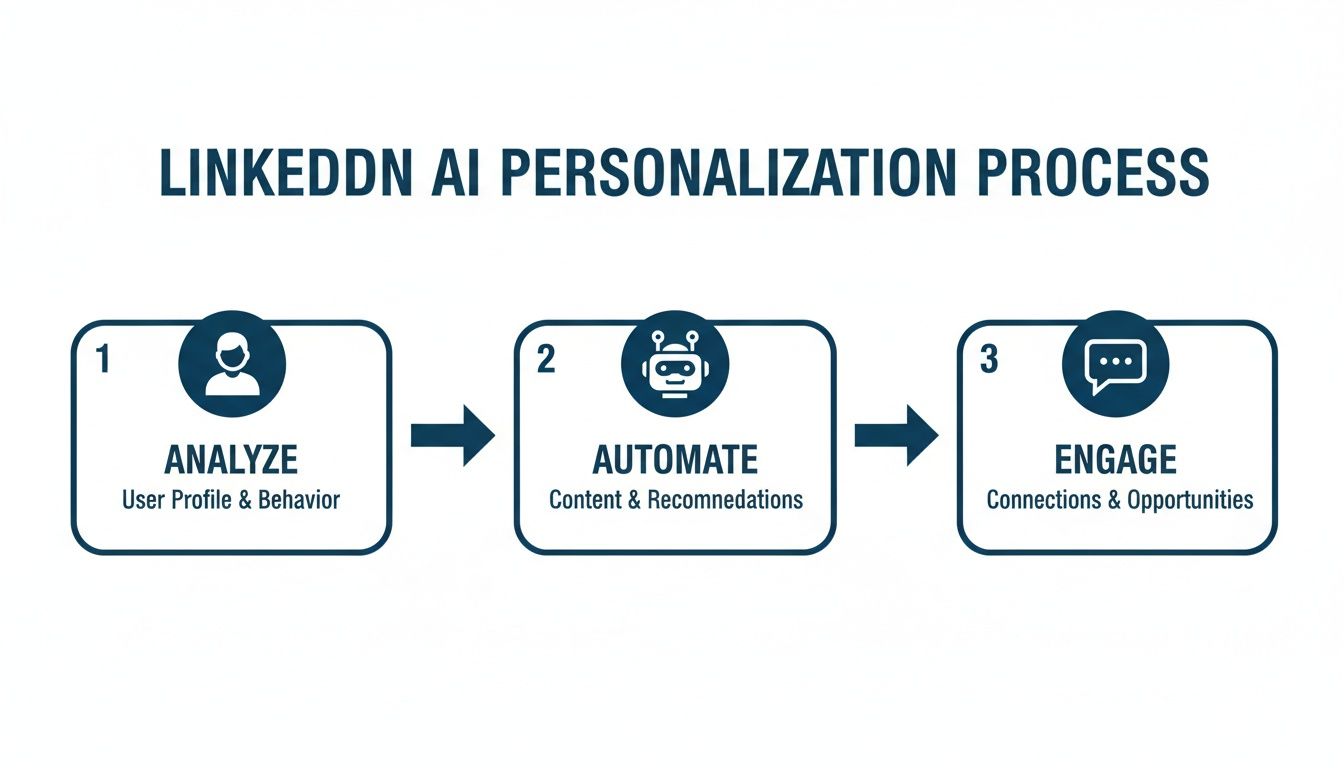
This cycle of learning and adapting is what makes a well-oiled AI strategy so effective.
This table outlines essential KPIs to track the effectiveness of your content personalisation AI strategy, moving from basic engagement to business impact.
Key Metrics for Measuring Personalisation Success
Metric | What It Measures | Why It Is Important |
|---|---|---|
Conversion Rate | Percentage of users who take a desired action (e.g., sign-up, download). | Directly links personalised content to business goals like lead generation. |
Click-Through Rate (CTR) | The ratio of users who click on a specific link to the number of total users who view it. | Shows how compelling and relevant your content is to different audience segments. |
Audience Growth | The rate at which you gain new followers or subscribers from specific segments. | Indicates if your content is successfully attracting your target personas. |
Lead Quality Score | A score assigned to leads based on their profile and engagement data. | Helps determine if your personalised content is attracting higher-value prospects. |
Sales Cycle Length | The average time it takes to close a deal with leads who engaged with personalised content. | A shorter cycle can show that personalised content is educating and nurturing leads more effectively. |
Customer Lifetime Value (CLV) | The total revenue a business can expect from a single customer account. | Shows if personalisation is contributing to long-term loyalty and higher-value relationships. |
Tracking these metrics gives you a clear picture of what's working and what isn't, allowing you to fine-tune your approach for better results.
This approach is already paying off across different sectors. Global reports show that around 55% of businesses have started using AI for content creation, and an impressive 68% of companies report a better return on investment from their content marketing after bringing AI tools into the mix. You can check out more AI adoption trends on synthesia.io. For a deeper dive into the specific metrics you should be tracking, have a look at our guide on how to measure content performance. By focusing on these impactful KPIs, you create a direct link between your content efforts and real business growth, proving the value of your strategy to stakeholders and guiding future improvements.
Navigating the Ethical Landscape of AI Personalisation

As powerful as content personalisation AI is, it’s not just a tool; it comes with some serious responsibilities. Using this technology the right way means looking past simple engagement metrics and really thinking about the ethics of how you gather and use people's data. Building trust with your audience is everything, and that starts with being upfront and responsible.
The whole game of AI personalisation runs on data. That immediately throws the spotlight on data privacy. To do this ethically, you have to be completely open about what info you're collecting and how it's powering your personalisation engine. No more vague policies or hiding things in the small print.
This isn’t just about being a good person; it's a legal minefield in many parts of the world. Think about the General Data Protection Regulation (GDPR) in the European Union. It lays down strict rules for handling consumer data, putting the control back into the hands of the individual.
Upholding Data Privacy and Transparency
Your commitment to privacy needs to be loud, clear, and easy to find. People have a right to know what data points you're tracking—from the articles they read to how they engage with your posts on LinkedIn. This kind of transparency is the bedrock of any trustworthy relationship.
To make this real, make sure your privacy policies are written in plain English, not legal jargon, and are easy to access. If you want to see an example of how this looks in practice, you can check out how we handle data in our own privacy policy.
The golden rule here is simple: treat your audience's data with the same respect you'd want for your own. Ethical personalisation is a two-way street built on mutual trust, not a one-way data grab.
When you're upfront about your data practices, you give your audience the power to make informed choices. This isn't just about staying compliant; it’s about building a brand reputation that people genuinely respect.
Avoiding Filter Bubbles and Echo Chambers
One of the biggest traps with hyper-personalisation is accidentally creating a "filter bubble" or an "echo chamber." This is what happens when an algorithm gets so good at showing people what they like that it stops showing them anything else. It ends up shielding them from different viewpoints and new ideas, just reinforcing what they already believe.
Sure, this might bump up your engagement in the short term, but over time, it narrows your audience's perspective and can make your content feel stale. A professional on LinkedIn, for example, needs to see a wide range of industry news and opinions, not just a tiny slice that confirms their existing biases.
The fix? You have to deliberately build diversity into your content strategy.
Introduce Contrasting Viewpoints: Every so often, share content that offers a different—but still professional—take on a trending topic.
Explore Adjacent Topics: If someone's really into "sales leadership," your AI could nudge them toward related content on "team psychology" or "market analysis."
Promote Serendipity: Tweak your system to sometimes surface high-quality, relevant content that doesn't perfectly align with a user's past behaviour. It’s about creating those happy accidents of discovery.
This thoughtful approach keeps your audience sharp and informed, rather than stuck in a repetitive content loop.
Addressing and Mitigating Algorithmic Bias
Finally, we have to talk about algorithmic bias. It's a huge deal. AI models learn from the data we feed them. If that data is packed with historical biases related to gender, race, or anything else, the AI will learn and amplify those same biases, often at a massive scale.
For instance, an AI personalising job-related content could unintentionally start showing senior leadership roles mostly to men if its training data reflects old societal imbalances. That’s not just unfair; it's incredibly damaging to your brand and the community you're trying to build.
Regularly auditing your AI systems for fairness isn't optional; it's essential. This means digging into your data sets and checking the outcomes of your personalisation algorithms to spot and fix any skewed results. When you're crafting your personalisation strategy, you need to think about the wider ethical picture. For a much deeper dive, it's worth exploring the common ethical considerations in artificial intelligence. Using this technology responsibly means you're not just a user of AI—you're a steward of its ethical application.
The Commercial Impact of AI-Driven Personalisation
Let's be clear: using AI for content personalisation isn't just about making your posts feel a little more relevant. It's a hard-nosed commercial decision that directly impacts your bottom line. Done right, this technology draws a straight line between your content efforts and real-world revenue growth, customer loyalty, and a massive competitive edge.
Personalisation has moved from a "nice-to-have" novelty to a core business function, and that shift is happening fast. It’s no longer a question of if you should adopt these tools, but how quickly you can get them running to pull ahead of the pack. The business case is solid, and the market growth numbers back it up.
Fuelling Revenue and Loyalty
At its core, AI-driven personalisation is about forging stronger relationships, but on a massive scale. When your audience feels like you truly understand them, they're far more likely to engage with your content, become customers, and stick around for the long haul.
Increased Conversions: Presenting the right message at exactly the right time is the key to boosting conversions. Think about it: a prospect seeing a case study from their own industry is infinitely more likely to take the next step than someone who sees a generic, one-size-fits-all example.
Higher Customer Lifetime Value (CLV): Personalisation builds loyalty. Customers who consistently receive relevant, helpful content feel valued. They stay with your brand longer and make repeat purchases, which sends their lifetime value through the roof.
Improved Lead Quality: For B2B professionals, this is huge. AI helps you cut through the digital noise to attract and nurture better-quality leads by serving up content that speaks directly to their specific challenges and professional goals.
Moving beyond broad-stroke messaging with AI transforms your content from a simple marketing asset into a powerful engine. It becomes your best tool for building high-value, long-term customer relationships that you can literally take to the bank.
A Multibillion-Euro Market Validation
Still not convinced? Just follow the money. The investment pouring into this technology tells you everything you need to know about its commercial importance.
Here in Germany, the market for AI-based personalisation has exploded from a few early experiments into a full-blown industry. Market analyses peg the German market at roughly USD 18.5 billion, with projections showing it will climb to around USD 30 billion by 2035. This isn't just hype; it reflects sustained, heavy investment from retailers, platforms, and software companies. You can dig into more of the numbers on the German AI personalisation market growth.
This incredible growth isn't just a trend; it's the market screaming that the ROI on AI personalisation is real. Getting on board with this evolution is how you stop just keeping up and start leading your field. By creating more meaningful and impactful digital experiences, you deliver measurable commercial results that truly matter to your audience.
A Few Common Questions About Content Personalisation AI
As we dig into the power of AI-driven content, a few questions always pop up. It's only natural. This section tackles those common hurdles and clears up how this tech can work for you, no matter the size of your business.
Let's get straight to some of the most frequent queries from professionals and creators looking to make this work.
How Is AI Personalisation Different from Traditional Segmentation?
Think of traditional segmentation like sorting mail by postcode. You group people based on broad, fixed categories like their job title, industry, or company size. It’s a decent first step, but everyone in that postcode gets the exact same letter.
Content personalisation with AI is a whole different ball game. It zooms in on what people actually do—the posts they click, the comments they leave, the articles they share. It's the difference between a generic flyer and a personal note that references a conversation you just had. AI doesn't just talk to the group; it adapts the message for the individual, in real time.
Can Small Businesses and Solo Creators Actually Use This?
Absolutely. Not long ago, this kind of sophisticated personalisation was locked away in the ivory towers of big corporations with huge data science teams. Today, a new wave of user-friendly AI tools has completely levelled the playing field.
Platforms built for one-person operations and small teams can analyse your LinkedIn engagement, learn your unique writing style, and suggest different content angles for specific audience segments. A solo creator can now achieve a level of personal relevance that once took an entire marketing department. It's a massive advantage for building a personal brand or growing a small business.
You don't need a huge budget or a computer science degree to get started anymore. The trick is to begin with a clear goal and use smart, intuitive tools that handle the heavy lifting of data analysis and content adaptation for you.
Where Do I Start If I Have Barely Any Data?
Starting with limited data isn't the roadblock most people think it is. Personalisation is a cycle—it builds on itself. You can kick things off by focusing on the data you already have, like the job titles and industries of your LinkedIn connections.
Use an AI tool to create slightly different versions of a post for two or three of your main audience groups. As soon as people start engaging, you're collecting valuable behavioural data. That new information then fuels more precise, more effective personalisation for your next post. It’s an iterative process: you start small, see what works, and gradually build a much sharper picture of your audience.
Ready to stop guessing what your audience wants and start creating content that genuinely connects? Postline.ai is your AI sidekick for writing, improving, and scheduling LinkedIn posts that get people talking. Turn your ideas into polished content in minutes and build a professional presence that stands out. Explore Postline.ai and start your free trial today.

Run every client pipeline in one place
Give each LinkedIn profile its own voice, calendar, approval flow, and analytics. Start in minutes.
Start free trial