
What Is a Brand Voice and How Do You Build One?
What is a brand voice? Learn how to define your brand's unique personality with clear components, real-world examples, and a step-by-step development guide.

Your brand voice is the unique personality your company shows the world through its words. Think about it like this: if your brand was a person, what would they sound like? Witty and irreverent? Warm and reassuring? Maybe professional and straight-to-the-point?
That distinct character is what should echo through every single thing you write, from the copy on your website right down to your LinkedIn posts.
Defining Your Brand Personality

So, what is a brand voice, really? It’s much more than just a snappy definition. It’s the conscious, strategic decision to translate your company’s core values and mission into a consistent communication style. It’s not just what you say, but how you say it, every single time.
This carefully crafted personality is what makes your brand instantly recognisable in a sea of competitors. It’s what helps people connect with you on a more human level.
When every customer touchpoint feels familiar and genuine—from your emails to your blog posts to your LinkedIn updates—you build a cohesive and reliable brand experience. That consistency is the bedrock of trust.
Why It Matters More Than Ever
Let’s be honest, people today are looking for real connections, not just another sales pitch. In Germany, for example, the hunger for authenticity is completely changing how companies have to communicate. One study found that 56% of German internet users want more control over the content they see, which is a massive signal that generic, one-size-fits-all messaging just doesn’t cut it anymore.
This is exactly where your brand voice becomes your secret weapon. It helps you:
- Build Trust: A consistent voice makes your brand feel predictable and dependable. People know what to expect.
- Stand Out: It carves out your unique space, separating you from competitors who might sell similar things but don’t sound like you.
- Foster Connection: A relatable personality doesn’t just attract customers; it builds a loyal community of people who feel like they’re part of something.
Your brand voice is the soul of your content. It’s the invisible thread that ties everything together, making your brand not just seen, but actually remembered and felt.
Getting your voice right is the first real step toward building a brand identity that sticks. If you’re ready to dig in and figure out your own, our guide on how to find your writing voice is a great place to start.
Why a Consistent Voice Builds Unbreakable Trust
Picture this: you meet someone new. The first time, they’re the life of the party—energetic, funny, and full of stories. The next time you see them, they’re quiet and serious. The third time, they’re so formal and distant you feel like you’re talking to a stranger. You’d probably feel confused, maybe even a little suspicious. You’d have no idea who they really are.
That’s exactly what an inconsistent brand voice does to your audience.
Consistency isn’t about sounding like a broken record. It’s about being reliable. When your communication feels familiar and predictable everywhere—from your website copy to your LinkedIn posts to your customer support emails—you create a powerful sense of security. People learn what to expect from you, and that’s the absolute bedrock of trust.
This unified experience makes your brand feel whole. A steady, recognisable voice reassures your audience that they’re dealing with a coherent organisation that knows exactly who it is and what it stands for.
The Real Cost of Inconsistency
When your voice swings wildly, it shatters your brand’s identity. One day your LinkedIn posts sound like they were written by a corporate lawyer, and the next, your website is packed with casual slang. This kind of disconnect doesn’t just muddle your message; it actively corrodes trust.
This confusion creates friction. It forces people to constantly re-evaluate who you are, making it incredibly difficult for them to form any kind of real connection. And that connection is critical—studies show that 81% of consumers need to trust a brand before they’ll even think about buying. An unstable voice cuts that trust-building process off at the knees.
A consistent brand voice is a promise. It promises your audience that the brand they connected with yesterday is the exact same one they’ll find tomorrow, creating a seamless and trustworthy experience.
This is how you turn casual buyers into loyal fans. People don’t just buy products; they buy into the story and personality of a brand they feel they know and can count on.
From Recognition to Revenue
Building this kind of unbreakable trust isn’t just a feel-good exercise; it has a direct impact on your bottom line. A consistent brand presentation across all platforms can increase revenue by up to 23%. Why? Because trust gets rid of hesitation and makes buying from you a no-brainer.
A strong, unwavering voice helps you hit several key business goals:
- It Fosters Brand Recognition: When your voice is distinct, people start to recognise you instantly, even without seeing your logo. It becomes your sonic signature.
- It Builds Customer Loyalty: People stick with brands they trust. A reliable voice makes customers feel understood and secure, which keeps them coming back.
- It Simplifies Communication: With a clear voice guiding you, all your marketing efforts become more efficient. Every single piece of content reinforces the same core identity.
A consistent definition of your brand voice turns every interaction, no matter how small, into another brick in a foundation of trust. Over time, that foundation becomes so solid it can support lasting customer relationships and real, sustainable growth.
The Four Building Blocks of a Powerful Brand Voice
Trying to define a brand voice can feel a bit like trying to catch smoke. It’s there, you can feel it, but making it solid is another story. To get a real grip on it, we need to break it down into four essential components.
Think of these as the fundamental building blocks. When you put them together in the right way, you create a personality that’s distinct, memorable, and consistently you.
1. Character: The Core Personality
First up is your brand’s character. This is its core personality—the who behind the words. Is your brand a wise Sage, a rebellious Outlaw, a nurturing Caregiver, or an adventurous Explorer? Pinning down an archetype like this gives you a clear north star for how your brand should act, think, and speak.
Take Google for example. As a Sage brand, it communicates with clarity and authority, always aiming to educate and empower. On the flip side, an Explorer brand like Patagonia uses language that’s rugged and inspiring, challenging its audience to push their own boundaries. Nailing down your character is the first real step to figuring out what your brand voice should sound like.
2. Tone: The Emotional Flavour
If character is what you are, tone is the emotional inflection you use in different situations. Your core character doesn’t change, but your tone has to adapt to the context. You wouldn’t use the same pumped-up, celebratory tone from a launch announcement in an empathetic customer support email, right?
It’s just like in real life. Your personality stays the same, but you speak differently to your best friend than you do in a high-stakes business meeting. A truly consistent brand voice depends on mastering these subtle tonal shifts without losing your core self.
A brand’s Character is permanent, but its Tone is adaptable. The key is ensuring every tone still feels authentic to the core Character, creating a flexible yet consistent communication style.
3. Language: The Specific Words You Use
Language is where your brand voice gets tangible. This is all about the specific vocabulary, phrasing, and sentence structures you choose to use. It’s about making deliberate word choices that reinforce the character you’ve defined.
Get into the weeds with these linguistic details:
- Vocabulary: Are you using simple, everyday words or technical, industry-specific terminology? Do you lean into slang and contractions, or do you keep things more formal?
- Sentence Structure: Are your sentences short and punchy, or are they longer and more descriptive?
- Rhythm and Pace: Does your writing feel energetic and fast-paced, or is it more calm and deliberate?
These choices are what make your voice feel casual, sophisticated, witty, or straight-to-the-point.
This is exactly how a consistent voice creates a seamless experience, which ultimately builds unbreakable trust with your audience.
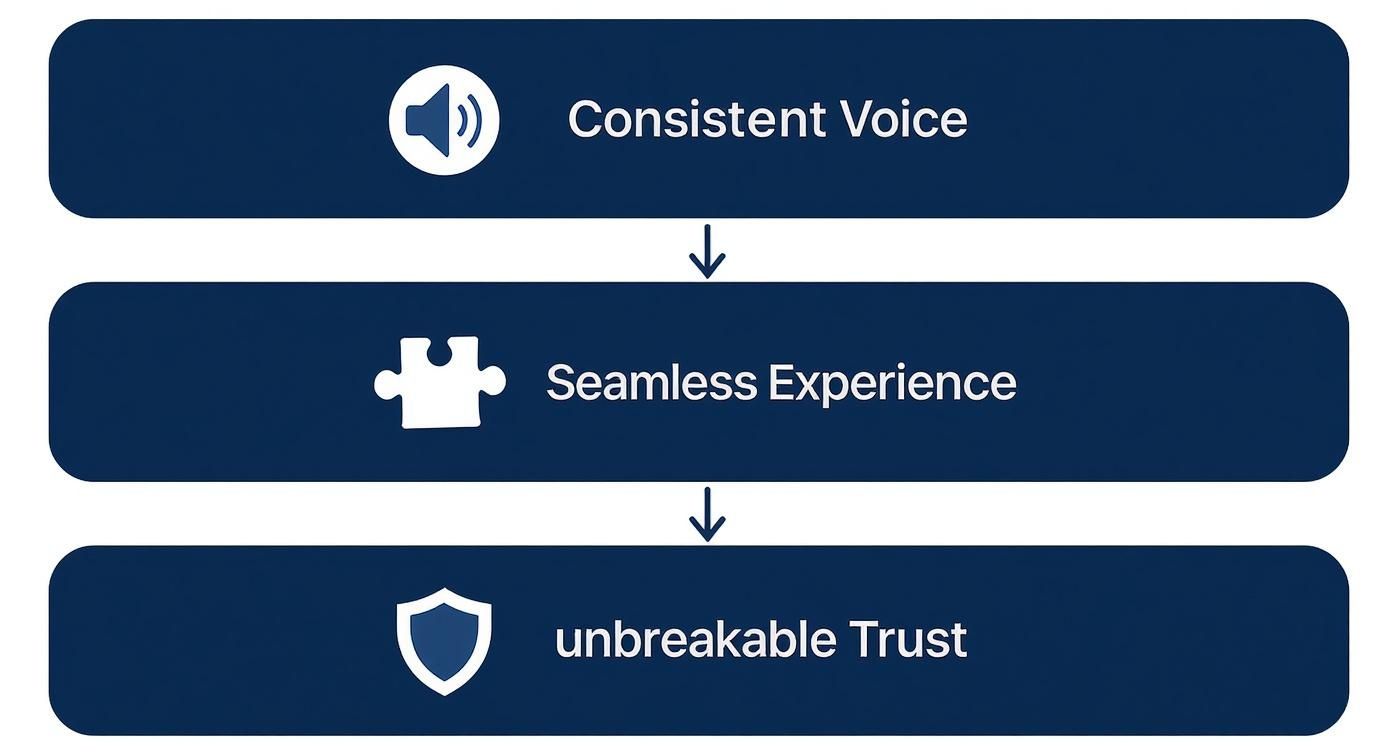
As the visual shows, that trust doesn’t just happen by accident. It’s the direct result of a carefully built and consistently applied communication strategy.
4. Purpose: The Mission Driving Your Message
Finally, every single word you write must be guided by your brand’s purpose. What’s the underlying mission behind your communication? Are you here to educate, entertain, inspire, or reassure?
Your purpose is the “why” that fuels everything. It ensures your communication isn’t just consistent in style, but also in substance. When every post, email, and comment reinforces your core mission, your brand voice becomes a powerful tool for building a genuine connection, turning passive readers into your most loyal advocates.
To see how these four components come together, let’s look at a breakdown for a couple of common brand archetypes.
Brand Voice Component Breakdown
| Component | Description | Example (The ‘Explorer’ Brand) | Example (The ‘Caregiver’ Brand) |
|---|---|---|---|
| Character | The brand’s core personality or archetype. | Adventurous, independent, ambitious. | Nurturing, supportive, compassionate. |
| Tone | The emotional inflection used in different contexts. | Positive: Inspiring, bold, motivating. Negative: Direct, challenging, resilient. | Positive: Warm, gentle, reassuring. Negative: Empathetic, concerned, understanding. |
| Language | The specific vocabulary and sentence structure. | Active verbs, vivid imagery, short sentences. Uses words like “discover,” “conquer,” “journey.” | Simple, accessible words, gentle rhythm. Uses words like “support,” “care,” “together.” |
| Purpose | The underlying “why” behind every message. | To inspire people to push their limits and explore the world. | To make people feel safe, cared for, and understood. |
As you can see, defining these four building blocks gives you a practical framework. It takes the abstract concept of “voice” and turns it into a concrete set of guidelines you can actually use day-to-day.
Learning from How Leading Brands Communicate
Theory gives you the building blocks, but seeing a powerful brand voice in action is where the real learning happens. To really get a feel for what a brand voice is, let’s break down the communication styles of two massive brands: Zalando and Adidas. By digging into how they apply their unique voices, we can turn these abstract ideas into something concrete and practical.
We’ll look at their website copy, social media feeds, and ad campaigns to see exactly how their distinct personalities connect with their audiences. This isn’t just a quick glance; it’s a deep dive into the specific choices that make their communication work so well.
Zalando: The Stylish and Empowering Friend
Zalando’s voice is effortlessly cool, inclusive, and empowering. It’s like getting fashion advice from that one stylish, supportive friend who just wants you to feel amazing. They ditch the overly technical fashion jargon and instead use language that’s both accessible and aspirational.
Their communication is built on a simple, clear foundation:
- Character: The Trendsetter. Zalando positions itself as your go-to guide for personal style—always ahead of the curve but never intimidating.
- Language: Their vocabulary is modern and positive, often using direct, conversational phrases. Sentences are typically clean and easy to read, making the whole experience feel smooth.
- Purpose: To empower individual expression through fashion. Every piece of communication, from a product description to an Instagram story, reinforces the idea that style is a tool for self-confidence.
This approach works especially well in the German market. A brand voice’s effectiveness is closely tied to trust and loyalty, and recent data shows that 53% of Germans are enrolled in loyalty programs. Zalando’s loyalty programme, Zalando Plus, uses this same empowering and personalised voice to make members feel genuinely valued, strengthening that all-important customer relationship. You can find out more about how German retail is changing in the Retail Radar Germany study from Avaus.com.
Adidas: The Driven and Innovative Athlete
Adidas, on the other hand, embodies the spirit of an athlete. Their voice is energetic, motivational, and laser-focused on performance and innovation. It speaks directly to the competitor inside all of us, whether you’re a pro athlete or just trying to beat your personal best.
Let’s break down the components of their powerful voice:
- Character: The Coach or Mentor. Adidas is constantly pushing its audience to achieve more, giving them both the inspiration and the high-performance tools to get there.
- Tone: Their tone is consistently confident, direct, and inspiring. When it comes to product-focused content, it shifts to become more technical and precise, highlighting their commitment to innovation.
- Purpose: To inspire creators to harness the power of sport in their lives. Their famous tagline, “Impossible is Nothing,” perfectly captures this driving mission.
Both Zalando and Adidas are masters at adapting their tone for different channels—from a playful Instagram reel to a serious press release—without ever losing their core character. This flexibility is the hallmark of a truly mature brand voice.
By looking at these examples, you can see how a well-defined voice becomes more than just a marketing tactic. It’s a complete communication system that builds a narrative and forges a real emotional connection. For more inspiration, check out these excellent business storytelling examples that show how a great voice can bring a brand’s mission to life.
How to Create and Document Your Brand Voice
Pinning down your brand voice isn’t some abstract marketing exercise—it’s a practical, hands-on process. It starts by taking an honest look at where you are right now and deciding where you want to go. This isn’t about guesswork. It’s about making deliberate choices to build a personality that truly connects with your ideal customers.
The first step is a simple content audit. Just gather up your recent blog posts, social media updates, and even a few customer emails. Read through them as objectively as you can and look for patterns.
Is there an accidental personality already peeking through? You might find you’re more formal than you realised, or perhaps way more casual.
Clarify Your Core Foundation
Once you’ve got a baseline, it’s time to connect your voice to your brand’s mission and values. What’s the fundamental reason your business exists? Who are you trying to help? For your voice to feel genuine, it has to be an authentic extension of these core principles.
From there, try to boil your brand’s personality down into three descriptive words. Are you witty, inspiring, and direct? Or maybe you’re more empathetic, clear, and reassuring. Choosing these adjectives gives you a simple but powerful filter for every single piece of content you create.
This is especially vital on social platforms, where people are actively researching brands. For instance, 51% of Germans aged 16-34 see social media as a crucial tool when looking into brands. It just goes to show how a clear voice can shape perception from the very first impression.
Document Everything in a Brand Voice Chart
Here’s the thing: an undocumented voice is just a suggestion. To make sure everyone on your team is on the same page, you need to create a simple brand voice chart. This document is the cornerstone of your strategy, translating those three descriptive words into practical, real-world guidelines.
And don’t worry, this chart doesn’t need to be some complicated, 50-page manual. A simple table is often the most effective tool.
Here’s a basic template to get you started:
| Voice Characteristic | What It Means | Examples (Do This) | Examples (Don’t Do This) |
|---|---|---|---|
| Witty | Use clever wordplay; be humorous but smart. | “Our software works harder than your morning coffee.” | “Our synergistic solution leverages paradigms.” |
| Inspiring | Motivate action; focus on possibilities. | “Let’s build something amazing together.” | “You should probably try our product.” |
| Direct | Get straight to the point; use clear language. | “It’s fast. It’s simple. It works.” | “In consideration of various factors…” |
The goal of a brand voice chart is clarity, not complexity. It should be a practical tool that a writer can glance at and immediately understand how to sound like your brand.
By documenting these rules, you create a single source of truth that empowers your entire team to speak with one, unified personality. Our detailed guide offers more templates and tips for creating effective brand voice guidelines.
Once your voice is defined, you can learn how to put it into action with tips for effective copywriting for social media.
Putting Your Brand Voice to Work on LinkedIn

Alright, you’ve got the building blocks of your brand voice. Now, let’s unleash it where it can make a massive difference: LinkedIn. Just because it’s a professional network doesn’t mean your content has to be stiff and robotic. Far from it. LinkedIn is the perfect stage to let your character shine and build real connections.
The trick is to balance your personality with professionalism. Your core voice—whether it’s witty, inspiring, or straight-to-the-point—should always be present, just fine-tuned for a business-minded crowd. This is how you stop posting generic company updates and start sparking actual conversations.
From Corporate to Compelling
Let’s look at a real-world example. Here’s how a standard corporate announcement can be transformed by injecting a clear brand voice.
Before (Generic Voice): “Our company is pleased to announce the launch of our new software update, which includes several feature enhancements designed to improve workflow efficiency.”
After (Witty & Direct Voice): “Tired of clunky workflows? We were too. Our latest update is here to make your workday 10x smoother. Say goodbye to unnecessary clicks and hello to getting things done.”
See the difference? The second one grabs you. It connects with a real pain point and uses a specific, engaging voice to make the message stick.
On LinkedIn, your voice is your greatest differentiator. It’s what stops the scroll and turns a passive reader into an engaged follower by making your brand feel human and relatable.
Empowering Your Team as Advocates
Your brand voice shouldn’t be locked away in the marketing department, only to be used on the official company page. The real magic happens when you empower your entire team to use it. Give them the brand voice chart and encourage them to share their own insights, framed by its guidelines.
Suddenly, you have an authentic chorus of voices all reinforcing your brand’s personality, which massively expands your reach. To get the most out of this, it’s crucial to follow proven social media posting best practices to make sure every post lands with maximum impact.
For anyone on your team looking to take it a step further, learning how to build a personal brand on LinkedIn is a fantastic next move. When everyone is aligned, your brand becomes impossible to ignore.
Got Questions About Brand Voice? We’ve Got Answers.
As you start to pin down your brand’s voice, a few questions always seem to pop up. It’s totally normal. Let’s walk through the big ones so you can move forward with a clear, confident strategy.
Can My Brand Use Different Tones?
Yes! In fact, it’s a must. Think of it like this: your brand voice is your underlying personality—that doesn’t change day to day. But your tone is the mood you adopt for a specific situation.
You wouldn’t use the same tone to handle a customer complaint as you would to announce a massive company win, right? One needs empathy and reassurance, the other calls for excitement and celebration. The trick is making sure every tone still feels like it’s coming from the same core personality.
How Is Brand Voice Different From Brand Image?
This is a great question, and the distinction is super important.
Here’s a simple way to look at it: brand voice is how you talk, while brand image is how you’re seen. Your voice comes through in the words you choose for your website copy, your social media updates, and your emails. It’s your communication style.
Your image, on the other hand, is the whole visual and perceptual package—your logo, your colour palette, the design of your products, and the overall feeling people get from interacting with you. They’re two different things, but they absolutely must be in sync to create a brand that feels whole and trustworthy.
How Often Should We Revisit Our Brand Voice?
Your brand voice should have some staying power; you don’t want to change it with every passing trend. That just creates confusion.
That said, it’s not carved in stone. A good rule of thumb is to give it a proper review once a year. You should also take a fresh look anytime your business goes through a major change, like breaking into a new market or launching a completely new product line. This little check-in makes sure your voice is still hitting the right notes with your audience and truly reflects who you are now.
Ready to turn your shiny new brand voice into LinkedIn content that actually connects? Postline.ai uses smart AI and deep personalisation to help you write posts that sound just like you, only faster. Start creating standout content in minutes at https://postline.ai.

Run every client pipeline in one place
Give each LinkedIn profile its own voice, calendar, approval flow, and analytics. Start in minutes.
Start free trial