
8 Powerful Thought Leadership Content Examples for 2025
Explore 8 powerful thought leadership content examples. Learn how to create reports, op-eds, and guides that establish authority and build your brand.

In a content-saturated world, simply participating in the conversation is no longer enough. To stand out, professionals and brands must evolve from being content creators to becoming genuine thought leaders. But what does that truly mean? It’s about moving beyond rehashing known facts and, instead, contributing novel ideas, challenging conventions, and providing a clear, authoritative voice that guides your industry forward.
True thought leadership isn’t just about being knowledgeable; it’s about shaping the conversation and influencing perspectives. This requires a strategic approach to content that builds credibility and provides undeniable value. It’s the difference between adding to the noise and becoming the signal that others tune in to follow.
This article unpacks eight distinct and powerful thought leadership content examples, moving from foundational formats to the pinnacle of industry influence. For each one, we will dissect the strategy, analyse the specific tactics used, and provide actionable takeaways you can implement immediately. We’ll explore everything from original research reports to interactive tools, giving you a replicable blueprint for building your own authority and making a lasting impact. Let’s examine what separates fleeting content from enduring influence.
1. Original Research Reports and Data Studies
Original research is a cornerstone of effective thought leadership. Instead of commenting on existing industry conversations, this format allows you to create the conversation. By conducting proprietary surveys, analysing unique data sets, or commissioning formal studies, you generate fresh insights that no one else has. This positions your brand as a primary source of knowledge and an indispensable resource for decision-makers.
These comprehensive reports establish authority by contributing new, verifiable knowledge to your field. They move beyond opinion and provide evidence-backed conclusions that help others navigate complex challenges, validate strategic choices, and understand emerging trends.

Why It Works
This type of thought leadership content is powerful because it’s inherently unique and defensible. While competitors can imitate your blog posts, they cannot replicate your proprietary data. Annual reports like HubSpot’s State of Marketing Report or the Edelman Trust Barometer become industry benchmarks that journalists, executives, and other creators cite for years, generating high-quality backlinks and sustained brand visibility.
Actionable Takeaways
- Define a Niche Question: Start with a focused hypothesis that addresses a critical knowledge gap or a common pain point in your industry.
- Prioritise Methodology: For your data to be credible, your methodology must be sound. Clearly explain your sample size, data collection process, and analytical framework to build trust.
- Amplify Through Derivative Content: A single report can fuel your content calendar for months. Break down key findings into blog posts, infographics, social media carousels, and webinar topics to maximise reach.
- Plan a Multi-Channel Launch: Build anticipation before publication. Coordinate a distribution strategy across email, social media, PR outreach, and partnerships to ensure your report makes a significant impact on day one.
2. Visionary Op-Eds and Opinion Pieces
Visionary op-eds and opinion pieces are persuasive articles where leaders take a definitive stance on key industry issues, future trends, or controversial topics. Rather than simply reporting facts, this format is designed to argue for a particular viewpoint, challenge conventional wisdom, or propose innovative solutions. It showcases executive expertise and drives important conversations, positioning the author as a forward-thinking authority.
This approach allows leaders to shape industry narratives and demonstrate a deep, nuanced understanding of their domain. By contributing to high-profile publications or company blogs, they can influence peers, customers, and policymakers, establishing a clear and compelling point of view.

Why It Works
This form of thought leadership content excels at building a personal brand alongside a corporate one. It attaches a human face and a strong voice to a company’s mission. When leaders like Satya Nadella write about AI ethics or Reid Hoffman discusses the future of work, they are not just promoting Microsoft or LinkedIn; they are shaping public discourse. These pieces are powerful because they are built on perspective and conviction, which builds trust and commands attention in a crowded marketplace.
Actionable Takeaways
- Lead with a Contrarian View: Start with a hook that challenges a widely held belief in your industry. This immediately captures attention and signals that you have a unique perspective.
- Support Arguments with Experience: Ground your opinions in personal anecdotes, specific data, or insightful case studies. This adds credibility and makes your arguments more relatable and persuasive.
- Develop a Clear Vision: Conclude your piece with a clear call to action or a compelling vision for the future. Don’t just critique the present; outline a better path forward.
- Connect with Editors: Build relationships with editors at target industry publications. A well-placed op-ed can significantly amplify your message and is a key part of an effective thought leadership strategy.
3. Long-Form Educational Guides and Definitive Resources
Comprehensive educational guides act as definitive, one-stop resources that cover a specific topic with exhaustive detail. Instead of a simple blog post, these are deep, often 3,000+ word assets that combine expert instruction, practical examples, and unique frameworks. They position a brand as a master of its subject matter, serving as the go-to reference for industry professionals seeking to truly understand a complex area.
These guides move beyond basic “how-to” content by offering multiple perspectives, advanced insights, and a structured learning path. They are designed to be bookmarked, shared, and returned to repeatedly, becoming a cornerstone of a brand’s intellectual property and a powerful lead generation tool.

Why It Works
This thought leadership content example works because it builds immense trust and authority by providing overwhelming value for free. It captures high-intent organic traffic for broad, competitive keywords and becomes a link-building magnet. Evergreen resources like Moz’s Beginner’s Guide to SEO or the detailed guides from Backlinko have become foundational texts in their industry. They attract loyal audiences and demonstrate an unparalleled commitment to educating the market.
Actionable Takeaways
- Choose Strategic Topics: Focus on broad, high-value topics that have significant search volume and are central to your business offerings. The goal is to own the definitive resource for that subject.
- Structure for Skimmability: Use clear headers, bullet points, pull quotes, and images to break up the text. A well-organised guide allows users to find the exact information they need quickly.
- Incorporate Unique Insights: Interview internal and external experts to add perspectives no one else has. Include proprietary data, original examples, or custom frameworks to make your guide truly unique.
- Plan for Regular Updates: To maintain its value and search rankings, a definitive guide must stay current. Schedule annual or biannual reviews to refresh statistics, update examples, and add new insights. A well-defined content creation workflow can make this process more manageable.
4. Executive Video Series and Webinar Presentations
Executive video series and webinars humanise a brand by putting its leaders front and centre. This format shifts thought leadership from a static, written medium to a dynamic, engaging visual experience. By featuring key executives in interviews, presentations, or panel discussions, companies can showcase their passion, deep expertise, and unique perspective in a more personal and compelling way.
This approach builds a direct connection with the audience, allowing viewers to see the conviction and personality behind the brand’s ideas. It transforms abstract concepts into tangible conversations, making complex topics more accessible and demonstrating leadership in real-time.
Why It Works
Video content excels at conveying nuance and emotion, which are critical for authentic thought leadership. While anyone can write an article, not everyone can confidently articulate a forward-thinking vision on camera. Series like Goldman Sachs’ Talks at GS or Salesforce’s ambitious Salesforce+ streaming service become destination content, positioning their executives as accessible, authoritative industry guides rather than just corporate figures. This format is a powerful way to stand out in crowded content landscapes.
Actionable Takeaways
- Invest in Production Quality: Poor audio or lighting can undermine your message. Invest in good-quality cameras, microphones, and lighting to ensure your executives look and sound professional.
- Develop a Consistent Format: Create a recognisable brand for your series with a standard intro/outro, visual identity, and episode structure. This builds audience familiarity and anticipation.
- Clip and Amplify Key Moments: A 30-minute webinar contains dozens of shareable moments. Isolate powerful quotes, key data points, or compelling stories into short clips perfect for social media platforms. For an in-depth guide, explore how to post a video on LinkedIn.
- Repurpose Live Content: Host live webinars to generate engagement and capture leads through registration. Afterwards, edit the recording and offer it as on-demand content, transcribing it for blog posts and accessibility to maximise its value.
5. Innovative Framework Development and Methodologies
Creating a proprietary framework or methodology is a powerful form of thought leadership that goes beyond commentary. It involves developing a unique, repeatable system or conceptual model that helps others understand and solve complex problems. This approach codifies your expertise into branded intellectual property, differentiating your perspective and providing a memorable structure for your ideas.
Well-designed frameworks act as mental shortcuts, making sophisticated concepts accessible and actionable. They offer a new lens through which to view a challenge, positioning you not just as an expert, but as an innovator who has organised chaos into a clear, usable process.
The infographic below illustrates the core components that transform an idea into an influential framework.
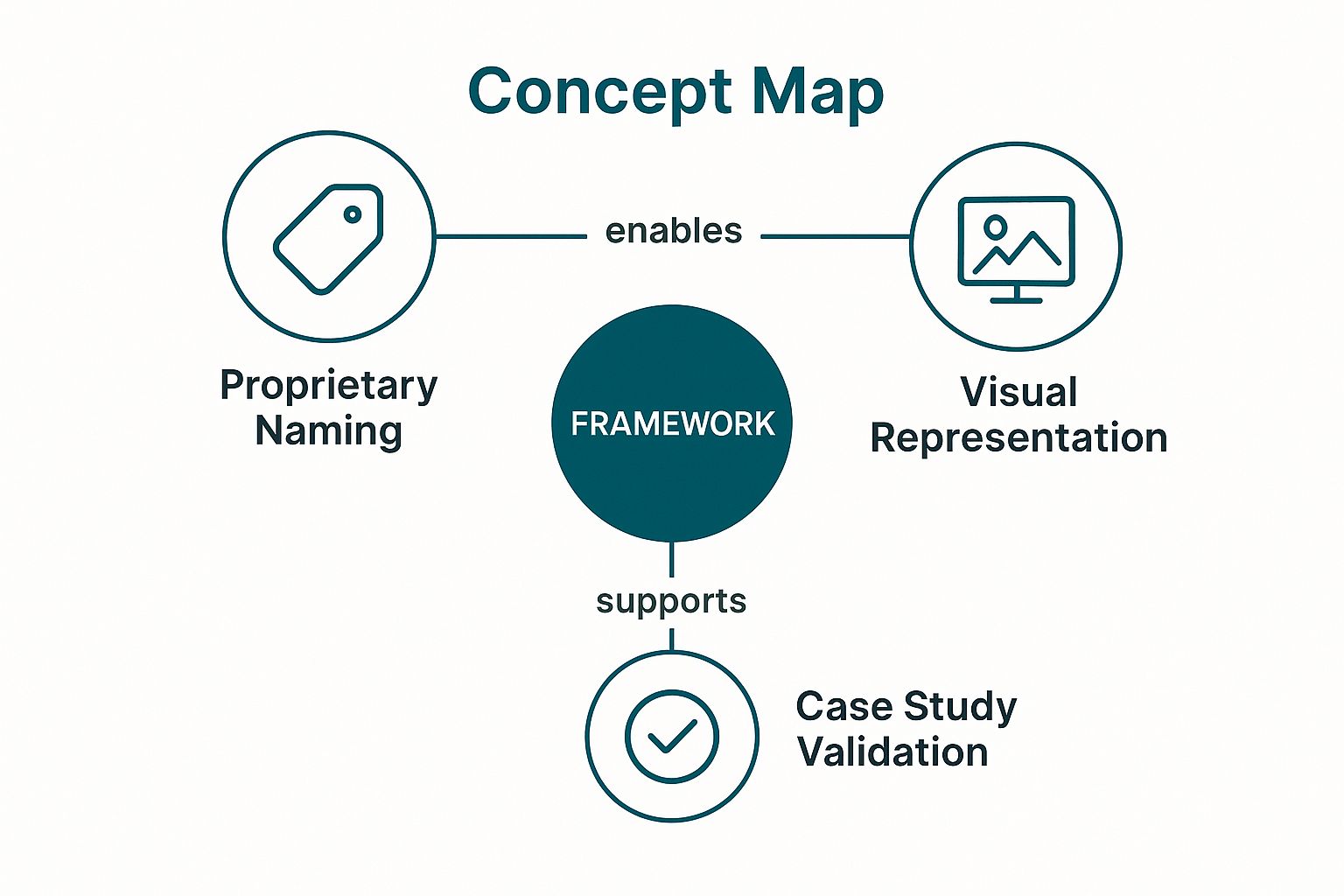
As shown, a memorable name, a clear visual model, and proof through case studies work together to build a defensible and recognisable intellectual asset.
Why It Works
This thought leadership content example is potent because it creates a common language around your ideas. Frameworks like Simon Sinek’s Golden Circle or Donald Miller’s StoryBrand 7-Part Framework become iconic because they are simple to grasp, visually distinct, and proven to deliver results. They are inherently shareable and become synonymous with their creator, turning a name into a respected brand and a method into an industry standard.
Actionable Takeaways
- Solve a Recurring Problem: Develop your framework by documenting the process you use to solve a consistent, high-value problem for your clients or your business.
- Visualise the Concept: Create a simple, memorable diagram or model. A strong visual makes your framework easier to understand, recall, and share. For innovative approaches to creating compelling visual thought leadership, consider learning about making AI-generated videos.
- Give It a Memorable Name: Use alliteration, an acronym, or a numerical structure (e.g., “The 7 Steps”) to make the framework’s name catchy and easy to remember.
- Build an Ecosystem: Don’t just publish the framework. Build a content ecosystem around it with blog posts, case studies, templates, and workshops that explain and validate each component.
6. Podcast Series Featuring Expert Conversations
An executive-hosted or branded podcast series creates an ongoing platform for thought leadership by facilitating deep conversations with industry experts, customers, and other influential voices. Podcasts allow for more nuanced and personal discussions than most written formats, revealing the thinking process and personality behind the expertise. This serial format builds audience loyalty and positions the host as a central connector and curator of important industry conversations.
Instead of just broadcasting your own ideas, a podcast allows you to learn in public and associate your brand with other respected leaders. By hosting insightful dialogues, you establish authority not just as a subject matter expert, but as a key figure within your professional community. This is one of the most effective thought leadership content examples for building relationships at scale.
Why It Works
The power of a podcast lies in its intimacy and ability to build genuine connection. Listeners feel like they are part of an exclusive conversation, which fosters trust and loyalty over time. Shows like Reid Hoffman’s Masters of Scale or Guy Raz’s How I Built This have become essential listening in the business world because they consistently deliver value through high-calibre guests and storytelling. This format transforms a brand from a mere service provider into a trusted source of industry intelligence and inspiration.
Actionable Takeaways
- Define Your Niche and Audience: Start with a clear focus. Who are you trying to reach, and what specific challenges or interests do they have? A tightly defined niche is easier to own.
- Invest in Quality Audio: Poor sound quality is a common reason listeners abandon a podcast. Invest in good microphones and basic editing software to ensure a professional and enjoyable experience.
- Develop a Guest Strategy: Create a list of 20-30 potential guests before you even launch. This ensures you have a pipeline of content and helps validate your show’s concept.
- Create Derivative Content: A single podcast episode can be a goldmine for other content formats. By repurposing key moments into social media clips, blog posts, and quote graphics, you can maximise the reach of every conversation. For more on this, explore these content repurposing strategies.
7. Industry-Defining Books and Publications
Publishing a book is the ultimate expression of thought leadership, offering an unparalleled platform to explore a complex idea in its entirety. While blogs and whitepapers deliver value in focused bursts, a book allows you to present a complete framework, share years of research, and cement your authority on a subject. It transforms your intellectual capital into a tangible, high-value asset.
This format moves beyond simply contributing to a conversation; it aims to define it. A well-executed book serves as a permanent business card, a powerful lead magnet, and a launchpad for speaking engagements, workshops, and consulting opportunities, establishing the author as a foremost expert in their field.
Why It Works
Books have a perceived value and shelf life that digital content often lacks. They represent a significant investment of time and expertise, signalling deep mastery to the reader. Landmark publications like Simon Sinek’s Start with Why or Clayton Christensen’s The Innovator’s Dilemma didn’t just share ideas; they created new business vernaculars and established frameworks that entire industries adopted. This type of thought leadership content example generates enduring credibility and a legacy that outlasts fleeting trends.
Actionable Takeaways
- Build an Audience First: Before writing a book, cultivate a following through other content channels like a blog or newsletter. This provides a built-in audience for your launch and validates interest in your topic.
- Structure Before You Write: Develop a detailed chapter-by-chapter outline. This roadmap keeps your narrative focused, ensures a logical flow, and prevents you from getting lost in the writing process.
- Plan a Comprehensive Launch: Your book launch strategy should begin at least six months before publication. Coordinate a multi-channel campaign involving email marketing, PR outreach, podcast interviews, and advance reader testimonials to build momentum.
- Repurpose for Maximum Impact: A book is a content goldmine. Develop keynote speeches, workshops, online courses, and smaller content pieces based on its core concepts to extend its reach and create new revenue streams.
8. Interactive Tools, Assessments, and Calculators
Interactive content transforms passive consumption into active engagement. Instead of just reading about a solution, your audience can experience its value firsthand. By building custom tools, self-assessments, or calculators, you codify your expertise into a practical, scalable format that delivers personalised insights directly to the user. This approach demonstrates your capability, rather than just talking about it.
These digital experiences establish authority by solving a tangible problem for your audience on the spot. They provide immediate, customised value based on user inputs, making your brand an indispensable resource for answering critical business questions and validating strategic decisions.
Why It Works
This form of thought leadership content is exceptionally powerful because it offers utility and creates a memorable brand interaction. Competitors can write similar articles, but they can’t easily replicate a well-built tool that solves a genuine pain point. Tools like HubSpot’s Website Grader or CoSchedule’s Headline Analyser become go-to resources in their respective fields, generating high-intent leads and fostering brand loyalty through repeated use.
Actionable Takeaways
- Solve a Specific Pain Point: Identify a frequent, high-value question your customers ask and build a tool that provides a clear, immediate answer.
- Minimise Initial Friction: Keep the number of initial input fields low to encourage completion. You can always ask for more information later.
- Provide Value Before the Gate: Offer a valuable insight or result first, then gate the full, detailed report behind an email submission to increase conversion rates.
- Design for Shareability: Create results pages that are visually appealing and easy to screenshot. Include pre-populated social sharing buttons to encourage users to post their scores or outcomes.
Thought Leadership Content Types Comparison
| Type | Implementation Complexity 🔄 | Resource Requirements ⚡ | Expected Outcomes 📊 | Ideal Use Cases 💡 | Key Advantages ⭐ |
|---|---|---|---|---|---|
| Original Research Reports and Data Studies | High - needs statistical expertise, data collection, and ethics approval | Significant time and financial investment; data analysis tools | High-quality leads, media coverage, lasting authority | B2B tech leadership, consulting, SaaS benchmarks, professional services | Unique content, credibility, multiple repurposing |
| Visionary Op-Eds and Opinion Pieces | Medium - requires strong executive opinions, editorial relationships | Moderate; executive time and writing skill | Builds personal and company brand; media and speaking invites | Thought leadership on trends, timely/controversial topics | Executive voice, quick production, shareability |
| Long-Form Educational Guides and Resources | High - extensive research, writing, and updates required | Significant time; subject matter experts; SEO effort | Sustained organic traffic, lead generation, brand authority | Complex topics, high-value keywords, company expertise | Comprehensive knowledge, SEO, multiple formats |
| Executive Video Series and Webinars | High - professional production, editing, and live event management | High costs; executive commitment; media training | High engagement, trust, executive charisma | Executive communication, live engagement, visual demos | Personal connection, repurposing content, SEO boost |
| Innovative Framework Development | High - requires validation, research, and trademarking | Significant expert input, design, testing | Competitive differentiation, intellectual property, consulting | Differentiated expertise, speaking, certification programs | Memorable, proprietary, scalable expertise |
| Podcast Series Featuring Expert Conversations | Medium-High - regular production and guest coordination | Moderate audio production resources | Audience loyalty, network expansion, brand positioning | In-depth industry conversations, audience building | Voice intimacy, guest leverage, repurposing |
| Industry-Defining Books and Publications | Very High - lengthy writing, editing, and publishing process | Long-term author commitment, editing, marketing | Highest credibility, speaking/consulting opportunities | Ultimate thought leadership, comprehensive topic mastery | Legacy asset, media coverage, premium pricing |
| Interactive Tools, Assessments, Calculators | Very High - development, maintenance, and UX design | Technical development teams, marketing support | High engagement, qualified leads, viral sharing potential | Personalized insights, lead generation, practical application | Scalable expertise, lead capture, user engagement |
From Insight to Influence: Your Next Step in Thought Leadership
Becoming a recognised thought leader is a marathon, not a sprint. It is a journey built on a foundation of consistent, high-value contributions that genuinely advance your industry’s conversation. As we have explored through the various thought leadership content examples in this article, the path to influence is not defined by a single format but by a core principle: create unique and undeniable value.
The examples showcased, from HubSpot’s data-driven research reports to Adam Grant’s industry-defining books, all share a common DNA. They don’t just rehash existing information; they introduce new perspectives, provide novel frameworks, or offer definitive solutions to complex problems. Your own journey begins by identifying where your unique expertise intersects with your audience’s most pressing needs.
Distilling the Core Strategies
Reflecting on the examples, several key themes emerge as critical for success:
- Authenticity is Non-Negotiable: Whether it’s a visionary opinion piece or a conversational podcast, your genuine voice, perspective, and passion must be the driving force.
- Originality Commands Attention: The most powerful thought leadership stems from original research, innovative frameworks, or first-hand executive insights. It creates a defensible point of view that cannot be easily replicated.
- Utility Builds Trust: From interactive calculators to long-form educational guides, content that helps your audience solve a real problem forges a lasting connection and establishes your authority.
- Consistency Creates Momentum: A single great whitepaper is a moment; a consistent stream of valuable insights across different formats becomes a movement.
Your Actionable Path Forward
The leap from consuming thought leadership content examples to creating your own can feel daunting, but it starts with a single, focused step. Don’t aim to create an industry-defining book overnight. Instead, ask yourself: what is the most valuable, unique insight I can share with my network this week?
Start by translating your expertise into a tangible format. If you are a data wizard, a small-scale LinkedIn poll and analysis could be your entry point. If you are a natural communicator, a short video series breaking down a complex topic might be the perfect fit. For further inspiration on diverse and impactful content formats, delve into these 8 potent thought leadership content examples for B2B leaders to see how others have successfully carved out their niches.
The ultimate goal is not just to create content but to cultivate a distinct point of view that adds genuine value to your professional community. Start small, commit to consistency, and focus on being the most helpful and insightful voice you can be. Your influence will grow from there.
Ready to turn your insights into influential content? Postline.ai helps you consistently generate high-quality, authentic thought leadership posts for LinkedIn by analysing your unique voice and providing real-time research. Start building your authority today at Postline.ai.

Run every client pipeline in one place
Give each LinkedIn profile its own voice, calendar, approval flow, and analytics. Start in minutes.
Start free trial