
A Guide to Social Selling on LinkedIn That Actually Works
Master social selling on LinkedIn with our guide. Turn your profile into a lead magnet, create content that attracts clients, and build valuable relationships.

Let’s be real for a moment: the old sales playbook is gathering dust on a shelf somewhere, and for good reason. Interruptive cold calls and generic email blasts just don’t cut it anymore. Your buyers are smarter, more sceptical, and have zero time for a sales pitch they didn’t ask for.
This is exactly why social selling on LinkedIn isn’t just another buzzword—it’s a fundamental shift in how we connect with prospects. It’s about building genuine relationships and establishing yourself as a credible resource before you even think about asking for a sale.
Instead of “always be closing,” the new mantra is “always be helping.” You do this by sharing valuable insights, engaging with what your prospects are talking about, and positioning yourself as a trusted advisor. Essentially, you’re turning cold outreach into warm, welcome conversations.

If you want a deeper dive into the core principles, we’ve covered them in our guide on what is social selling. The main takeaway, though, is moving from a strategy of interruption to one of attraction.
The Shift From Pitching to Helping
Think about it this way.
Scenario one: a salesperson blasts out a cold, copy-pasted InMail that immediately asks for a 15-minute demo. The person on the other end has no idea who they are and hits “delete” without a second thought. That approach is all about the seller’s needs.
Now, let’s look at the social selling approach. A sales pro consistently shares content that addresses their industry’s biggest headaches. They drop a thoughtful comment on a prospect’s post, adding real value to the conversation. Over weeks and months, they build recognition and trust. When they finally do reach out, it’s not a pitch—it’s the start of a relevant conversation. They’ve earned the right to have that discussion.
Social selling isn’t about finding a new way to spam people. It’s about building your professional brand so that your ideal customers come to you. You’re trading aggressive tactics for authentic authority.
Your Buyers Are Already Here
The opportunity is massive, and it’s right in front of you. Your potential customers are on LinkedIn right now, looking for solutions, checking out vendors, and consuming professional content.
Take Germany, for example. LinkedIn’s user base there shot up from 15.72 million in May 2023 to a projected 22 million by March 2025. That’s a staggering 40% growth in under two years. With the 25-34 age group as the largest segment, you’ve got a direct line to the ambitious professionals making B2B decisions.
Not showing up and being active on the platform is like keeping your shop closed during peak business hours. You’re simply missing out.
Turn Your Profile Into a Client Magnet
Let’s get one thing straight: your LinkedIn profile is no longer a static CV. It’s your digital storefront, your personal sales page, working for you 24/7. If you want to succeed with social selling, you have to stop thinking about it as a list of job duties. Instead, see it as a resource built specifically for your ideal client.
When a prospect lands on your page, you have a few seconds to make them think, “Finally, someone who gets my problem.”
This whole transformation kicks off with your headline. Seriously, ditch the generic job titles like “Sales Manager at Company X.” It’s a waste of prime real estate. You need to craft a client-centric headline that screams value. Think less about what you are and more about the outcome you deliver.
- Before: Account Executive
- After: Helping SaaS Founders Reduce Churn and Increase Customer Lifetime Value
See the difference? That small tweak instantly repositions you as a problem-solver, not just another employee on the payroll. It’s the single most important change you can make.
Crafting a Compelling Narrative
Alright, next up is your “About” section. This is your chance to tell a story and forge a genuine connection. Please, avoid the dry, chronological summary of your career history. Nobody reads that. Instead, structure it to hook potential clients from the first line.
(If you really want to go deep on this, our guide on how to build a personal brand on LinkedIn is a great place to start.)
A killer “About” section needs four things:
- A Hook: Kick it off with a statement that hits on your target audience’s biggest pain point.
- Your Solution: Get straight to the point. Who do you help, and what results do you get for them?
- Social Proof: Drop in a key achievement or a quick client win to build instant credibility.
- A Clear Call-to-Action: Don’t leave them hanging. Tell them exactly what to do next, whether that’s dropping you a message or booking a call.
This isn’t a biography; it’s an active sales asset designed to pull prospects into a conversation.
Maximising Your Visual Real Estate
And for goodness’ sake, don’t forget your banner image. It’s the billboard at the top of your page. Use it to broadcast a clear value prop, show off a client testimonial, or promote your latest guide. It’s a massive visual cue that reinforces your headline and expertise before they even scroll.
This isn’t just fluffy advice. LinkedIn is exploding. In Germany alone, the user base shot up from 17.52 million in December 2023 and is on track to hit 22 million by March 2025. That’s a 25.7% jump, which means more decision-makers are on the platform vetting people just like you. A polished first impression is non-negotiable. You can read more about Germany’s LinkedIn user growth on napoleoncat.com.
Your profile isn’t about you. It’s a mirror reflecting your ideal client’s challenges and aspirations. Every single element—from your headline to your banner—needs to show them you have the solution they’ve been looking for.
Creating Content That Starts Real Conversations
Once your profile is looking sharp, it’s time to get into the real engine of social selling on LinkedIn: your content. Let’s be clear, just posting for the sake of it isn’t going to move the needle. The whole point is to create posts that build your authority, solve genuine problems, and naturally pull in leads by sparking actual conversations.
This all starts with knowing your audience inside and out. What are their biggest headaches? What common myths do they believe about your industry? What are they really trying to achieve? Your content plan lives or dies by the answers to these questions. Don’t guess. Pay close attention to the exact language your prospects use on sales calls and in their own posts—that’s where the gold is.
Defining Your Content Pillars
To stop yourself from staring at a blank screen every morning, you need a plan. The easiest way is to organise your ideas around a few core themes, or “content pillars.” These pillars should speak directly to the challenges and interests of your ideal clients. This simple structure keeps you focused, ensuring every post reinforces your expertise and delivers real value.
Here are a few content pillars I’ve seen work wonders:
- Myth-Busting: Take a common misconception in your industry and tear it down. Explain why it’s wrong and what people should do instead. This instantly positions you as a credible expert.
- Sharing Client Wins: Don’t just brag. Tell a story. Frame a customer success story around the specific problem they had, how you helped them solve it, and the tangible results they got. It’s powerful social proof.
- Behind-the-Scenes Insights: Give people a peek behind the curtain. Share a lesson you learned from a recent project or a look at your process. This makes your brand feel more human and builds a ton of trust.
- Actionable Tips: Share a quick, practical tip that your audience can use today to solve a small but annoying problem. These posts are incredibly shareable and useful.
To make things even easier, you can build a weekly framework around these pillars. This helps make content creation a manageable habit rather than a daily crisis. We dive much deeper into this in our complete LinkedIn content strategy guide.
Your Weekly Social Selling Content Framework
A practical framework like this helps organise your weekly content creation around key social selling themes, ensuring your feed stays balanced and engaging.
| Day | Content Pillar Focus | Post Topic Idea | Goal of Post |
|---|---|---|---|
| Monday | Myth-Busting | “Why [Common Industry Advice] is terrible advice” | Establish authority and challenge assumptions. |
| Tuesday | Actionable Tips | “A 5-minute hack to solve [common problem]” | Provide immediate, tangible value. |
| Wednesday | Sharing Client Wins | “How [Client Name] achieved [Result]” | Build social proof and credibility. |
| Thursday | Behind-the-Scenes | “A mistake I made this week and what I learned” | Humanise your brand and build trust. |
| Friday | Personal/Industry Take | “My honest thoughts on the latest [Industry] trend” | Spark discussion and show personality. |
Using a simple table like this takes the guesswork out of what to post, so you can focus on writing quality content.
From Idea to Polished Post
Now, a great idea is only half the battle. Execution is everything. A fantastic concept can fall completely flat if it’s presented poorly. To make sure your content actually resonates and brings in leads, you absolutely have to learn how to post on LinkedIn for maximum impact.
Think of your profile as the first step in this process. It has to be primed and ready for the traffic your content will generate.
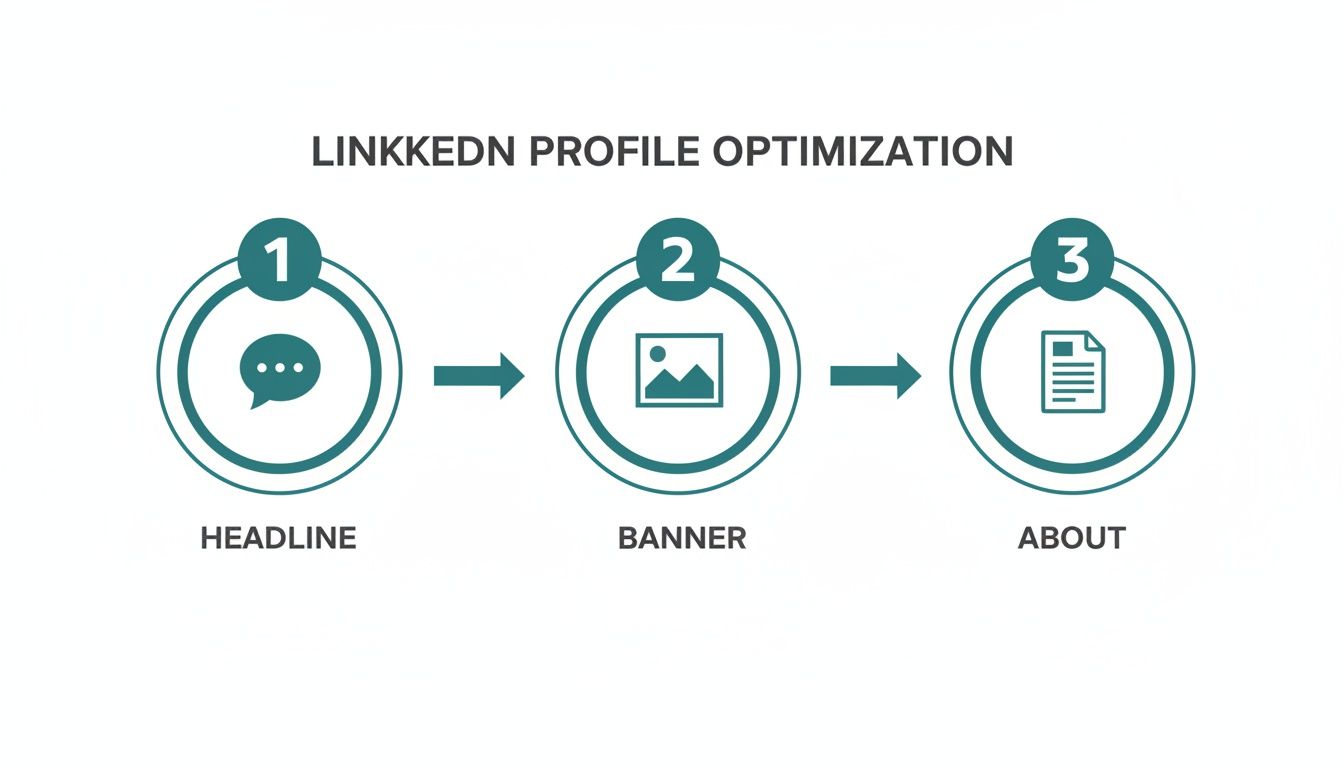
This visual breaks down how each piece of your profile—from your headline to your banner—works together to create a killer first impression.
Always remember, the goal isn’t to go viral; it’s to start meaningful conversations with the right people.
A post with ten comments from ideal prospects is far more valuable than a post with 100 likes from a random audience. Focus on engagement that leads to relationships, not just vanity metrics.
Think about it this way. A post that flops is often something generic, like a company announcement. But a post that works? That’s often a personal story about a mistake you made and what it taught you. One is corporate fluff; the other is relatable, builds empathy, and invites people to share their own experiences. And that is the perfect entry point for a real conversation.
How to Engage and Nurture Your Network Authentically
 Creating killer content is a fantastic start, but it’s only half the story. The real magic of social selling on LinkedIn happens in the trenches—the comments, the DMs, and the subtle back-and-forth that builds actual relationships. This is where you shift from just another voice in the feed to a trusted connection.
There’s one golden rule here, and it’s dead simple: give more than you take. Your goal isn’t to pounce on every interaction with a sales pitch. It’s to show up, be genuinely helpful, and earn the right to have a real business conversation when the time is right.
This means your daily and weekly workflow needs to be built around authentic engagement, not just shouting about your own stuff.
Master the Art of the Thoughtful Comment
The easiest way to stay on someone’s radar is by leaving insightful comments on posts from your prospects and industry leaders. But a quick “Great post!” or “I agree!” is just noise. It won’t cut it. Your comments need to add something to the conversation and, ideally, invite a reply.
Here’s a simple framework for leaving comments that actually get noticed:
- Acknowledge and Add: Start by referencing a specific point they made, then add your own quick insight or ask a follow-up question.
- Share a Mini-Story: Briefly connect their point to a personal experience or a client situation. This builds an immediate, human connection.
- Ask an Open-Ended Question: Get a real conversation going by asking something that can’t be answered with a simple “yes” or “no.”
This approach turns a passive “like” into an active conversation starter. You’re no longer a silent follower; you’re a thoughtful peer. Over time, these small interactions build a powerful sense of familiarity and trust.
Moving the Conversation to DMs
Once you’ve built some recognition through comments, you can think about taking the next step. But even here, your first direct message should never be a cold pitch. It’s simply a continuation of the helpful, value-first relationship you’ve already started building.
Let’s look at the difference between a cringey, copy-paste message and one that actually starts a conversation.
The Bad Outreach (Avoid This At All Costs):
“Hi [Name], I see you work in [Industry] and thought you might be interested in our [Product]. It helps companies like yours achieve [Vague Benefit]. Do you have 15 minutes for a demo next week?”
This is impersonal, selfish, and gets deleted on sight.
The Good Outreach (This Is What You’re Aiming For):
“Hi [Name], really enjoyed your recent post on [Topic]. Your point about [Specific Detail] made me think. I actually came across an article about that the other day and thought you might find it interesting. No strings attached, just thought I’d share!”
See the difference? This message is personal, references a shared interest, and offers value without asking for a single thing in return. It’s a human-to-human interaction, laying the groundwork for a proper business chat down the road.
The opportunity for these connections is immense. LinkedIn commands around 287 million users across Europe, with Germany alone contributing over 22 million, making it the undisputed B2B hub in the DE region. B2B marketers confirm that this high-intent audience helps generate leads twice as effectively as other channels. You can find out more about social media trends in Europe on sprinklr.com.
Measuring the Metrics That Actually Matter
To get better at social selling, you have to measure it. Simple as that. But if you’re only tracking likes and follower counts, you’re looking at vanity metrics. They feel good, but they don’t actually tell you if you’re making an impact on the business.
Real success is found in the actions that lead to genuine relationships and, ultimately, revenue.
So, let’s shift your focus. Instead of obsessing over likes, ask yourself: How many inbound connection requests did I get from ideal prospects this week? How many real conversations did I start in the DMs? These are the numbers that signal your strategy is actually working.
Getting to Grips with Your Social Selling Index
LinkedIn gives you a built-in tool to see how you’re doing. It’s called the Social Selling Index (SSI), and it’s a score out of 100 that grades your performance across four key areas. Think of it as your personal scoreboard for social selling.
Your SSI score is broken down into four pillars, each worth 25 points:
- Establishing Your Professional Brand: This is all about how complete and client-focused your profile is. A high score here means your profile is properly set up to attract the right people.
- Finding the Right People: This one measures how well you’re using LinkedIn’s search tools to pinpoint and connect with decision-makers in your industry.
- Engaging with Insights: Are you sharing valuable content? Are you jumping into relevant conversations? This pillar tracks how you’re building your reputation as a go-to expert.
- Building Relationships: This looks at the strength of your network and your knack for nurturing connections that could turn into real opportunities.
A higher SSI score often lines up with better engagement and more successful outreach. It’s a handy benchmark to check if your daily efforts are truly moving the needle.
Looking Beyond the SSI Score
While the SSI is a great diagnostic tool, some of your most important metrics can’t be boiled down to a single number. They’re more qualitative and require a hands-on review to figure out what’s really driving results.
Don’t get lost in the numbers game. The end goal isn’t a perfect SSI score; it’s to start conversations that lead to closed deals. Your focus should always be on the quality of your interactions, not just the quantity of your connections.
Set up a simple monthly review for yourself. At the end of each month, look back at your activity and ask some tough questions. For a deeper dive, you can export data from LinkedIn Analytics to Excel and track trends over time.
Which posts sparked the most comments from prospects? Which outreach messages got the best responses? This is the kind of analysis that helps you double down on what works and ditch what doesn’t.
Common Questions About Social Selling on LinkedIn
Diving into a new strategy always throws up a few questions. When it comes to getting social selling on LinkedIn off the ground, I see the same handful of hurdles and uncertainties pop up time and time again. Let’s tackle them head-on with some straight-up, practical advice.
How Much Time Should I Really Spend on This Daily?
This is the big one, isn’t it? The good news is, consistency beats intensity every single time. You don’t need to block out huge chunks of your day. In fact, that’s a recipe for burnout.
Aim for a focused 20-30 minutes of solid, daily activity. It’s a small habit, but when you repeat it day in and day out, it builds incredible momentum.
Here’s a simple way to break it down:
- 10 minutes: Jump into your feed. Leave thoughtful comments and react to posts from people on your radar.
- 10 minutes: Work on your content. Write a fresh post or schedule something from one of your core content pillars.
- 5 minutes: Send a personalised connection request or a value-first DM. No spamming!
Trust me, a dedicated 20 minutes each day is infinitely more effective than a random two-hour blitz once a week. It keeps you top-of-mind and weaves social selling into your routine until it’s second nature.
What Is the Difference Between a Personal Brand and Social Selling?
Great question. The two are deeply connected, but they aren’t the same thing.
Think of it like this: your personal brand is your reputation. It’s the expertise, trust, and value people associate with your name. It’s basically what people say about you when you’re not in the room. You build this by consistently sharing valuable insights and letting your unique perspective shine through.
Social selling is the action you take to put that reputation to work. It’s the process of using your trusted brand to build relationships, spot opportunities, and naturally guide conversations towards business.
You can’t have effective social selling without a strong personal brand holding it all up. Your brand earns you the trust; social selling turns that trust into real opportunities.
Can I Use Social Selling if I Am Not in a Sales Role?
Absolutely. In fact, people outside of traditional sales roles often see massive benefits. At its core, social selling is just professional relationship-building done well, and at scale.
Let’s be honest, everyone is “selling” something.
- A founder is selling their vision to investors and the first few crucial hires.
- A project manager is selling their ideas to get buy-in from internal teams.
- A consultant is selling their expertise to land that next client.
The core skills—sharing what you know, having meaningful conversations, and building a trusted network—are non-negotiable for any professional who wants to advance their career or become a recognised voice in their industry.
Will Social Selling Work in a Very Traditional Industry?
Yes, and it might just be your biggest competitive advantage. While everyone else is stuck using outdated, interruptive methods, you get to be the modern, helpful advisor who actually stands out.
Decision-makers in traditional industries are still just people. They appreciate expertise, they value trust, and they’re definitely looking for solutions to their problems.
When you show up sharing educational content that solves their challenges—without a hard pitch—you position yourself as a forward-thinking resource. It’s an incredibly powerful way to build credibility in a space where most people aren’t even trying.
Ready to stop guessing and start creating LinkedIn content that actually makes an impact? Postline.ai uses powerful AI to help you brainstorm ideas, write engaging posts in your unique voice, and schedule it all effortlessly. Try Postline.ai today and see how easy building your brand and mastering social selling can be.

Run every client pipeline in one place
Give each LinkedIn profile its own voice, calendar, approval flow, and analytics. Start in minutes.
Start free trial