A Guide to Personal Reputation Management for Professionals
Master personal reputation management to elevate your career. Our guide explains how to build, protect, and repair your online brand, with a focus on LinkedIn.

Let’s be honest, personal reputation management is just a fancy term for taking control of your story online. It’s the deliberate act of shaping what people find when they search for your name, making sure it aligns with who you are professionally and what you stand for.
Your Professional Reputation Is Your Most Valuable Asset

Think of your professional reputation as your personal stock price in the career market. Every post you share on LinkedIn, every comment you leave, and every project you’re tagged in causes that stock to tick up or down. A strong, positive reputation is magnetic—it pulls in opportunities, builds instant trust with peers, and can put your career on the fast track.
On the flip side, a negative or non-existent online presence can quietly shut doors you never even knew were opening. The stakes for professionals are incredibly high now. Before anyone agrees to a meeting, considers a partnership, or extends a job offer, you can bet they’re looking you up online. What they discover creates their first impression, long before you’ve had a chance to say a single word.
Your Digital Storefront
Your online presence, particularly your LinkedIn profile, is essentially your digital storefront. For a long time, you could get away with leaving it unattended—a bit dusty, with nothing much in the window. Not anymore. A bare-bones profile today can signal that you’re out of touch or disengaged from your industry.
This is where effective personal reputation management comes in. It’s the art of thoughtfully curating that storefront. It means stocking the shelves with high-value insights, cleaning the glass with a professional headshot and a sharp bio, and actively welcoming the people who stop by to browse. Leaving it all to chance is like letting random strangers paint graffiti on your front door.
Your digital footprint is the modern-day curriculum vitae. It’s a living, breathing document that tells the world who you are, what you stand for, and the value you bring to the table.
This guide is your roadmap for taking back the reins. We’re going to skip the abstract theory and dive straight into a practical, step-by-step framework for building a reputation that actively works for you. The aim is to create a digital identity that doesn’t just look professional but also builds real career momentum.
It all boils down to a few core activities:
- Building Trust: Regularly sharing content that proves you know your stuff.
- Creating Visibility: Making sure your professional profile shows up first—and positively—in search results.
- Attracting Opportunities: Positioning yourself as the expert that recruiters and potential collaborators are eager to find.
Once you get a handle on these elements, your online presence shifts from a passive background detail into your most powerful professional asset.
What Is Personal Reputation Management, Really?
Let’s cut through the jargon. Personal reputation management isn’t some dark art; it’s the simple, ongoing work of shaping what people see and think about you online. It’s not a one-and-done task. It’s a constant cycle of monitoring what’s being said, actively building a positive narrative, protecting that story, and, when things go wrong, stepping in to repair the damage.
I like to think of it as tending a ‘Digital Garden’. You’re the head gardener, and your reputation is the garden itself. Every article you share, every comment you leave, every connection you make—that’s a seed you’re planting. If you just leave it, you can’t be surprised when weeds of misinformation or negativity start to choke out the good stuff.
This simple idea shows that managing your reputation is both a proactive and a reactive game. Proactive work is like preparing the soil and planting beautiful flowers. Reactive work is pulling the weeds after they’ve sprouted.
The Digital Gardener Analogy
To make this feel less abstract, let’s get our hands dirty and break down what a gardener actually does:
- Planting and Cultivating (Building): This is where you get ahead of the game. You’re proactively planting seeds of value by sharing genuine insights, posting helpful comments, and showcasing what you know. Every thoughtful post is another flower that strengthens your garden.
- Watering and Nurturing (Protecting): A beautiful garden doesn’t just happen; it needs consistent care. This means actually engaging with your network, replying to comments, and keeping your profiles fresh. It’s this regular maintenance that keeps your digital presence alive and well.
- Weeding (Repairing): Sooner or later, weeds pop up. They might be negative comments, outdated info, or just plain unfair criticism. A huge part of reputation management is spotting these problems and dealing with them before they take over.
- Surveying the Land (Monitoring): A good gardener knows their plot. They walk it regularly to check for pests or dry spots. For you, this means using tools like Google Alerts or just paying attention to what people are saying about you. It’s how you catch problems before they become crises.
This analogy really drives home a core truth: if you don’t actively tend to your digital garden, something else will. Weeds grow all by themselves.
Proactive vs Reactive Reputation Management Strategies
Understanding the difference between being proactive and reactive is the absolute key to getting this right. Too many people only start thinking about their reputation when there’s a fire to put out (that’s the reactive part). The smartest professionals, however, spend most of their time on proactive work.
A truly robust strategy includes tactics like Search Engine Reputation Management, which is all about making sure that when someone Googles you, they like what they see. By consistently creating positive, valuable content, you build a strong foundation that can weather almost any storm.
Here’s a look at how these two approaches stack up against each other.
Proactive vs Reactive Reputation Management Strategies
Understanding the two fundamental approaches to managing your professional brand online.
| Strategy Type | Objective | Key Actions | Example on LinkedIn |
|---|---|---|---|
| Proactive | To build a strong, positive, and resilient online narrative before a crisis occurs. | Creating valuable content, optimising profiles, engaging with your network, seeking positive reviews. | Consistently publishing articles on your expertise to establish yourself as a thought leader. |
| Reactive | To control damage, correct misinformation, and respond to negative feedback after an incident. | Addressing negative comments, issuing clarifications, ‘flooding the zone’ with positive content. | Responding professionally to a critical comment on your post and moving the conversation offline. |
This isn’t just theory; it has a real-world impact, especially in competitive, innovation-heavy markets. Take the DACH region, for instance. Germany alone poured €203.4 billion into innovation in 2023. In that kind of environment, a solid online reputation is currency. Executives there see reputation as their number one risk—with 90% calling it paramount and 88% actively managing it—because they know a great digital presence is what attracts the best talent and partners. You can read more about these DACH region innovation insights.
At the end of the day, a smart approach to personal reputation management is spending 80% of your time building and just 20% repairing. When you focus on the proactive stuff, you build a digital presence so strong that the occasional bit of negativity barely makes a dent.
The Four Pillars of a Strong Professional Reputation
A powerful professional reputation isn’t something that just happens by accident. It’s built intentionally, resting on four solid pillars that work together to create a personal brand that feels real, reliable, and resilient. Think of them like the legs of a table—if one is shaky, the whole thing wobbles.
Mastering these pillars is the heart of effective personal reputation management. They are Authenticity, Consistency, Expertise, and Engagement. Each one shapes how you’re perceived online, turning a simple digital profile into a dynamic asset that attracts opportunities. Let’s break down what each pillar really means and how you can start strengthening it today.
Pillar 1: Authenticity
Authenticity is the bedrock of trust. It’s all about making sure the professional image you project online genuinely reflects who you are, what you stand for, and how you actually sound. When your content could have been written by anyone, it doesn’t connect.
People follow people, not faceless corporate-sounding accounts. This is your cue to share your unique perspective, weave in personal stories from your professional journey, and let your personality come through. It’s the difference between just stating a fact and sharing a hard-won lesson from a real-world experience.
Authenticity isn’t about oversharing every detail of your life. It’s about ensuring your professional voice is recognisably and consistently yours. This is what turns a casual connection into a loyal follower.
To really nail this, you need to cultivate a distinct voice. You can dig deeper into this by exploring different personal branding strategies that help you define and project what makes you unique.
Pillar 2: Consistency
Consistency is what builds momentum and keeps you on people’s radar. It’s the simple act of showing up for your audience regularly, whether that means posting three times a week or jumping into discussions every single day. An inconsistent presence quietly signals unreliability.
Imagine if your favourite TV series suddenly started airing episodes at random times on random days—you’d probably tune out pretty quickly. The same logic applies to your professional content. A predictable rhythm builds anticipation and trains your network to look forward to your insights. This is a crucial part of the ‘Build’ phase in the reputation lifecycle.
The diagram below shows how personal reputation management is a continuous cycle, with building a presence through consistent action being a vital step.
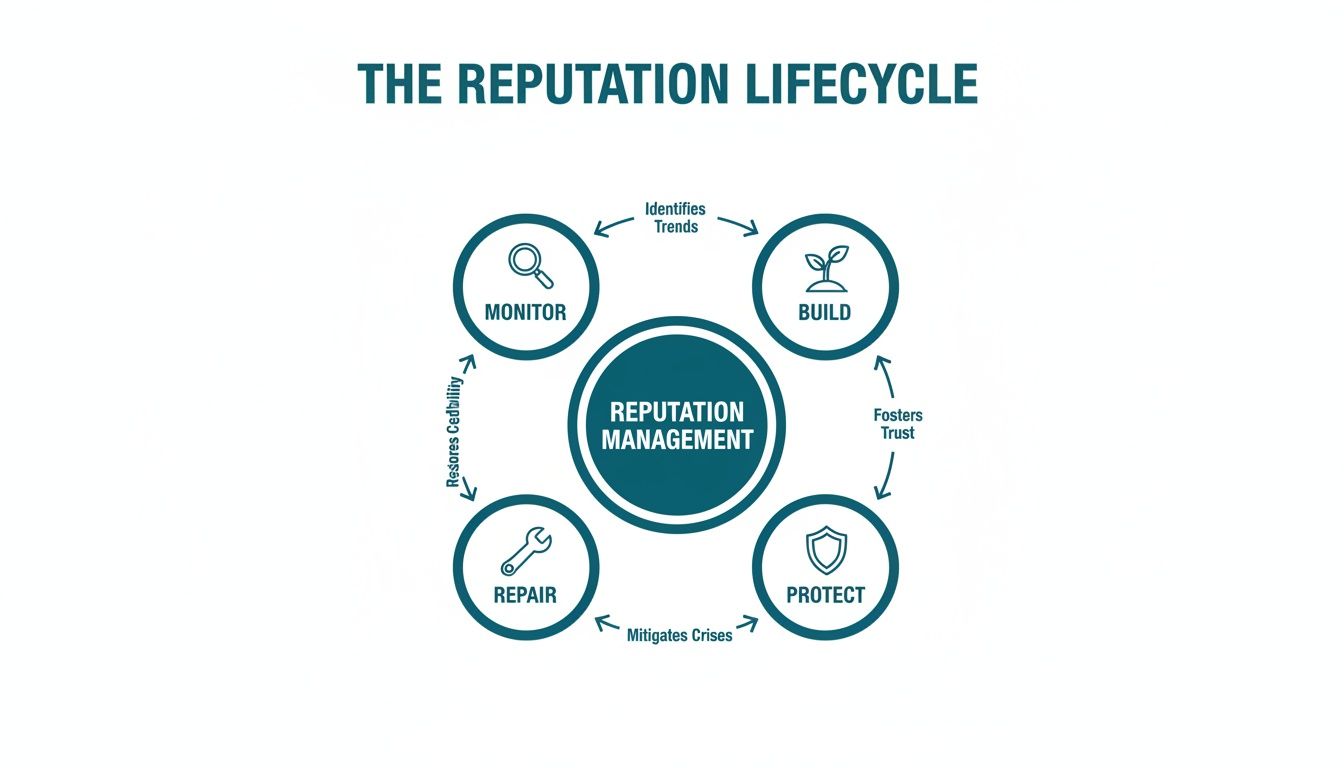
This shows that building your reputation isn’t a one-and-done task. It’s an active, ongoing process that fits into a larger cycle of monitoring, protecting, and, when needed, repairing.
Pillar 3: Expertise
In the professional world, expertise is your currency. It’s the tangible proof that you know your stuff. This pillar is about shifting from just having an opinion to providing real value, deep insights, and practical advice that actually helps your audience solve problems or get their heads around complex topics.
Building this pillar means you have to share what you know, consistently. You don’t need to have all the answers, but you should strive to be a go-to source of reliable information in your niche.
Here are a few simple ways to showcase your expertise:
- Break down the complicated: Take a tricky industry concept and simplify it in a post that anyone can understand.
- Share your wins (and how you got them): Detail a project you worked on, explaining the challenge, your process, and the outcome.
- Offer a fresh take: Comment on a recent industry trend with a perspective that isn’t just repeating what everyone else is saying.
Every piece of content that teaches your network something new reinforces your position as a credible authority.
Pillar 4: Engagement
Finally, engagement is what turns your broadcast into a conversation. A strong reputation isn’t built by shouting your thoughts into the void; it’s forged in the back-and-forth of genuine human interaction. This pillar is all about actively participating in your professional community.
This goes way beyond just posting your own content. It means leaving thoughtful comments on other people’s posts, answering questions you receive, and acknowledging those who take the time to engage with you.
Meaningful engagement signals that you are an active, approachable member of your industry, not just a passive observer. When you invest time in your network, your network will invest its trust in you.
Your Playbook for Building a Reputation on LinkedIn
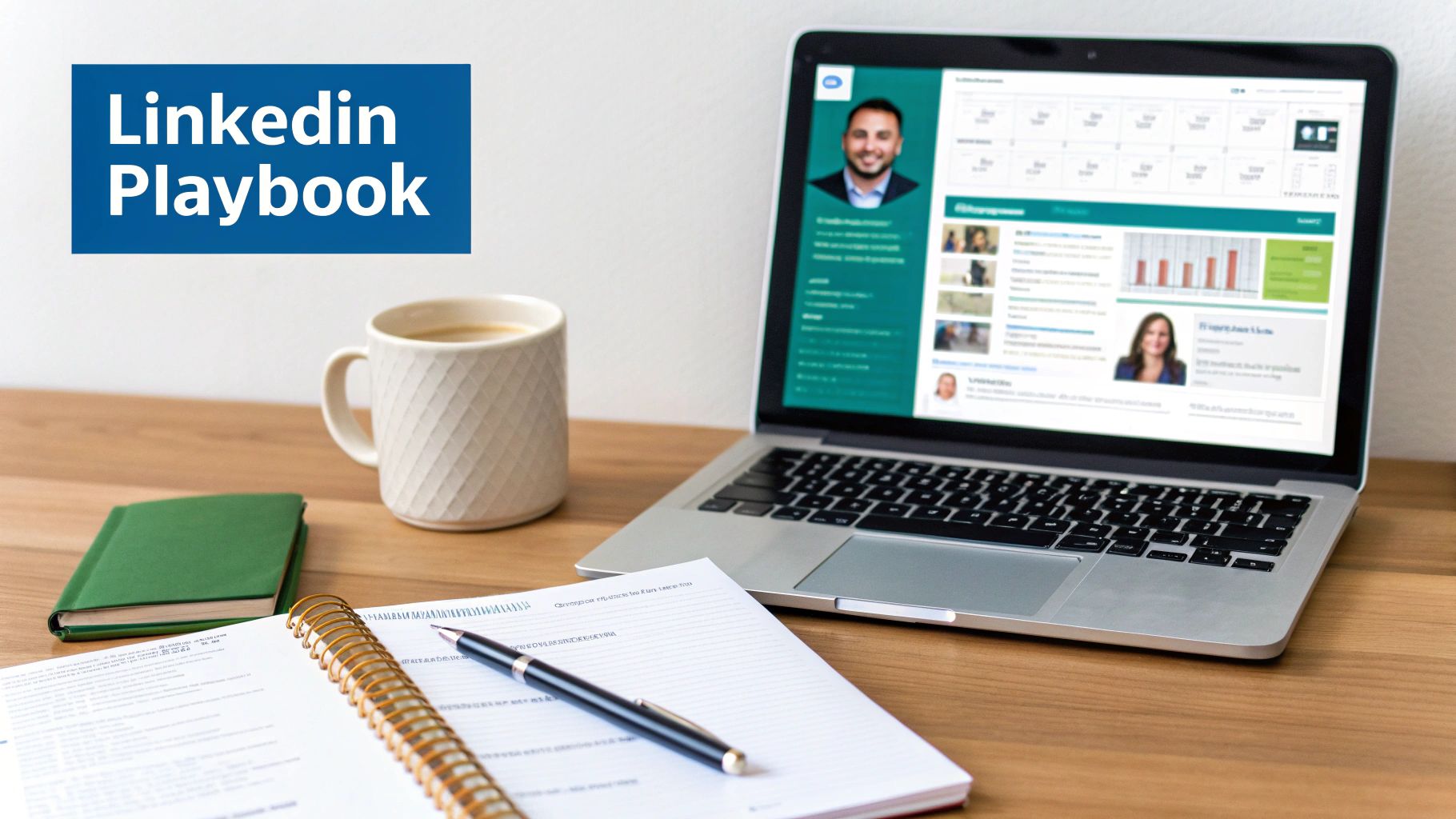 Alright, now that we’ve covered the core ideas, it’s time to get our hands dirty. LinkedIn is the undisputed arena for professional personal reputation management, and this playbook will guide you, step-by-step, in turning your profile from a dusty old CV into a magnet for new opportunities.
We’ll start with the essentials—getting your profile right—before diving into a sustainable content plan that actually provides value. Think of this as your practical guide to building a professional brand that gets noticed, starting right now.
Optimise Your Digital Handshake
Your LinkedIn profile is often the very first time someone “meets” you professionally. Before you even think about posting, you have to make sure that first impression is a strong one. It’s your digital handshake—it needs to feel firm, confident, and professional.
To really get this right, you need to optimize your LinkedIn profile for results, not just for looks. This goes way beyond simply listing your past jobs; it’s about telling a compelling story.
Here are the absolute must-haves you need to nail:
- A Professional Headshot: Get a clear, high-quality photo where you look both competent and approachable. No holiday snaps or blurry, cropped pictures from a wedding.
- A Value-Driven Headline: Don’t just state your job title. Your headline should instantly answer the question, “How do I help people?” So instead of “Marketing Manager,” try something like, “Marketing Manager Helping B2B SaaS Companies Drive Growth Through Content.”
- A Compelling “About” Section: This is where you tell your story. Write in the first person and talk about your expertise, your mission, and what you’re genuinely passionate about in your work. Let your personality shine through.
- Detailed Experience Sections: Don’t just list what you were responsible for. Show what you achieved with measurable results. Use bullet points to highlight things like “Increased lead generation by 45%“ or “Managed a project budget of €250,000.”
A well-optimised profile is the bedrock for everything else you do. It gives people the context and credibility they need to actually care about what you have to say next.
Develop Your Content Strategy
Once your profile is polished and ready, the next move is to build a content strategy that consistently delivers value to your network. Firing off random posts about industry news just won’t cut it. You need a clear plan that cements your expertise and fosters a real community around your name.
A solid content strategy rests on three pillars: finding your topics, mixing up your content formats, and creating an efficient workflow. For a much deeper look into this, our guide on how to build a personal brand on LinkedIn breaks it down further.
The goal of your content is not just to be seen, but to be remembered. Aim to become the go-to person your network thinks of when they have a question in your field.
Let’s break down how to get there.
Find Your Content Sweet Spot
The best, most effective content you’ll create lives at the intersection of three circles:
- Your Expertise: What do you know like the back of your hand?
- Your Audience’s Problems: What keeps your network up at night? What are their biggest headaches?
- Your Authentic Interests: What parts of your field do you genuinely find fascinating?
When you find topics that sit in that sweet spot, your content will feel both valuable to others and effortless for you. You’ll never run out of things to say, and people will actually want to listen.
Create a Diverse Content Mix
Posting the same type of content over and over is a fast track to being ignored. A winning LinkedIn strategy uses a mix of different formats to keep your audience engaged and show different sides of your professional self.
Try thinking in terms of a weekly rhythm:
- Insight Post: Share a unique take on an industry trend or a lesson you learned the hard way.
- Story Post: Tell a short story about a professional challenge you faced or a project that taught you something important.
- Question Post: Ask a genuinely thoughtful question to get a conversation going with your network.
- Value Post: Offer a practical tip, a useful resource, or a simple framework your audience can use straight away.
This kind of mix ensures you’re not just shouting into the void. You’re building a real community through shared experiences and conversations.
Establish a High-Leverage Workflow
On LinkedIn, consistency is king. But that doesn’t mean it should take over your life. The secret is to build a workflow that helps you create great content without burning out. Batching is a game-changer here.
Carve out just one hour a week to plan, write, and schedule all of your posts for the week ahead. Tools like Postline.ai can seriously accelerate this process, helping you brainstorm ideas, write polished posts in your own voice, and get them scheduled in minutes. This turns content creation from a daily chore into a quick, manageable weekly task, so you can maintain a strong, consistent presence without the stress.
How to Handle Negative Feedback and Repair Your Reputation
It’s a moment every professional dreads: seeing a negative comment, a bad review, or an outright unfair attack on your online profile. That sinking feeling in your stomach is real. The first instinct is often to either delete the comment immediately or fire back with a defensive reply. But trust me, both of those knee-jerk reactions will almost certainly make things worse.
The real goal here isn’t to win an argument; it’s to handle the situation with grace, calm the waters, and take back control of your story. A measured, thoughtful response shows everyone watching that you’re a mature professional who can handle pressure. In a strange way, a crisis like this can actually become an opportunity to show your true character.
Acknowledge, Act, and Move On
When that negative feedback pops up, the worst thing you can do is pretend it didn’t happen. Ignoring it doesn’t make it go away—in fact, silence often looks like an admission of guilt or, just as bad, like you simply don’t care. A timely and professional response is absolutely essential.
The numbers don’t lie. Research shows that just one negative review can scare off up to 30 potential customers. That’s a massive impact. But here’s the flip side: 55% of consumers actually feel more positive about a business when they see a quick, professional reply to criticism. Given it can take a dozen good reviews to cancel out the damage from a single bad one, responding well isn’t just good etiquette—it’s a critical business move. You can dig deeper into the impact of online reviews on customer perception to see just how high the stakes are.
So, what should you do? Follow this simple three-step process:
- Acknowledge Publicly: First, post a brief, calm reply right where the comment was made. Thank them for the feedback and acknowledge their point without getting defensive. Something simple and professional is all you need.
- Act by Moving Offline: Next, immediately offer to take the conversation private. Suggest they email you or send a direct message so you can resolve the issue one-on-one. This shows you’re serious about fixing things without creating a public spectacle.
- Move on by ‘Flooding the Zone’: This is where the repair work really begins. After you’ve handled the immediate issue, you have to get back to consistently sharing high-value, positive content. This proactive flood of good stuff effectively pushes the negativity down and out of sight, reinforcing the professional image you want to project.
The Do’s and Don’ts of Responding
Navigating public criticism is tricky, and it’s easy to let emotions take over. A panicked or angry response can turn a small spark into a raging fire. That’s why having a clear set of rules in your back pocket is so important for staying composed and strategic.
Your response to criticism is often more important than the criticism itself. A calm, respectful, and solution-oriented reply can turn a negative situation into a public display of your professionalism and commitment to accountability.
To help you manage these tough interactions, here’s a quick reference guide.
Do’s and Don’ts of Responding to Online Criticism
This is your quick reference guide for handling negative feedback professionally and effectively.
| Do | Don’t |
|---|---|
| Do respond quickly and professionally. | Don’t delete negative comments or reviews. |
| Do acknowledge the person’s feelings. | Don’t engage in a public argument. |
| Do take the conversation offline promptly. | Don’t get emotional or make it personal. |
| Do learn from valid criticism for growth. | Don’t use fake accounts to defend yourself. |
Sticking to these guidelines will help you stay in control of the situation and, more importantly, your reputation. Remember, shortcuts like buying engagement to drown out bad comments are a terrible idea. Our article on why you should never buy LinkedIn followers breaks down exactly why these inauthentic tactics will backfire and damage your credibility.
At the end of the day, true personal reputation management is about building an authentic, resilient presence that can stand up to a little heat.
Tools and Workflows for Smart Reputation Management
Staying on top of your personal reputation management doesn’t mean you have to be glued to your screen 24/7. In fact, it’s quite the opposite. With the right tools and a smart workflow, you can build a powerful online presence without it taking over your actual job. The secret is to work smarter, not just harder, by letting technology handle the grunt work.
Let’s look at a real-world example. Picture a busy marketing consultant named Anna. Every Monday morning, she sets aside just one hour to manage her entire week’s worth of LinkedIn activity. Instead of getting stuck staring at a blank cursor, she leans on an AI-powered platform to get things moving.
Building an Efficient Content Workflow
First, Anna checks for trending topics in her industry. The tool flags a new report that everyone in her network is talking about. Instead of just hitting ‘share,’ she decides to create a post that unpacks the key takeaways and offers her own expert analysis.
She gives the AI a simple prompt: “Draft a LinkedIn post about the new B2B marketing report. I want to focus on the surprising statistic about video content and add my take that most companies are still underinvesting here.” Within seconds, the AI generates a post that sounds like her, complete with a great hook and the right hashtags.
The best reputation management workflows aren’t about spending more time online; they’re about maximising the impact of the time you do spend. Technology allows you to turn one hour of focused effort into a full week of consistent value.
With a solid draft in hand, Anna uses the platform’s research feature to pull the exact statistic from the report, which adds a nice layer of credibility. She schedules it to post on Tuesday when her network is most active. She does this three more times—creating a post sharing a client story for Thursday, a thought-provoking question for Friday, and a quick tip for the weekend. Just like that, her content calendar is locked and loaded for the week in less than an hour.
Creating a Complete Toolkit
That AI-driven content engine is the core of her strategy, but it’s not the only piece. To have all her bases covered, Anna rounds out her toolkit with a couple of other key tools:
- Monitoring Tools: She has Google Alerts and social listening software set up to ping her anytime her name or brand gets mentioned. This lets her keep an eye on the conversation and jump on any potential problems before they snowball.
- Scheduling Platforms: For anyone juggling more than one social account, dedicated social media automation tools are a lifesaver. They help maintain a steady posting rhythm across all your channels without you having to do it manually.
By mixing AI-powered content creation with proactive monitoring, Anna has built a simple, repeatable process. It keeps her visible and in control of her professional story, all in just a few hours a month. It’s a perfect example of how the right tech can turn reputation management from a chore into a powerful and manageable habit.
Frequently Asked Questions About Personal Reputation Management
It’s natural to have questions when you start getting serious about your professional brand. Let’s tackle some of the most common ones that come up when people decide to take the reins of their personal reputation management.
How Long Does It Take to Build a Good Professional Reputation Online?
Honestly? It’s a marathon, not a sprint. You can definitely start seeing some positive movement within a few months of putting in the work, but carving out a name for yourself as a trusted expert in your field usually takes a solid 6 to 12 months.
That timeframe involves regularly sharing high-value content and genuinely connecting with your network. Think of it like building trust in any important relationship—it just doesn’t happen overnight. The real secret sauce is consistency. Showing up again and again with useful insights is what slowly but surely builds your authority and makes your professional brand one that people remember and rely on.
Can I Manage My Online Reputation Myself, or Do I Need an Expert?
For most professionals, managing your own reputation is completely doable. In fact, it’s often preferable. You know your voice, your experience, and your industry better than anyone. With modern tools available to help with the heavy lifting of content creation and scheduling, you can focus on the message while the tech handles the logistics.
The time to call in the experts is when you’re facing a serious crisis. If you’re dealing with severe reputation damage—like a public scandal, a targeted negative campaign, or legal troubles—a specialised PR or legal agency is your best bet.
What Is the Single Most Important Thing for My Personal Reputation?
If you do only one thing, do this: proactively create and share content that showcases your expertise and who you really are. An empty online profile is a massive liability. If there’s nothing out there about you, a single negative comment or bad review can easily become your entire online identity.
By consistently putting out insightful content, you’re building a strong “digital defence.” It ensures that when someone looks you up, they find your professional story, told in your own words. It’s about owning your narrative before someone else has the chance to write it for you.
Ready to take control of your LinkedIn presence without all the hassle? Postline.ai is your AI-powered assistant for writing, polishing, and scheduling standout posts in just minutes. Turn your expertise into new opportunities and build a reputation that truly works for you. Start managing your professional brand the smarter way at https://postline.ai.

Run every client pipeline in one place
Give each LinkedIn profile its own voice, calendar, approval flow, and analytics. Start in minutes.
Start free trial