
A Modern Playbook For LinkedIn Lead Gen In The German Market
Unlock the German B2B market with this guide to LinkedIn lead gen. Learn profile optimization, content strategy, and outreach that drives real connections.
Before you even think about sending a connection request, your LinkedIn profile needs a serious overhaul. Think of it less as a digital CV and more as a dedicated landing page designed to attract and convert your ideal clients. This is your foundation.
In a market like Germany, where expertise and credibility are everything, getting this right from the start is non-negotiable.
Laying the Groundwork for Lead Gen Success
Your LinkedIn profile is the bedrock of your entire strategy. It’s the first impression you’ll make on a potential client, and you need to make it count. This isn’t about just having a professional photo and a list of old jobs; it’s about meticulously engineering every section to build trust and position you as the only logical choice in your field.
This foundational work has never been more critical. As of March 2025, LinkedIn’s user base in Germany swelled to 22 million, finally overtaking its long-time rival, Xing, in professional relevance. This signals a major shift—professionals in the DACH region (Germany, Austria, and Switzerland) are now all-in on LinkedIn for serious B2B networking. A weak profile just won’t cut it anymore.
Craft a Headline That Actually Sells
Let’s be blunt: your headline is the most valuable piece of real estate on your profile. It follows you everywhere—search results, connection requests, comments. A generic job title like “Sales Manager at XYZ GmbH” is a wasted opportunity.
Instead, you need a value-driven headline that speaks directly to your ideal client’s biggest problem.
Compare these two:
- Generic: Sales Director | ABC Software
- Optimised & Client-Focused: Helping German Manufacturing Firms Reduce Production Downtime by 30% with Smart Automation Solutions | Logistics & Supply Chain Expert
See the difference? The second one immediately tells a prospect who you help, the specific problem you solve, and the incredible results you deliver. It’s packed with keywords like “German Manufacturing Firms” and “Smart Automation” that your ideal clients are actively searching for.
Turn Your “About” Section Into a Compelling Story
Too many people treat their “About” section like a formal, third-person biography. That’s a mistake. This is your chance to connect on a human level. Write in the first person and structure it as a narrative that guides the reader from their pain point directly to your solution.
A powerful “About” section needs four key ingredients:
- A Hook: Kick things off by hitting on a major challenge your target audience faces.
- Your Solution: Briefly explain how you solve that problem and for whom.
- Social Proof: Weave in key results, client wins, or notable achievements to build credibility.
- A Clear Call-to-Action (CTA): Don’t leave them hanging. Tell them exactly what to do next—connect with you, book a call, or visit your website.
This three-step process shows how to move from a strong headline to a compelling story and finally to undeniable proof of your expertise.
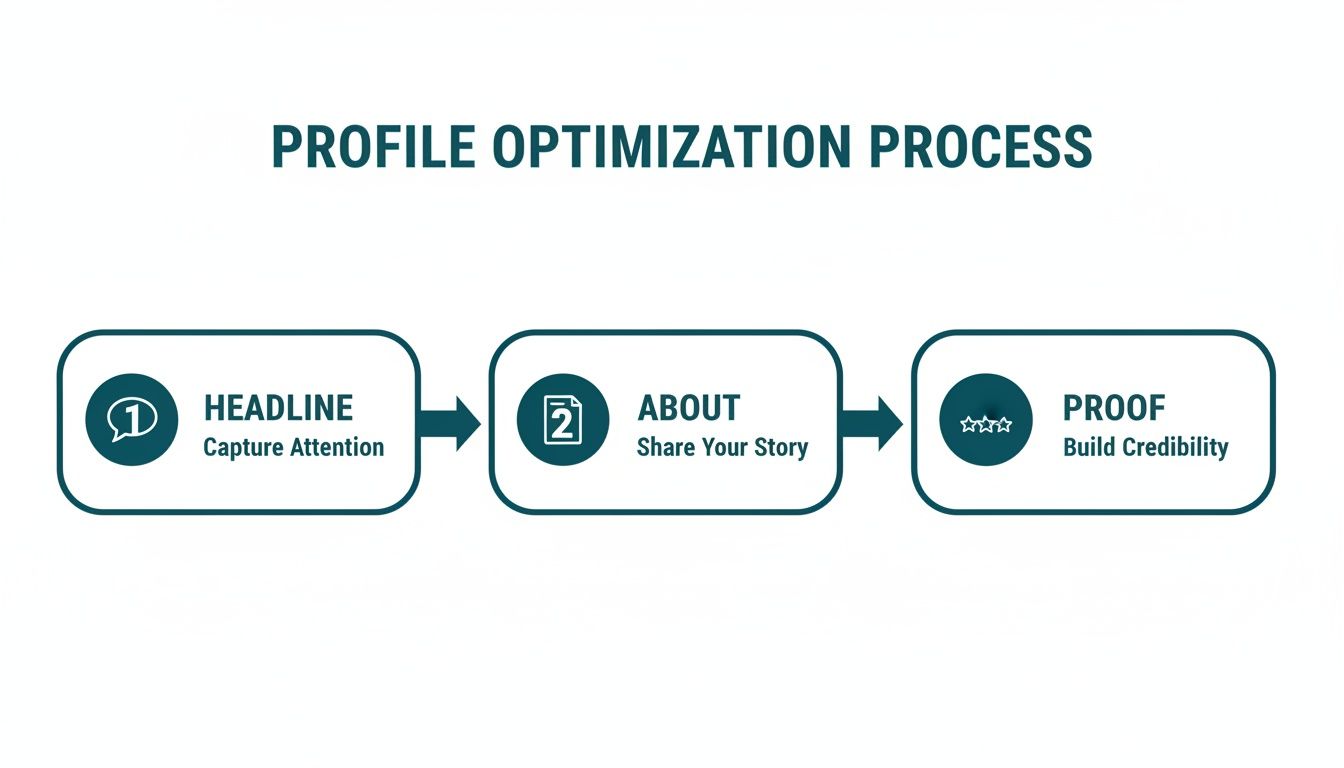
It’s not about acing one section; it’s about creating a seamless, trust-building experience from top to bottom.
Add Layers of Concrete Social Proof
In the German B2B world, trust isn’t given; it’s earned with hard evidence. You need to back up your claims with tangible proof of your skills and successes.
Here’s how to build that instant credibility:
- Recommendations: Don’t just wait for them. Actively ask past clients and colleagues for detailed recommendations. A specific, results-focused testimonial is worth a hundred generic endorsements.
- Rich Media: Under each role in your “Experience” section, upload relevant materials. Think case studies, project presentations, white papers, or even short videos. Show, don’t just tell.
- The Featured Section: This is your highlight reel. Pin your absolute best content to the top of your profile—a published article, a powerful client testimonial video, or a link to a webinar you hosted.
To help you stay on track, I’ve put together a quick checklist covering the essentials.
Essential Profile Optimization Checklist
This table breaks down the key elements you need to transform your LinkedIn profile into a lead-generating machine.
| Profile Element | Optimization Goal | Quick Tip |
|---|---|---|
| Profile Photo | Appear professional, approachable, and trustworthy. | Use a high-quality headshot where you’re looking at the camera and smiling. No holiday snaps! |
| Banner Image | Visually communicate your value proposition or brand. | Design a custom banner with your company logo, a tagline, or a call-to-action. |
| Headline | Attract your ideal client and state your unique value. | Focus on the outcome you provide for your clients, not just your job title. Use the formula: I help [X] do [Y] so they can [Z]. |
| About Section | Tell a story that builds connection and credibility. | Write in the first person. Start with a hook, present your solution, add proof, and end with a clear CTA. |
| Featured Section | Showcase your best work and most valuable resources. | Pin a mix of content: a top-performing post, a client case study, and a link to your calendar or website. |
| Experience | Demonstrate your expertise with tangible results. | Instead of listing duties, describe your accomplishments using numbers and metrics. Add rich media. |
| Recommendations | Build third-party validation and trust. | Proactively request detailed recommendations from happy clients that highlight specific results. |
By following this checklist, you ensure every part of your profile is working hard to establish your authority and attract the right people.
When you meticulously fine-tune these elements, your profile starts doing the heavy lifting for you, warming up prospects long before you ever reach out. For a more detailed walkthrough, check out our guide on how to create a business profile on LinkedIn.
Pinpointing Your Ideal German Audience
So, you’ve polished your profile until it shines. What’s next? A common mistake is to start firing off connection requests to anyone who looks vaguely relevant. That’s a fast track to a bloated network and crickets for results.
Successful LinkedIn lead gen is a game of precision, especially in the nuanced German B2B market. It’s about finding the right people, not just collecting contacts.
This all starts by getting crystal clear on your Ideal Customer Profile (ICP). Think of an ICP as a detailed blueprint of the company that stands to gain the most from what you offer. This isn’t just about company size or industry; it’s a deep dive into the very DNA of your perfect client.
Moving Beyond Generic Search Filters
Forget casting a wide net with a search like “Marketing Manager” in Germany. You’ll be drowning in thousands of irrelevant results. To get traction, you need to get specific.
A well-defined ICP for the German market might look something like this:
- Industry: Maschinenbau (Mechanical Engineering) or Automotive Suppliers.
- Company Size: 100-500 employees, targeting the powerhouse Mittelstand.
- Geography: Focusing on manufacturing hubs like Baden-Württemberg or Bavaria.
- Pain Points: They’re likely grappling with supply chain snags or the push for digital transformation.
- Decision-Maker: Head of Logistics (Logistikleiter) or Head of Production (Produktionsleiter).
This level of detail turns your search from a shot in the dark into a targeted strike. It’s the difference between shouting in a crowded stadium and having a meaningful conversation in the right person’s office. If this concept is new to you, our guide on how to identify your target audience is a fantastic starting point.
Key Takeaway: Stop thinking in terms of job titles alone. Define the company first, then pinpoint the specific roles and challenges within it. This company-first approach is a game-changer for B2B lead generation.
Mastering Sales Navigator for Precision Targeting
With your ICP locked in, LinkedIn Sales Navigator becomes your superpower. Its advanced filters are the key to unlocking serious LinkedIn lead gen, letting you zero in on prospects with surgical precision.
Let’s apply this to our German Mittelstand ICP. In Sales Navigator, we can build a search that standard LinkedIn just can’t match.
Here’s how that looks in practice:
- Geography: Start by filtering for “Germany,” then zoom into specific states like “Baden-Württemberg.”
- Industry: Select “Machinery” and “Automotive.”
- Company Headcount: Set the range to “51-200“ and “201-500“ to capture those mid-sized businesses.
-
Job Title: Use precise German titles. The Boolean search is your friend here – try
"Leiter Logistik" OR "Logistikleiter" OR "Head of Supply Chain". - Keywords: Add terms like “supply chain optimisation”, “lean manufacturing”, or “Industrie 4.0” to find people actively engaged with these topics.
This layered search filters out all the noise. What you’re left with is a high-quality, manageable list of people whose professional world aligns perfectly with your solution.
Uncovering Prospects Through Content and Groups
Direct searching is only half the battle. You can also find high-intent leads by simply observing who’s talking about the problems you solve.
Start by exploring German-language LinkedIn Groups. Search for communities like “Logistik & Supply Chain Management DACH” or “Produktion und Fertigung.” These are virtual water coolers for your ideal clients. Don’t just jump in and start pitching. Listen first.
- Who is asking sharp questions about challenges you can solve?
- Who is sharing relevant articles about industry shifts?
- Who is openly asking for recommendations for tools like yours?
It’s the same story with content. Follow key influencers and target companies in your sector and pay close attention to the comment sections on their posts. The people engaging there are often the very decision-makers you want to reach. They are actively invested in their field, making them much warmer prospects for your outreach.
This approach lets you find people who are already signalling a need, which dramatically improves your chances of getting a positive response.
Crafting Content That Captures Your German Audience
Once you’ve polished your profile and know exactly who you’re talking to, your content becomes the real workhorse of your LinkedIn strategy. But here’s the thing about the German market: substance will win out over fluff every single time. Professionals here want practical insights and real expertise, not a feed full of motivational clichés.
Think of your content as having two critical jobs: first, to establish your authority, and second, to act as a magnet, drawing inbound interest your way. Every post should be another piece of the puzzle, one that, when put together, makes it crystal clear to prospects why you’re the expert they need to talk to. This isn’t about chasing viral fame; it’s about methodically delivering value that warms up your sales pipeline.
The Bedrock of High-Value Content
Before we jump into specific post formulas, let’s nail down the core principle: your content must solve a real problem or share a unique point of view. The German professional audience is sharp. They can spot a superficial post from a mile away.
For every single piece you create, ask yourself these questions:
- Is it relevant? Does this directly hit on a pain point, a challenge, or a goal that matters to my Ideal Customer Profile?
- Is it credible? Am I backing up what I’m saying with data, personal experience, or a perspective they haven’t heard before?
- Is it clear? Is my message easy to grasp, well-structured, and scannable for someone with only 30 seconds to spare?
Get these three things right consistently, and you’ll build the trust that’s absolutely essential for any business relationship.
Proven Content Formulas for the German Market
Tired of staring at a blank screen? Stop guessing what to post. These battle-tested formulas give you a solid structure so you can focus on what really matters: sharing your unique expertise.
1. The Problem-Agitate-Solve Framework
This is a classic for a reason—it works incredibly well on LinkedIn. You start by calling out a common problem, dig into the “why” of what makes it so frustrating, and then offer up your solution or a fresh way to think about it.
- Let’s say you sell logistics software to manufacturing firms.
- You could kick things off with a hook like, “Supply chain disruptions aren’t just an inconvenience; they’re costing German manufacturers millions.” Then, agitate by diving into the knock-on effects—production delays, angry clients, shrinking margins. Finally, solve by sharing a specific strategy or insight that subtly ties back to what your software does.
2. The Data-Driven Insight Carousel
Carousels, or document posts, are fantastic for breaking down complex ideas into bite-sized, visual slides. German professionals love a well-researched argument backed by solid data.
Try building a 5-7 slide carousel that:
- Hits them with a compelling statistic or industry trend on the very first slide.
- Uses the next few slides to explain the context and the “why” behind that number.
- Wraps up with actionable takeaways on the final slides.
This format instantly positions you as a thoughtful analyst who sees the bigger picture. And the numbers don’t lie. Recent data shows that LinkedIn engagement in Europe is on the rise, with interactions per post globally jumping 22% in 2024. For Germany specifically, the real leverage comes from employee advocacy—posts shared by individuals see 8x higher engagement than brand posts. This just proves how much people value personal, insightful content. You can dig into more regional engagement trends on Contentin.io.
Storytelling That Forges Real Connections
Facts tell, but stories sell. Sharing a personal experience or a client’s success story is how you humanise your brand. It builds a far deeper connection than just rattling off a list of features and benefits.
A powerful story-based post really only needs three things:
- The Situation: Briefly set the scene. What challenge was your client up against?
- The Action: What specific steps did you or your team take to tackle it?
- The Result: What was the measurable outcome? Use numbers to make it tangible and impactful.
Pro Tip: When you’re telling client stories, always make the client the hero. Your solution was simply the tool that helped them achieve their success. This simple shift makes the story much more relatable and feels less like a sales pitch.
This narrative style is far more memorable and shareable than a dry case study. For more inspiration on filling out your content plan, check out our deep dive into building a powerful LinkedIn content strategy.
Keeping the Content Engine Running with Postline.ai
Let’s be honest, the hardest part of any content strategy is consistency. This is where a tool like Postline.ai becomes a game-changer for serious LinkedIn lead gen. Instead of scrambling for ideas every day, you can get ahead by planning and automating your workflow.
Imagine you have a great idea for a “Problem-Agitate-Solve” post. You can feed that core concept into Postline.ai, and its AI can help you flesh out the details, sharpen the hook, and polish the language. The ‘Learns Your Voice’ feature is especially powerful; it trains on your past content to make sure every AI-assisted post sounds genuinely like you. This maintains that crucial personal touch that the German audience values so highly.
By using Postline.ai to schedule a healthy mix of these content formulas, you can build a consistent, authoritative presence that keeps nurturing your network. You’ll be turning passive connections into active, inbound leads—all without burning yourself out.
Mastering The Art Of Smart Outreach And Engagement
Let’s be honest, the days of blasting out hundreds of generic, automated connection requests are long gone. That strategy doesn’t just get you terrible results; it actively damages your professional reputation. Real success with LinkedIn lead gen, especially in a relationship-focused market like Germany, is built on genuine connection and a “value-first” approach to engagement.
It’s time to stop thinking in terms of volume and start thinking in terms of relationships. The goal isn’t to start with a cold ask. It’s to warm up a prospect by becoming a familiar, helpful presence in their professional world before you ever show up in their inbox.
This one simple shift in mindset can be the difference between a dismal 5% acceptance rate and one that soars above 40%.
The Pre-Connection Warm-Up
Before you even think about hitting that “Connect” button, you need to get on your prospect’s radar. The idea is to create a flicker of recognition so your name isn’t a complete mystery when you finally reach out. It’s all about doing the groundwork.
Start by following your top prospects and turning on notifications for their posts. Then, carve out just 15 minutes a day to thoughtfully engage with what they’re sharing. And I don’t mean dropping a generic “Great post!” comment. That’s just noise.
Instead, add real value to the conversation:
- Ask a smart question that gets them to expand on their point.
- Share a related statistic or a quick personal story that backs up their argument.
- Tag another expert you know who could contribute to the discussion.
This simple habit accomplishes two critical things. First, it proves you’ve actually read and understood their content. Second, it positions you as a peer who adds to the conversation, not just another salesperson lurking in the digital shadows.
Crafting a Connection Request That Actually Works
Once you’ve engaged with a prospect’s content a few times over a week or two, they’ll be far more open to a connection request. Now you have the perfect opening for a message that is hyper-personal and relevant.
A generic request is a completely wasted opportunity. A personalised one shows you’ve put in the effort.
Just look at the difference:
- Generic & Ineffective: “Hi Julia, I’d like to connect with you.”
- Personalised & Effective: “Hi Julia, I really valued your perspective on supply chain resilience in your post yesterday. Your point about diversifying suppliers is something we’re seeing across the industry. Would be great to connect and follow your insights.”
The second one works because it’s specific, timely, and builds on a shared professional interest. It’s not a pitch; it’s a genuine invitation to continue a conversation you’ve already started.
Key Takeaway: Your connection request shouldn’t be the start of the conversation. It should feel like the natural next step after you’ve already built a bit of rapport through public engagement. This small change in timing makes a huge difference.
Following Up Without Being Annoying
Great, they accepted your request! But the work isn’t over. This is where most people either drop the ball or go in too hard with a sales pitch. The secret is to keep adding value, not to immediately ask for a 15-minute call.
A simple, effective follow-up sequence might look something like this:
-
The “Thank You” & Value Add (within 24 hours): Send a short message thanking them for connecting. Then, give them something useful related to the topic you’ve already discussed. Maybe it’s a link to a new industry report, a helpful article, or a relevant case study. The crucial part? There is no ask. You’re just being helpful.
-
The Gentle Nudge (3-5 days later): If you don’t hear back, you can send a light follow-up. A great way to do this is to ask a question about the resource you sent. For example, “Did you find that report on manufacturing automation useful? I was particularly interested in the section on predictive maintenance.”
This patient, multi-touch approach is all about building a relationship. By consistently offering value and showing genuine interest, you move from being a cold contact to a trusted resource. When the time is finally right to talk business, the conversation will feel natural and welcome, not forced and salesy.
Scaling Your Efforts With Intelligent Automation
Consistency is the absolute engine of a successful LinkedIn lead gen strategy. We all know this. But the daily grind of thinking up ideas, writing compelling copy, and engaging with everyone is a massive time sink. This is where intelligent automation stops being a buzzword and becomes your best friend, letting you scale your efforts without losing that crucial human touch.
Let’s be clear: the goal isn’t to let a robot take over. It’s about offloading the repetitive, mechanical tasks so you can pour your energy into what actually matters—having real conversations, nurturing warm leads, and, of course, closing deals.
Plan Your Content In Hours, Not Days
That feeling of dread when you realise you haven’t posted today? It’s a killer for creativity. Instead of scrambling for an idea every single morning, you can use modern tools to sit down and map out an entire month of high-value posts in just a couple of hours. This simple act of batching turns content creation from a reactive chore into a proactive strategy.
When you plan your content calendar, you can make sure you’ve got a healthy mix of post formats—deep-dive insights, data-backed carousels, and relatable personal stories. This approach keeps you top-of-mind with your network and consistently delivers the kind of value German B2B professionals really appreciate. You can find plenty of great social media automation tools out there to fit how you like to work.
The Power of Automation: True automation doesn’t replace your strategy; it amplifies it. By handing off the grunt work of writing and scheduling, you get your time back to focus on genuine, one-on-one engagement with the people who are most likely to become your next client.
Maintain Authenticity With AI That Learns Your Voice
One of the biggest (and most valid) fears about using AI for content is that it will sound generic and robotic. A discerning audience can spot that a mile away. But the tools available today are built specifically to solve this problem. We’re well beyond the days of soulless text generators; now, it’s about creating a true digital assistant.
For instance, platforms like Postline.ai have a powerful ‘Learns Your Voice’ feature. This tech actually analyses your past content—how you phrase things, your specific tone, even the industry jargon you use. It then trains its AI model on your unique writing style.
What does that mean for you? Every post the AI helps you draft sounds like it came directly from you. You can turn a simple idea into a series of polished, on-brand posts in minutes, all while keeping that personal touch that’s so vital for building trust.
A Practical Workflow Automation Example
Let’s walk through a real-world scenario. Say you want to create a post about a recent supply chain headache in the German automotive sector. Here’s how you could use intelligent automation to turn that one idea into a full week of content:
- The Spark: You feed the basic concept into a tool like Postline.ai: “Talk about the impact of the latest semiconductor shortages on German car manufacturers.”
- AI Brainstorm: The tool instantly gives you several different angles to explore. Maybe a text-only post on mitigation strategies, a carousel breaking down the key numbers, and a personal story about how a client navigated the crisis.
- Draft and Refine: You pick the angles you like best, and the AI drafts the posts, making sure they sound just like you. All you have to do is pop in, add your final insights, and drop in a specific call-to-action.
- Set and Forget: With just a few clicks, you schedule these posts to go live at the best times throughout the week.
This entire workflow might take you 30 minutes. Compare that to the hours you’d spend writing each of those posts from scratch.
To see just how much of a difference this makes, let’s look at the time breakdown.
Manual Effort vs. AI-Assisted Workflow
| Activity | Manual Approach (Time/Week) | AI-Assisted Approach (Time/Week) | Key Benefit |
|---|---|---|---|
| Content Brainstorming | 2–3 hours | 30 minutes | Overcome writer’s block with multiple AI-generated ideas and angles. |
| Drafting & Writing | 5–7 hours | 1–2 hours | Go from a rough idea to a polished draft in minutes, not hours. |
| Post Scheduling | 1 hour | 15 minutes | Bulk schedule an entire week or month of content in one go. |
| Total Time Saved | ~6-8 hours/week | Reinvested into direct engagement, sales calls, and strategic planning. |
By cleverly automating the mechanics, you build a consistent, high-value presence that nurtures your network and drives inbound opportunities without burning you out. And to take it a step further, think about how a lead generation chatbot on your website can act as a 24/7 assistant, capturing interest even when you’re offline and extending your reach far beyond LinkedIn alone.
Answering Your Top LinkedIn Lead Gen Questions
Let’s be honest, getting into the swing of LinkedIn lead gen can feel a bit like learning a new language, especially when you’re trying to connect with the discerning German B2B market. Even when you’ve got your profile dialled in and a solid content plan, questions always come up.
This is where we get into the nitty-gritty. Think of this as your troubleshooting guide, moving past the basic “how-to” and into the “what if” scenarios you’ll actually face when turning connections into real business opportunities.
How Much Time Should I Really Dedicate to LinkedIn Daily?
This is the big one, isn’t it? The truth is, it really depends on your goals, but I can tell you from experience that consistency beats intensity every single time. You absolutely do not need to spend hours glued to your screen to see results.
A focused, daily habit is far more powerful. I always recommend a “power half-hour” approach.
- 10 Minutes: Jump into your feed and engage. Leave a few thoughtful comments on posts from your key prospects or people you admire in your industry.
- 10 Minutes: Send out a small batch of highly personalised connection requests or follow-up messages. Quality over quantity.
- 10 Minutes: Circle back to respond to any new messages in your inbox or comments on your own content.
This simple 30-minute routine keeps the wheels turning. It ensures you’re consistently building relationships and staying visible without letting LinkedIn swallow your entire day. It’s all about smart, focused action, not endless scrolling.
Is LinkedIn Sales Navigator Actually Worth the Investment?
For anyone who’s serious about lead generation on LinkedIn, Sales Navigator is less of a luxury and more of a must-have tool. The standard search is fine for casual networking, but if you want a systematic way to find and organise prospects, it’s essential.
The real magic of Sales Navigator is its precision. You can zero in on decision-makers using incredibly specific filters like company size, seniority level, or even recent job changes. This alone saves countless hours of manual searching and makes sure the lists you build are full of high-quality, relevant people.
If you’re generating more than a couple of high-value leads per month, the return on investment from Sales Navigator typically pays for the subscription very, very quickly. It turns your prospecting from a guessing game into a data-driven science.
What Are the Biggest Mistakes to Avoid in the German Market?
The German B2B culture is built on directness, expertise, and trust. A generic, hard-sell approach that might get a bit of traction elsewhere will almost certainly fall flat here.
Steer clear of these common missteps:
- Pitching Too Early: Whatever you do, don’t lead with a sales pitch in your connection request or first message. It’s widely seen as disrespectful and unprofessional.
- Ignoring Privacy Norms: Be incredibly mindful of data privacy laws like DSGVO/GDPR. Never scrape contact details or add people to mailing lists without their explicit consent.
- Being Overly Casual: Always maintain a professional tone. You can certainly be friendly, but hold back on the slang or emojis until you’ve actually built some rapport.
Success in the German market comes from proving your expertise and building genuine, trust-based relationships over time.
How Do I Prove LinkedIn Is Actually Working?
You have to be able to measure your return on investment. The good news is, the data is on your side. In the DE region, 53% of B2B marketers are actively looking for prospects right on the platform. Overall, LinkedIn is shown to be 277% more effective for lead generation than other major social networks. In fact, 40% of marketers see it as the best place to find high-quality leads. You can dig into more of these powerful LinkedIn lead generation statistics on Sopro.io.
To track your own success, just focus on a few key metrics that really matter:
- Connection Acceptance Rate: Are your personalised requests working? You should be aiming for a rate above 30%.
- Reply Rate to Follow-Ups: How many of your messages are actually starting a conversation?
- Meetings Booked: This is the ultimate goal. Track how many conversations that started on LinkedIn turn into actual sales calls.
By keeping an eye on these numbers, you can draw a straight line from your activity on the platform to real business outcomes, proving the value of your time and effort.
Ready to scale up your LinkedIn strategy without losing that authentic touch? Postline.ai is your AI-powered assistant for writing, improving, and scheduling high-impact LinkedIn posts faster than ever. It learns your unique voice, pulls in real-time research, and helps you consistently create content that grabs attention and generates leads.
Start your free trial at https://postline.ai and transform your LinkedIn presence today.

Run every client pipeline in one place
Give each LinkedIn profile its own voice, calendar, approval flow, and analytics. Start in minutes.
Start free trial