
A Modern Guide to LinkedIn for Lead Generation
Unlock the power of LinkedIn for lead generation. Learn to optimize your profile, create content that converts, and build a predictable sales pipeline.
Tapping into LinkedIn for lead generation is all about transforming your professional network from a list of contacts into a reliable stream of high-quality leads. It’s a system that involves fine-tuning your profile to pull in your ideal clients, sharing valuable content that cements your authority, and using smart, strategic outreach to turn those connections into actual customers.
Building Your Foundation for LinkedIn Success

Before you even think about sending a single message, your personal and company profiles need to be primed for conversion. Seriously, think of your profile less like a CV and more like a dedicated landing page built to speak directly to your ideal customer. If this foundation is weak, every single outreach effort you make will be less effective.
This initial setup is non-negotiable, especially when you realise that a staggering 80% of LinkedIn users are the ones driving business decisions at their companies. When one of them lands on your profile, it has to instantly answer their silent, all-important question: “What’s in it for me?”
Craft a Benefit-Driven Headline
Your headline is the most valuable piece of digital real estate on your entire profile. It follows you everywhere—into connection requests, your comments, and every search result. Don’t waste it with a generic job title like “CEO at Company X.” Instead, you need to turn it into a powerful, client-focused value proposition.
The trick is to focus on the outcome you deliver. For instance, a financial advisor could swap “Financial Advisor at ABC Wealth” for something far more compelling like, “Helping Tech Founders Navigate Exit Planning & Wealth Management.” See the difference? It immediately calls out to a specific audience and hones in on their biggest challenge.
Write a Compelling About Section
This is where you get to tell your story and build some genuine trust. My biggest tip? Ditch the third-person narrative. Writing in the first person feels so much more authentic and creates a real, direct connection with whoever’s reading. I find it helpful to structure the section like a mini-journey for your prospect.
Try a simple, but incredibly effective, framework:
- The Hook: Kick things off with a bold statement or a probing question that hits on your ideal client’s primary challenge.
- The Problem: Show them you genuinely get it. Empathise with their struggles and the pains they’re facing.
- The Solution: Briefly touch on how you solve this problem and what makes your approach different from everyone else’s.
- The Proof: This is where you can drop in specific results, stats, or mention the types of clients you’ve helped.
- The Call-to-Action: Don’t leave them hanging! End with a clear next step, whether it’s inviting them to connect, download a resource, or book a quick chat.
And if you’re managing a brand presence, these same principles apply. We’ve put together a full breakdown on how to create a business profile on LinkedIn to make sure your company page perfectly complements your personal lead generation efforts. A consistent brand message across both just amplifies your visibility.
Key Takeaway: Your LinkedIn ‘About’ section should read less like a biography and more like a sales page. Make it scannable, empathetic, and laser-focused on how you help your target audience win.
Strategically Use the Featured Section
Think of the ‘Featured’ section as your personal portfolio. It’s prime real estate right below your ‘About’ section, giving you a golden opportunity to pin your best content and showcase your expertise. This is your chance to go beyond words and provide tangible proof of your value.
A few powerful assets to feature include:
- Case Studies: Nothing beats highlighting a successful client project with clear, measurable results.
- Testimonials: Pin a link to a short video or a well-designed graphic with a glowing client review.
- Lead Magnets: Offer up a free eBook, checklist, or a webinar registration link to capture their contact details.
- Top-Performing Posts: Got a post that blew up with engagement? Feature it! It shows you know how to start conversations.
By curating this section thoughtfully, you create multiple touchpoints for a prospect to engage with your brand and slide right into your sales funnel. This foundational work is what turns your profile from a static online resume into an active, 24/7 lead generation machine. For a deeper dive, it’s worth exploring these proven LinkedIn lead generation strategies specifically for solo founders.
Crafting Content That Pulls in Your Ideal Clients
A polished profile is your digital handshake, but your content is the conversation that follows. This is where the real magic happens for LinkedIn lead generation. It’s not about just showing up and posting; it’s about strategically sharing value that educates, builds trust, and cements your status as the go-to expert in your niche.
When you get this right, your content does the heavy lifting for you. It warms up your network so that when you do reach out, it’s not a cold interruption but a welcome continuation of a conversation you’ve already started. You’re building a community around your expertise, making potential clients familiar with your value long before you ever land in their DMs.
The Content Formats That Actually Work on LinkedIn
Let’s be honest, not all content gets the same love from the LinkedIn algorithm—or your audience. To get real traction, you need to focus on the formats that consistently deliver the goods.
- Text-Only Posts: Don’t underestimate the power of pure text. It’s fantastic for sharing personal stories, challenging a common industry belief, or dropping a quick, actionable tip. The secret is a killer opening line—a hook that stops the scroll and makes people have to click “…see more”.
- Carousels (PDF Documents): These are visual gold. Carousels let you break down complex ideas into simple, digestible slides. Think of them as mini-presentations that teach your audience something valuable, making them incredibly shareable.
- Native Video: Nothing builds a personal connection faster than video. Short, insightful clips (aim for under 90 seconds) where you share a single piece of advice or react to an industry trend perform incredibly well. Remember, authenticity beats high production value every time.
By mixing these formats, you keep your feed fresh and appeal to how different people prefer to learn. You might share a lesson learned in a text-only post, then follow it up with a carousel that details the framework behind that lesson.
Building a Realistic and Sustainable Content Rhythm
Consistency is what separates the authorities from the amateurs on LinkedIn. In fact, companies that post weekly see twice as much engagement on their content. But consistency isn’t about burning yourself out by posting multiple times a day. It’s about finding a realistic cadence you can actually maintain.
Here’s a simple, effective schedule to get you started.
Weekly LinkedIn Content Plan Example
This table provides a basic framework to help you plan a varied content mix. The goal is to address different audience needs throughout the week, guiding them from problem-awareness to solution-seeking.
| Day | Content Theme | Post Format | Call-to-Action (CTA) |
|---|---|---|---|
| Monday | Problem/Pain Point Focus | Text-Only | “What’s your biggest challenge with X?” |
| Wednesday | Educational/How-To | Carousel or Video | “Download my free checklist on this topic.” |
| Friday | Personal Story/Industry Insight | Image with Text | “What are your thoughts?” |
Having a structure like this removes the daily “what on earth do I post?” panic. Before long, your audience will start to anticipate your content, which is how you build a truly loyal following. For a more in-depth approach, take a look at our complete LinkedIn content strategy guide.
Reaching Beyond Your Borders With Smart Content
Don’t forget to tailor your content strategy to your target market’s location. Germany, for example, has become a massive opportunity for B2B marketers, now home to 22 million LinkedIn users—that’s nearly 27% of the entire population.
The largest user group is aged 25-34, representing a dynamic and highly engaged professional audience. What’s more, Europe boasts a strong 4.05% conversion rate for sponsored updates, proving that a well-crafted message can have a powerful impact. Digging into these regional details can give your lead generation efforts a serious edge. You can find more on the growing German market from the latest user statistics on NapoleonCat.
Expert Insight: The best content on LinkedIn doesn’t just talk about what you do. It demonstrates how you think. Share your process, your missteps, and your unique perspective—that’s what builds real authority and attracts clients who value your expertise.
Ultimately, every piece of content serves one primary purpose in your lead generation funnel: building trust at scale. Think of each post as a small deposit into a trust bank with your prospects. By consistently providing value, you ensure that when it’s time to make a withdrawal—like asking for a meeting—you’ve more than earned it.
Mastering Outreach That Builds Real Connections

While a great profile and solid content will bring people to your door, a proactive outreach strategy is what fills your pipeline predictably. This is where we move from simply attracting interest to intentionally starting conversations. The whole point is to build real professional relationships that can naturally lead to business, not just to fire generic sales pitches into the dark.
Think of successful LinkedIn outreach as a system. It’s a repeatable process of finding the right people, reaching out with a message that actually connects, and giving value long before you ever ask for anything. Forget the pushy, old-school sales tactics; this is all about sparking meaningful dialogue.
Identifying Your Ideal Prospects with Precision
Before you send a single connection request, you need to know exactly who you’re talking to. Honestly, this is the most critical part of the whole process. Sending a brilliant message to the wrong person is a complete waste of time. This is where a tool like LinkedIn Sales Navigator becomes a non-negotiable part of your toolkit.
Yes, the free version of LinkedIn has search filters, but Sales Navigator gives you a much deeper level of control. You can build incredibly specific lead lists using filters that go way beyond a simple job title.
Some of the most powerful filters you can use are:
- Keywords: Search for specific terms in a person’s profile, like “SaaS sales” or “supply chain optimisation.”
- Company Headcount: Zero in on businesses that are the right size for your product or service.
- Seniority Level: Focus your energy on the people who can actually make decisions by filtering for VPs, Directors, or C-suite executives.
- “Posted on LinkedIn in last 30 days”: This one is pure gold. It ensures you’re only reaching out to active users who are far more likely to see and reply to your message.
By layering these filters, you can go from a vague search like “Marketing Managers in Germany” to something laser-focused: “Marketing Managers at software companies with 50-200 employees in the Berlin area who have posted on LinkedIn this month.” That kind of precision is the bedrock of effective outreach.
Crafting Connection Requests That Actually Get Accepted
Your connection request is your first impression. The default, empty request is lazy and immediately tells people you couldn’t be bothered. A personalised note is your way in, and it doesn’t need to be some elaborate essay.
The secret is to make it about them, not you. Your note should quickly and clearly answer one question: “Why are you connecting with me?”
Here are a few angles I’ve seen work time and time again:
- The Common Ground: Mention a group you share, a mutual connection, or the same university. This creates an instant, low-friction reason to connect.
- The Content Compliment: Did they share a great post or write an interesting article? Mention it. A simple, “Loved your recent post on AI in marketing—that point about data privacy was spot on” shows you’ve actually paid attention.
- The Value Proposition: Briefly connect your world to theirs. For example, “Hi [Name], I saw you lead the marketing team at [Company]. I specialise in helping SaaS companies improve their content ROI and thought it’d be great to connect.”
Key Takeaway: The goal of the connection request isn’t to make a sale. It’s just to get the door open for a conversation later. Keep it short, make it personal, and focus on them.
Steering the Conversation From Connection to Call
Once someone accepts your request, the real work starts. Your follow-up messages are where you build that initial rapport and gently guide the conversation toward a business need. If you rush this part, you’ll get ignored. Fast.
Here’s a simple, effective sequence you can adapt:
- Message 1 (The Thank You & Open Question): As soon as they connect, send a quick thank-you message. Then, ask a low-pressure, open-ended question about their role or industry. Something like, “Thanks for connecting, [Name]. Out of curiosity, how is your team navigating the new privacy changes in digital advertising?” This invites them to respond without being salesy.
- Message 2 (The Value Add): Wait a few days, then share something genuinely useful—an article, a case study, a quick video—that relates to your initial conversation. You can frame it as, “Saw this and thought of our chat. It has some interesting data on ad performance post-update.” You’re giving value with zero strings attached. For more ideas, our guide on how to reach out to someone with a mutual connection on LinkedIn offers specific templates you can use.
- Message 3 (The Ask): If they reply to your value-add message, that’s your green light. Now you can confidently transition to the ask. A soft call-to-action works best: “Glad you found that helpful. If you’re open to it, I’d be happy to share a few specific strategies we’ve used to help other SaaS teams with this. Would a brief 15-minute chat next week work?”
This patient, value-first approach shows you respect their time and positions you as a helpful expert, not just another salesperson. Remember, 80% of people on LinkedIn are in roles that drive business decisions, and they appreciate a thoughtful approach. By mastering this conversational flow, you can turn cold outreach into a reliable system for generating high-quality leads.
Turning Eyeballs into Emails with Killer Lead Magnets
A great content and outreach game will get you noticed, but you need a solid bridge to get interested people off LinkedIn and into your world. This is exactly where lead magnets come in. Think of them as the irresistible offer that convinces your ideal client to happily hand over their contact info in exchange for your expertise.
The goal is simple: give them something so valuable they don’t think twice about typing in their email address. This isn’t a hard sell; it’s a value exchange. You offer a solution to a real, nagging problem—a deep-dive eBook, an exclusive webinar spot, a detailed case study—and in return, you get a direct line to nurture that relationship.
What Makes a Lead Magnet Irresistible?
The best lead magnets solve one specific, urgent problem for your target audience. A vague “guide to marketing” gets ignored, while a “5-Step Checklist for B2B SaaS Companies to Cut Customer Acquisition Costs” gets clicked. The more niche and relevant your offer, the more valuable it seems.
Here are a few formats that consistently work well:
- In-depth eBooks or Whitepapers: Perfect for exploring a complex topic and showing you’re the go-to expert in your field.
- Exclusive Webinar Invites: Live training creates a sense of urgency and gives you a chance to connect with your audience directly.
- Templates or Checklists: People love actionable resources they can put to work immediately. These are often easy to create, too.
- Case Studies: Nothing builds trust like showing real results. A detailed breakdown of a successful project is pure gold.
And remember, you don’t always have to start from scratch. Those brilliant ideas you’re sharing in your posts can often be expanded into a more substantial guide or checklist. You can learn more about effective content repurposing strategies to save time and get more mileage out of your work.
Making it Effortless with LinkedIn’s Tools
Once you’ve got a fantastic offer, you have to make it dead simple for people to grab it. Every extra click or form field you add is another chance for them to lose interest. This is where LinkedIn’s own tools are brilliant, creating a seamless experience for the user.
Key Insight: LinkedIn Lead Gen Forms are a total game-changer. They pre-fill with a user’s profile info, which can boost conversions to around 13%—that’s more than five times the average for a standard website landing page.
This one feature removes the single biggest hassle: manually typing in their name, company, and email. By using these forms, you’re not just making life easier for your prospects; you’re massively improving your own results.
The numbers back this up. LinkedIn is 277% more effective for lead generation than other major social platforms, and an incredible 80% of B2B marketing leads from social media start right here. To really make your efforts count, you should also explore powerful strategies for creating irresistible lead magnets that tie directly into your email marketing.
Measuring Success and Optimising Your Workflow
Putting a solid LinkedIn strategy into action is one thing, but if you’re not measuring your results, you’re just guessing. Tracking your efforts is what turns random activity into a predictable lead generation machine. It’s time to stop chasing vanity metrics like post likes and start focusing on the numbers that actually fill your sales pipeline.
You don’t need a complex dashboard or expensive software to do this well. It’s all about consistently watching a handful of key performance indicators (KPIs) that tell you what’s hitting the mark and what needs a rethink. This clarity is what allows you to truly optimise your LinkedIn for lead generation workflow.
Key Metrics That Actually Matter
When you’re looking at your results, some numbers tell a much more important story than others. Chasing likes might feel good, but tracking conversion points is what drives revenue. Let’s dig into the metrics that show real movement from a new connection to a new client.
Here are the essential KPIs you should have your eye on:
- Connection Acceptance Rate: This is your first real test. It tells you how well your profile and connection request messages are working. If the rate is low, it’s a red flag that your headline isn’t compelling or your note feels too generic.
- Reply Rate to Follow-Up Messages: Once someone accepts your request, how many are actually responding to that first message? This KPI shows whether your initial outreach is sparking genuine curiosity or getting lost in the noise.
- Positive Reply Rate: Not all replies are created equal. This metric filters out the polite “no, thanks” and focuses on the people who express interest or are open to a conversation. This is where you separate the prospects from the polite dismissals.
- Meetings Booked: This is where the rubber meets the road. It’s the metric that directly links your LinkedIn hustle to real, tangible sales opportunities.
- Qualified Leads Generated: Of course, not every meeting will be with your dream client. Tracking how many of your booked meetings actually fit your ideal customer profile tells you if your targeting is on point or needs adjusting.
Tracking Your Lead Generation Funnel
By keeping a close watch on these numbers, you get a crystal-clear view of your sales funnel and can spot exactly where prospects are dropping off. For example, a high connection acceptance rate but a painfully low reply rate tells you your profile is doing its job, but your follow-up messages are falling flat.
Expert Insight: It’s no secret that LinkedIn is a goldmine for B2B. In fact, 89% of B2B marketers use it for lead generation. The ones who really crush it are those who treat it like a proper sales funnel, meticulously tracking each stage to find and fix any leaks.
To keep everything organised without getting bogged down, a simple tracking system will do the trick. You could use a basic spreadsheet or a dedicated CRM. The important thing is to update it weekly so you can spot trends and make smart, data-driven decisions.
This is the simple, powerful process of turning your valuable content directly into leads for your sales funnel.
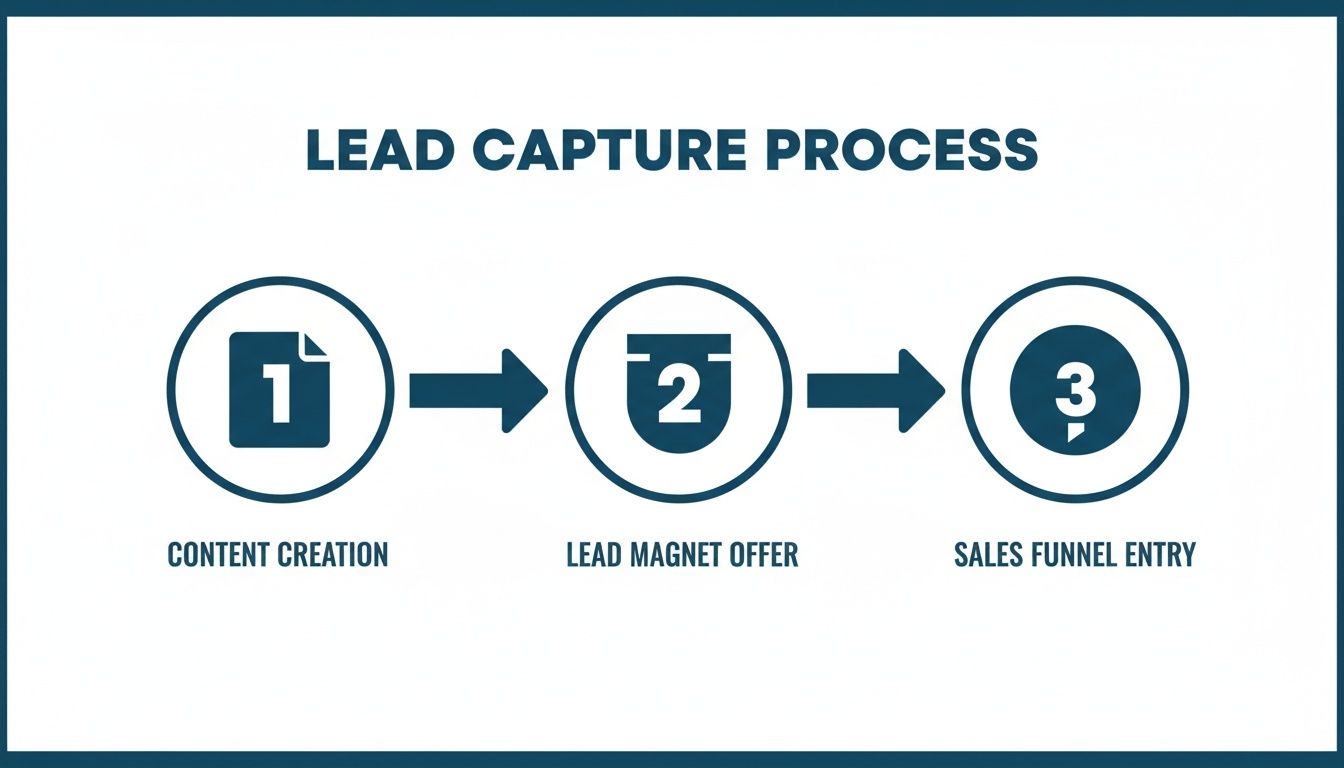
That transition from a great piece of content to a compelling lead magnet is the critical bridge that takes someone from being a passive follower to an active lead.
A good way to get a handle on your performance is to benchmark against industry standards. Here’s a quick look at some key metrics, what they mean, and what you should be aiming for.
Key LinkedIn Lead Generation Metrics to Track
| Metric | What It Measures | Good Benchmark | How to Improve |
|---|---|---|---|
| Profile Views | The number of people who have looked at your profile. | 50-100+ per week | Optimise your headline with keywords; engage in relevant groups and on influencer posts. |
| Connection Acceptance Rate | The percentage of connection requests that are accepted. | 30-40% | Personalise every connection request; have a professional and benefit-driven headline. |
| Content Engagement Rate | Likes, comments, and shares as a percentage of your followers or views. | 2-5% | Post a mix of valuable content (text, images, video); ask engaging questions; reply to all comments. |
| Click-Through Rate (CTR) | The percentage of people who click the link in your post or message. | 1-2% | Use strong calls-to-action (CTAs); make the value of clicking the link immediately obvious. |
| Conversion Rate (Lead Magnet) | The percentage of people who download your lead magnet after clicking the link. | 20-30% | Ensure your landing page is clear, professional, and focused on the benefits of the download. |
| Meetings Booked | The absolute number of sales meetings scheduled from LinkedIn outreach. | 5-10 per month | Refine your messaging sequence; focus on solving problems, not just selling features. |
Tracking these numbers gives you a clear roadmap for what to focus on next. If your engagement is low, work on your content strategy. If your conversion rate is weak, it’s time to improve your landing page.
Building a Sustainable Workflow
At the end of the day, the best strategy is one you can actually stick with without burning out. Consistency will always beat short-term intensity. That means building a weekly routine that integrates content creation, outreach, and engagement in a way that feels manageable.
Your time is your most valuable resource. The goal of this entire system is to automate the repetitive bits so you can spend your time where it matters most: having meaningful conversations with high-quality prospects. When you tie all these pieces together, you’re no longer just “on LinkedIn”—you’re running a scalable, predictable engine for business growth.
Got Questions About LinkedIn Lead Gen? We’ve Got Answers
Even with the best playbook in hand, you’re bound to run into a few tricky situations when you start generating leads on LinkedIn. That’s perfectly normal. Let’s walk through some of the most common questions I hear and get you the clear, practical answers you need to keep moving forward.
“How much time do I actually need to spend on this every day?”
This is always the first question, and the real answer is that consistency beats intensity, every single time. You don’t need to chain yourself to your desk for hours on end to make this work.
What you do need is a focused, daily habit. I always tell people to block out 30 to 60 minutes a day. This isn’t for mindless scrolling; it’s for targeted, purposeful action.
So, what can you get done in that time?
- 15 minutes: Jump into your feed and engage. Leave thoughtful, genuine comments on posts from your top prospects and key voices in your industry.
- 15 minutes: Work through your target list and send out a handful of new, personalised connection requests.
- 15 minutes: Check your inbox to follow up with new connections and keep existing conversations moving forward.
This approach keeps you from feeling overwhelmed and helps you build real momentum. With 89% of B2B marketers turning to LinkedIn for leads, it’s that consistent, daily presence that will make you stand out from the noise.
“Is LinkedIn Sales Navigator really worth the money?”
If you’re truly serious about generating leads on LinkedIn, then yes. Absolutely, one hundred percent. The free version is great for keeping in touch with your existing network, but Sales Navigator is a different beast entirely. It’s built specifically for this job.
Here’s the best way I can put it: Using the free search is like casting a single fishing line into a massive lake and hoping for a bite. Sales Navigator is like having a state-of-the-art sonar system that pinpoints exactly where schools of your ideal fish are hiding.
The magic is in its advanced search filters. You can dial in your search with incredible precision—filtering by company size, seniority, recent job changes, or even finding people who are already active posters on the platform. This level of detail saves you a colossal amount of time and ensures your outreach is so relevant it’s hard to ignore. Your connection and reply rates will thank you.
“What do I do if my connection requests are being ignored?”
First off, don’t panic. It happens to the best of us. An ignored request isn’t a rejection; it’s just feedback telling you to fine-tune your approach. The first place to look is your own profile. Does your headline immediately tell your target audience how you can help them? A generic job title like “Account Executive” just isn’t going to grab anyone’s attention.
Next, take an honest look at your connection note. Did you personalise it, or did you send a generic template? Mentioning a mutual connection, a piece of content they recently shared, or a group you’re both in can make a world of difference. Whatever you do, avoid a sales pitch in the request.
My Two Cents: Never, ever follow up on an ignored request by sending another one. It’s a bad look. Instead, change your tactic. Go find one of their posts and leave a genuinely insightful comment. This gets your name in front of them in a low-pressure way, warming them up for a potential future attempt.
“How should I handle prospects who go silent after connecting?”
Ghosting is part of the game. People get busy, inboxes get flooded, and your message can easily get buried. The key is to be patient, professional, and always lead with value in your follow-ups. Simply pinging them with “just checking in” is a waste of both your time and theirs.
Give it a few business days, then try a different angle. Send a follow-up that offers something genuinely useful. Maybe it’s a link to a fascinating article, a case study relevant to their industry, or an invitation to a free webinar you’re hosting. Your goal is to shift their perception of you from “salesperson” to “helpful resource.” A gentle, value-packed nudge is always more effective than a pushy, empty one.
Ready to take the guesswork out of your LinkedIn content? Postline.ai uses powerful AI and real-time research to help you craft posts that actually get noticed. Stop staring at a blank screen and start building your authority. See how Postline.ai can transform your LinkedIn strategy today.

Run every client pipeline in one place
Give each LinkedIn profile its own voice, calendar, approval flow, and analytics. Start in minutes.
Start free trial