
How to Generate B2B Leads That Convert
Learn how to generate B2B leads with this expert guide. Discover actionable strategies for research, personalized outreach, and scaling your efforts.
To generate B2B leads that actually convert, you need to ditch the old spray-and-pray method. It’s time to move from high-volume outreach to a smarter, value-driven strategy.
The whole game has changed. Today, it’s all about combining deep prospect research with genuine personalisation and, crucially, staying on the right side of privacy laws. This is how you build relationships, not just hit quotas.
Moving Beyond Volume in B2B Lead Generation
The old playbook of blasting out generic messages? It’s officially broken. Decision-makers are drowning in noise and have zero patience for anything that isn’t hyper-relevant to them.
This guide is about shifting your focus from pure volume to a more intelligent, relationship-driven approach. It’s absolutely essential for anyone trying to figure out how to generate B2B leads in today’s market. We’re not just playing a numbers game anymore; we’re using technology for precision, not just scale.
It all boils down to building real connections that turn into measurable business growth. To get there, you need a new mindset built on three core pillars:
- Deep Research: Get to know a prospect’s company, their specific role, and what they’ve been up to before you even think about reaching out.
- Genuine Personalisation: Craft messages that hit on specific pain points or mention recent achievements. Show them you’ve actually done your homework.
- Strict Compliance: Always follow data privacy regulations. It builds trust and saves you from some seriously expensive fines.
The Importance of a Modern Approach
In sophisticated markets, this kind of nuanced, relationship-first strategy isn’t just a nice-to-have—it’s mandatory. Take Germany, for example. Generating B2B leads there means prioritising personalisation and being meticulous about privacy.
Unlike the more transactional US market, German business culture puts a huge premium on trust and long-term partnerships. You win here by offering bespoke solutions, not by spamming inboxes.
This is especially true when you factor in regulations like the General Data Protection Regulation (GDPR). This law governs data protection and privacy for every single person in the European Union, and its reach is massive.

As you can see, the regulation’s scope is no joke. Compliance is a non-negotiable cornerstone of any B2B lead generation strategy in Europe. One wrong move with data handling or unsolicited messages can lead to eye-watering fines and a trashed reputation.
A successful modern lead generation framework isn’t about finding shortcuts; it’s about building a more sustainable, respectable, and ultimately more profitable pipeline by treating prospects like partners from the very first interaction.
This means you need to thoughtfully integrate tools and tactics designed for quality over quantity. For a closer look at different tactics and a broader view of what’s working now, it’s worth exploring some proven strategies for B2B lead generation. Getting your head around this mindset is the first real step toward building a lead generation engine that actually works.
Pinpointing Your Ideal Customers with Precision
Let’s be honest, effective B2B lead generation starts long before you even think about writing a message. Real success comes from an almost obsessive understanding of exactly who you’re trying to reach. If you don’t have a precise target, even the most persuasive outreach is just noise. The goal here is to trade in your wide, inefficient net for a finely-tuned spear, focusing your energy only on prospects who are a damn good fit for what you offer.
This first phase is all about building a solid Ideal Customer Profile (ICP). An ICP is way more than a simple list of industries. Think of it as a detailed blueprint of the companies that get the most value from your solution. It forces you to get crystal clear on the attributes that signal a perfect match, making sure you concentrate your efforts where they’ll actually make a difference.
Defining Your Ideal Customer Profile
The best place to start is with your favourite current customers. What do they all have in common? Your ICP needs to be built on data, not just a gut feeling. Look for the patterns across a few key data points.
A strong ICP usually boils down to criteria like these:
- Industry or Vertical: Are you going after FinTech, automotive manufacturing, or SaaS companies? Get specific.
- Company Size: This could be by employee count (e.g., 50-200 employees) or by annual revenue.
- Geographical Location: Pinpoint the countries, regions, or even cities where your best customers are based.
- Technology Stack: Do they use certain software that plays nicely with your own solution?
- Recent Buying Signals: Have they just landed a new round of funding, hired key people, or announced an expansion?
This simple flow chart really nails down how to move from broad ideas to a specific, actionable list.
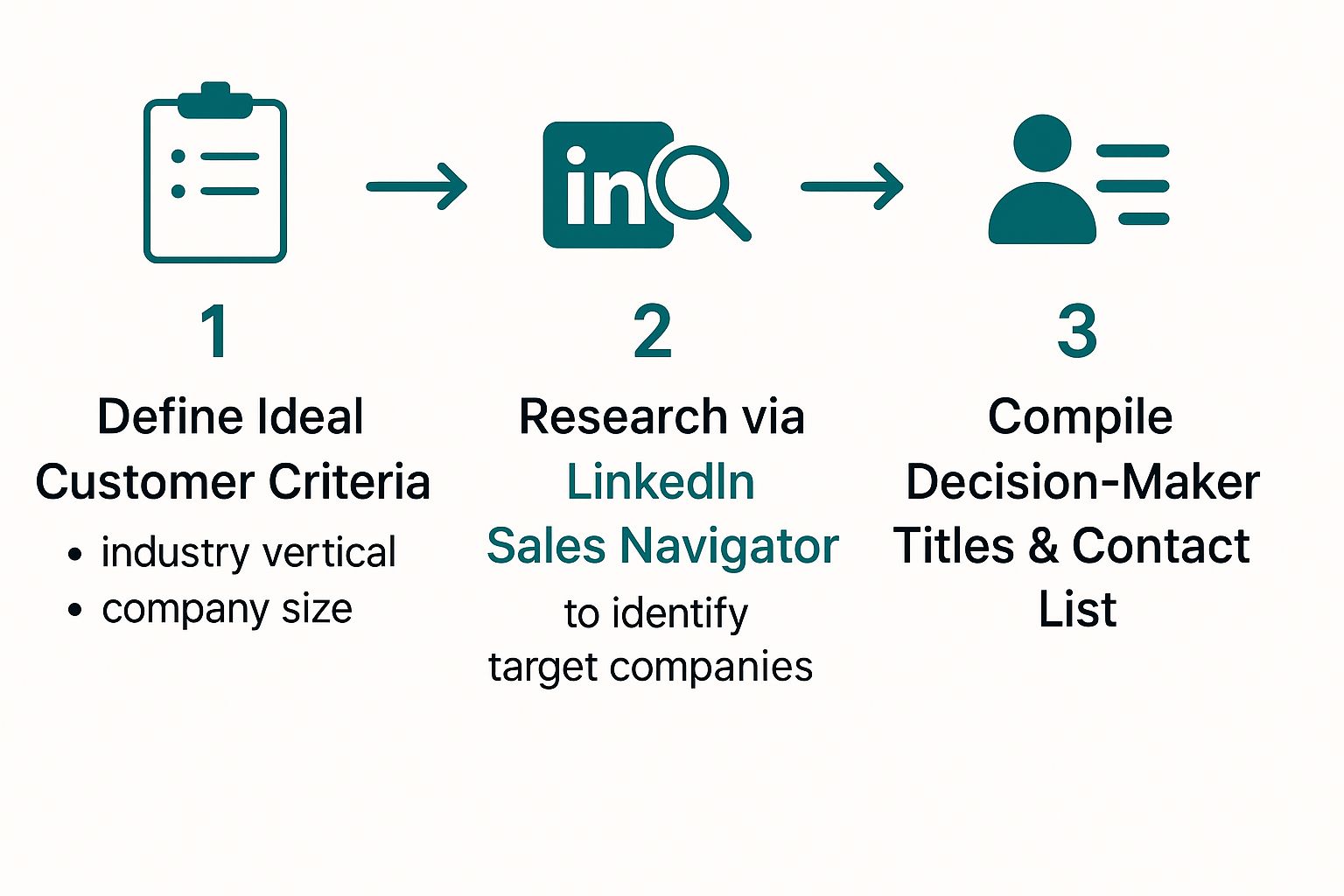
As the infographic shows, a methodical approach—defining who you want, finding them, and then identifying the right person to talk to—is the bedrock of smart B2B prospecting.
A Real-World Example in Germany
Let’s make this tangible by looking at a high-value market. The German B2B scene, especially in telecommunications, automotive, and finance, is a goldmine for lead generation. Why? It’s packed with industry leaders, and the business culture really values quality relationships.
You’ve got major telecom players like Deutsche Telekom, Vodafone, and O2 headquartered in hubs like Bonn, Dusseldorf, and Munich. The automotive sector is anchored by giants like Mercedes and Volkswagen in Stuttgart and Wolfsburg, all of them constantly on the hunt for innovative tech in areas like AI and cybersecurity.
So, for a software company selling a project management tool, a sharp ICP might look something like this:
- Industry: German Automotive Sector
- Company Size: 5,000+ employees
- Pain Point: Struggling to manage complex, cross-departmental product launch timelines.
Just like that, your target list shrinks from thousands of irrelevant companies to a handful of high-potential accounts like Porsche, BMW, and their key suppliers. Much more manageable.
Finding the Right People Inside Target Companies
Okay, you’ve got your target companies. Now the real challenge begins: finding the key decision-makers. Firing off a generic message to a company’s main inbox is a complete dead end. You have to connect with the actual people who feel the pain your product solves.
A crucial lesson in learning how to generate B2B leads is realising you’re not selling to a company; you’re selling to a person within that company. Your research has to go beyond the organisation to understand that individual’s role, responsibilities, and recent activities.
This is where a tool like LinkedIn Sales Navigator is an absolute game-changer. It lets you filter for specific job titles within your target accounts. For our German automotive example, you wouldn’t just search for “CEO.” That’s pointless. Instead, you’d be looking for titles like:
- Head of Product Development
- Engineering Programme Manager
- Director of R&D Operations
These are the people right in the thick of the problem you solve. By zeroing in on them, you turn a generic company list into a curated prospect list, primed and ready for personalised outreach. To really get the most from the platform, have a look at our guide on using LinkedIn audience insights for even better targeting. This kind of precision is what every single successful lead generation campaign is built on.
Crafting Outreach That Actually Gets Replies
Let’s be honest, generic connection requests and copy-paste emails are a one-way ticket to being ignored. After all that work you put into finding the right people, this is the moment that turns a promising prospect into a real sales opportunity. So, how do you write something that actually starts a conversation?
It’s all about breaking through the noise.

The days of blasting a template to hundreds of people are long gone. Today, relevance is everything. Your very first message has to instantly show you’ve done your homework and aren’t just another automated bot clogging up their inbox.
The Power of AI-Driven Personalisation
This is where you can get a serious advantage. Instead of spending hours digging through someone’s digital footprint, modern tools like Postline.ai can scan a LinkedIn profile in seconds. It flags recent posts, company news, and even shared connections, giving you the perfect, unique conversation starter.
This isn’t about pretending to be their best friend. It’s about finding a genuine reason to connect. Did they just share an article on supply chain headaches? Did their company announce a new green initiative? These are the golden nuggets you can build your entire outreach around.
The goal of the first message isn’t to sell. It’s to earn the right to a second conversation. You do that by proving you’re relevant and offering something of value right away.
Just think about the difference it makes. A weak message feels like a sales pitch from the get-go. A strong, personalised one feels like a chat between peers, which is far more likely to get a response.
To show you exactly what I mean, here’s a breakdown of different personalisation levels. You can see how quickly a message goes from forgettable to compelling.
Outreach Personalisation Levels From Weak to Strong
| Personalisation Level | Example Message | Effectiveness | Why It Works (or Fails) |
|---|---|---|---|
| None | “Hi, I’d like to connect.” | Very Low | Zero effort shown. Comes across as lazy or automated. It’s easily ignored. |
| Weak (Role-Based) | “Hi [Name], I see you’re a [Job Title] at [Company]. We help people in your role solve [Problem]. Can we talk?” | Low | Slightly better, but still generic. It’s all about you and what you want, not them. |
| Good (Company-Based) | “Hi [Name], congrats on [Company]’s recent funding round! As you scale, managing [Challenge] can be tough. Worth a chat?” | Medium | Shows you’re paying attention to their company. It’s relevant but could still feel opportunistic. |
| Strong (Activity-Based) | “Hi [Name], I saw your LinkedIn post about [Topic]. Great point on [Specific Insight]. We helped a client facing that exact issue achieve a 15% cost reduction. Would a short case study be useful?” | High | This is the sweet spot. It’s specific, references their own thoughts, shows you listened, and offers immediate value without asking for anything. |
As you can see, the most effective outreach connects directly with something the individual has recently said or done. It’s personal, relevant, and value-driven.
Transforming Templates into Powerful Messages
Let’s get practical with a real-world before-and-after. Imagine you’re selling logistics software to a manager at a big manufacturing firm.
The Weak Template (Before):
“Hi [First Name], I saw you work at [Company Name] and wanted to connect. My company helps businesses like yours optimise their logistics. Are you free for a quick chat next week?”
This is bland, forgettable, and totally self-serving. It screams, “I want to sell you something,” and gives the recipient zero reason to reply. It’s destined for the delete folder.
The Powerful Message (After):
“Hi [First Name], I saw your recent post on LinkedIn about the rising costs of raw material shipping—great insights. It seems many in the automotive sector are facing similar pressures. We recently helped a similar firm reduce their transport overhead by 15% with a predictive routing model. Happy to share the short case study if it’s useful.”
See the difference? This version is built on research and generosity. It acknowledges their expertise, shows you understand their industry, and offers a relevant resource with no strings attached. This is how you build trust and generate B2B leads that actually want to talk to you. To really nail this, you need to learn how to write inquiry letters that get replies.
Adopting the Value-First Framework
The “Value-First” framework is a simple but game-changing mindset for outreach. Every single message you send should offer something valuable to the prospect before you ask for their time.
So, what does “value” actually look like here?
- A Relevant Insight: Share a key statistic or trend from their industry they might find interesting.
- A Helpful Resource: Offer a link to a useful blog post, a non-gated case study, or a whitepaper that speaks to their challenges.
- A Meaningful Compliment: Genuinely praise a recent company win or an insightful article they published.
- An Introduction: If it makes sense, offer to introduce them to someone in your network who could be a beneficial connection.
This approach completely flips the old sales dynamic. You’re no longer just a salesperson trying to take up their time; you’re a helpful expert sharing valuable information. This builds instant credibility and makes people far more open to an eventual meeting.
Our guide on how to reach out using a mutual connection on LinkedIn digs into this even deeper. When you consistently lead with value, you earn their attention and prove that a conversation with you is worth having.
Scaling Your Lead Generation Engine Smartly
Hyper-personalisation is the secret sauce for starting great conversations, but it has one major enemy: growth. You simply can’t sit there and manually write thousands of unique, thoughtful messages every month unless you have a small army of sales reps. This is where a lot of businesses hit a wall. They assume they have to choose between quality and quantity.
But the real trick to generating B2B leads that actually convert is finding that sweet spot in the middle.
The answer isn’t to just start blasting generic templates to everyone. It’s about building a smart, semi-automated workflow. This approach lets technology do the heavy lifting—the repetitive, boring stuff—so you can focus on what humans do best: building actual relationships. It’s about letting software manage the schedule while you manage the conversation.
Designing a Smart Outreach Sequence
A solid outreach sequence is more than just a single message. It’s a carefully planned series of touchpoints designed to get on your prospect’s radar without being annoying. Think of it as a few gentle nudges, not a constant sales pitch.
A typical sequence on LinkedIn might look something like this:
- Touchpoint 1 (Day 1): The personalised connection request. This is where that deep research you did earlier comes into play. You’ll reference a recent post, a shared connection, or a big company win.
- Touchpoint 2 (Day 3): A follow-up message right after they accept. This is your chance to offer a piece of genuine value—a link to a relevant case study, a helpful article you wrote, or an interesting industry stat.
- Touchpoint 3 (Day 7): A much softer, engagement-focused follow-up. Maybe you just like or comment on one of their recent LinkedIn posts. This keeps you top-of-mind without being intrusive.
- Touchpoint 4 (Day 12): One final, direct follow-up. Here, you can gently circle back, ask if they had a moment to look at the resource you sent, and propose a quick chat.
This kind of structured approach keeps you visible without turning into a pest. We all know most sales take multiple touchpoints, yet so many salespeople give up after just one or two tries. A scheduled sequence makes sure that doesn’t happen.
The Power of Intelligent Automation
This is exactly where a tool like Postline.ai becomes a game-changer. Instead of juggling spreadsheets and calendar reminders for every connection and follow-up, you can build and schedule these multi-step sequences. You write the personalised messages, you set the timing, and you let the system run the playbook for you.
But here’s the most important part—the bit that separates smart automation from spam.
The second a prospect replies to any message in your sequence, the automation must stop. This is the golden rule of scaling outreach. A response is your signal to jump in and have a real, human conversation.
This simple feature prevents that incredibly embarrassing moment when an automated follow-up goes out after someone has already replied. Imagine a prospect replies to your second message with, “Thanks, this looks interesting, I’ll check it out.” The last thing you want is for your system to send a message a few days later saying, “Did you see my last message?” It completely shatters the illusion and kills any trust you were building.
Best Practices for Timing and Frequency
How you time your messages is just as critical as what you say. Bombard someone with too many messages in a few days, and you’ll come off as desperate. But space them out too far, and you’ll lose all momentum.
Here are some timing guidelines that have worked well for us:
| Cadence Element | Recommended Timing | Rationale |
|---|---|---|
| Initial Follow-Up | 2-3 days after connection | Gives them time to see your first message without feeling rushed. |
| Second Follow-Up | 4-5 days after the first | Acts as a gentle reminder while adding more value or context. |
| Final Message | 5-7 days after the second | Offers one last, polite chance to connect before you pause outreach. |
The whole point is to create a rhythm that feels professional and natural. You’re showing persistence and genuine interest, not just impatience.
By combining this thoughtful scheduling with a tool to manage the process, you build a powerful B2B lead generation engine. You can reach a huge number of prospects with personalised, relevant messages without losing the authentic touch needed to build real business relationships. For more on this, our guide on how to automate LinkedIn posts offers some great strategies for managing your presence at scale.
Turning Conversations into Sales Opportunities
Getting a reply is a huge win, but it’s just the opening bell. The real art is turning that initial flicker of interest into a genuine sales opportunity. This is where your focus has to shift from outreach to nurturing, from getting attention to building trust.

That first conversation after you connect is your moment to prove you’re a valuable advisor, not just another vendor. It’s a delicate balance. You need to maintain momentum without coming across as pushy or overly aggressive. The trick is to consistently provide value that speaks directly to their potential pain points.
From Chat to Call The Right Way
Let’s be honest, the end goal of your LinkedIn chat is to get them on a discovery call. But asking “Are you free to chat next week?” right after they reply is one of the most common mistakes I see. It can shut down the conversation instantly. You haven’t earned that right yet.
Instead, your mission is to keep up that value-first approach. Offer relevant, helpful content that cements your position as an expert who gets their world.
Here’s a practical way to do it:
- Share a Relevant Case Study: If they mentioned a specific challenge, send over a short, powerful case study showing how you helped a similar company. Just frame it as, “This might be useful since you mentioned X.”
- Offer a Whitepaper or Report: Provide a link to an industry report or a whitepaper your company produced. Crucially, make sure it’s non-gated to remove any friction.
- Provide a Quick, Actionable Tip: If you can offer a small piece of advice right there in the chat that helps them, do it. This builds immense goodwill.
The smoothest transition to a call happens when the prospect feels they have more to gain from talking to you than you have to gain from selling to them. This shift occurs when you consistently offer value without asking for anything in return.
Once you’ve shared a resource and they’ve responded positively, then you can make the move. A good way to phrase it is, “Glad you found that helpful. There are a few other specific strategies we used with that client that aren’t in the case study. If it’s a priority, I’m happy to walk you through them on a quick 15-minute call.”
Tracking Interactions to Prevent Lost Leads
As you start scaling your outreach, trying to manage these new relationships in your head or a spreadsheet becomes impossible. This is where a Customer Relationship Management (CRM) tool becomes non-negotiable. Every interaction—every message, every resource shared, every follow-up—needs to be logged.
Without proper tracking, promising leads will inevitably fall through the cracks. You’ll forget to follow up, mix up details between prospects, and kill your momentum. Think of your CRM as your second brain, making sure every conversation is tracked and every next step is crystal clear.
This organised approach is only becoming more important. The global B2B lead generation services market is projected to grow significantly, hitting USD 9.18 billion by 2035. As German businesses continue their digital shift, the demand for qualified leads is only going to intensify, highlighting the country’s central role in the European lead generation ecosystem.
By meticulously tracking each step, you create a reliable process for converting conversations into qualified opportunities. This discipline is what separates sporadic success from a predictable, scalable sales pipeline. To get a deeper look at the entire process, check out our comprehensive guide on LinkedIn B2B lead generation.
Got Questions About B2B Lead Generation? We’ve Got Answers.
Jumping into B2B lead generation can feel like you’re trying to solve a puzzle with pieces missing. Even when you think you have a solid game plan, questions always pop up about the small details—timing, execution, and how to know if what you’re doing is actually working.
Let’s clear the air and tackle some of the most common questions we hear from people trying to generate B2B leads. Getting these right will help you dodge common pitfalls and build a pipeline that’s a lot more predictable. It’s all about swapping that uncertainty for a clear path forward.
How Long Until I See Real Results?
This is the big one, and the honest answer is: it depends. There’s no magic switch. How quickly you see results hinges on your industry, who you’re trying to reach (a junior manager is easier to get a meeting with than a C-suite executive), and how good your outreach is.
You should start seeing the first signs of life—new connections and initial replies on LinkedIn—within the first one or two weeks of running a consistent campaign. Think of these as early signals that your message is hitting the mark.
But turning those first few chats into genuine sales opportunities? That’s more of a long game. For most B2B sales, expect this to take anywhere from one to three months. Sales cycles are just longer here; you’re building trust and helping someone navigate their company’s buying process, which all takes time. The key is consistency. Dipping in and out with sporadic effort just won’t cut it.
What Are The Biggest Mistakes People Make?
It’s easy to go wrong, but a few mistakes are especially toxic for your campaigns. The absolute number one error is choosing volume over real personalisation. Blasting out hundreds of generic, copy-paste messages is the fastest way to kill your reputation and get yourself ignored.
Another classic blunder is not doing enough homework on your Ideal Customer Profile (ICP). If you don’t really know who you’re selling to, you end up with a scattergun approach—targeting the wrong companies or the wrong people inside them. It’s a massive waste of time and energy.
Giving up too early is another killer. One message is almost never enough. A polite, value-first follow-up strategy isn’t just a good idea; it’s absolutely essential to actually get anywhere.
And finally, don’t ignore the rules of the playground. Sending way too many connection requests on LinkedIn or ignoring data privacy laws like GDPR can get your account restricted or land you in serious hot water. Play it smart.
Should I Use An Automated Tool or Do It All Manually?
This isn’t an either/or situation. The best approach is a smart mix of both.
Trying to do everything by hand is great for personalisation, but it’s impossible to scale. You’ll burn out before you get any real momentum. On the flip side, fully automated, “set it and forget it” outreach might be scalable, but it usually comes across as spam and gets terrible results.
The sweet spot is a hybrid model.
- Use smart tools like Postline.ai for the boring, repetitive stuff. Think scheduling messages, keeping track of replies, and managing your follow-up sequences.
- Use your brain for the high-value tasks that a machine can’t replicate. This is where you do deep research on a prospect, write a truly personalised opening message, and have a real conversation once they reply.
Think of technology as your assistant, not your replacement. It should free you up to be more human, not less.
How Do I Actually Measure If My Campaign Is Working?
You need to look at a mix of metrics to get the full story. Some tell you what’s happening right now, while others show you the end result.
Leading Indicators (What’s happening now):
- Connection Acceptance Rate: Are people accepting your request? This tells you if your profile and initial hook are working.
- Reply Rate: Are they writing back? This shows if your core message is interesting enough to start a conversation.
- Email Open Rate: If you’re using email, this tells you if your subject lines are compelling.
These are your real-time health checks.
Lagging Indicators (The business results):
- Number of Qualified Leads Generated: How many people fit your ICP and have shown genuine interest?
- Meetings Booked: This is a huge step. It means you’ve moved from a chat to a real sales conversation.
- Deals Closed: The ultimate goal and the true measure of your campaign’s ROI.
By tracking both, you can see exactly where your process is strong and where it’s breaking down.
Ready to put these answers into practice? Postline.ai gives you AI-powered writing, real-time research, and smart scheduling to help you land high-quality B2B leads on LinkedIn without sounding like a robot. Start writing outreach that actually gets replies today at https://postline.ai.

Run every client pipeline in one place
Give each LinkedIn profile its own voice, calendar, approval flow, and analytics. Start in minutes.
Start free trial