
How to Build Your Brand on LinkedIn and Stand Out
Learn how to build your brand on LinkedIn with our guide. We cover everything from defining your strategy to creating content that grows your influence.

If you want to build your brand, you need to stop thinking of your LinkedIn presence as just a digital CV. It’s so much more than that. Think of it as your professional handshake, your portfolio, and your go-to networking event all rolled into one. This isn’t about occasional updates; it’s about a real strategy. Making this shift turns your profile from a static page into a dynamic voice that actually opens doors.
Why Building a LinkedIn Brand Is No Longer Optional
In the professional world, visibility is opportunity. Plain and simple. A dormant LinkedIn profile is a huge missed chance to connect with peers, find new clients, or get noticed by that dream recruiter. The platform has grown way beyond a simple job board. It’s now a place where ideas fly, real relationships are formed, and careers are forged. By actively managing your presence, you get to control your own professional story.
This is especially true if you’re an entrepreneur, a leader, or working in sales. Your brand isn’t just about what you sell. It’s about the expertise and value you bring to your network, consistently. Every insightful post, every thoughtful comment, and every genuine connection you make adds to an asset that works for you 24/7.
The Power of a Professional Network
The sheer size of LinkedIn makes it a non-negotiable arena for anyone serious about brand building. Just look at the numbers. In early 2025, LinkedIn had 21.0 million registered members in Germany alone, reaching almost 24.9% of the entire population. Its potential ad reach shot up by 3.0 million users (16.7%) in just one year, from early 2024 to early 2025. You can check out more on this growth over at DataReportal.
This massive, switched-on audience is actively looking for industry insights, solutions to their pain points, and connections with people who know their stuff. When you consistently show up and add value, you naturally become a go-to expert in your field. This is the heart of effective social selling—building relationships that organically lead to business.
“Your personal brand on LinkedIn is a reflection of your professional reputation. It’s not about being an ‘influencer’; it’s about being influential within your specific niche by sharing what you know.”

This image nails it. Building a professional identity is an intentional act. It’s something you actively create, not something that just happens because you have a profile.
Moving from Intention to Action
Let’s be honest, the biggest hurdle for most people is getting from “I should really post more” to actually having a solid plan. This is where a clear strategy and the right tools make all the difference.
If you want to dive deeper into the fundamentals, check out these strategies for how to build brand awareness effectively. This guide will walk you through the frameworks and tools—like Postline.ai—that turn this challenge into a manageable, and even powerful, part of your professional growth. It’s all about helping you define your voice, find topics, and create content that truly connects.
Laying the Groundwork for Your Personal Brand
Before you even think about writing your first post, you need a blueprint. Seriously. Trying to build a brand without a clear foundation is like building a house without plans—it’s messy, wastes a ton of energy, and the whole thing will probably collapse. This isn’t about fluffy ideas; it’s about making solid decisions that will shape every single thing you post.
This initial work is what takes you from vague targets to a razor-sharp focus. Instead of saying you want to reach “entrepreneurs,” a strong foundation helps you pinpoint a specific niche, like “early-stage SaaS founders in Berlin’s FinTech scene.” That kind of clarity is what makes a brand stand out instead of getting lost in the endless scroll.

This entire process can feel a bit abstract, so I find it helpful to break it down into a simple framework. Think of it as your brand’s DNA.
Here’s a table to guide you through defining your core pillars:
Defining Your Core Brand Pillars
| Brand Pillar | Guiding Question | Postline.ai Feature to Use |
|---|---|---|
| Value Proposition | Why should anyone listen to me specifically? What unique perspective do I offer? | AI Memory to store your unique expertise, methods, and achievements. |
| Target Audience | Who am I actually talking to? What are their biggest professional headaches and goals? | Audience Explorer to analyse real conversations and uncover pain points in your niche. |
| Brand Voice | How do I want to sound? Am I the expert professor or the witty friend at the bar? | Brand Voice Settings to define your tone, style, and vocabulary for consistent output. |
By filling this out, you’re not just brainstorming—you’re creating a strategic guidepost that Postline.ai can use to make sure every piece of content is perfectly aligned with your brand from day one.
Nailing Your Unique Value Proposition
Your value proposition is the heart of your brand. It’s the simple, powerful answer to, “Why should I follow you?” To figure this out, find the sweet spot where your expertise, your passions, and your audience’s real-world needs all meet.
Here’s a practical exercise: imagine your brand is a person. What are their top three personality traits? Are they analytical, empathetic, and forward-thinking? Or maybe rebellious, witty, and brutally honest. Choosing these adjectives gives you a filter for every future decision.
Your value proposition isn’t just what you do. It’s the unique solution you offer to a specific problem for a specific group of people. It’s your promise, delivered over and over again.
Once you have this, you can draft a positioning statement. This is for your eyes only, not a public slogan. It follows a simple formula: “I help [TARGET AUDIENCE] achieve [A RESULT] by using [MY UNIQUE METHOD].”
For example: “I help German B2B tech marketers generate qualified leads by implementing data-driven, human-centric content strategies.” Simple, clear, and powerful.
Getting to Know Your Audience (For Real)
Knowing your audience goes way beyond surface-level demographics. You need to understand their biggest professional nightmares, their career dreams, and the conversations they’re already part of. What keeps them up at night? What are they trying to achieve?
This is where having the right tools makes a huge difference. Instead of just guessing, you can use something like Postline.ai’s ‘Audience Explorer’ to dig into what your niche is actually talking about. It uncovers their real pain points and trending topics, giving you a goldmine of content ideas.
Think about:
- Pain Points: What are their recurring frustrations? For a software developer, it might be dealing with legacy code or inefficient workflows.
- Aspirations: What’s their ultimate goal? A sales pro might be dreaming of leading a team or smashing their quota by 50%.
- Watering Holes: Where do they hang out online? Pinpoint the key LinkedIn groups they’re in, the influencers they follow, and the publications they read.
Defining Your Unmistakable Brand Voice
Your brand voice is the personality that comes through in your writing. It’s not just what you say, but how you say it. A consistent voice builds trust and makes your content instantly recognisable in a crowded feed.
To get this right, you need to set some clear ground rules. Are you professional and authoritative, or more casual and conversational? Do you use industry jargon, or do you pride yourself on making complex ideas easy to understand? For a deep dive, check out our guide on how to develop your brand voice guidelines.
To make sure you stick to it, a feature like Postline.ai’s ‘AI Memory’ is a game-changer. You feed it key details about your expertise, your background, and your preferred tone. From then on, every piece of content—whether you draft it yourself or get some AI help—sounds authentically and consistently like you. This solid foundation is the secret to making your content efforts finally pay off.
Creating Content That Connects and Converts
Alright, you’ve laid the groundwork for your brand. Now for the fun part: turning that strategy into content that actually gets noticed and makes people care. This is where we move from planning to doing. We’re talking about crafting posts that don’t just sit there, but educate, inspire, and build real trust with your audience.
The secret? Don’t try to be everything to everyone. Settle on three to five core topics—what I call content pillars. These are the subjects you can talk about with authority, and they need to line up perfectly with what your audience is desperate to know. Think of yourself as a niche media company, and these pillars are your main shows. Sticking to them keeps you focused and makes sure you’re consistently delivering value.
Here’s a simple way to think about the journey from a random thought to a published post. It’s a process, not a fluke.
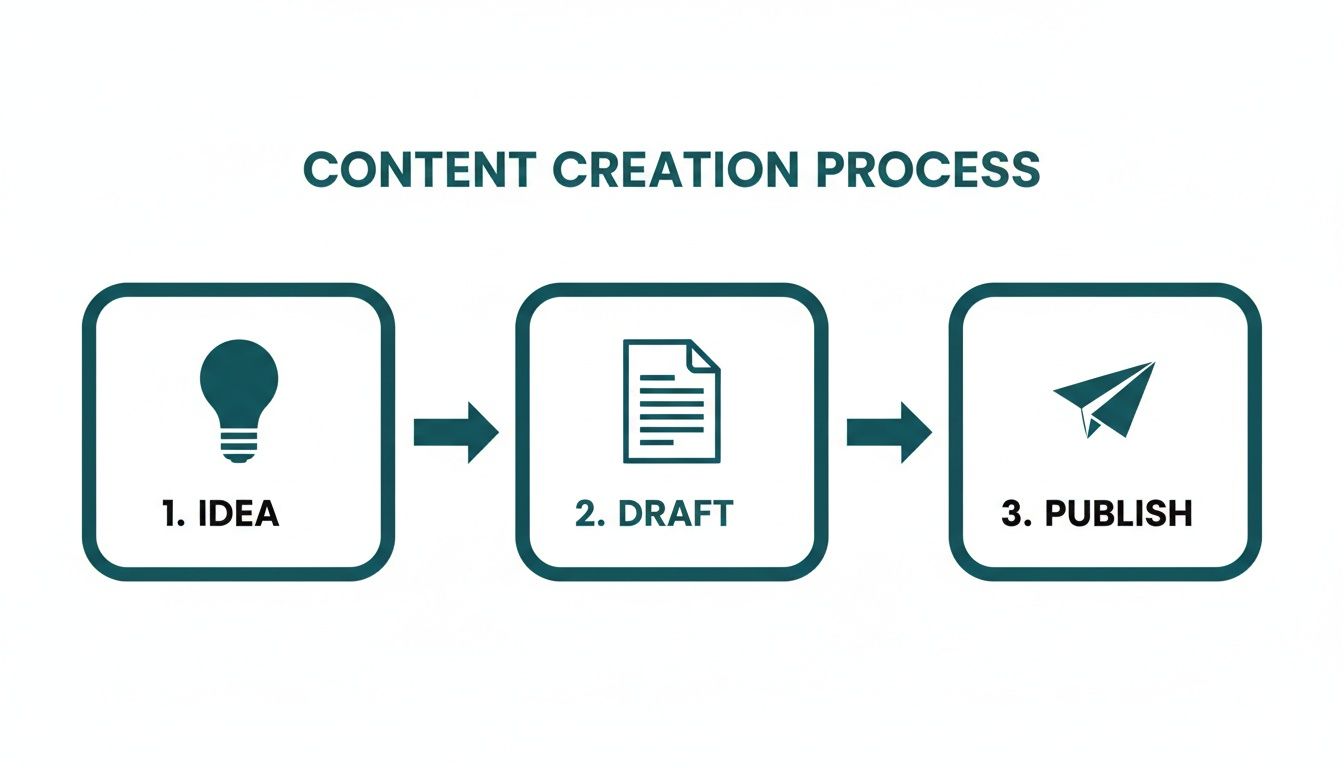
This little visual is a great reminder that strong content doesn’t just happen by magic. It’s a structured workflow, which is exactly what you need to build a brand that lasts.
From Simple Idea to Polished Post
Every killer post begins with a tiny spark of an idea. But let’s be honest, turning that spark into something polished and engaging can feel like a real slog. This is where having the right tools in your corner makes a world of difference. For instance, with Postline.ai’s ‘AI Post Generator’, you can feed it a simple concept and watch it spit out a well-structured draft in seconds.
Let’s imagine a marketing consultant wants to post about brand voice.
- The initial thought: “Why a consistent brand voice is a big deal for B2B tech companies.”
- The AI-assisted draft: The tool might generate a post starting with a strong hook, outlining key points on building trust and recognition, and finishing with a clear call-to-action.
- Adding some muscle: Now, using the ‘Online Research’ feature, the consultant can instantly pull in a powerful stat, like “88% of consumers say authenticity is a key factor when deciding what brands they like and support.”
Just like that, a basic idea becomes a data-backed, authoritative post that’s way more likely to stop the scroll and start a conversation.
Mastering the Art of the Hook
Let’s get one thing straight: the first line of your LinkedIn post is everything. It decides whether someone keeps scrolling or gives you their attention. You’ve got less than three seconds. No pressure.
So, ditch the boring, predictable openings. Try one of these proven formulas instead:
- The Contrarian Take: Start with an opinion most people disagree with. “Stop obsessing over vanity metrics. Here’s what actually moves the needle…”
- The Story Opener: Drop them right into the middle of a story. “I completely bombed my first big client presentation. The lesson I learned saved my career.”
- The Shocking Statistic: Lead with a number that makes people sit up. “95% of new products fail. The reason why is simpler than you think.”
- The Direct Question: Get their brain working immediately. “What’s the single biggest mistake you see leaders make?”
A great hook is a promise you make to the reader—a promise of a valuable insight, a great story, or a fresh perspective. Your job is to make sure the rest of the post delivers on it.
Your hook is the headline. If it doesn’t grab them, the rest of your brilliant content might as well not exist. I often spend as much time on my first sentence as I do on the entire body of the post.
Structuring Posts for Readability and Impact
Once you’ve hooked them, you have to keep them. The key is making your content easy to scan. Nobody wants to tackle a huge wall of text on their phone. Smart formatting is your best friend here—it guides the eye and makes your key points stand out. If you want a deeper dive on this, check out our complete guide on how to write engaging LinkedIn posts.
Here’s a quick before-and-after to show you what I mean.
Before (The dreaded wall of text):
“To build your brand effectively, you must understand your audience’s pain points and create content that addresses them directly. This means conducting thorough research and developing content pillars that align with your value proposition. Many people fail because they post inconsistently or their content is too self-promotional. The goal should always be to provide value first, which in turn builds trust and authority in your niche over time.”
After (Formatted for actual humans):
Want to build your brand?
Stop talking about yourself. Start solving your audience’s problems.
Here’s how: → Identify their REAL pain points. (Not what you think they are). → Create content pillars that offer tangible solutions. → Show up consistently. Trust isn’t built in a day.
Provide value relentlessly. The authority (and business) will follow.
See the difference? The second version is instantly more readable, powerful, and much more likely to be shared.
This is especially critical in fast-growing markets. For example, in Germany, where the digital marketing scene is set to explode in 2025 with 90% of the population online and a 10% growth in digital ad spend, you have to stand out. As digital channels become more crowded, brilliantly formatted LinkedIn content becomes your unfair advantage.
By combining a solid strategy with smart, tactical content creation, you’ll do more than just connect with your audience—you’ll turn that attention into real opportunities.
Building a Sustainable Content Workflow
Let’s be honest. The single biggest reason most people fail to build their brand on LinkedIn isn’t a lack of good ideas—it’s inconsistency. The pressure to come up with something brilliant every single day is a fast track to burnout. The secret isn’t about chasing perfection; it’s about building a sustainable system that makes consistency feel almost effortless.
This is where batch creation completely changes the game. Instead of scrambling for a post idea every morning, you set aside a few hours once a month to plan and draft everything. This approach saves an incredible amount of time and mental energy, letting you maintain momentum without the daily grind.

This image is exactly what we’re aiming for: a well-organised content system that runs smoothly in the background.
Planning a Month of Content in One Go
Imagine sitting down for just a couple of hours and walking away with a full month of high-quality LinkedIn posts, ready to go. That’s the reality when you have a structured workflow. With a tool like Postline.ai, this process becomes even simpler.
First off, you can jump into the ‘Content Ideas’ feature to brainstorm a list of topics that tie back to your content pillars. No more staring at a blank screen. The tool gives you personalised suggestions, so you never run out of inspiration for posts that will actually connect with your audience.
Once you have your ideas, you can drag them straight into the ‘Post Scheduler’. This is where you draft each post, polish the copy, and slot it into the calendar for a specific date and time. Having this visual overview transforms an abstract goal into a concrete, manageable plan.
“Consistency is the most underrated growth lever. A good post published consistently is infinitely more powerful than a perfect post that never gets written. Your workflow is your brand’s engine.”
This system takes the friction out of creating content, turning it into an achievable habit rather than a daily chore. For a deeper dive into structuring your process, check out our complete guide to creating a powerful content creation workflow.
Smart Scheduling and Organisation
Just creating content in batches is only half the battle. To really maximise your impact, you need to be smart about when you post. Hitting ‘publish’ at 9 a.m. on a Tuesday might get you completely different results than posting at 4 p.m. on a Thursday.
Your LinkedIn Analytics are your best friend here. Pay close attention to when your posts get the most engagement and start looking for patterns. Are your followers most active during their morning commute or their lunch break? Tailor your schedule to meet them where they are.
Once you’ve figured out your best posting times, you can set them up in your Postline.ai scheduler. This makes sure every piece of content goes live when your audience is most likely to see and interact with it.
To keep your pipeline flawlessly organised, get a labelling system in place. Postline.ai’s ‘Status Labels’ are perfect for this. You can tag posts as:
- Idea: For those initial thoughts that need a bit more work.
- Draft: For content that’s written but needs a final review.
- Scheduled: For posts that are finalised and ready to fly.
- Published: To keep track of what’s already gone live.
This simple organisational layer stops anything from slipping through the cracks and gives you a clear, at-a-glance view of your entire content strategy. It turns the often chaotic process of content management into a predictable, repeatable, and powerful system for growth.
Engaging Your Audience to Grow Your Network
Putting out great content is a massive step forward, but let’s be honest—it’s only half the job. The real magic, the kind that sparks real growth, happens in the conversations you start and, just as crucially, the ones you join.
Think of your content calendar as your broadcast schedule. Your engagement routine? That’s how you build a community. A passive audience might see your posts, but an engaged community will champion them. That shift is the difference between being a voice in the crowd and becoming a go-to person in your niche.
Beyond the Like: The Power of Meaningful Engagement
It’s so easy to get caught up in chasing likes. They give you a quick dopamine hit, but they’re a passive signal. A thoughtful comment, on the other hand, is an active investment of someone’s time and thinking. It’s the single most powerful way to get noticed—not just by the original poster, but by their entire audience.
Put yourself in their shoes. When someone drops a generic “Great post!” on your content, it’s nice but instantly forgettable. But what about when someone adds their own insight, asks a genuinely challenging question, or shares a relevant story? You remember them. You’re far more likely to click on their profile and see what they’re about.
That’s the real currency of networking on LinkedIn.
Your brand isn’t just built by what you broadcast; it’s forged in the value you contribute to the community. Every insightful comment you leave is like planting a seed for a future relationship or opportunity.
This is especially true in a crowded professional space. For instance, LinkedIn’s user base in Germany is on track to hit 22 million by March 2025, with a massive 7.8 million of those users in the core 25-34 age group. In a market that competitive, just posting content is like shouting into the wind. Your engagement is what makes you stand out.
Your Daily Engagement Framework
Consistency in engagement is just as important as consistency in posting. You need a simple, repeatable routine that won’t swallow your whole day. Here’s a practical framework you can start with today:
- Block out 15-20 minutes daily. Put it in your calendar. Treat it like a meeting you can’t miss.
- Focus on 5-10 key people. Pinpoint a core group of influencers, ideal clients, and peers in your niche. Make it a priority to read and thoughtfully comment on their posts first.
-
Use the “Triple-A” commenting method. This simple trick turns your comments into genuine conversation starters.
- Acknowledge: Start by agreeing with or validating a key point. (“This is such a crucial point about X…”)
- Add: Contribute your own unique perspective or a related experience. This is where you provide real value. (“I saw this firsthand when…”)
- Ask: End with an open-ended question to keep the conversation going. (“How do you see this evolving over the next year?”)
This structure immediately elevates your comments from generic praise to something that positions you as a knowledgeable and engaged peer. To really dig in and grow your network, mastering powerful community engagement strategies is a game-changer.
Turning Connections into Relationships
When you consistently show up and add value, you’ll naturally start getting more inbound connection requests. But you should also be strategic about who you reach out to.
Found someone whose content consistently hits the mark? Don’t just send a generic request. Personalise it. It makes all the difference.
Try something like this:
“Hi [Name], I’ve been really enjoying your posts on [Topic], especially your recent one about [Specific Detail]. That insight about [Mention a Key Takeaway] was spot on. Would love to connect and continue learning from you.”
This simple message does a few things beautifully:
- It proves you’ve actually been paying attention.
- It creates an immediate point of connection based on a shared interest.
- It frames the relationship around mutual learning and respect.
An approach this thoughtful has a dramatically higher acceptance rate than a cold request. It’s how you build a real professional relationship, not just another number in your connection count.
Common Questions About LinkedIn Branding
Diving into LinkedIn branding can feel a bit like learning a new language. You’ve got the strategy down, you’ve got the tools ready, but those practical, real-world questions always seem to pop up. This section is all about tackling those common hurdles.
Think of this as your personal FAQ for those “am I doing this right?” moments. We’ll cut straight to the point and give you the advice that actually matters for building a brand that lasts.
How Often Should I Post on LinkedIn to Build My Brand?
This is the big one, isn’t it? Everyone asks this, and the answer is probably simpler than you’d expect: consistency trumps frequency, every single time. The aim isn’t to spam your network’s feed just for the sake of it. That’s a one-way ticket to getting muted or ignored.
A good rhythm to aim for is 3-5 high-quality posts per week. It’s frequent enough to stay on people’s radar but realistic enough that you won’t burn out trying to create content. Honestly, showing up regularly with something valuable is far more powerful for building your brand than a frantic burst of activity followed by radio silence.
A consistent presence signals reliability. When your network knows they can count on you for solid insights every few days, you stop being just another voice and start becoming a trusted resource.
To make this genuinely manageable, planning ahead is a game-changer. Using a scheduler, like the one built into Postline.ai, lets you batch your content creation. You can get a week’s worth of posts lined up and ready to go, which completely removes that daily pressure of “what do I post today?” and keeps your consistency locked in.
What Metrics Should I Track for Brand Growth?
It’s so easy to get caught up in the vanity metrics. Likes and follower counts feel good, but they don’t really tell you if your brand is making a real impact. To get the true story, you have to look a little deeper.
Let’s move past the surface-level stuff and focus on the numbers that actually signal connection and opportunity. Here’s what you should really be watching:
- Post Views & Impressions: This is your baseline. Are people even seeing your content? It’s the first checkpoint for your reach.
- Comments: This one is huge. A high number of comments means your content is hitting a nerve and sparking actual conversations. It’s a massive indicator that what you’re saying resonates.
- Profile Views: Is your content interesting enough to make people click on your name to find out more about you? A spike in profile views after a post is a fantastic sign that your brand is pulling people in.
- Inbound Connection Requests & DMs: These are the ultimate signals of success. When people are proactively reaching out to connect or message you, your brand isn’t just being seen—it’s creating real-world opportunities.
How Can I Sound Authentic When Using AI Writing Tools?
The fear of sounding like a robot is completely valid, but it’s also completely avoidable if you use AI the right way. The trick is to treat it as a creative partner, an assistant that helps you get your thoughts out faster—not as a ghostwriter that replaces you.
Tools like Postline.ai are designed for this very reason. It has features like ‘Learns Your Voice’, which actually analyses your past writing to mimic your style, and ‘AI Memory’, which remembers key details about your expertise so you don’t have to repeat yourself.
The process should always start with your ideas. Your stories, your unique take on things, your experiences. Feed those raw thoughts to the AI to help structure them into a solid draft. Then comes the most important step: you go back in and edit. You inject your personality, tweak the wording, and add those little anecdotes that make it sound undeniably like you.
What Is the Biggest Branding Mistake on LinkedIn?
Without a doubt, the single biggest mistake I see people make is being too salesy, too soon. Nobody logs onto LinkedIn to be pitched to. They’re there to connect with other people, not with a walking, talking advert. Your main goal should always be to help, to educate, or to inspire.
Build your content strategy on a foundation of generosity. Tell personal stories, be open about the lessons you’ve learned, and give away your best advice with no strings attached. Building a brand is a long game, and it’s built on trust. Focus on providing real value to your community first, and you’ll find that the business opportunities will start coming to you.
Ready to stop guessing and start building a brand that gets noticed? Postline.ai mixes powerful AI with deep personalisation, helping you create standout LinkedIn content that sounds just like you, but way faster. Start your free trial today and see the difference.

Run every client pipeline in one place
Give each LinkedIn profile its own voice, calendar, approval flow, and analytics. Start in minutes.
Start free trial